
The term “RMS current” might sound like a niche piece of electrical engineering jargon, but its implications ripple far beyond the laboratory and into the core of our technological world. From the reliable operation of your smartphone charger to the stability of the power grid that fuels our cities, understanding RMS current is fundamental. On a website dedicated to Tech, Brand, and Money, this concept bridges the gap between the physical underpinnings of our digital lives and the financial realities of powering them.
The Foundation: Why Simple Amperage Isn’t Enough
When we talk about electrical current, our first instinct might be to think of a simple, steady flow, like water through a pipe. This is often referred to as DC (Direct Current) and is measured in amperes (A). However, the electricity that powers most of our homes and devices is AC (Alternating Current). AC current doesn’t flow in a single direction; instead, it periodically reverses, oscillating back and forth at a specific frequency (typically 50 or 60 Hz).

This back-and-forth nature of AC presents a challenge: how do we quantify its “strength” or “effectiveness” when it’s constantly changing? Simply taking an instantaneous reading of the current would be misleading, as it would only tell us the value at a single point in time. A peak value, while informative, doesn’t tell us the average effect the current has over a period. This is where the concept of RMS current comes in.
RMS stands for Root Mean Square. It’s a mathematical way to express the equivalent DC current that would produce the same amount of heat in a resistor. Think of it this way: AC current, with its fluctuating intensity, can still deliver power and generate heat. RMS current provides a standardized metric that allows us to compare the power-delivering capability of AC and DC circuits on an equal footing.
The Mathematical Derivation of RMS
The name “Root Mean Square” itself gives us a clue to its calculation. Let’s break it down:
- Square: We first take the square of the instantaneous current values over a period of time. Squaring the values has two important effects: it makes all the values positive (regardless of whether the current is flowing in the positive or negative direction) and it emphasizes larger current values more significantly.
- Mean: Next, we calculate the average of these squared values. This gives us the mean square value of the current.
- Root: Finally, we take the square root of the mean square value. This brings the value back to the original units of current (amperes) and represents the effective DC equivalent.
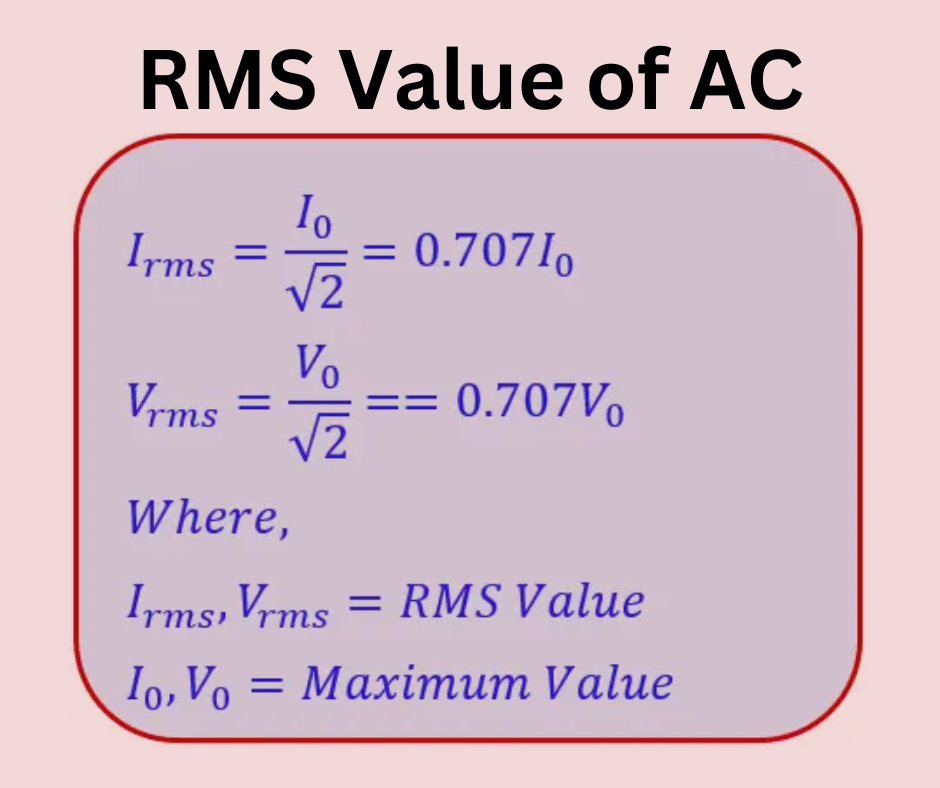
For a sinusoidal AC waveform, which is the most common type of AC encountered, the RMS value is calculated as:
$I{RMS} = frac{I{peak}}{sqrt{2}}$
Where $I{RMS}$ is the RMS current and $I{peak}$ is the peak current (the maximum value the current reaches during its oscillation). This relationship highlights that the RMS value is approximately 70.7% of the peak value for a pure sine wave.
Why RMS Current Matters: The Heartbeat of Modern Technology
The importance of RMS current extends far beyond theoretical calculations. It’s a critical parameter for a multitude of reasons, impacting the design, efficiency, and safety of nearly every electrical device and system we use.
Ensuring Reliable Power Delivery and Device Performance
At its core, the effectiveness of an electrical component or system is often judged by its ability to deliver consistent power. Since RMS current is the measure of equivalent DC power, it’s directly linked to how well a device will perform.
-
Power Supplies and Chargers: When you look at the specifications of a power adapter for your laptop or smartphone, you’ll often see ratings in volts and amperes. These amperes are typically RMS values. The power supply must be designed to deliver a certain RMS current to adequately charge your device and power its components. If the power supply cannot provide the required RMS current, your device may charge slowly, overheat, or not function correctly. This is a direct link to the “Tech” aspect of our website – the seamless functioning of our gadgets.
-
Motor and Appliance Performance: Electric motors, found in everything from washing machines to industrial machinery, are designed to operate efficiently at specific RMS current levels. An insufficient RMS current can lead to reduced torque, overheating, and premature failure of the motor. Similarly, heating elements in appliances like toasters and ovens rely on the power dissipated by current, which is directly proportional to the square of the RMS current.
-
Grid Stability and Load Management: The vast AC power grids that supply electricity to our homes and businesses are designed and operated based on RMS current considerations. Utilities must manage the total RMS current load on the grid to prevent overloads, voltage drops, and potential blackouts. Understanding RMS current is crucial for engineers to predict power flow, design transformers, and ensure the stability of the entire electrical infrastructure. This ties into the “Money” aspect, as grid instability and power outages have significant economic consequences.
Safety and Protection: The Unsung Hero of Electrical Systems
Perhaps one of the most critical roles of RMS current lies in its contribution to electrical safety.
-
Overcurrent Protection Devices: Fuses and circuit breakers are essential safety devices that protect electrical circuits from damage due to excessive current. These devices are rated based on the RMS current they can safely handle. A fuse or circuit breaker rated at, say, 15 amperes, is designed to interrupt the circuit if the RMS current exceeds this value for a certain duration. This prevents overheating of wires, which could lead to fires, and protects sensitive electronic components from being damaged by surges.
-
Understanding Electrical Hazards: When dealing with high-voltage AC systems, understanding the RMS current is vital for assessing the potential for electrical shock. While peak current might be higher, it’s the RMS value that dictates the overall power delivered and thus the severity of an electrical hazard. Safety regulations and protocols in industrial and residential settings are heavily based on RMS current ratings to ensure worker and public safety.
Efficiency and Power Factor: Optimizing Energy Consumption
In AC circuits, the concept of “power factor” also plays a role in energy efficiency, and RMS current is integral to its understanding. Power factor is a measure of how effectively electrical power is being converted into useful work. In AC circuits, due to the reactive nature of some components (like inductors and capacitors), the voltage and current waveforms may not be perfectly in phase.
-
Calculating Apparent, Real, and Reactive Power: RMS current is used alongside RMS voltage to calculate apparent power (the total power supplied). Real power (the power actually doing work) is calculated using the power factor. For many electrical loads, especially those with inductive components like motors, the current lags behind the voltage. This can lead to a lower power factor, meaning that for a given RMS current and voltage, less real work is being done.
-
Energy Costs and Optimization: In industrial and commercial settings, utilities often penalize consumers with a low power factor. By understanding and improving the power factor, often through the use of capacitors, businesses can reduce their overall electricity consumption and costs. This is a direct link to “Money” – optimizing energy usage translates into financial savings. Furthermore, improved power factor can lead to higher efficiency for electrical equipment, a key aspect of “Tech” innovation.
RMS Current in the Broader Tech Landscape
While the fundamental principles of RMS current are rooted in electrical engineering, its impact is pervasive across various technological domains.
Digital Security and Network Infrastructure
Even in the realm of digital security and networking, RMS current has a subtle but significant presence.
-
Power Supply Units (PSUs) for Servers and Data Centers: The massive data centers that power our cloud services and online interactions rely on robust power infrastructure. The PSUs for these servers are designed to deliver stable RMS current to ensure continuous operation. Fluctuations in RMS current can impact the performance and longevity of these critical systems.
-
Network Equipment: Routers, switches, and other networking hardware also have power requirements that are specified in terms of RMS current. Ensuring these devices receive the correct RMS current is vital for maintaining network stability and preventing data loss.
Personal Branding and Consumer Electronics
On a more personal level, understanding RMS current can help consumers make informed purchasing decisions and appreciate the engineering behind their everyday gadgets.
-
Choosing the Right Chargers and Power Banks: When selecting a power bank or a multi-port charger, looking at the RMS current ratings will give you a better idea of its charging speed capabilities for different devices. A higher RMS current rating generally implies faster charging.
-
Understanding Appliance Ratings: When buying new appliances, the energy efficiency ratings are often tied to how effectively they utilize RMS current to perform their intended function. This can inform choices that lead to lower electricity bills.

Conclusion: The Unseen Force Shaping Our Connected World
The concept of RMS current, though mathematically derived, is far from an abstract academic exercise. It is the silent, consistent force that underpins the reliable operation of our technological infrastructure. From the seamless charging of our smartphones to the stable flow of electricity that powers our global economy, RMS current ensures that AC power, with all its complexities, can be effectively measured, managed, and harnessed.
As we continue to embrace increasingly sophisticated technologies, our reliance on stable and efficient power delivery will only grow. Understanding RMS current is not just for electrical engineers; it’s for anyone interested in the fundamental workings of the modern world, the economic implications of energy consumption, and the underlying technology that shapes our daily lives. It is a crucial piece of the puzzle that connects the tangible world of electricity to the intangible world of data, innovation, and progress.
aViewFromTheCave is a participant in the Amazon Services LLC Associates Program, an affiliate advertising program designed to provide a means for sites to earn advertising fees by advertising and linking to Amazon.com. Amazon, the Amazon logo, AmazonSupply, and the AmazonSupply logo are trademarks of Amazon.com, Inc. or its affiliates. As an Amazon Associate we earn affiliate commissions from qualifying purchases.