
In the dynamic world of projects, whether they involve cutting-edge technology, building a compelling brand, or managing intricate financial ventures, the efficient allocation and utilization of resources are paramount. At the heart of this optimization lies a critical concept: resource leveling. But what exactly is resource leveling, and why is it so fundamental to achieving success across the diverse landscapes of tech, brand, and money?
Resource leveling is a project management technique used to address resource over-allocation and under-allocation by adjusting project activities’ start and finish dates, or by altering the scope of work, to ensure that resources are utilized as smoothly and consistently as possible throughout the project lifecycle. In essence, it’s about smoothing out the peaks and valleys of resource demand, preventing bottlenecks and ensuring that your team, your budget, and your brand don’t suffer from erratic or insufficient resource availability.
This article will delve into the core of resource leveling, exploring its definition, its strategic importance, and how its principles can be effectively applied to projects within the realms of technology, branding, and finance. We’ll uncover how mastering resource leveling can lead to more predictable outcomes, enhanced efficiency, and ultimately, greater success in achieving your project goals.
The Core Principles of Resource Leveling
At its most basic, resource leveling is about balance. Projects, by their nature, often demand a fluctuating amount of resources. Some phases might require a heavy concentration of skilled developers or marketing specialists, while others might see a lull. Without intervention, this can lead to situations where:
- Resource Over-allocation: Too many tasks are assigned to a single resource (person, equipment, budget) at the same time, exceeding their capacity. This results in delays, burnout, decreased quality, and potential project failure.
- Resource Under-allocation: Resources are not fully utilized during certain project phases, leading to wasted time, increased costs, and missed opportunities.
Resource leveling aims to rectify these imbalances. It’s a proactive approach that identifies potential over-allocations and seeks to resolve them by:
- Delaying Tasks: If a task requires a resource that is already over-allocated, its start date can be pushed back to a point where the resource becomes available. This often means extending the project timeline.
- Splitting Tasks: In some cases, a large task can be broken down into smaller, more manageable sub-tasks that can be performed sequentially or by different resources, easing the load on any single individual.
- Modifying Task Duration or Effort: Adjusting the estimated time or effort required for a task, potentially by reassigning it or breaking it down further.
- Reducing Scope (less common): In extreme cases, if resource constraints are severe and cannot be resolved through scheduling adjustments, a project manager might consider reducing the scope of work to align with available resources.
Understanding the Relationship with Resource Smoothing
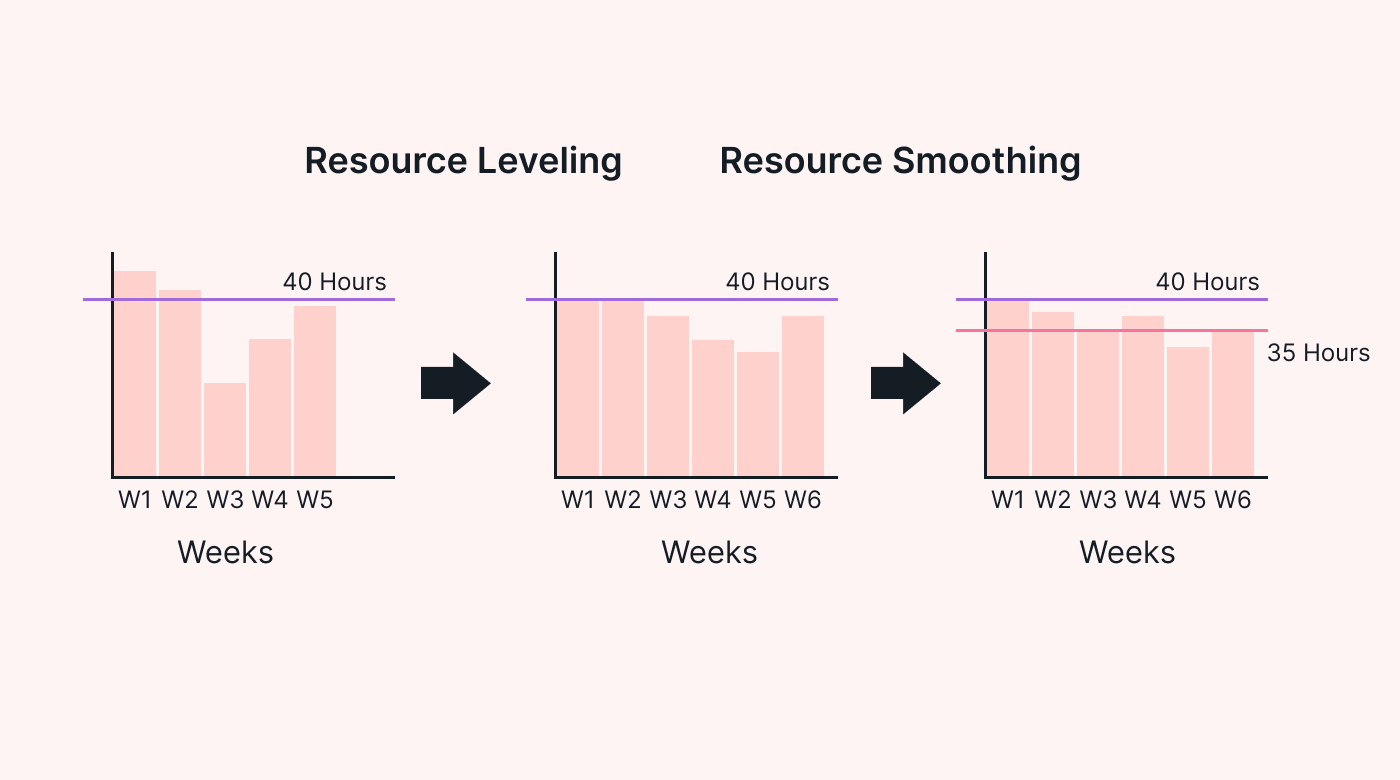
It’s important to distinguish resource leveling from its close cousin, resource smoothing. While both aim to optimize resource utilization, they have different objectives and constraints:
- Resource Leveling: Prioritizes meeting the project’s original deadline. To achieve this, it may extend the project duration by delaying tasks. The goal is to resolve over-allocations by accepting the risk of a longer project timeline.
- Resource Smoothing: Aims to keep the project on its original schedule while reducing resource fluctuations. It operates within the existing project timeline, adjusting task durations or shifting tasks slightly without impacting the overall completion date. This is only possible if there is some float or slack in the schedule that can be utilized. If there is no float, resource smoothing cannot be performed without impacting the deadline.
In essence, resource leveling is the more robust solution for tackling significant over-allocations, even if it means extending the project. Resource smoothing is a more delicate adjustment that works within tighter time constraints.
Resource Leveling in the Tech Landscape: Navigating Innovation and Execution
The technology sector is characterized by rapid innovation, complex dependencies, and highly specialized skill sets. Projects in this domain often involve multiple teams, intricate software development cycles, and the integration of cutting-edge AI tools, apps, and gadgets. Resource leveling plays a crucial role in ensuring that these ambitious projects stay on track and deliver their intended impact.
Addressing Skill Shortages and Bottlenecks in Tech Teams
In tech, finding and retaining skilled personnel is a constant challenge. A single senior AI engineer, a cybersecurity expert, or a lead full-stack developer might be critical to several concurrent projects. Without resource leveling, such individuals can become significant bottlenecks.
Scenario Example: Imagine a project developing a new AI-powered application. The AI model training requires a dedicated machine learning engineer, while the front-end development needs a UI/UX specialist, and the back-end infrastructure relies on a cloud architect. If the machine learning engineer is also assigned to another critical project simultaneously, the AI training phase will be delayed.
Applying Resource Leveling:
- Identifying the Over-allocation: Project management software would flag the machine learning engineer as over-allocated during the proposed AI training period.
- Leveling the Schedule: The resource leveling process would analyze the dependencies and available float. If the AI training phase has flexibility, its start date might be pushed back until the engineer is free from their other commitment. Alternatively, if the project timeline is fixed, and the engineer’s availability cannot be shifted, the project manager might explore options like:
- Bringing in a temporary contractor: If budget allows, a short-term resource can alleviate the bottleneck.
- Reassigning less critical tasks: Can some of the engineer’s less time-sensitive duties on other projects be delegated to a junior team member or postponed?
- Phased Development: Can the AI model training be broken down into smaller phases that can be performed sequentially with the engineer’s limited availability?
Managing Infrastructure and Tooling Resources
Beyond human resources, tech projects also rely heavily on specialized infrastructure and tools. This can include cloud computing instances, powerful development servers, testing environments, and licensed software. These are often finite and expensive.
Scenario Example: A team is developing a new mobile app that requires extensive testing on various devices and operating systems. They have a limited number of testing rigs and a specific software license for a performance analysis tool. If multiple development sprints demand simultaneous access to these resources, conflicts will arise.
Applying Resource Leveling:
- Demand Forecasting: By analyzing the project schedule, project managers can predict periods of high demand for specific testing rigs or the analysis tool.
- Scheduling Adjustments: Resource leveling can schedule tasks that require these shared resources at different times, ensuring that each team or sprint gets adequate access without overloading the system. This might involve staggering testing phases or allocating specific time slots for tool usage.
- Budgetary Considerations: In some cases, resource leveling might reveal that the current infrastructure is insufficient for projected project demands. This could trigger a discussion about investing in additional resources, which in itself is a financial decision driven by project needs.

Resource Leveling in Brand Building: Consistency and Perception Management
Building and maintaining a strong brand is a continuous endeavor that requires consistent effort across various departments, from marketing and design to public relations and customer service. In brand-centric projects, resource leveling is vital for ensuring that brand messaging is coherent, visual identity is consistently applied, and marketing efforts are strategically timed and adequately supported.
Ensuring Cohesive Messaging and Visual Identity
A brand’s strength lies in its consistency. Inconsistent messaging or diluted visual identity can confuse customers and erode trust. Brand projects, such as a rebranding initiative, a new product launch campaign, or an ongoing content marketing strategy, require careful orchestration of resources.
Scenario Example: A company is undergoing a significant rebranding. The design team is responsible for creating new logos and visual assets, the marketing team is tasked with developing new campaign materials, and the content team is producing updated website copy and social media posts. If the lead graphic designer is over-allocated across all these initiatives simultaneously, the quality of design might suffer, and the rollout timeline could be jeopardized.
Applying Resource Leveling:
- Prioritizing Brand Elements: Resource leveling would help identify which design assets or content pieces are most critical for the initial launch or phase of the rebranding.
- Staggered Deliverables: The process can help stagger the deliverables. For instance, the logo might be finalized first, followed by core visual guidelines, and then specific campaign assets. This allows the design team to focus on one critical element at a time.
- Cross-functional Collaboration: It can also highlight the need for better communication and coordination between teams. Perhaps some content creation can begin based on preliminary design concepts, reducing the burden on the designer when final assets are ready.
Optimizing Marketing Campaign Execution
Marketing campaigns are often time-sensitive and require a coordinated effort involving creative development, media buying, social media management, and analytics. Resource leveling ensures that these campaigns are launched effectively and have the necessary support throughout their duration.
Scenario Example: A product launch campaign is planned. It involves creating a series of video advertisements, designing ad banners, writing ad copy, booking media slots, and setting up tracking mechanisms. The video production team might be booked for a specific period, and the digital marketing team needs sufficient lead time to set up campaigns.
Applying Resource Leveling:
- Phased Campaign Development: Resource leveling can help align the availability of resources for each phase of the campaign. The video production might be scheduled for the first few weeks, followed by banner design, and then the digital marketing team can begin campaign setup once key assets are ready.
- Contingency Planning: By identifying potential resource conflicts, project managers can proactively plan for contingencies. If a key marketer is out sick, having a backup plan for campaign management becomes crucial.
- Budget Allocation: Resource leveling can also inform budget allocation. If a campaign requires significant advertising spend, ensuring that the marketing team has the capacity to manage these budgets effectively and that the creative assets are ready to support the media spend is vital.
Resource Leveling in Finance: Safeguarding Budgets and Maximizing Returns
The financial sector, whether in personal finance management, investing, or corporate finance, is inherently tied to resource allocation and the pursuit of optimal returns. Resource leveling, in this context, translates to careful budget management, efficient allocation of capital, and ensuring that financial activities are executed without jeopardizing financial stability.
Prudent Budget Management and Cost Control
For any business or large-scale financial project, maintaining a healthy budget is paramount. Resource leveling in finance means ensuring that expenditures are planned and executed in a way that avoids costly overruns and maximizes the impact of every dollar spent.
Scenario Example: A company is undertaking a major infrastructure upgrade that involves significant capital expenditure over several quarters. Different departments are requesting funding for their respective parts of the upgrade, and there’s a risk that the cumulative requests in a single quarter might exceed the allocated capital budget for that period.
Applying Resource Leveling:
- Cash Flow Management: Resource leveling helps in smoothing out cash outflows by staggering large expenditures across different fiscal periods. Instead of one quarter seeing a massive outflow, the costs are distributed more evenly, improving cash flow predictability.
- Identifying Funding Gaps: By projecting resource needs over time, financial managers can identify potential funding gaps early on. This allows them to arrange for additional financing or adjust project timelines to align with available funds.
- Optimizing Investment Periods: For investment projects, resource leveling can help determine the optimal times to deploy capital. Instead of investing a large sum all at once, phased investments, timed according to market conditions or project milestones, can be more strategic.
Ensuring Efficient Allocation of Capital and Financial Resources
Beyond managing expenditures, resource leveling in finance also applies to how capital is deployed for investments or revenue-generating activities. It’s about ensuring that the right financial resources are available at the right time to capture opportunities and achieve financial objectives.
Scenario Example: An investment fund is looking to diversify its portfolio by investing in a mix of stocks, bonds, and real estate. Each asset class has different liquidity needs and requires varying amounts of capital at different times.
Applying Resource Leveling:
- Strategic Capital Deployment: Resource leveling can help the fund manager plan the timing of their investments. For instance, if a significant real estate purchase is planned for Q3, they might gradually build up the necessary capital through smaller, more liquid investments in Q1 and Q2.
- Managing Liquidity: It ensures that sufficient liquid assets are always available to meet short-term obligations or to capitalize on unexpected investment opportunities without having to liquidate less liquid assets at unfavorable prices.
- Risk Mitigation: By carefully planning the allocation of financial resources, project managers can mitigate risks associated with market volatility or unexpected financial demands. This ensures that the overall financial health of the project or organization remains robust.

Conclusion: The Strategic Imperative of Resource Leveling
In the interconnected domains of technology, branding, and finance, resource leveling is not merely a project management tactic; it’s a strategic imperative. It’s the art and science of ensuring that your most valuable assets – your people, your budget, and your brand reputation – are utilized optimally, consistently, and predictably.
By embracing the principles of resource leveling, project managers and leaders can transform potential chaos into controlled execution. In the fast-paced tech world, it means delivering innovative solutions without burnout or technical debt. For brand builders, it ensures a consistent and impactful presence that resonates with audiences. And in the financial arena, it safeguards fiscal health and maximizes the return on every investment.
Ultimately, mastering resource leveling empowers you to navigate the complexities of any project with greater confidence, achieving more robust outcomes, and paving the way for sustained success in your technological advancements, your brand’s trajectory, and your financial prosperity.
aViewFromTheCave is a participant in the Amazon Services LLC Associates Program, an affiliate advertising program designed to provide a means for sites to earn advertising fees by advertising and linking to Amazon.com. Amazon, the Amazon logo, AmazonSupply, and the AmazonSupply logo are trademarks of Amazon.com, Inc. or its affiliates. As an Amazon Associate we earn affiliate commissions from qualifying purchases.