
QR factorization, a term that might sound like a cryptic code or a niche academic pursuit, is in reality a foundational mathematical technique with far-reaching implications across the domains of technology, brand management, and even personal finance. While its origins lie in linear algebra, its applications have permeated areas we interact with daily, often without realizing it. This article aims to demystify QR factorization, exploring its core concepts, its relevance to the ever-evolving tech landscape, how it subtly influences brand perception and marketing, and its surprising utility in the realm of money and finance.

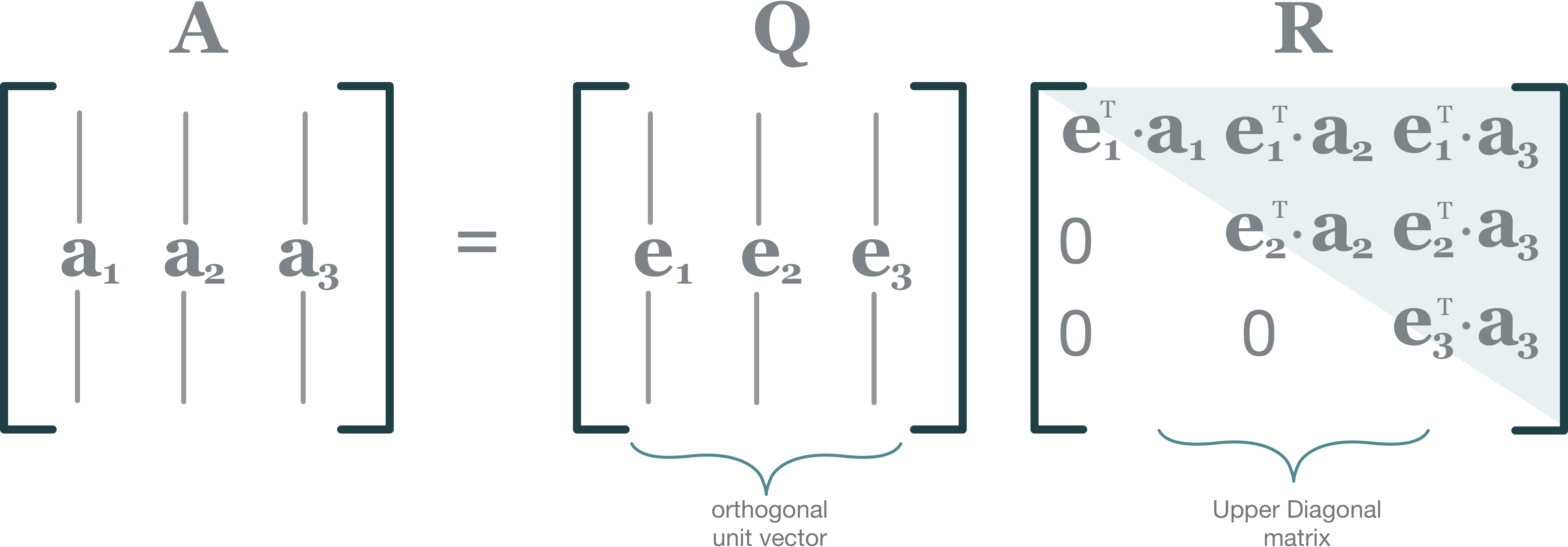
QR factorization, at its heart, is a method of decomposing a matrix into the product of two other matrices: an orthogonal matrix (Q) and an upper triangular matrix (R). This decomposition is incredibly powerful because it transforms a complex matrix into simpler, more manageable components, making subsequent operations significantly easier and more efficient. Let’s break down what these components mean and why their combination is so valuable.
Understanding the Building Blocks: Q and R
The Orthogonal Matrix (Q)
The “Q” in QR factorization represents an orthogonal matrix. In simpler terms, an orthogonal matrix is a square matrix whose columns (and rows) are orthonormal vectors. “Orthonormal” is a combination of “orthogonal” and “normal.” Orthogonal vectors are perpendicular to each other, meaning their dot product is zero. Normal means that each vector has a length (or magnitude) of 1, also known as a unit vector.
What makes orthogonal matrices so special? They preserve lengths and angles. This means that when you multiply a vector by an orthogonal matrix, its length and orientation in space remain unchanged, only its position might shift. Think of rotations and reflections in geometry – these are operations performed by orthogonal matrices. In practical terms, this property is crucial in algorithms where preserving the scale and relationships between data points is vital, preventing numerical instability.
The Upper Triangular Matrix (R)
The “R” represents an upper triangular matrix. This is a square matrix where all the entries below the main diagonal are zero. The entries on and above the diagonal can be any number.
Upper triangular matrices are remarkably easy to work with, especially when it comes to solving systems of linear equations. If you have a system represented by an upper triangular matrix, you can solve for the variables using a technique called back-substitution. You start with the last variable, solve for it, then substitute that value into the equation for the second-to-last variable, and so on. This sequential solving process is computationally efficient and less prone to errors.
The Factorization: Q * R = A
The essence of QR factorization is the decomposition of an original matrix “A” into the product of “Q” and “R,” such that $A = QR$. This might seem like just a rearrangement, but it’s the transformation into these specific types of matrices that unlocks its potential. By breaking down a general matrix “A” into an orthogonal matrix “Q” and an upper triangular matrix “R,” we are essentially separating the “rotational” or “preserving” aspects (Q) from the “scaling” or “simplifying” aspects (R).
QR Factorization in the Digital Realm: Powering Tech Trends
The “Tech” category on our website delves into a vast array of innovations, and QR factorization is a silent workhorse powering many of them. Its ability to simplify complex data representations and facilitate efficient computations makes it indispensable in various technological applications.
1. Solving Linear Systems and Optimization
At its core, many problems in computer science and engineering can be framed as solving systems of linear equations. Whether it’s simulating physical systems, optimizing resource allocation, or performing complex calculations in scientific computing, these problems often boil down to manipulating matrices.
- Numerical Stability: QR factorization is a preferred method for solving linear systems because it is numerically stable. Unlike other methods that can accumulate errors due to floating-point arithmetic, QR factorization tends to be more robust, leading to more accurate solutions, especially with large or ill-conditioned matrices. This is critical for applications where precision is paramount, such as in weather forecasting, structural analysis, or high-frequency trading algorithms.
- Eigenvalue Problems: A significant application of QR factorization is in finding the eigenvalues and eigenvectors of a matrix. These values are fundamental to understanding the behavior of linear systems and are used in numerous algorithms, including principal component analysis (PCA) for dimensionality reduction in machine learning and signal processing. The QR algorithm, which repeatedly applies QR factorization, is a standard method for computing eigenvalues.
2. Machine Learning and AI Tools
The explosion of Artificial Intelligence and Machine Learning has further amplified the importance of QR factorization.
- Data Preprocessing and Dimensionality Reduction: Before training machine learning models, data often needs to be preprocessed. Techniques like PCA, which rely on eigenvalue decomposition, are used to reduce the dimensionality of datasets while retaining the most important information. QR factorization plays a role in efficiently computing the components needed for these reductions, making it faster and more manageable to train models on large datasets.
- Solving Least Squares Problems: In machine learning, models are often trained by minimizing errors, which frequently leads to solving overdetermined systems of linear equations – a classic “least squares” problem. QR factorization provides a stable and efficient way to find the best approximate solution for these problems, forming the backbone of many regression algorithms and model fitting procedures.
- Deep Learning Architectures: While not always explicitly visible to the end-user, the underlying mathematical operations within deep neural networks often involve large matrix multiplications. Techniques derived from or utilizing QR factorization can be employed in optimizing these computations, especially in specialized layers or during model compression and optimization for deployment on resource-constrained devices.
3. Digital Security and Cryptography
While the direct application of QR factorization in common encryption algorithms might be less prevalent than in other areas, its underlying principles are relevant to more advanced cryptographic research and secure communication protocols. The manipulation and decomposition of matrices are fundamental to understanding the mathematical underpinnings of certain cryptographic systems. Moreover, the emphasis on numerical stability in QR factorization aligns with the need for robust and error-free computations in security-sensitive applications.
The Subtle Influence of QR Factorization on Brands and Marketing
The “Brand” category focuses on how businesses build and maintain their identity, reputation, and market presence. While QR factorization might not be a direct marketing tool, its impact on the technologies that enable modern branding and marketing is undeniable.
1. Data Analysis for Consumer Insights
Modern marketing relies heavily on understanding consumer behavior. This involves analyzing vast amounts of data collected from various touchpoints – website visits, social media interactions, purchase history, and more.
- Market Segmentation and Profiling: Techniques like clustering and dimensionality reduction, often powered by linear algebra methods that utilize QR factorization (e.g., in PCA for feature extraction), help marketers segment their audience into distinct groups with similar characteristics and preferences. This allows for more targeted and effective marketing campaigns.
- Predictive Analytics: By analyzing historical data, marketers can build predictive models to forecast future trends, customer churn, or the success of new campaigns. QR factorization’s role in stable linear system solutions and eigenvalue problems contributes to the robustness of these predictive models, leading to more reliable business decisions and optimized marketing spend.
2. Optimization of Advertising and Content Delivery
The digital advertising landscape is a complex ecosystem where efficiency and effectiveness are paramount.
- Ad Placement and Bidding: Real-time bidding (RTB) for online advertisements involves complex algorithms that analyze user data and context to determine optimal ad placements and bidding strategies. These algorithms often rely on solving linear systems and optimization problems, where QR factorization can play a role in ensuring computational speed and accuracy.
- Personalized Content Recommendations: Recommendation engines, crucial for e-commerce and content platforms, analyze user behavior and item characteristics to suggest relevant products or content. The underlying matrix factorization techniques used in many recommendation systems often employ or are related to the principles of decomposing matrices, where QR factorization can be a foundational concept for efficient computation. A better understanding of user preferences, facilitated by these analytical tools, leads to more engaging and personalized brand experiences.
3. Brand Reputation and Crisis Management
While not a direct tool, the analytical power derived from QR factorization’s underlying mathematical principles can indirectly contribute to brand management. The ability to quickly and accurately analyze large datasets related to public sentiment, media coverage, or customer feedback can be crucial during a brand crisis. Faster, more reliable insights enable quicker and more informed responses, helping to mitigate reputational damage.
QR Factorization and the World of Money: From Personal Finance to Business
The “Money” category encompasses personal finance, investing, and business finance. Here, QR factorization’s impact, though often unseen, can be quite significant, particularly in the quantitative finance and algorithmic trading sectors.
1. Algorithmic Trading and Financial Modeling
The financial markets are increasingly driven by sophisticated algorithms that make trading decisions in fractions of a second.
- Risk Management: Financial institutions use complex models to assess and manage risk. These models often involve analyzing large covariance matrices of asset returns. QR factorization is a key step in many portfolio optimization techniques and risk assessment methods, such as those used in calculating Value at Risk (VaR) and performing stress tests. Its numerical stability is vital here, as small errors can lead to massive financial losses.
- High-Frequency Trading (HFT): HFT strategies rely on executing a large number of orders at extremely high speeds. The underlying algorithms need to process market data, identify trading opportunities, and execute trades with minimal latency. QR factorization can be used to efficiently solve the linear systems that arise in some HFT models, contributing to the speed and reliability of these operations.
- Econometric Modeling: Econometric models, used to understand economic relationships and forecast economic indicators, often involve solving large systems of equations. QR factorization provides a robust method for obtaining these solutions, which are crucial for informing investment strategies and economic policy.
2. Personal Finance and Investment Analysis
While individual users might not directly perform QR factorization, the tools and platforms they use for personal finance and investment analysis often leverage it.
- Robo-Advisors: Robo-advisors that offer automated investment advice and portfolio management utilize sophisticated algorithms. These algorithms often incorporate linear regression and optimization techniques to construct diversified portfolios tailored to individual risk tolerances and financial goals. The stable and efficient computations provided by QR factorization contribute to the accuracy and reliability of these services.
- Investment Research Platforms: Platforms offering in-depth financial analysis and research utilize powerful statistical tools. When analyzing historical stock prices, bond yields, or other financial instruments, these platforms might employ techniques that rely on QR factorization for tasks like regression analysis, factor modeling, and performance attribution. This helps investors make more informed decisions about where to allocate their capital.
3. Business Finance and Operations
Beyond trading floors, QR factorization can touch upon business finance in areas requiring data-driven decision-making.
- Supply Chain Optimization: Businesses often use mathematical models to optimize their supply chains, from inventory management to logistics. Solving the linear systems that arise in these optimization problems can be crucial for minimizing costs and maximizing efficiency.
- Credit Risk Assessment: Financial institutions use sophisticated models to assess the creditworthiness of individuals and businesses. These models can involve complex statistical analysis of financial data, where robust linear algebra techniques, including QR factorization, can play a role in ensuring accurate risk evaluation.

Conclusion: A Ubiquitous Mathematical Foundation
From the sophisticated algorithms that power AI and machine learning to the precise calculations that underpin financial markets, QR factorization stands as a testament to the enduring power of fundamental mathematical concepts. It’s a technique that, while often operating behind the scenes, provides the computational robustness and efficiency needed to drive innovation across technology, refine brand strategies through data analysis, and manage financial resources effectively. Understanding what QR factorization is, even at a high level, offers a glimpse into the intricate mathematical machinery that shapes our modern digital and financial worlds. It’s a reminder that complex, cutting-edge applications are often built upon a solid foundation of elegant and powerful mathematical principles.
aViewFromTheCave is a participant in the Amazon Services LLC Associates Program, an affiliate advertising program designed to provide a means for sites to earn advertising fees by advertising and linking to Amazon.com. Amazon, the Amazon logo, AmazonSupply, and the AmazonSupply logo are trademarks of Amazon.com, Inc. or its affiliates. As an Amazon Associate we earn affiliate commissions from qualifying purchases.