
In the vast and intricate world of technology, where every command, every operation, and every data manipulation plays a crucial role, understanding fundamental concepts is paramount. One such cornerstone concept, often taken for granted yet indispensable, is “decrement.” Far from being a mere academic term, decrement is a foundational operation that underpins countless algorithms, software functionalities, and system processes. At its core, to decrement means to reduce the value of a variable, counter, or quantity, typically by a specific, often unit-based, amount. While seemingly simple, the implications and applications of decrement extend across various domains of computing, from the granular level of CPU operations to the high-level logic of complex applications.
This article delves into the essence of decrement, exploring its definition, practical manifestations in programming, its significance in software development, and the nuances that developers must understand to harness its power effectively. By dissecting this seemingly elementary concept, we uncover its pervasive influence and highlight why a thorough grasp of decrement is vital for anyone navigating the tech landscape.
The Core Concept of Decrement in Programming
At the heart of almost all programming languages lies the ability to manipulate data, and a fundamental aspect of this manipulation is the alteration of numerical values. Decrement, in this context, refers specifically to the operation of decreasing a variable’s value. While this can be achieved through simple subtraction, programming languages often provide specialized operators or functions for this common task, particularly for reducing a value by one.
Basic Definition and Syntax
Conceptually, decrement is the inverse of increment. If increment adds to a value, decrement subtracts. The most common form of decrement involves reducing an integer variable by exactly one. This operation is so frequent in programming that many languages provide a shorthand, unary operator to perform it efficiently.
For instance, in C, C++, Java, JavaScript, and many other C-like languages, the decrement operator is ––. If you have a variable x with a value of 5, applying x–– would change its value to 4. This is equivalent to x = x - 1 or x -= 1, but the unary decrement operator is often more concise and, in some contexts, can be more performant as it might translate to a single machine instruction.
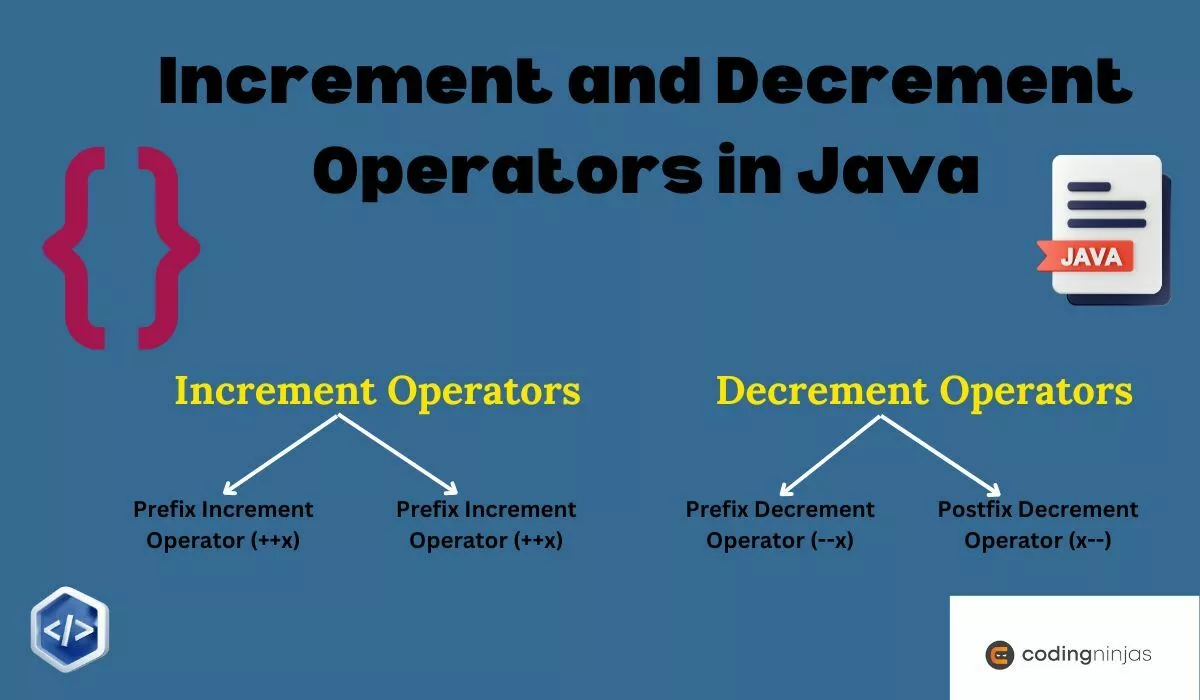
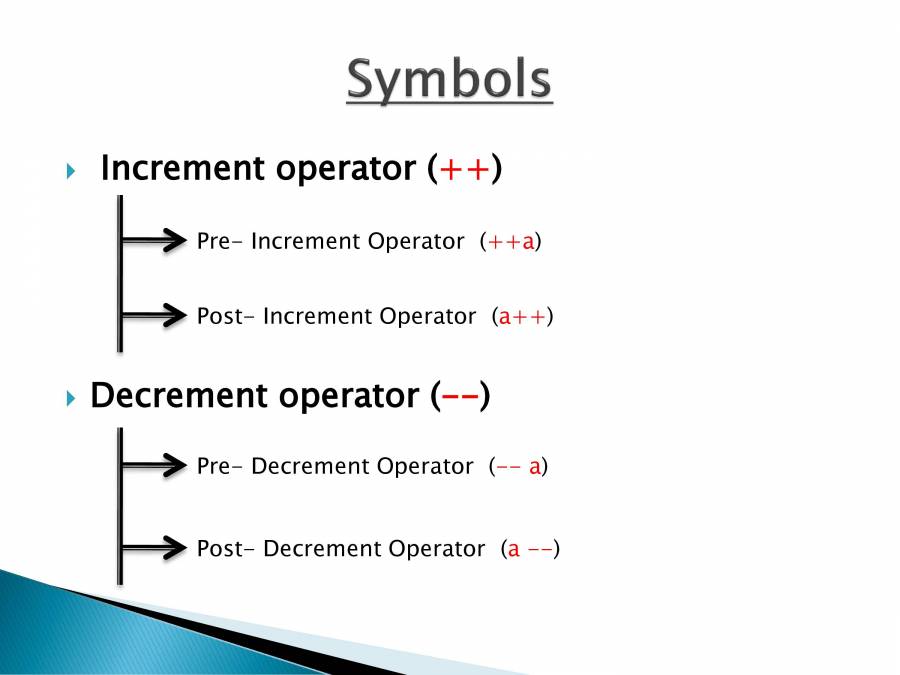
Unary Decrement Operators (Prefix vs. Postfix)
A crucial distinction within the realm of unary decrement operators is the difference between their prefix and postfix forms. This difference dictates when the decrement operation takes place relative to when the variable’s value is used in an expression.
- Prefix Decrement (
––x): When the––operator precedes the variable, the variable’s value is decremented before it is used in the expression.
java

int x = 5;

int y = --x; // x becomes 4, then y is assigned 4.

// Result: x is 4, y is 4
- Postfix Decrement (
x––): When the––operator follows the variable, the variable’s original value is used in the expression before it is decremented.
java

int x = 5;

int y = x--; // y is assigned 5, then x becomes 4.

// Result: x is 4, y is 5
Understanding this distinction is critical to avoiding subtle bugs and ensuring the correct flow of logic, especially in complex expressions or loop conditions where the timing of value updates can significantly alter program behavior.
Decrement in Different Programming Languages
While the –– operator is prevalent in C-family languages, the concept of decrement is universal, though its syntax may vary.
- Python: Python does not have a unary
––operator. Decrement is performed explicitly using the subtraction assignment operator:x -= 1. - JavaScript: Supports both
––xandx––identical to C/Java. - Assembly Language: At a lower level, decrement often translates to specific CPU instructions like
DEC(decrement) on x86 processors, which directly reduce the value in a register or memory location by one. This highlights how fundamental the operation is to computing hardware. - Other Languages (e.g., Ruby, Swift): Like Python, many modern languages prioritize readability and often opt for
x -= 1over specialized unary operators, viewing them as potential sources of confusion regarding side effects.
Despite syntactic variations, the underlying principle of reducing a value remains consistent across all programming paradigms and languages.
Why is Decrement Important? Practical Applications
The significance of decrement extends far beyond a simple arithmetic operation. It is a cornerstone of control flow, data management, and resource allocation in virtually every software system. Its importance stems from its role in managing iterative processes, tracking resources, and facilitating orderly progression through data structures.
Controlling Loops and Iterations
One of the most common and critical applications of decrement is in controlling loops. Loops are fundamental constructs that allow a block of code to be executed repeatedly, and decrement is often used to manage the loop’s counter variable, ensuring that the loop terminates correctly after a specified number of iterations.
- Counting Down: A
forloop, for instance, can be designed to count down from a starting value to zero or another lower bound, using a decrementing counter. This is particularly useful when iterating through collections in reverse order or when a process needs to repeat a fixed number of times, reducing the remaining count with each iteration.
java

for (int i = 10; i > 0; i--) {

    System.out.println("Countdown: " + i);

}

// Output: Countdown: 10, 9, ..., 1
- While Loops: Similarly,
whileloops often rely on a condition that involves a decremented variable to control their execution. The loop continues as long as the variable meets the condition, and with each iteration, the variable is decremented, eventually causing the condition to become false and the loop to terminate.
Managing Counters and Indices
Beyond loops, decrement is essential for managing various types of counters and indices that track quantities, positions, or states within a program.
- Array Traversal (Reverse): When processing elements of an array or list from the end to the beginning, a decrementing index is indispensable. This can be more efficient in certain scenarios, such as removing elements from a list without shifting indices of unprocessed items.
- Game Development: In games, decrement is used for player health, ammunition counts, timer countdowns, and lives remaining. Each hit, shot, or passing second decrements a corresponding variable.
- System Resources: Operating systems and applications use decrement to track available resources. For example, a mutex might decrement a counter when a resource is acquired and increment it when released, though the inverse is more common for resource availability. More directly, decrement might be used to track the number of free slots in a buffer or the remaining retries for an operation.
Resource Management and Data Structures
In more complex scenarios, decrement plays a role in managing resources and the integrity of data structures.

- Stack Operations: In a stack data structure, when an element is popped, the stack pointer (an index indicating the top of the stack) is typically decremented to point to the new top element, effectively “removing” the item by adjusting the accessible range.
- Memory Management: While often handled at a lower level or by garbage collectors, manual memory management might involve decrementing reference counts to objects. When a reference count reaches zero, it indicates that the object is no longer in use and its memory can be deallocated.
- Queues (for consumption): While queues often involve incrementing a “head” pointer for adding elements, a “tail” or “size” counter might be decremented as elements are processed and removed, indicating fewer items remaining in the queue.
Beyond Simple Subtraction: Advanced Considerations
While the basic concept of decrement is straightforward, its application in advanced computing scenarios introduces complexities that require careful handling. These considerations often revolve around concurrency, low-level system interactions, and performance optimization.
Atomic Decrement for Concurrency
In multi-threaded or concurrent programming environments, multiple threads might attempt to decrement the same shared variable simultaneously. A naive decrement operation (x–– or x -= 1) is not inherently atomic, meaning it’s not guaranteed to complete as a single, uninterrupted operation. It typically involves three steps: read the value, decrement the value, write the new value. If two threads perform these steps concurrently, they can lead to a “race condition,” where the final value is incorrect (e.g., two decrements result in only a reduction of one).
To address this, “atomic decrement” operations are crucial. These are special hardware-level instructions or software primitives (like mutexes, semaphores, or atomic integer classes) that guarantee the decrement operation on a shared variable is performed indivisibly. For example, Java’s AtomicInteger.decrementAndGet() method ensures that the decrement operation on a shared integer is thread-safe, preventing data corruption in concurrent scenarios. This is vital for maintaining the integrity of shared counters, resource pools, and synchronization mechanisms.
Decrement in Hardware and Low-Level Programming
At the machine code level, decrement is not just a high-level language construct but a direct CPU instruction. Processors typically have specific instructions (e.g., DEC on x86, or simple arithmetic subtraction instructions) designed for fast decrement operations on registers or memory locations. Understanding this low-level interaction is important for:
- Assembly Programming: Directly manipulating registers and memory addresses often involves
DECinstructions to manage loop counters, stack pointers, or byte offsets. - Embedded Systems: In embedded programming, where resources are limited and performance is critical, a deep understanding of how decrement operations translate to hardware instructions can influence optimization decisions and efficient resource utilization.
- Operating Systems: Kernel development frequently uses decrement for managing task queues, resource locks, and internal timers, often relying on atomic operations for robustness.
Performance Implications
For most high-level applications, the performance difference between x–– and x = x - 1 is negligible due to modern compiler optimizations. Compilers are intelligent enough to optimize x = x - 1 into the most efficient machine instruction if possible. However, in extremely performance-critical loops or embedded systems, using a unary decrement operator or a direct assembly instruction might offer a marginal advantage by potentially translating to fewer machine cycles.
More significant performance considerations arise with atomic decrements. While necessary for thread safety, atomic operations are generally more expensive than their non-atomic counterparts because they involve memory barriers or locks, which introduce overhead. Therefore, developers must strike a balance: use atomic decrements when thread safety is absolutely required for shared mutable state, but avoid them unnecessarily on local or thread-private variables where a simple decrement suffices.
Common Pitfalls and Best Practices
While decrement appears straightforward, its usage, especially in conjunction with other operations, can lead to subtle bugs. Adhering to best practices can prevent these issues and contribute to more robust and readable code.
Understanding Side Effects (Prefix vs. Postfix)
The most common pitfall with the –– operator is misinterpreting the side effect of prefix versus postfix forms. As discussed earlier, whether the variable is decremented before or after its value is used in an expression can drastically change the outcome.
Best Practice:
- When the timing of the decrement matters for the current expression’s evaluation, be explicit. Use prefix
––xif you need the decremented value immediately, and postfixx––if you need the original value and then want to decrement it. - For clarity, especially in complex expressions, consider separating the decrement operation from the expression where the value is used (e.g.,
x = x - 1; y = x;instead ofy = --x;). This often makes the code more readable and less prone to misinterpretation. - Avoid using
––(or++) operators within complex expressions where their side effects might be difficult to track or lead to undefined behavior (as in some languages where the order of evaluation for certain operations isn’t strictly defined).
Avoiding Off-by-One Errors
Off-by-one errors are notorious in programming, and decrement operations, especially in loop conditions, are frequent culprits. These errors occur when a loop executes one time too many or one time too few, often due to incorrect boundary conditions.
Best Practice:
- Carefully define loop boundaries: When decrementing, ensure that your loop condition correctly reflects the desired range. If you want to iterate from
ndown to1(inclusive), your condition might bei > 0ori >= 1. If you want to iterate down to0(inclusive), it might bei >= 0. - Test edge cases: Always test loops and decrementing logic with edge cases, such as an initial value of 0, 1, or the maximum possible value, to ensure the loop behaves as expected at its boundaries.
- Be consistent: Choose a consistent style for defining your loop conditions (e.g., always
i > 0or alwaysi >= 1) to reduce mental overhead and potential errors.
Readability and Maintainability
While concise, excessive use of specialized operators or complex expressions involving side effects can reduce code readability and make it harder for others (or your future self) to understand and maintain.
Best Practice:
- Prioritize clarity: For simple decrements outside of loop conditions,
x -= 1is often just as clear, if not clearer, thanx––. Choose the style that makes the code most understandable. - Consistent style guide: Adhere to a team or project’s coding style guide, which might dictate preferences for decrement operations.
- Use meaningful variable names: Clear variable names help in understanding the context of why a value is being decremented.
Conclusion
The concept of “decrement,” while seemingly rudimentary, is a fundamental building block in the edifice of software development and computing. From its direct translation into CPU instructions to its ubiquitous presence in loop control, counter management, and advanced concurrent programming, decrement underpins the dynamic nature of nearly every technological system we interact with.
Understanding the nuances between prefix and postfix operators, recognizing its critical role in managing shared resources through atomic operations, and applying best practices to avoid common pitfalls are not just theoretical exercises but essential skills for any competent developer. By mastering the humble decrement, programmers gain a deeper insight into efficient, robust, and error-free code, proving that even the simplest operations hold profound significance in the complex world of tech. It is a testament to the idea that true mastery in technology often stems from a thorough understanding of its most basic, yet powerful, components.
aViewFromTheCave is a participant in the Amazon Services LLC Associates Program, an affiliate advertising program designed to provide a means for sites to earn advertising fees by advertising and linking to Amazon.com. Amazon, the Amazon logo, AmazonSupply, and the AmazonSupply logo are trademarks of Amazon.com, Inc. or its affiliates. As an Amazon Associate we earn affiliate commissions from qualifying purchases.