
For investors and financial professionals, the holiday season brings more than just festive gatherings and year-end celebrations; it brings a specific set of rules and adjusted hours for the global financial markets. Understanding the intricacies of the Christmas Eve trading schedule is essential for managing liquidity, executing year-end strategies, and ensuring that portfolios are positioned correctly before the markets go dark for the holiday.
While the general rule of thumb is that the U.S. stock market observes an early closing time on Christmas Eve, the specifics can vary based on the day of the week and the recommendations provided by industry regulatory bodies. Navigating these shortened hours requires a blend of tactical planning and an understanding of the broader market dynamics that define the final days of the calendar year.

The Standard Christmas Eve Trading Schedule
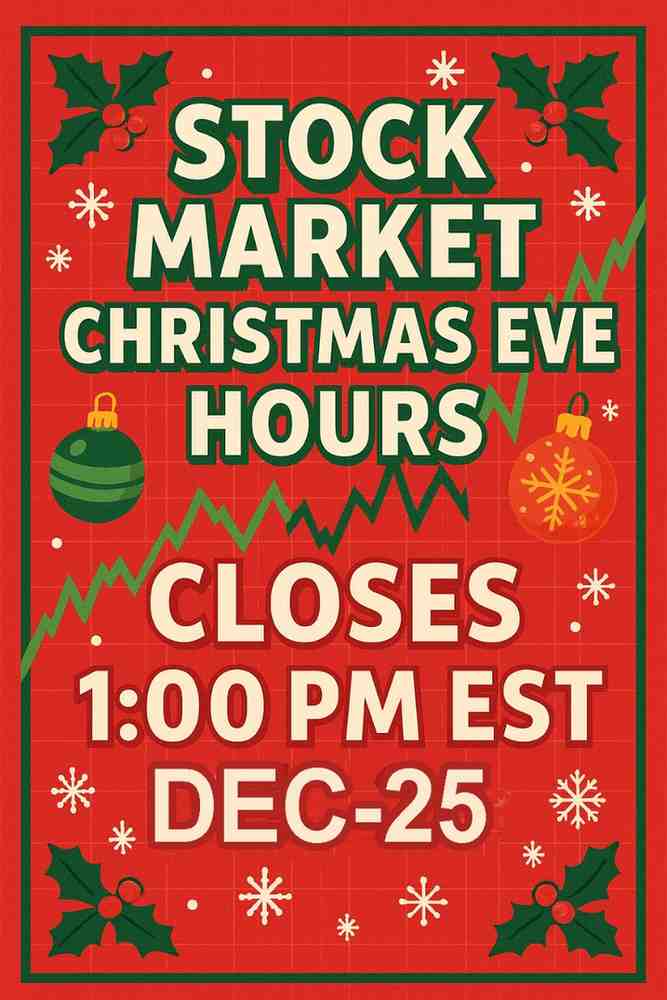
In the United States, the primary equity exchanges—the New York Stock Exchange (NYSE) and the Nasdaq—typically observe an early close on December 24th. Under normal circumstances, when Christmas Eve falls on a weekday, the markets open at their usual time of 9:30 AM Eastern Time (ET) but close their doors at 1:00 PM ET.
This three-and-a-half-hour trading session is significantly shorter than the standard six-and-a-half-hour day. It is important to note that crossing sessions and late trading hours are also truncated. For example, most extended-hours trading platforms will cease operations shortly after the 1:00 PM bell, meaning investors have a very narrow window to react to any mid-day news or economic data.
When Christmas Eve Falls on a Weekend
The schedule becomes slightly more complex when the calendar doesn’t align with the workweek. If Christmas Eve falls on a Saturday, the markets do not observe an early close on the preceding Friday. Instead, the Friday remains a full trading day, and the markets simply remain closed on Monday, December 26th, in observance of Christmas Day.
Conversely, if Christmas Eve falls on a Sunday, the market operates as a full session on the preceding Friday. The “observation” of the holiday typically shifts to the following Monday. Because the stock market is a highly regulated environment, these dates are finalized well in advance by the exchanges, allowing institutional and retail traders to adjust their algorithms and staffing levels accordingly.
The Bond Market and International Differences
While equity investors watch the 1:00 PM ET deadline, those involved in fixed income must follow a different set of guidelines. The Securities Industry and Financial Markets Association (SIFMA) generally recommends a 2:00 PM ET close for the trading of U.S. dollar-denominated government securities, mortgage-backed securities, and corporate bonds on Christmas Eve.
Internationally, the tradition of the early close is widely observed but not universal. The London Stock Exchange (LSE) usually closes at 12:30 PM local time, while the Euronext markets may have varying schedules depending on the specific country’s labor laws and cultural traditions. For the global macro investor, this staggered closing schedule creates a period of fragmented liquidity that requires careful navigation.
Liquidity, Volatility, and the “Thin” Market Phenomenon
One of the most critical aspects of trading during shortened holiday hours is the precipitous drop in trading volume. As institutional desks at major banks and hedge funds wind down for the year, the “depth” of the market—the ability of the market to sustain relatively large orders without a price change—diminishes significantly.
The Risks of Low Volume
In a “thin” market, even a moderately sized trade can cause a disproportionate move in a stock’s price. Because there are fewer buyers and sellers at various price points, the bid-ask spread—the difference between what a buyer is willing to pay and what a seller is willing to accept—tends to widen. For retail investors, this means that market orders can be executed at prices that are less favorable than anticipated.
Professional traders often advise against executing large, non-essential trades during the final two hours of a Christmas Eve session. The lack of liquidity can lead to “flash” movements if unexpected news breaks, as there aren’t enough active participants to provide the usual “cushion” of liquidity that exists during a standard Tuesday in October.
Algorithmic Impact
In the modern era, a significant portion of trading is executed by automated systems. During holiday sessions, many firms tighten the parameters of their algorithms or take them offline entirely to avoid the risks associated with low volume. However, the algorithms that remain active can sometimes exacerbate volatility. If an automated system triggers a sell-off in a low-volume environment, the lack of human intervention can lead to a rapid downward spiral until a “circuit breaker” or a manual override occurs.
The Santa Claus Rally: Myth or Market Reality?
No discussion of late-December trading is complete without mentioning the “Santa Claus Rally.” This financial phenomenon refers to the historical tendency for the stock market to experience a rise in prices during the last five trading days of December and the first two trading days of January.
Why Does the Rally Happen?
Several theories exist to explain this seasonal surge. One primary driver is the “January Effect” precursor, where investors begin positioning themselves for the coming year. Additionally, the holiday season often sees a reduction in tax-loss harvesting (which we will explore below), as most of that selling has already occurred earlier in the month.
There is also a psychological element at play. With institutional traders away, the market is often driven by retail investors who tend to be more optimistic. Furthermore, year-end bonuses and the general “festive” sentiment can lead to increased buying pressure. Statistically, the S&P 500 has risen during this specific period approximately 75% of the time since the 1950s, making it one of the most reliable seasonal patterns in finance.
Managing Expectations
While the Santa Claus Rally is a documented trend, it is never a guarantee. Economic headwinds, such as unexpected inflation data or geopolitical shifts, can easily override seasonal optimism. Smart investors view the rally as a tailwind rather than a foundational reason to enter a position. Relying solely on historical seasonality without considering current fundamental valuations is a recipe for risk.
Essential Year-End Financial Strategies
The shortened trading hours on Christmas Eve serve as a final deadline for several critical personal finance and investment maneuvers. Because the market is closed on Christmas Day and potentially the following day, the window for executing year-end trades is much smaller than it appears on the calendar.
Tax-Loss Harvesting
One of the most effective ways to improve net returns is through tax-loss harvesting. This involves selling securities at a loss to offset capital gains tax liabilities. If you have realized significant gains earlier in the year, selling underperforming assets before the market closes on the final trading days of December can provide a valuable tax shield.
However, investors must remain mindful of the “wash-sale rule.” The IRS prohibits taxpayers from claiming a loss on the sale of a security if they purchase a “substantially identical” security within 30 days before or after the sale. If you intend to harvest a loss on Christmas Eve, you must be prepared to stay out of that specific position for at least a month or find a non-identical alternative to maintain your market exposure.
Portfolio Rebalancing
The end of the year is an ideal time to assess whether your asset allocation still aligns with your risk tolerance. If the equity market has had a stellar year, your portfolio may now be “overweighted” in stocks and “underweighted” in bonds or cash. Rebalancing involves selling a portion of your winning positions and reallocating those funds to underrepresented asset classes. Using the Christmas Eve session to finalize these adjustments ensures that you enter the new year with a disciplined strategy rather than a skewed portfolio.
Charitable Contributions and RMDs
For those managing retirement accounts, Christmas Eve is often the practical deadline for ensuring that Required Minimum Distributions (RMDs) have been processed. While the legal deadline is December 31st, the logistical reality of bank transfers and brokerage processing times means that waiting until the last minute is a dangerous game. Similarly, for those looking to make charitable donations of appreciated stock—a highly tax-efficient way to give—the transfer must be initiated well before the holiday break to ensure the transaction is recorded within the current tax year.
Preparing Your Portfolio for the New Year
As the 1:00 PM bell rings on Christmas Eve, the focus shifts from the immediate mechanics of the trade to the broader outlook for the coming four quarters. The period between Christmas and New Year’s Day is often a time of reflection for the strategic investor.
Reviewing Macro Trends
The final days of December are an opportune time to analyze the macro trends that will likely define the upcoming year. This includes monitoring central bank commentary, interest rate projections, and corporate earnings forecasts. While the market is quiet, the data remains active. Reviewing your “investment thesis” for each major holding can help you decide whether to hold, add, or exit positions once full liquidity returns in January.
Setting Financial Goals
Successful investing is as much about behavior as it is about math. Use the holiday hiatus to set concrete, measurable financial goals. Whether it’s increasing your 400k contribution percentage, building a larger cash reserve for opportunistic buying, or diversifying into international markets, having a clear roadmap will prevent impulsive decision-making during the high-volatility periods that often characterize the first quarter.

Conclusion: The Value of the Closing Bell
The 1:00 PM close on Christmas Eve is more than just a logistical adjustment; it is a signal for investors to pause. In a world of 24/7 news cycles and high-frequency trading, the forced quiet of the holiday market provides a necessary break. By understanding the schedule, respecting the risks of low liquidity, and executing essential tax and rebalancing strategies ahead of time, you can transition into the new year with financial clarity and peace of mind. The markets will always reopen, but the opportunity to strategically position your wealth before they do is a window that closes sooner than many expect.
aViewFromTheCave is a participant in the Amazon Services LLC Associates Program, an affiliate advertising program designed to provide a means for sites to earn advertising fees by advertising and linking to Amazon.com. Amazon, the Amazon logo, AmazonSupply, and the AmazonSupply logo are trademarks of Amazon.com, Inc. or its affiliates. As an Amazon Associate we earn affiliate commissions from qualifying purchases.