
The stock market is often described as the heartbeat of the global economy—a complex, pulsing system of buyers, sellers, algorithms, and institutions. To the casual observer, it can appear as a chaotic sea of green and red tickers, fluctuating without rhyme or reason. However, what happens to the stock market is rarely a product of pure chance. Instead, it is the result of a sophisticated interplay between macroeconomic policy, corporate performance, investor psychology, and technological infrastructure. Understanding these dynamics is essential for any investor seeking to build long-term wealth and navigate the inevitable cycles of the financial world.
The Macroeconomic Engine: How Interest Rates and Inflation Dictate Movement
At the highest level, the stock market is heavily influenced by the “macro” environment. This refers to the broad economic conditions that affect every business and consumer. The most powerful force in this category is the central bank, specifically the Federal Reserve in the United States.
The Federal Reserve and the Cost of Capital
What happens to the stock market when interest rates change is perhaps the most scrutinized relationship in finance. When the Federal Reserve raises interest rates to combat inflation, the cost of borrowing increases for both consumers and corporations. For a business, higher interest rates mean that expanding operations, buying new equipment, or funding research and development becomes more expensive. This often leads to lower corporate profits.
Furthermore, higher interest rates change the “discount rate” used by analysts to value future cash flows. In a high-interest-rate environment, a dollar earned five years from now is worth less today than it would be if rates were near zero. This is why high-growth tech stocks, which often promise significant profits in the distant future, tend to see their valuations compress when rates rise. Conversely, when the Fed cuts rates, it “greases the wheels” of the economy, making capital cheaper and often fueling a rally in stock prices.
Inflationary Pressures and Purchasing Power
Inflation is the silent architect of market movement. Moderate inflation is generally seen as a sign of a healthy, growing economy. However, hyper-inflation or persistent high inflation can be toxic for the stock market. When the prices of raw materials and labor rise, companies face a choice: absorb the costs and see their profit margins shrink, or pass the costs onto consumers and risk lower sales volume.
Investors also view stocks as a hedge against inflation. Because companies can raise prices to keep up with the devaluing currency, equities historically outperform cash or fixed-income assets over long periods during inflationary cycles. However, the transition period—the time it takes for a market to adjust to a new inflationary reality—is often marked by extreme volatility.
Corporate Performance and the Earnings Cycle
While the macro environment sets the stage, individual stocks move based on the fundamental health of the companies they represent. The stock market, at its core, is a collection of businesses, and their ability to generate profit is the ultimate driver of value.
The Significance of Quarterly Earnings Reports
Four times a year, publicly traded companies release their earnings reports. This is a critical moment for the stock market. Investors look beyond the simple “headline” numbers of revenue and earnings per share (EPS). They look at “guidance”—the company’s own forecast of how it expects to perform in the coming months.
What happens to a stock during earnings season depends largely on expectations. If a company reports record profits but warns that growth is slowing down, the stock price may drop. This is because the market is a forward-looking mechanism; it cares less about what happened yesterday and more about what will happen tomorrow. The aggregation of these individual reports creates the “earnings season,” a period where the entire market may shift based on whether the corporate sector as a whole is exceeding or failing to meet analyst projections.
Sector Rotation and Industry Trends
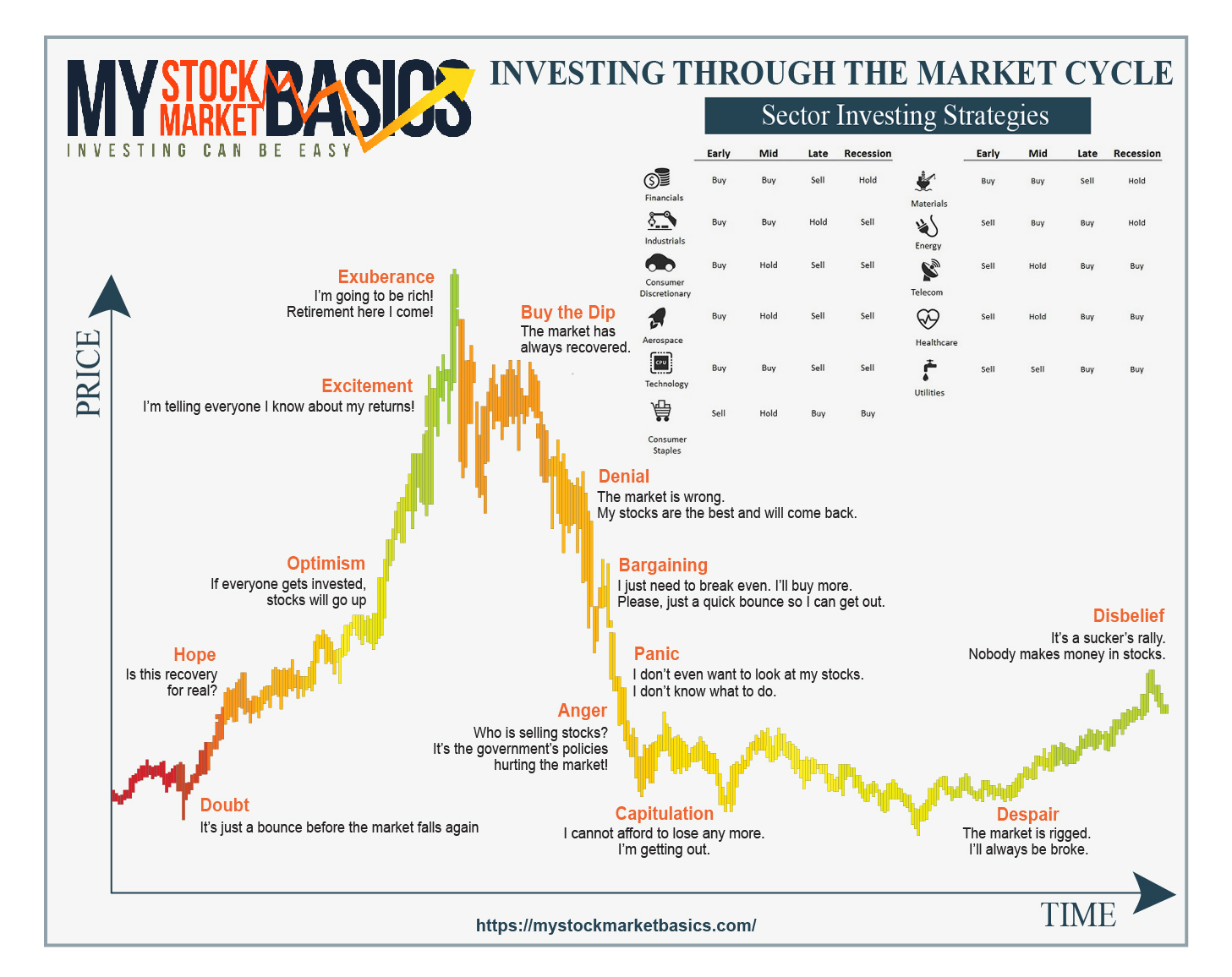
The stock market is not a monolith. It is divided into sectors—Technology, Healthcare, Energy, Consumer Staples, and more. Often, money flows out of one sector and into another in a process known as “sector rotation.”
For example, during an economic downturn, investors often move their money into “defensive” sectors like Utilities or Consumer Staples (companies that sell products people need regardless of the economy, such as electricity and soap). When the economy is booming, “cyclical” sectors like Industrials and Consumer Discretionary (luxury goods, travel) tend to outperform. These shifts represent the market’s collective attempt to position capital where it will be most productive given the current phase of the business cycle.
The Psychology of Investing: Fear, Greed, and Market Sentiment

Despite the prevalence of data and cold mathematics, the stock market is a deeply human institution. Behavioral finance teaches us that investors are not always rational actors. The collective emotions of millions of participants create cycles of euphoria and despair.
Behavioral Finance: Why the Market Overreacts
Human beings are wired for loss aversion—the pain of losing $1,000 is psychologically more intense than the joy of gaining $1,000. This instinct often leads to “panic selling” during market downturns. When a few investors start selling, prices drop, which triggers fear in others, leading to a cascade of selling that can push stock prices far below their actual intrinsic value.
The opposite is also true. During a “bull market,” the Fear Of Missing Out (FOMO) can drive prices to irrational heights. This was famously seen during the Dot-com bubble of the late 90s and the housing bubble of the mid-2000s. In these scenarios, what happens to the stock market is a total decoupling from reality, where valuations are driven by hype rather than profits.
The Impact of Geopolitical Uncertainty
Markets crave stability and predictability. When geopolitical tensions arise—such as trade wars, military conflicts, or political instability—the market typically reacts with a “flight to safety.” Investors sell off “riskier” assets like stocks and move into “safe havens” like gold or government bonds.
The immediate reaction to a geopolitical shock is usually a sharp drop in prices as the market “prices in” the new risks. However, history shows that the market is incredibly resilient. Once the initial shock passes and the implications are understood, the market often stabilizes and eventually recovers as it returns to focusing on corporate earnings and economic fundamentals.
Technological Evolution: Algorithmic Trading and the Modern Exchange
The physical floor of the New York Stock Exchange, with traders shouting and waving paper slips, is largely a relic of the past. Today, what happens to the stock market is determined in milliseconds by servers in high-tech data centers.
High-Frequency Trading (HFT) and Liquidity
A significant percentage of daily trading volume is now conducted by high-frequency trading (HFT) algorithms. These programs are designed to execute thousands of trades per second, profiting from tiny price discrepancies that exist for only a fraction of a moment.
HFT provides the market with “liquidity,” ensuring that there is almost always a buyer for every seller. However, it can also lead to “flash crashes”—sudden, violent drops in price caused by algorithms reacting to one another in a feedback loop. While these events are rare and usually brief, they highlight the technological fragility that exists beneath the surface of the modern financial system.
The Democratization of Investing
The rise of fintech apps and commission-free trading has fundamentally changed who participates in the market. Retail investors—individual people trading from their smartphones—now represent a significant force. We saw the power of this movement during the “meme stock” era, where retail investors coordinated on social media to drive up the prices of specific companies, catching institutional hedge funds off guard. This democratization has added a new layer of volatility and unpredictability to what happens to the stock market, as social media sentiment can now move billions of dollars in a matter of hours.
Strategies for Navigating Market Volatility
Given the myriad forces at play, the stock market can seem overwhelming. However, for the individual investor, the goal is not to predict every twist and turn, but to build a strategy that survives them.
Diversification and Risk Management
The only “free lunch” in finance is diversification. By spreading investments across different asset classes (stocks, bonds, real estate) and different sectors, an investor reduces the risk that a single event will wipe out their portfolio. If the tech sector takes a hit, perhaps their energy holdings or bond positions will remain stable.
Risk management also involves understanding one’s own “time horizon.” What happens to the stock market this week is irrelevant to a 30-year-old saving for retirement in 35 years. For the long-term investor, market volatility is not a threat; it is an opportunity to buy quality assets at a discount.

Long-Term Perspective vs. Short-Term Noise
The stock market is a machine that transfers wealth from the impatient to the patient. While the market can be highly volatile in the short term, its long-term trajectory has historically been upward. This is driven by human innovation, population growth, and the compounding nature of corporate earnings.
Understanding what happens to the stock market requires a dual focus: an awareness of the immediate economic and psychological triggers that cause daily fluctuations, and a steadfast belief in the long-term growth of the global economy. By filtering out the “noise” of the daily news cycle and focusing on sound financial principles, investors can harness the power of the market to achieve their financial goals. In the end, the stock market is not just a place where prices go up and down; it is a reflection of human progress and a primary engine for wealth creation in the modern world.
aViewFromTheCave is a participant in the Amazon Services LLC Associates Program, an affiliate advertising program designed to provide a means for sites to earn advertising fees by advertising and linking to Amazon.com. Amazon, the Amazon logo, AmazonSupply, and the AmazonSupply logo are trademarks of Amazon.com, Inc. or its affiliates. As an Amazon Associate we earn affiliate commissions from qualifying purchases.