
The Dow Jones Industrial Average (DJIA), often referred to simply as “the Dow,” is arguably the most recognized financial benchmark in the world. When news anchors report that “the market is up,” they are almost always referring to the movement of this specific index. Established in the late 19th century, it has served as a primary pulse for the American economy, evolving from a list of heavy industrial companies into a sophisticated collection of 30 blue-chip stocks. However, despite its ubiquity, the mechanics of how the Dow actually works—and why it remains relevant in a modern financial landscape dominated by technology—is frequently misunderstood by the average investor.

The Origin and Evolution of a Market Icon
To understand the Dow, one must look back to May 26, 1896, when Charles Dow and Edward Jones first published the average. At its inception, the index contained only 12 companies, primarily those in the industrial sector, such as sugar, cotton, oil, and tobacco. The logic was straightforward: if industrial companies were doing well, the broader economy was likely healthy.
Over the decades, the index expanded to 30 companies to better reflect the diverse nature of the American economy. Today, the “Industrial” moniker is largely a legacy term. The modern Dow includes giants from retail, technology, healthcare, and financial services. While it is a narrow slice of the thousands of publicly traded companies, the DJIA is designed to represent the most successful, stable, and influential corporations in the United States.
The Mechanics of a Price-Weighted Index
The most significant differentiator between the Dow Jones and other major indices, like the S&P 500 or the Nasdaq Composite, is its weighting methodology. While most modern indices are market-capitalization-weighted—meaning the larger a company’s total value, the more influence it has—the Dow is a price-weighted index.
Price Weighting Explained
In a price-weighted system, the component stocks are weighted based on their price per share. For example, a stock trading at $200 per share will have twice the impact on the index’s movement as a stock trading at $100 per share, regardless of the relative size of the companies.
This methodology often draws criticism from financial purists who argue that a company’s share price is arbitrary. A company could have a high share price but a smaller overall valuation than a company with a lower share price but more shares outstanding. However, the price-weighted approach is a historical artifact that has been maintained to ensure continuity and simplicity in the index’s long-term data set.
The Role of the Dow Divisor
Because of stock splits, spin-offs, and other corporate actions, you cannot simply add up the prices of the 30 stocks and divide by 30. If a company in the Dow undergoes a 2-for-1 stock split, its share price drops by half. Without an adjustment, the entire index would appear to “crash” simply because of a clerical change in how a company’s equity is structured.
To solve this, the index uses the “Dow Divisor.” The divisor is a continuously adjusted numerical value that accounts for these corporate changes. Instead of dividing the sum of the stock prices by 30, it is divided by this specific constant. As of recent years, the divisor is actually a decimal much smaller than one (e.g., approximately 0.15). Because the divisor is less than one, the sum of the prices is effectively multiplied, which is why a $1 move in any single Dow stock translates to several points of movement in the index total.
Composition and the Selection Process
Unlike the S&P 500, which uses a strict quantitative formula for inclusion, the Dow Jones Industrial Average is managed by a selection committee. This committee, comprised of representatives from S&P Dow Jones Indices and The Wall Street Journal, chooses companies based on qualitative and quantitative factors.
Criteria for Inclusion
There are no rigid rules for a company to join the Dow, but the committee typically looks for “blue-chip” characteristics. These include:
-
Reputation: The company must have an excellent reputation and a history of sustained growth.
-
Interest to Investors: The stock must be of significant interest to a large number of investors.
-
Sector Representation: The company must help the index maintain a representative balance of the U.S. economy.
-
U.S. Incorporation: The company must be incorporated and headquartered in the United States.
Because the index only holds 30 stocks, the committee is very selective. When a company is removed, it is usually because it has lost its industry leadership or the sector it represents has shrunk in economic importance. A recent example is the removal of General Electric in 2018—the last original member of the index—reflecting the decline of traditional massive industrial conglomerates in favor of tech and service-oriented firms.
Maintaining the 30-Stock Balance
The committee must also be mindful of share prices when adding new members. Because the Dow is price-weighted, adding a company with an exceptionally high share price (e.g., $1,000 per share) would give that single company an outsized influence over the entire index. This is why many high-value tech companies were excluded from the Dow for years until they performed stock splits to bring their share prices into a range compatible with the index’s structure.
The Dow as a Financial Barometer
For personal finance and investment strategy, the Dow serves several critical functions, though it should be used in context with other tools. Its primary value lies in its role as a sentiment indicator for the “old guard” of the American corporate world.
Why It Matters to Investors
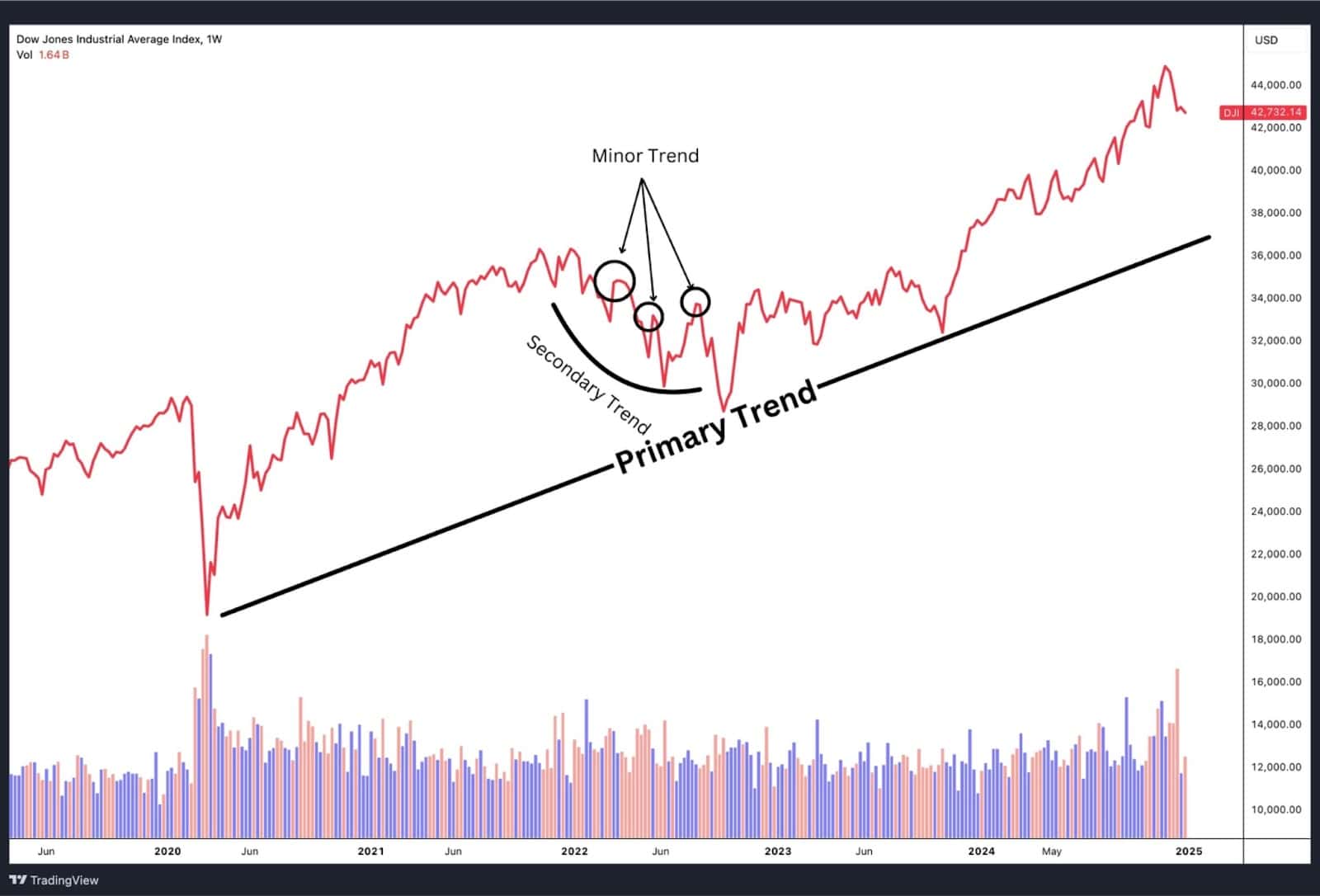
For the individual investor, the Dow provides a snapshot of how the largest, most stable companies are performing. These are typically the companies that pay dividends and have “moats” around their businesses. When the Dow is trending upward, it generally indicates a “risk-on” environment where institutional investors feel confident in the core of the U.S. economy.
However, the Dow’s narrow focus means it may not reflect the reality of the broader market. During a bull market led by small-cap growth stocks or emerging tech sectors, the Dow might lag behind the S&P 500 or the Nasdaq. Conversely, during periods of volatility, the Dow often proves more resilient because its components are established “cash cow” businesses that can weather economic downturns better than speculative startups.
The Psychology of the “Points”
One of the reasons the Dow remains the headline figure for the media is the psychological impact of its “points.” Because the index is currently valued in the tens of thousands, a “500-point drop” sounds catastrophic to the uninformed listener. In reality, a 500-point move on a 38,000-point index is less than a 1.5% change—a standard day in the financial markets. Understanding the percentage move is always more important for a portfolio than the raw point total.
Investing in the Dow: Strategies and Tools
While you cannot buy “the Dow” directly as a single stock, financial innovation has made it incredibly easy to gain exposure to the index through various financial tools.
Exchange-Traded Funds (ETFs)
The most popular way to track the index is through the SPDR Dow Jones Industrial Average ETF Trust, known by its ticker symbol DIA (often referred to as “Diamonds”). This ETF holds all 30 stocks in the exact proportions required to mirror the index. For a low expense ratio, an investor can effectively own a slice of all 30 blue-chip companies.
The “Dogs of the Dow” Strategy
A popular value-investing strategy involving the index is known as the “Dogs of the Dow.” At the beginning of each year, an investor identifies the 10 stocks in the DJIA with the highest dividend yields. The theory is that these companies are temporarily out of favor (hence the higher yield relative to price) but remain fundamentally strong blue-chip entities. By holding these 10 stocks for a year and rebalancing annually, investors often aim to outperform the total return of the index itself.
Using the Dow as a Benchmark
For those who manage their own portfolios or work with advisors, the Dow serves as a benchmark for “Large-Cap Value” or “Blue-Chip” performance. If your portfolio consists of stable, dividend-paying U.S. stocks, you should compare your annual returns against the DJIA. If you are consistently underperforming the Dow while taking on similar levels of risk, it may be time to reconsider your individual stock picks and move toward an index-tracking fund.

Conclusion: The Enduring Legacy of the 30
The Dow Jones Industrial Average is far from a perfect mathematical model of the global economy. Its price-weighted nature is an anomaly in a world of market-cap weighting, and its 30-stock limit is arguably too small to capture the full complexity of modern commerce. Yet, its longevity and the prestige of its components make it an indispensable tool for understanding market history and current investor sentiment.
By tracking the most influential companies in the United States, the Dow continues to fulfill the mission Charles Dow set out over a century ago: to provide a simple, clear, and reliable indicator of the economic health of the nation. For the modern investor, understanding how this index calculates value and how its members are selected is a foundational step in mastering the mechanics of the financial markets.
aViewFromTheCave is a participant in the Amazon Services LLC Associates Program, an affiliate advertising program designed to provide a means for sites to earn advertising fees by advertising and linking to Amazon.com. Amazon, the Amazon logo, AmazonSupply, and the AmazonSupply logo are trademarks of Amazon.com, Inc. or its affiliates. As an Amazon Associate we earn affiliate commissions from qualifying purchases.