
The stock market is often described as a “discounting mechanism,” a forward-looking entity that attempts to price in future economic realities today. When the market moves upward, it is rarely the result of a single event. Instead, it is typically the culmination of various macroeconomic, fundamental, and psychological factors converging to create a “risk-on” environment. To understand why the market goes up, one must look beyond the daily headlines and examine the underlying mechanics of capital flow, interest rate trajectories, and corporate resilience.
Investors frequently find themselves puzzled when the market rallies despite seemingly mediocre news. This phenomenon occurs because the market cares less about whether the news is “good” or “bad” in an absolute sense, and more about whether it is “better” or “worse” than previously expected. A rally is often the market’s way of breathing a sigh of relief as uncertainty dissipates or as positive growth catalysts begin to outweigh systemic risks.

Macroeconomic Catalysts and the Cost of Capital
At the heart of every sustained market rally is the influence of macroeconomic policy, specifically the actions of central banks. The relationship between interest rates and stock valuations is the most fundamental pillar of finance. When the stock market climbs, it is often reacting to a shift in the perceived trajectory of the “cost of capital.”
The Federal Reserve and Monetary Policy
The Federal Reserve, along with other global central banks, acts as the primary architect of market liquidity. When the Fed signals a pause in interest rate hikes or hints at future rate cuts—a stance known as being “dovish”—equity markets typically respond with a rally. Lower interest rates benefit the stock market in two distinct ways. First, they reduce the borrowing costs for corporations, allowing firms to fund expansion and innovation more cheaply. Second, lower rates reduce the “discount rate” used in financial models to value future cash flows. When the discount rate drops, the present value of future earnings rises, which justifies higher stock prices today.
Inflation Trends and the Consumer Price Index (CPI)
Inflation is a critical gauge for market health because of its direct impact on monetary policy. When inflation data, such as the Consumer Price Index (CPI), comes in lower than anticipated, the market often rallies on the assumption that the central bank will not need to tighten policy further. Cooling inflation suggests that the economy is achieving a “soft landing”—a scenario where price growth stabilizes without triggering a deep recession. For investors, this creates a Goldilocks environment: an economy that is not too hot to cause runaway inflation, but not too cold to stifle corporate earnings.
Corporate Earnings and Fundamental Performance
While macroeconomics sets the stage, the actual performance of companies—the “micro” level—provides the fuel for a market ascent. Stocks represent ownership in businesses, and if those businesses are generating more cash than expected, their valuations will naturally rise.
Beating the “Whisper Number”
During earnings season, the market’s direction is dictated by how actual corporate results compare to analyst estimates. A market-wide rally often occurs when a majority of companies in the S&P 500 or Nasdaq report earnings that exceed expectations. It is not just about the profit recorded in the past quarter, but also the “guidance” provided for the future. If CEOs express optimism about demand, supply chain stability, and margin expansion, investors feel emboldened to bid up share prices.
The Power of Share Buybacks and Dividends
Another internal driver of market growth is the return of capital to shareholders. When companies generate excess cash, they often engage in share buybacks. By reducing the number of shares outstanding, a company increases its earnings per share (EPS) even if total net income remains flat. This financial engineering creates a constant source of demand for stocks. When a significant portion of the market’s largest constituents—particularly in the technology and financial sectors—commit to massive buyback programs, it provides a “floor” for the market and encourages upward momentum.
Market Sentiment and Investor Psychology
Finance is as much a study of human behavior as it is a study of numbers. The stock market often goes up simply because the collective sentiment shifts from fear to greed, or from caution to confidence.
The Dynamics of Liquidity and “Dry Powder”
“Dry powder” refers to the cash reserves held by institutional investors, such as hedge funds, mutual funds, and private equity firms. When these entities are “under-invested,” they feel pressure to put capital to work to meet performance benchmarks. If the market begins a minor move upward, these institutional players often jump in to avoid underperforming their peers. This creates a self-fulfilling prophecy: buying leads to higher prices, which triggers more buying. This is often referred to as a “momentum trade.”
The Short Squeeze Phenomenon
In specific market cycles, a rally can be accelerated by a “short squeeze.” Short sellers are investors who bet that a stock’s price will fall by borrowing shares and selling them, hoping to buy them back later at a lower price. If the market unexpectedly moves up, these short sellers are forced to buy back shares to cover their positions and limit losses. This forced buying adds immense upward pressure on stock prices, often resulting in rapid, vertical climbs that can catch the broader market by surprise.
Technology and Innovation as Economic Engines
In the modern era, the stock market is heavily weighted toward technology. Consequently, a market-wide rally is often a “tech-led” rally, driven by breakthroughs that promise to transform productivity and profitability across the entire economy.
Productivity Gains Through Automation and AI
The integration of Artificial Intelligence (AI) and advanced automation has become a primary driver of market optimism. Investors are increasingly looking for “productivity plays”—technologies that allow companies to produce more with less. When a new technological paradigm emerges, the market begins to price in the long-term margin expansion that these efficiencies will bring. This is why a breakthrough in AI software or semiconductor hardware can lift not just the tech sector, but also logistics, healthcare, and manufacturing stocks.
Scaling Digital Infrastructure
The shift toward cloud computing and digital transformation represents a structural change in how business is conducted. As companies move from capital-intensive physical infrastructure to scalable digital models, their valuations often undergo “multiple expansion.” Investors are willing to pay a premium for businesses with recurring revenue and high scalability. When the market sees a broad adoption of these digital tools, it interprets it as a sign of long-term economic resilience, leading to sustained buying pressure.
Geopolitical Stability and Fiscal Policy
Finally, the market responds to the environment created by governments. While monetary policy (the Fed) handles the money supply, fiscal policy (government spending) and geopolitics handle the broader economic environment.
Legislative Clarity and Infrastructure Spending
Markets loathe uncertainty. When a major piece of legislation is passed—such as an infrastructure bill or a tax reform package—the market often rallies because the “rules of the game” have been established. Government spending acts as a direct stimulus to the private sector. Contracts for roads, bridges, energy grids, and defense systems flow to publicly traded companies, boosting their backlogs and future revenue projections.
Global Trade and Geopolitical De-escalation
The stock market is globalized. Conflict, trade wars, and tariffs act as “friction” on the global economy. Conversely, when trade tensions ease or when geopolitical conflicts move toward a resolution, the market rallies as “risk premiums” are removed. Investors no longer feel the need to hedge against catastrophic global disruptions, allowing capital to flow back into equities from safe-haven assets like gold or government bonds.

The Convergence of Factors
Ultimately, the stock market goes up because of a convergence of these factors. A rally might start with a favorable inflation report, gain steam through better-than-expected corporate earnings, and then accelerate as institutional investors deploy their cash to avoid missing out on the gains.
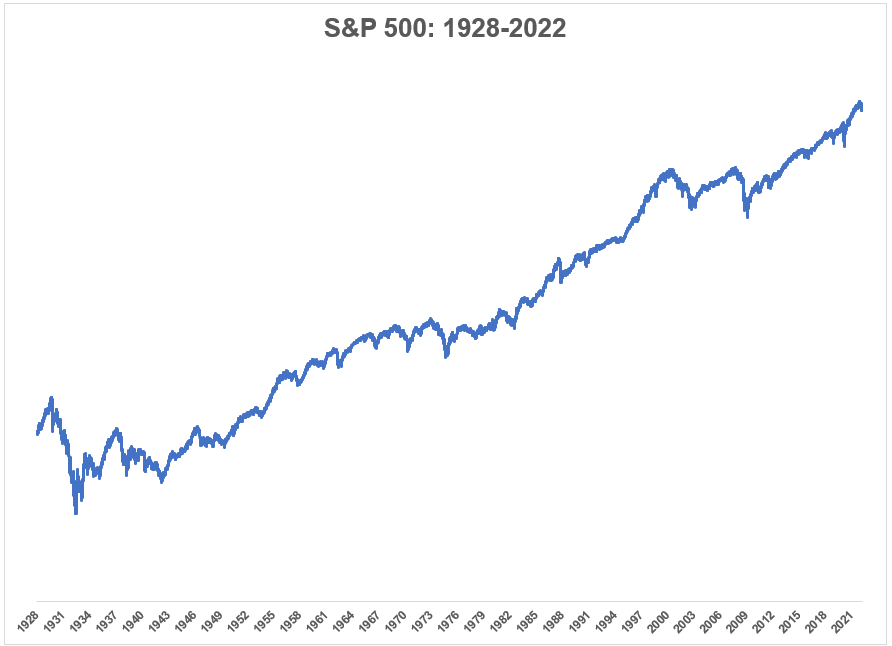
For the individual investor, understanding these drivers is essential for maintaining a long-term perspective. Rallies are rarely the result of “luck”; they are the market’s response to improving conditions, whether those conditions are found in a central bank’s boardroom, a tech company’s laboratory, or a government’s legislative halls. By identifying which of these pillars is currently supporting the market, investors can better position themselves to navigate both the peaks and the troughs of the financial cycle. Equity markets, despite their short-term volatility, are fundamentally designed to reflect the growth of human ingenuity and economic productivity over time. When the market goes up, it is a signal that, for the moment, the forces of growth have overcome the forces of stagnation.
aViewFromTheCave is a participant in the Amazon Services LLC Associates Program, an affiliate advertising program designed to provide a means for sites to earn advertising fees by advertising and linking to Amazon.com. Amazon, the Amazon logo, AmazonSupply, and the AmazonSupply logo are trademarks of Amazon.com, Inc. or its affiliates. As an Amazon Associate we earn affiliate commissions from qualifying purchases.