
In the contemporary financial landscape, the terms “share” and “share market” are foundational to the concept of wealth creation and capital movement. For the uninitiated, these terms can seem shrouded in complex jargon and intimidating volatility. However, at its core, the share market is a sophisticated mechanism designed to facilitate the growth of businesses while providing individuals with a platform to participate in that growth. Understanding the mechanics of shares and the ecosystem in which they operate is the first step toward achieving financial independence and mastering the art of professional investing.

Understanding the Fundamentals of Shares and Ownership
To grasp the intricacies of the financial markets, one must first understand the basic unit of exchange: the share. A share, often referred to as a “stock” or “equity,” represents a unit of ownership in a corporation. When a company decides to expand its operations, launch new products, or clear existing debts, it requires substantial capital. While it could take a bank loan, many companies choose to “go public” by issuing shares to investors.
What is a Share?
When you purchase a share, you are essentially buying a small piece of a company. As a shareholder, you become a partial owner of the business entities. This ownership entitles you to a portion of the company’s success, typically manifested in two ways: capital appreciation (increase in the share price) and dividends (a distribution of a portion of the company’s earnings). The number of shares you hold relative to the total number of shares outstanding determines your percentage of ownership in the firm.
Why Companies Issue Shares
For a corporation, issuing shares is a strategic move to raise “equity capital” without the burden of repayment that comes with a traditional loan. Unlike debt, equity does not require the company to pay regular interest. Instead, the company shares its future profits with the investors. This symbiotic relationship allows the company to scale rapidly while offering investors a chance to grow their wealth alongside a successful enterprise.
Common vs. Preferred Shares
In the world of finance, not all shares are created equal. Common shares are the most prevalent type, granting investors voting rights at shareholder meetings and a claim on profits through dividends. However, in the event of liquidation, common shareholders are last in line to receive any remaining assets. Preferred shares, on the other hand, usually do not offer voting rights but provide a higher claim on assets and earnings. Preferred shareholders receive dividends at a fixed rate and are paid out before common shareholders if the company faces insolvency.
How the Share Market Functions: The Global Ecosystem
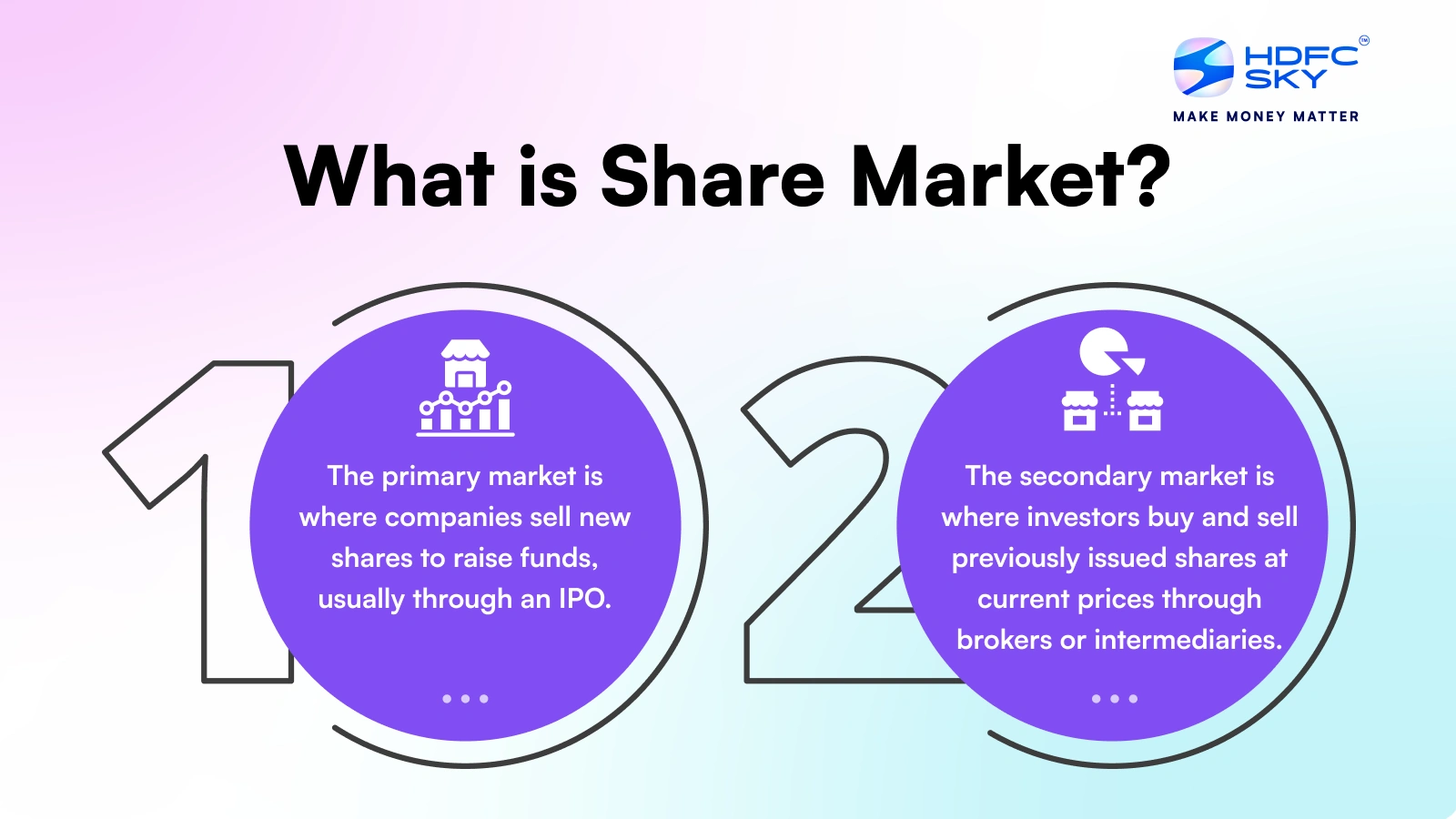
The share market is not a single physical location, but rather a vast, interconnected network of exchanges where shares are issued, bought, and sold. It serves as a bridge between companies looking for capital and investors looking for profitable opportunities. The market is broadly categorized into two segments: the primary market and the secondary market.
The Primary Market and the IPO
The primary market is where securities are created. This is where a company sells new shares to the public for the first time through a process known as an Initial Public Offering (IPO). During an IPO, the company works with investment banks to set a price for its shares and sells them to a pool of initial investors. Once these shares are sold, the capital goes directly to the company to fund its growth initiatives.
The Secondary Market and Stock Exchanges
The secondary market is what most people refer to when they talk about the “share market.” This is where investors trade previously issued shares among themselves. If you buy shares of a tech giant like Apple or a retail leader like Walmart today, you are likely buying them from another investor, not the company itself. This trading happens on regulated platforms known as Stock Exchanges, such as the New York Stock Exchange (NYSE), the NASDAQ, or the London Stock Exchange (LSE). These exchanges ensure transparency, liquidity, and fair pricing by matching buyers with sellers in real-time.
The Role of Indices
To gauge the health and performance of the share market, investors look at “Indices.” A stock market index, such as the S&P 500 or the Dow Jones Industrial Average, tracks the performance of a specific group of stocks that represent a sector or the entire market. These indices serve as benchmarks for investors to compare their portfolio performance and understand broader economic trends.
Mechanisms of Profit: How Investors Make Money
Investing in the share market is driven by the pursuit of financial returns. While the market involves risk, it has historically outperformed most other asset classes over the long term. There are three primary avenues through which an investor generates wealth in the share market.
Capital Appreciation
The most common way to profit is through capital appreciation. This occurs when the market price of a share increases over time. If you purchase a share at $100 and its value rises to $150 due to the company’s growth and increased demand, you have a “paper profit” of $50. If you sell the share at that price, you “realize” a capital gain. Prices are driven by a variety of factors, including company earnings, economic indicators, and investor sentiment.
Dividend Income
Dividends are a portion of a company’s profit distributed to its shareholders, usually on a quarterly or annual basis. Established, profitable companies often use dividends to reward loyal investors. For many, dividends represent a reliable source of passive income. Long-term investors often use a strategy called “Dividend Reinvestment,” where they use their dividend payouts to buy more shares, thereby leveraging the power of compounding to grow their holdings exponentially.
Rights Issues and Bonus Shares
Occasionally, companies may offer existing shareholders the right to buy additional shares at a discounted price (Rights Issue) or issue free shares to existing shareholders (Bonus Shares). These corporate actions are designed to reward shareholders and improve the liquidity of the stock without requiring a direct cash outlay from the company’s perspective.
Strategic Approaches to Share Market Investing
Success in the share market is rarely the result of luck; it is the product of disciplined strategy and rigorous analysis. Professional investors generally fall into two camps regarding how they evaluate potential investments: fundamental analysis and technical analysis.
Fundamental Analysis: Evaluating the Business
Fundamental analysis involves looking at the intrinsic value of a company. Investors examine financial statements, balance sheets, and cash flow reports to determine if a stock is undervalued or overvalued. Key metrics include the Price-to-Earnings (P/E) ratio, Debt-to-Equity ratio, and Return on Equity (ROE). The goal of a fundamental analyst is to find high-quality companies with strong management and competitive advantages that are trading at a fair price.
Technical Analysis: Evaluating the Market Trend
Technical analysis focuses on statistical trends gathered from trading activity, such as price movement and volume. Technical analysts believe that historical price patterns and market trends can predict future price movements. They use charts, moving averages, and various oscillators to identify “entry” and “exit” points. While fundamental analysis asks “what” to buy, technical analysis often asks “when” to buy.
Growth vs. Value Investing
Investors also choose between different philosophies. Growth investors look for companies that are expected to grow at an above-average rate compared to other profits in the market. These companies often reinvest their earnings into the business rather than paying dividends. Value investors, conversely, look for “bargains”—stocks that are trading for less than their intrinsic value, often due to market overreaction or temporary setbacks.
Risk Management and the Path to Professional Investing
While the potential for high returns is significant, the share market is inherently volatile. Prices can fluctuate wildly based on geopolitical events, interest rate changes, or industry shifts. Managing risk is the most critical component of a sustainable investment strategy.
Diversification: The Only Free Lunch
The golden rule of investing is diversification. By spreading your capital across different sectors (tech, healthcare, energy), different asset classes, and different geographic regions, you reduce the impact of a single company’s failure on your overall portfolio. This “eggs in many baskets” approach ensures that even if one sector underperforms, others may thrive, stabilizing your returns.
Understanding Risk Tolerance and Time Horizons
Every investor has a different “risk appetite.” A young professional with decades of earning potential might choose a high-risk, high-growth portfolio, whereas someone nearing retirement might prioritize capital preservation and dividend income. Your “time horizon”—how long you plan to keep your money invested—is a major factor in determining your strategy. Generally, the longer your time horizon, the more volatility you can afford to weather.

The Importance of a Demat and Trading Account
To participate in the modern share market, an investor needs two essential tools: a Trading Account and a Demat Account. The trading account is used to place buy and sell orders through a broker. The Demat (Dematerialized) account acts like a digital warehouse, holding your shares in electronic form. This system has replaced physical share certificates, making transactions faster, safer, and more efficient.
The share market is a powerful engine for economic growth and personal prosperity. By understanding what a share represents and how the market operates, individuals can transform from passive consumers into active owners of the global economy. Whether your goal is to build a retirement fund, generate passive income, or simply beat inflation, the share market provides the tools necessary to turn financial goals into reality. However, it requires patience, continuous learning, and a disciplined approach to navigate the complexities of the financial world successfully.
aViewFromTheCave is a participant in the Amazon Services LLC Associates Program, an affiliate advertising program designed to provide a means for sites to earn advertising fees by advertising and linking to Amazon.com. Amazon, the Amazon logo, AmazonSupply, and the AmazonSupply logo are trademarks of Amazon.com, Inc. or its affiliates. As an Amazon Associate we earn affiliate commissions from qualifying purchases.