
In the intricate world of computing, where software reigns supreme, the ability to compile, link, and execute programs is fundamental. Behind much of this magic, particularly on Unix-like operating systems, lies a remarkably versatile and robust file format known as ELF: the Executable and Linkable Format. Far more than just a simple container for executable code, an ELF file is a carefully structured blueprint that allows the operating system to understand, load, and run programs, manage shared libraries, and even debug complex applications.
Understanding ELF is akin to peering into the very architecture of how software comes to life on systems ranging from vast supercomputers to embedded devices. It’s a core concept for software developers, system administrators, and anyone curious about the inner workings of their digital environment. This article will demystify the ELF format, exploring its structure, its crucial role in the software lifecycle, and how it underpins the reliable execution of countless applications every day.

The Foundation of Executables: Understanding ELF’s Role
The Executable and Linkable Format (ELF) stands as a cornerstone of modern computing, serving as the standard binary format for executables, shared libraries, and core dumps on a vast array of operating systems. Its robust design and flexibility have cemented its position as an indispensable component in the software development and execution lifecycle.
Origins and Ubiquity
ELF was initially developed by Unix System Laboratories (USL) as part of the Application Binary Interface (ABI) for System V Release 4 (SVR4) in the late 1980s. Its primary goal was to provide a flexible and extensible format that could accommodate various hardware architectures and operating system needs, replacing older, less adaptable formats like a.out. The genius of ELF was its foresight in standardizing not just executables, but also object files (intermediate products of compilation), shared libraries (dynamically linked code modules), and core dumps (memory snapshots taken upon program crashes).
Today, ELF is the de facto standard for almost all Unix-like systems. This includes the immensely popular Linux distributions (Ubuntu, Fedora, Debian, etc.), FreeBSD, NetBSD, Solaris, and QNX, among many others. Its influence extends beyond traditional desktop and server environments into critical areas like embedded systems, game consoles (e.g., PlayStation series historically used ELF variants), and various specialized hardware platforms. While Windows predominantly uses the Portable Executable (PE) format and macOS uses Mach-O, ELF’s prevalence across the open-source world and various specialized computing domains makes it a truly universal language of binaries.
More Than Just an Executable
The “Executable and Linkable” in ELF isn’t merely descriptive; it’s a testament to its multifaceted utility. An ELF file isn’t just a program that you double-click to run. It’s a versatile container that can represent several types of binary artifacts:
- Relocatable File (Object File): These are the output of a compiler. They contain compiled code and data but are not yet executable. They typically have unresolved symbols (e.g., calls to functions defined in other files or libraries) that need to be linked. Think of them as individual construction bricks that need to be assembled.
- Executable File: This is the most common association with ELF. These files are ready to be run by the operating system. They contain all the necessary code, data, and information required for the kernel to load them into memory and begin execution. They often link dynamically to shared libraries.
- Shared Object File (Shared Library): These files contain code and data that can be shared by multiple programs at runtime. They are loaded into memory once and used by many applications, saving memory and disk space, and facilitating easier updates. Examples include
.sofiles on Linux. - Core Dump File: When a program crashes unexpectedly, the operating system can generate a core dump. This is a snapshot of the program’s memory image and register state at the time of the crash. Core dumps are also structured as ELF files, allowing debuggers to analyze the program’s state post-mortem and diagnose issues.
This versatility is a key reason for ELF’s enduring success. It provides a unified, structured way to handle every stage of the binary lifecycle, from individual compiled units to complete runnable programs and even diagnostic data.
Deconstructing the ELF Structure: Key Components
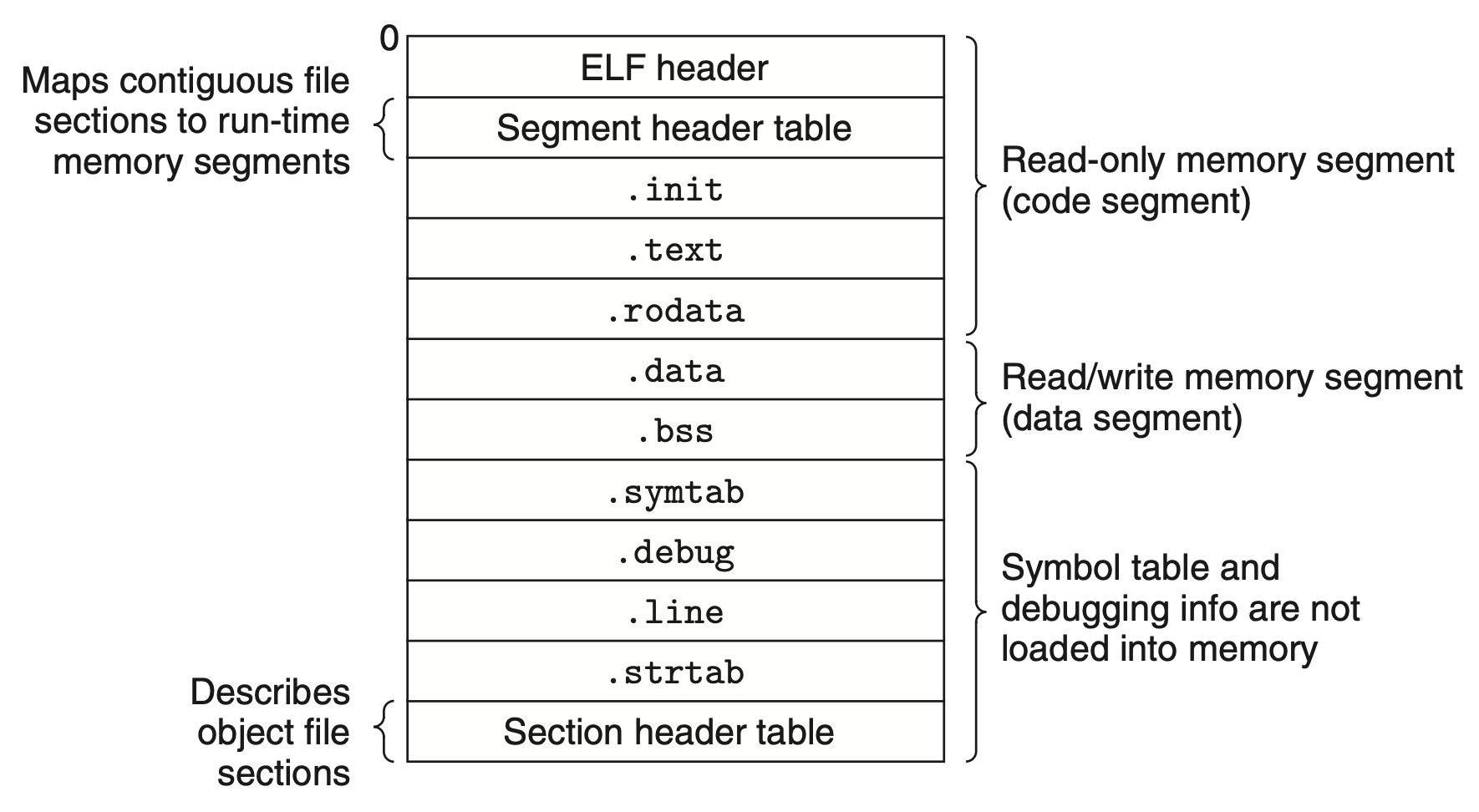
To truly appreciate ELF, one must delve into its internal architecture. An ELF file is not a monolithic block; rather, it’s a meticulously organized collection of sections and segments, each serving a specific purpose during linking or execution.
ELF Header
Every ELF file begins with a fixed-size ELF Header. This is the file’s primary descriptor, acting like a table of contents that provides crucial information about the file itself. Key fields in the ELF Header include:
- Magic Number (e_ident): The first few bytes are a “magic number” (usually
x7fELF) that uniquely identifies the file as an ELF binary. This allows the operating system to quickly recognize the file type. - Class (EI_CLASS): Indicates whether the file is 32-bit or 64-bit, determining the size of addresses and other structures within the file.
- Data Encoding (EI_DATA): Specifies the byte order (little-endian or big-endian) used for data within the file, crucial for cross-platform compatibility.
- Version (EI_VERSION): The version of the ELF specification.
- OS/ABI (EI_OSABI): Identifies the specific operating system and ABI (Application Binary Interface) for which the object was compiled (e.g., Linux, System V).
- Type (e_type): Distinguishes between the different ELF file types mentioned earlier (relocatable, executable, shared object, core dump).
- Machine (e_machine): Specifies the required architecture (e.g., ARM, x86, PowerPC), ensuring the program runs on compatible hardware.
- Entry Point (e_entry): For executable files, this is the virtual address where the program begins execution when loaded into memory.
- Program Header Table Offset (e_phoff): The file offset to the Program Header Table.
- Section Header Table Offset (e_shoff): The file offset to the Section Header Table.
The ELF Header is the gateway to understanding the entire file, providing the necessary pointers to locate other critical structures.
Program Header Table
The Program Header Table is essential for program execution. It describes how the operating system’s loader should map the file’s contents into memory at runtime. Each entry in this table is called a “segment.” Segments are logical groupings of sections (described next) that share common memory attributes (read-only, executable, writable).
Common segment types include:
- PT_LOAD: These segments represent portions of the file that need to be loaded into memory. Typically, an executable will have at least two
PT_LOADsegments: one for the program’s code (read-only and executable) and another for its initialized data (read-write). - PT_DYNAMIC: Points to the dynamic linking information, which is crucial for shared libraries.
- PT_INTERP: Specifies the path to the program interpreter (e.g.,
/lib/ld-linux.so.2for 32-bit Linux, or/lib64/ld-linux-x86-64.so.2for 64-bit), which is responsible for loading shared libraries. - PT_NOTE: Used for notes or comments.
- PTGNUSTACK: An unofficial but common segment that specifies stack permissions (e.g., non-executable stack for security).
The Program Header Table is primarily consumed by the kernel’s program loader and the dynamic linker. It provides the “runtime view” of the ELF file, dictating how the program’s virtual memory layout should be constructed.
Section Header Table
While the Program Header Table is for runtime loading, the Section Header Table is primarily for linking and debugging. It describes the individual “sections” that make up the ELF file. Sections are the smallest atomic units of an ELF file, containing specific types of data or code. Unlike segments, sections are typically not directly mapped to memory during execution but are used by the linker and other tools.
Key sections found in ELF files include:
.text: Contains the program’s executable instructions (code)..data: Stores initialized global and static variables..rodata: Holds read-only data, such as string literals and constants..bss: Contains uninitialized global and static variables. These don’t occupy space in the file but are allocated zero-filled memory at runtime..symtab: The symbol table, containing information about global and static functions and variables defined or referenced within the file..strtab: The string table, which stores human-readable names for symbols and sections..rela.text,.rela.data: Relocation tables, which tell the linker how to modify addresses within the.textor.datasections once all files are combined..dynamic: Contains information for the dynamic linker, such as shared library dependencies and relocation entries for dynamic symbols..init,.fini: Code executed before and after themainfunction, respectively..debug_info,.debug_line, etc.: Debugging information, used by debuggers to map executable code back to source code lines.
The Section Header Table provides the “link-time view” of the ELF file, organizing its raw data into meaningful units for manipulation by compilers, linkers, and debuggers.
Other Important Sections/Tables
Beyond the primary structures, several other tables and sections play crucial roles:
- Symbol Table (
.symtab,.dynsym): Lists all symbols (functions, variables) defined or referenced in the file. Each entry includes the symbol’s name (an index into a string table), its value (address), size, type, and binding (e.g., global, local, weak)..dynsymis a smaller table specifically for dynamically linked symbols. - String Table (
.strtab,.dynstr): Contains null-terminated strings representing names of symbols, sections, and other entities referenced in the ELF file..dynstrholds strings for the dynamic symbol table. - Relocation Tables (
.rel.*,.rela.*): These tables are vital for linking. When a compiler generates an object file, it might not know the final memory addresses of certain functions or data. Relocation entries instruct the linker (or dynamic linker) on how to modify (relocate) specific parts of the code or data once the final addresses are known. - Dynamic Section (
.dynamic): Crucial for dynamically linked executables and shared libraries. It contains a list of tag-value pairs that guide the dynamic linker, specifying required shared libraries, global offset table (GOT) and procedure linkage table (PLT) information, initialization/finalization functions, and more.

The ELF Lifecycle: From Code to Execution
The journey of a program, from human-readable source code to an executable binary, heavily relies on the ELF format at multiple stages.
Compilation and Linking
The process begins with source code (e.g., C, C++). A compiler translates this code into one or more relocatable ELF object files. Each object file contains the machine code for its respective source file, along with data, symbol tables, and relocation entries. At this stage, functions or variables defined in other source files or libraries are merely referenced as unresolved symbols.
Next comes the linker. The linker’s job is to combine these object files and resolve all the unresolved symbols.
- Static Linking: In static linking, the linker takes all the necessary code from libraries and object files and combines them into a single, self-contained executable ELF file. This executable includes all the code it needs, so it has no external dependencies on shared libraries.
- Dynamic Linking: In dynamic linking, the linker does not embed library code directly into the executable. Instead, it notes which shared libraries the executable needs and where to find their functions. The resulting executable ELF file is much smaller, and the actual loading of shared library code is deferred until runtime. This is the predominant method on modern Unix-like systems.
Loading and Execution
When a user attempts to run an executable ELF file, the operating system kernel takes over.
- Kernel Initialization: The kernel first reads the ELF Header to determine the file type, architecture, and where to find the Program Header Table.
- Memory Mapping: Using the Program Header Table, the kernel maps the file’s segments into the program’s virtual address space.
PT_LOADsegments are typically mapped: one segment for code (read-only, executable) and another for initialized data (read-write). Uninitialized data (.bss) is allocated and zeroed out. - Dynamic Linker Invocation: If the executable is dynamically linked (which most are), the kernel locates the
PT_INTERPsegment. This segment points to the dynamic linker/loader (e.g.,ld-linux.so). The kernel then loads and transfers control to this dynamic linker. - Shared Library Resolution: The dynamic linker’s primary task is to find and load all required shared libraries (specified in the
.dynamicsection). It then performs necessary relocations, resolving symbols from the shared libraries to their actual memory addresses within the running process. - Entry Point: Once all shared libraries are loaded and symbols resolved, the dynamic linker transfers control to the program’s entry point (as specified in the ELF Header’s
e_entryfield). The program then begins its execution.
The Advantage of Dynamic Linking
Dynamic linking, facilitated by the ELF format, offers several significant advantages:
- Memory Efficiency: Multiple programs can share a single copy of a shared library in memory, reducing the overall RAM footprint.
- Disk Space Savings: Executables are smaller as they don’t contain redundant copies of library code.
- Easier Updates: If a bug is found in a shared library, updating just the library file automatically fixes all programs that use it, without needing to recompile or redistribute the applications themselves.
- Modularity: Promotes modular software design, making development and maintenance more manageable.
- Security Implications: While beneficial, dynamic linking also introduces complexities, especially concerning security. Techniques like the Global Offset Table (GOT) and Procedure Linkage Table (PLT) are integral to dynamically resolved function calls, and understanding their interaction is crucial for both secure development and vulnerability analysis.
Interacting with ELF Files: Tools and Techniques
The prevalence of ELF has led to the development of a suite of powerful command-line tools that allow developers, system administrators, and security researchers to inspect, analyze, and manipulate these files.
Standard Utilities
The GNU Binutils package provides essential tools for working with ELF files:
readelf: This is arguably the most comprehensive tool for viewing the internal structure of an ELF file. It can display the ELF header, program headers, section headers, symbol tables, relocation entries, and much more in a human-readable format. For example,readelf -h my_programshows the ELF header, whilereadelf -S my_programdisplays section headers.objdump: A versatile tool for disassembling object files and executables.objdump -d my_programwill disassemble the executable sections, showing the machine instructions. It can also display sections (-s), headers, and other information.nm: Used to list symbols from object files and executables.nm my_programwill show the names, types, and addresses of symbols defined or referenced within the file. This is particularly useful for identifying functions and variables.ldd: (List Dynamic Dependencies) This command prints the shared libraries required by an executable or shared library.ldd my_programwill show which.sofiles the program links against and their paths on the system.
These tools are indispensable for debugging, understanding how programs are structured, and even reverse engineering.
Reverse Engineering and Security Implications
For security analysts and reverse engineers, a deep understanding of ELF is paramount. Analyzing malware often involves dissecting ELF binaries to understand their functionality, identify malicious code, and extract indicators of compromise. Debuggers like GDB (GNU Debugger) work intimately with ELF files, using their symbol and debug information to allow stepping through code, inspecting variables, and setting breakpoints.
The structure of ELF files is also a frequent target in exploit development. Vulnerabilities like buffer overflows can be exploited to overwrite return addresses, redirecting execution to attacker-controlled code. Understanding how the stack, heap, and program segments are laid out (as dictated by ELF’s program headers) is crucial for crafting effective exploits, as well as for implementing defensive measures like Address Space Layout Randomization (ASLR) and Data Execution Prevention (DEP). The Global Offset Table (GOT) and Procedure Linkage Table (PLT), fundamental to dynamic linking in ELF, are frequently targeted by advanced exploitation techniques to hijack control flow.
Beyond Linux: ELF in Specialized Environments
While Linux and other general-purpose Unix-like systems are where ELF is most visibly active, its adaptable nature has allowed it to proliferate into various specialized computing domains.
Embedded Systems and Firmware
Many embedded systems, from IoT devices to specialized controllers, rely on ELF. These systems often have strict resource constraints (limited memory, storage), and ELF’s modularity allows for efficient organization of firmware code, bootloaders, and device drivers. Custom toolchains for embedded processors frequently output ELF files, which are then either directly flashed onto ROM or further processed into specific firmware formats. The flexibility to define custom section types within ELF makes it well-suited for the unique memory layouts and operational requirements of embedded devices.
Gaming Consoles
Historically, several generations of popular gaming consoles have utilized ELF or variations of it as their executable format. For instance, the PlayStation 2 and PlayStation 3 both employed ELF-based executable formats for their games and system software. This choice allowed developers to leverage existing Unix-like development tools and paradigms, albeit often with proprietary extensions or modifications to the ELF standard to accommodate unique hardware features or security mechanisms. Understanding these console-specific ELF variants is crucial for homebrew development and emulation efforts.
The Future of Executable Formats
Despite its age, ELF remains incredibly robust and continues to evolve. While the core specification is stable, extensions and new section types are occasionally introduced to support emerging technologies or security features. For instance, compiler-generated security features like Control Flow Integrity (CFI) or specialized optimization techniques might require new ELF sections or metadata. The fundamental design principles—clear separation of link-time and run-time views, extensibility, and architecture independence—ensure ELF’s continued relevance as a cornerstone of software on a diverse range of systems. While new containerization technologies and virtualization layers abstract away some of these lower-level details for end-users, ELF continues to function as the underlying binary standard that makes it all possible.
Conclusion
The Executable and Linkable Format (ELF) is far more than just a technical detail; it is a foundational pillar of modern computing. From its origins as a robust standard for Unix System V to its ubiquitous presence across Linux, embedded systems, and even game consoles, ELF has proven its worth through its flexibility, extensibility, and meticulous design.
By providing a clear, structured blueprint for everything from raw compiled code to fully linked executables, shared libraries, and crucial debugging information, ELF enables the seamless transition from source code to running applications. Understanding its headers, segments, sections, and the intricate lifecycle of linking and loading not only demystifies how software functions but also equips developers and security professionals with critical insights into the very fabric of their digital world. As operating systems and software continue to evolve, the elegant and powerful architecture of the ELF file will undoubtedly remain a cornerstone of technical excellence.
aViewFromTheCave is a participant in the Amazon Services LLC Associates Program, an affiliate advertising program designed to provide a means for sites to earn advertising fees by advertising and linking to Amazon.com. Amazon, the Amazon logo, AmazonSupply, and the AmazonSupply logo are trademarks of Amazon.com, Inc. or its affiliates. As an Amazon Associate we earn affiliate commissions from qualifying purchases.