
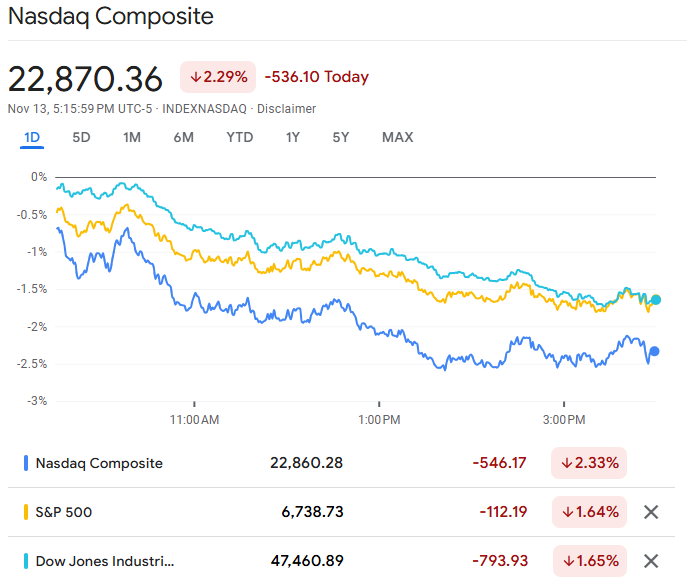
The financial markets are rarely a smooth ride, but few sectors experience the dramatic swings of the technology industry. When investors log into their brokerage accounts and see a sea of red concentrated in the Nasdaq or among high-growth software and semiconductor names, the immediate question is always: “Why is tech down today?” While every trading session has its unique nuances, the downward pressure on technology stocks usually stems from a predictable set of macroeconomic levers, valuation adjustments, and shifts in investor sentiment.
Understanding why the tech sector is underperforming requires looking beyond the daily headlines. It involves analyzing the relationship between interest rates and future earnings, the reality of corporate guidance versus analyst expectations, and the cyclical nature of capital rotation. For the modern investor, a dip in tech is not just a moment of volatility—it is a lesson in the complex mechanics of the global financial system.
The Macroeconomic Catalyst: Interest Rates and the Cost of Capital
The most frequent culprit behind a tech sell-off is the movement of interest rates, specifically those tied to the 10-year Treasury yield. In the world of finance, technology companies are often categorized as “growth stocks.” Their primary value lies not in the cash they are generating today, but in the massive profits they are expected to produce five, ten, or twenty years into the future.
The Discounted Cash Flow (DCF) Reality
To determine what a company is worth today, analysts use a Discounted Cash Flow (DCF) model. This model takes those future earnings and “discounts” them back to the present day using a specific interest rate. When interest rates rise, the discount rate increases. Mathematically, this makes those future dollars less valuable in today’s terms. Because tech companies have a higher proportion of their value tied to the distant future compared to stable “value” sectors like utilities or consumer staples, they are disproportionately hit when yields climb.
The Higher-for-Longer Narrative
Market volatility often spikes when the Federal Reserve or other central banks signal that interest rates will remain elevated for a longer duration than previously anticipated. High interest rates act as a gravity force on the stock market, but they are particularly punishing for tech firms that rely on cheap debt to fund research, development, and aggressive expansion. When the “cost of money” goes up, the path to profitability becomes steeper, leading investors to reassess the premium they are willing to pay for growth.
Valuation Overstretch and the “Priced for Perfection” Problem
Another reason tech often leads market declines is the sheer height of its valuations. During periods of optimism, technology stocks frequently trade at high Price-to-Earnings (P/E) ratios. Investors pay a premium because they believe the company’s innovation will lead to a dominant market position. However, this creates a situation where stocks are “priced for perfection.”
The Danger of Met Expectations
In the tech sector, meeting expectations is often not enough. If a major software company reports strong earnings but provides a “soft” outlook for the next quarter, the stock may plummet. Investors in this niche are hyper-focused on the rate of acceleration. If a cloud computing firm grows its revenue by 25%, but it grew by 30% the previous year, the market may interpret this as a sign of saturation, triggering a sell-off.
The Psychology of Profit Taking
Tech stocks are frequently the biggest winners in a bull market. When institutional investors—such as hedge funds and pension funds—need to “de-risk” their portfolios or lock in gains, they often sell the assets that have appreciated the most. This profit-taking can create a snowball effect. As the largest players trim their positions in big-cap tech to balance their portfolios, the downward pressure triggers stop-loss orders for retail investors, accelerating the decline.
Sector Rotation: Moving from Growth to Value
Market participants often engage in “sector rotation,” which is the movement of capital from one industry to another based on the economic cycle. Tech is the poster child for the “Growth” category. However, there are times when the market decides that “Value” is the place to be.
The Reopening and Reflation Trade
When economic data suggests that inflation is stickier than expected or that the broader economy is robust, investors may rotate out of high-flying tech stocks and into “old economy” sectors like banking, energy, or industrials. These sectors often benefit from higher interest rates or increased commodity prices. In these scenarios, tech isn’t necessarily “failing” as a business; rather, it is simply being used as a source of funds for investors to chase higher yields or more stable dividends elsewhere.
Flight to Quality vs. Speculative Bubbles
Within the tech sector itself, there is often a bifurcation between “Big Tech” (the profitable giants) and speculative, non-profitable tech. On days when tech is down, the damage is often most severe among companies that have yet to turn a profit. During times of financial uncertainty, investors flee speculative assets in favor of companies with strong balance sheets and consistent cash flow. If the overall tech sector is down, it may be a sign that the market is narrowing its focus toward quality and shedding the “excess” of the speculative growth phase.
The AI Hype Cycle and Infrastructure Realities
In the current financial landscape, much of the technology sector’s movement is tied to the development and implementation of Artificial Intelligence (AI). While AI represents a massive leap in productivity and potential revenue, it is also subject to intense cycles of hype and disappointment.
The Capex Burden
For tech companies to lead in AI, they must spend billions of dollars on hardware, specifically high-end semiconductors and data center infrastructure. Investors closely monitor Capital Expenditure (Capex) reports. If a company is spending aggressively on AI but cannot yet show how that investment is translating into bottom-line profit, the market may become skeptical. A “down” day for tech can often be traced back to a realization that the ROI (Return on Investment) for AI might take longer to materialize than the hype suggested.
Geopolitical and Regulatory Headwinds
Technology is no longer just a business sector; it is a matter of national security and global diplomacy. Trade restrictions on semiconductor chips, antitrust lawsuits against search engines, and privacy regulations in various jurisdictions all create a cloud of uncertainty. When a new regulatory hurdle is announced or tensions rise between major tech-producing nations, the entire sector can feel the chill. Investors hate uncertainty, and the tech sector is currently at the center of the most complex regulatory and geopolitical environment in decades.
Navigating the Downturn: A Financial Perspective
For an investor, seeing tech down can be unsettling, but it is a fundamental part of the market’s plumbing. These periods of “digestion” are often where the most significant long-term opportunities are created.
The Role of Diversification
The volatility of tech underscores the importance of a diversified financial strategy. Relying solely on growth stocks leaves a portfolio vulnerable to the interest rate fluctuations mentioned earlier. Financial advisors often suggest balancing tech exposure with value-oriented sectors or fixed-income assets to dampen the blow during tech-led corrections.

Long-Term Thesis vs. Short-Term Noise
It is essential to distinguish between a “bad day” for a stock and a “bad business.” If a company’s fundamental ability to innovate, capture market share, and generate cash remains intact, a dip driven by macroeconomic factors or sector rotation might be viewed as a buying opportunity rather than a reason to panic. The history of the stock market shows that while tech experiences the sharpest drawdowns, it has also historically provided some of the most significant long-term wealth creation.
In conclusion, when tech is down today, it is rarely due to a single event. It is usually a confluence of rising yields, high valuations, and a shift in the collective appetite for risk. By understanding these financial levers, investors can move away from reactive decision-making and toward a more disciplined, strategic approach to the most dynamic sector in the world economy. The red on the screen is not just a loss; it is a reflection of the global economy’s constant search for equilibrium between growth and stability.
aViewFromTheCave is a participant in the Amazon Services LLC Associates Program, an affiliate advertising program designed to provide a means for sites to earn advertising fees by advertising and linking to Amazon.com. Amazon, the Amazon logo, AmazonSupply, and the AmazonSupply logo are trademarks of Amazon.com, Inc. or its affiliates. As an Amazon Associate we earn affiliate commissions from qualifying purchases.