
The Dow Jones Industrial Average (DJIA) is perhaps the most recognized symbol of the American financial system. Every morning, as the clock strikes 9:30 AM Eastern Time, the “opening bell” at the New York Stock Exchange signals more than just the start of a trading session; it marks the beginning of a daily narrative of global economic health, investor confidence, and corporate performance. When an investor asks, “What did the Dow Jones open at today?” they are rarely looking for just a number. They are seeking an entry point into understanding how the world’s most influential blue-chip companies are reacting to the overnight flow of information.

The opening price of the Dow is a critical data point that sets the stage for the trading day. It represents the culmination of hours of pre-market activity, international market movements, and the collective digestion of news cycles that occurred while the domestic exchanges were closed. Understanding how this number is derived and why it matters is essential for anyone looking to navigate the complexities of personal finance and institutional investing.
The Mechanics of the Market Open: How the Price is Set
The opening price of the Dow Jones is not a random starting point. It is the result of a highly sophisticated process of price discovery. Unlike the continuous trading that occurs throughout the day, the “opening print” is a singular moment where supply and demand are reconciled after a period of relative dormancy.
Pre-Market Trading and Futures
Long before the physical bell rings on Wall Street, the “Dow Futures” have been trading. Futures contracts allow investors to speculate on the value of the index before the actual stock market opens. These contracts trade nearly 24 hours a day and provide a “preview” of where the market is likely to open. If an international event occurs at 3:00 AM—such as a change in European central bank policy or a major geopolitical shift—it will be reflected in the futures market first. By the time the 9:30 AM open arrives, the opening price of the DJIA usually aligns closely with where the futures were trending in the final minutes of the pre-market session.
The Role of the Opening Auction
The actual opening price of the 30 individual stocks that comprise the Dow Jones is determined through an auction process. On the New York Stock Exchange (NYSE), Designated Market Makers (DMMs) facilitate this. They look at all the “limit” and “market” orders that have accumulated overnight. The goal is to find the single price point that will execute the maximum number of shares. This process ensures that the opening price is a fair representation of the market’s immediate consensus. When all 30 stocks have their opening prices established, the Dow Jones Industrial Average index value is calculated, providing the official “open” for the day.
Why the Opening Price Matters to Your Portfolio
For the casual observer, the opening price is a headline. For the active investor, it is a signal. The relationship between the previous day’s “close” and today’s “open” can tell a story of institutional conviction or retail panic.
The Significance of the “Gap”
One of the most important concepts in market analysis is the “gap.” If the Dow Jones opens significantly higher than it closed the previous day, it is called “gapping up.” Conversely, opening lower is “gapping down.” These gaps represent a sudden shift in sentiment that could not be traded during regular hours. A large gap down often suggests that bad news—perhaps a disappointing earnings report from a heavyweight like Microsoft or Goldman Sachs—was so impactful that investors were unwilling to buy the stock at yesterday’s prices.
Volatility and the First Hour of Trading
The first 30 to 60 minutes after the Dow opens are typically the most volatile of the day. This is known as the “amateur hour” by some and the “institutional rebalancing” by others. During this window, the market is processing the “opening print” and reacting to the overnight news. High volatility at the open can present opportunities for short-term traders, but for long-term investors, it is often a period of noise that requires a disciplined approach to avoid emotional decision-making.
Macroeconomic Drivers Influencing Today’s Open

The Dow Jones does not move in a vacuum. Its opening value is sensitive to a specific set of “macro” triggers that investors watch with hawk-like intensity. When you check the opening price, you are seeing the market’s immediate reaction to these three primary pillars:
Central Bank Policy and Interest Rates
The Federal Reserve is arguably the most significant driver of the Dow’s opening direction. In an era where interest rate decisions dictate the cost of capital, any “hawkish” or “dovish” signals from Fed officials can cause the Dow to open hundreds of points higher or lower. High interest rates generally pressure the industrial and tech giants within the Dow by increasing borrowing costs and discounting future earnings. Therefore, if a Fed governor gives a speech at 8:00 AM hinting at a rate hike, the Dow’s opening price will almost certainly reflect that pessimism.
Corporate Earnings Season
Four times a year, the “Big 30” companies—including Apple, Disney, and Walmart—release their quarterly financial results. Because many of these reports are released either after the market closes or before it opens, the “opening price” of the Dow serves as the verdict on these reports. If a core component of the Dow reports record-breaking profits and raises its guidance, it can single-handedly lift the entire index at the open, regardless of broader economic sentiment.
Global Geopolitics and Commodity Prices
Because the Dow consists of multinational corporations, it is sensitive to global stability. Changes in the price of oil affect Dow components like Chevron. Trade tensions with major partners affect manufacturing giants like Boeing or Caterpillar. The opening price captures the market’s assessment of how these global variables will impact the bottom line of American industry in the coming months.
Strategic Thinking: How to Use the Opening Data
Knowing what the Dow Jones opened at today is only useful if you know how to apply that information to your financial strategy. Professional investors distinguish between “price” and “value,” and the opening bell is where that distinction is most visible.
Avoiding the “Reactionary Trap”
Many retail investors make the mistake of seeing a sharp drop at the market open and immediately selling their positions. This is often a mistake. History shows that the “opening print” can often be an emotional extreme. If the Dow opens down 200 points, it may spend the rest of the day “filling the gap” as buyers realize the initial reaction was overblown. A sound financial strategy involves waiting for the initial volatility to settle before making significant changes to a portfolio.
The Dow as a Psychological Benchmark
While the S&P 500 is often used as the professional benchmark for performance, the Dow Jones remains the psychological benchmark for the public. When the Dow hits “round numbers”—such as 30,000 or 40,000—it affects consumer confidence. An opening price that pushes the Dow past a major psychological resistance level can trigger a “fear of missing out” (FOMO) rally, driving prices even higher as the day progresses.
Long-Term Perspectives vs. Daily Fluctuations
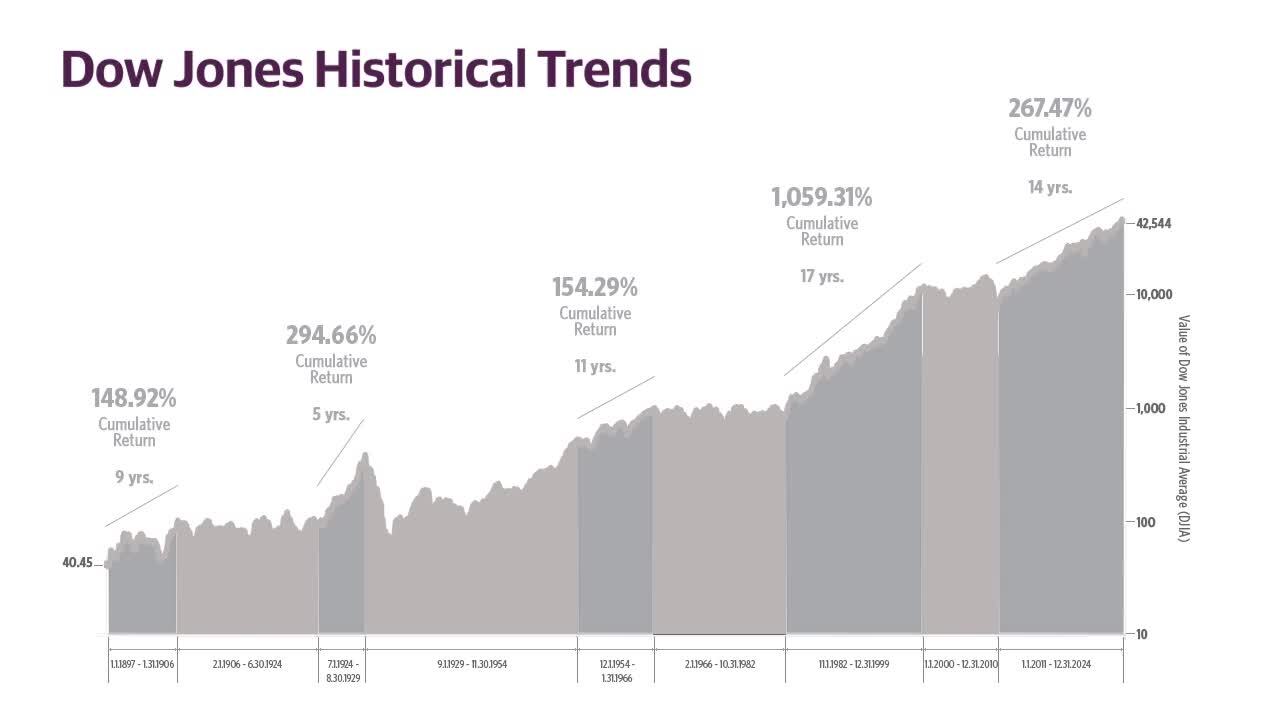
For the long-term wealth builder, the daily opening price is a single brick in a very large wall. While it is important to stay informed, obsessive monitoring of the Dow’s open can lead to “ticker fatigue.” Successful investing in the Dow Jones components—which are chosen for their stability and leadership—requires looking past the daily opening price and focusing on the underlying fundamental health of the 30 companies that make up the index.
The Evolution of the Dow and the Modern Investor
The Dow Jones Industrial Average has changed significantly since its inception in 1896. What started as a list of twelve industrial companies (mostly in railroads and energy) has evolved into a diverse cross-section of the modern economy, including technology, healthcare, and financial services.
When you look at the opening price today, you are looking at a “price-weighted” index. This means that stocks with higher share prices have a greater influence on the Dow’s movement than those with lower share prices. This is a unique quirk of the Dow; a $1 move in a high-priced stock like UnitedHealth Group will move the Dow’s opening value much more than a $1 move in a lower-priced stock like Verizon.
In conclusion, “what the Dow Jones opened at today” is more than a statistic; it is a pulse check on the global financial ecosystem. It reflects the intersection of overnight global events, institutional logic, and the mechanical efficiency of the modern exchange. By understanding the forces that shape this opening number, investors can move beyond the “what” and begin to understand the “why,” leading to more informed, confident, and strategic financial decisions. Whether the market opens in the green or the red, the informed investor knows that the opening bell is not the end of the story, but the beginning of a new chapter in the ongoing journey of wealth creation.
aViewFromTheCave is a participant in the Amazon Services LLC Associates Program, an affiliate advertising program designed to provide a means for sites to earn advertising fees by advertising and linking to Amazon.com. Amazon, the Amazon logo, AmazonSupply, and the AmazonSupply logo are trademarks of Amazon.com, Inc. or its affiliates. As an Amazon Associate we earn affiliate commissions from qualifying purchases.