
The Dow Jones Industrial Average (DJIA), often referred to simply as “the Dow,” is one of the most watched stock market indices in the world. Established in 1896 by Charles Dow and Edward Jones, it serves as a price-weighted measurement of 30 prominent companies listed on stock exchanges in the United States. Unlike the S&P 500, which tracks 500 large-cap stocks based on market capitalization, the Dow focuses on a select group of “blue-chip” companies that are considered leaders in their respective industries. For investors, understanding which stocks make up this index is essential for gauging the overall health of the American economy and the broader financial markets.

Understanding the Blue-Chip Benchmark
The Dow Jones Industrial Average is unique because of its price-weighted methodology. In a market-capitalization-weighted index, companies with the largest total market value have the most influence. However, in the Dow, the stock price itself determines the weight. A company with a $300 stock price will have a greater impact on the index’s daily movement than a company with a $50 stock price, regardless of their relative company sizes.
The Selection Process
Unlike many indices that follow a strict mathematical formula for inclusion, the Dow is managed by a selection committee at S&P Dow Jones Indices. There are no permanent rules for a stock to be included, but the committee generally looks for companies with an excellent reputation, sustained growth, and a high level of interest among a wide range of investors. Furthermore, the committee aims to maintain adequate sector representation that reflects the current state of the U.S. economy. This is why the index, which originally consisted purely of industrial firms like those in railroads, sugar, and oil, now includes massive technology, healthcare, and retail giants.
The Role of the Dow Divisor
Because the index is price-weighted, stock splits or dividends could theoretically cause the index value to drop even if the market is healthy. To prevent this, the “Dow Divisor” is used. This is a continuously adjusted numerical value used to calculate the index level. When a company in the Dow undergoes a stock split, the divisor is adjusted so that the index’s value remains consistent before and after the event. As of recent years, the divisor has dropped significantly below 1, meaning that a $1 change in any component stock price translates to a much larger move in the total index points.
The 30 Components of the Dow Jones Industrial Average
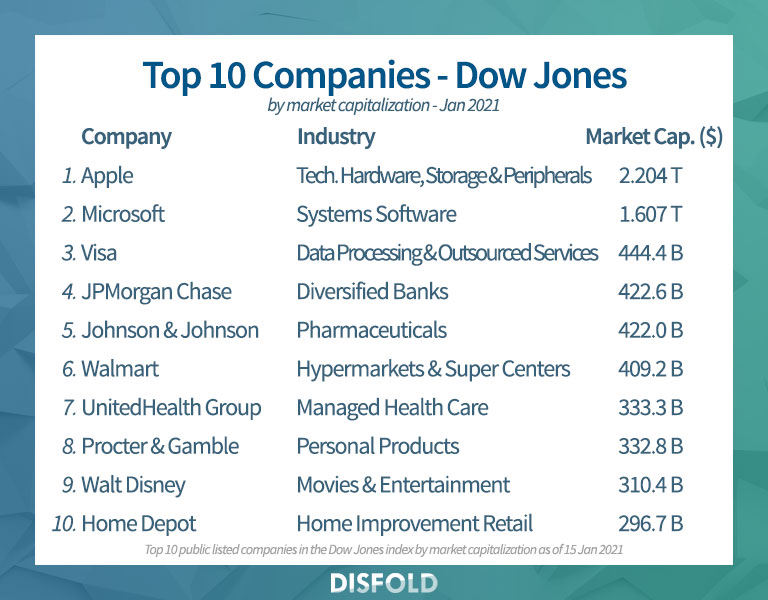
The 30 stocks within the Dow represent a cross-section of the modern economy. While the “Industrial” name remains for historical reasons, the components span technology, financials, healthcare, consumer discretionary, and more. As of late 2024, the index includes some of the most recognizable names in global business.
Technology and Communications
In the modern era, technology has become the driving force of the index.
-
Microsoft (MSFT): A pillar of the enterprise software and cloud computing world.
-
Apple (AAPL): The consumer electronics giant that serves as a bellwether for global retail health.
-
Nvidia (NVDA): A recent addition that replaced Intel, reflecting the shift toward Artificial Intelligence and high-performance computing.
-
Salesforce (CRM): A leader in cloud-based customer relationship management software.
-
Cisco Systems (CSCO): Essential for global networking and telecommunications infrastructure.
-
International Business Machines (IBM): A legacy tech giant focused on hybrid cloud and AI services.
Financial Services
The financial sector is heavily represented in the Dow, as it reflects the flow of capital and credit in the economy.
-
Goldman Sachs (GS): One of the most influential investment banks in the world.
-
JPMorgan Chase (JPM): The largest bank in the United States by assets.
-
American Express (AXP): A key player in the premium credit and travel services market.
-
Visa (V): A dominant force in global digital payments and transaction processing.
-
Travelers Companies (TRV): Representing the insurance sector and risk management.
Healthcare and Pharmaceuticals
As the U.S. population ages, healthcare has become a massive component of the national GDP and the Dow.
-
UnitedHealth Group (UNH): Usually the most influential stock in the index due to its high share price.
-
Johnson & Johnson (JNJ): A diversified healthcare giant spanning medical devices and consumer health.
-
Merck (MRK): A pharmaceutical powerhouse focused on innovative medicines.
-
Amgen (AMGN): A leader in biotechnology and specialized therapeutics.

Consumer Goods and Retail
These stocks represent the spending habits of the American consumer.
-
Amazon (AMZN): Added in 2024 to replace Walgreens, reflecting the dominance of e-commerce and cloud services.
-
Walmart (WMT): The world’s largest brick-and-mortar retailer.
-
Home Depot (HD): The leading home improvement retailer, often seen as a proxy for the housing market.
-
McDonald’s (MCD): A global icon of the fast-food industry.
-
Coca-Cola (KO): The world’s most recognized beverage brand.
-
Procter & Gamble (PG): The consumer staples leader, producing everything from detergent to paper towels.
-
Nike (NKE): The premier global brand for athletic footwear and apparel.
-
Walt Disney (DIS): A titan in media, entertainment, and theme parks.
Industrial and Energy
The “traditional” sectors that built the original index still maintain a strong presence.
-
Boeing (BA): A critical aerospace and defense contractor.
-
Caterpillar (CAT): The leading manufacturer of construction and mining equipment.
-
Honeywell (HON): A diversified industrial conglomerate involved in aerospace and building technologies.
-
3M (MMM): Known for its wide range of industrial and consumer products.
-
Chevron (CVX): The sole energy representative in the index following the removal of ExxonMobil in 2020.
-
Dow Inc. (DOW): A major materials science and chemical company (not to be confused with the index name itself).
Why the Dow Matters for Your Portfolio
For the individual investor, the Dow Jones Industrial Average serves several purposes. While it is less diversified than the S&P 500 or the Nasdaq Composite, its focus on “blue-chip” companies makes it an excellent indicator of “Main Street” stability. These are companies that typically have consistent earnings, pay reliable dividends, and possess the cash reserves to weather economic downturns.
Performance vs. Diversification
Because the Dow only tracks 30 stocks, it is more concentrated than other major indices. This can be a double-edged sword. If one or two high-priced stocks have a particularly bad day (or a particularly good one), they can skew the entire index. However, because these 30 companies are so large and integrated into the global economy, their collective performance is usually a very accurate reflection of general market sentiment. Historically, the Dow has shown a strong correlation with the S&P 500 over the long term, despite its narrower focus.
Investing in the Dow
Investors who want exposure to these 30 stocks without buying each one individually typically look toward Exchange-Traded Funds (ETFs). The most famous of these is the SPDR Dow Jones Industrial Average ETF Trust, known by its ticker symbol DIA (or “Diamonds”). By investing in a Dow-tracking ETF, an investor gains immediate exposure to the 30 component companies in the same proportions as the index. This is a popular strategy for those seeking a “set-it-and-forget-it” approach to blue-chip investing.
Yield and Income
Many of the companies in the Dow are mature businesses that prioritize returning value to shareholders through dividends. This makes the Dow a favorite for income-focused investors. For example, companies like Coca-Cola, Procter & Gamble, and Verizon are known for their long histories of consistent dividend payouts. When compared to the tech-heavy Nasdaq, the Dow typically offers a higher average dividend yield, making it an attractive option for those building a retirement portfolio or seeking passive income.
The Evolution of the Dow: Keeping Pace with Change
The Dow is not a static list; it evolves as the economy evolves. The removal of Walgreens Boots Alliance in favor of Amazon and the removal of Intel in favor of Nvidia represent a profound shift in the index’s composition. These changes highlight the decreasing relevance of traditional retail pharmacies and legacy semiconductor manufacturing in favor of cloud computing, e-commerce, and the AI revolution.
How Changes Are Decided
The S&P Dow Jones Indices committee reviews the index components periodically. A change is usually triggered by a significant shift in a company’s business model, a merger, or a prolonged period of decline in relevance or share price. For instance, when General Electric (GE)—the last remaining original member of the 1896 index—was removed in 2018, it signaled the end of an era and the rise of a new technological and financial landscape.
Criticisms of the Dow
Despite its prestige, the Dow faces criticism from some financial experts who argue that price-weighting is an antiquated method. They point out that a stock split—which is essentially an accounting move that doesn’t change a company’s fundamental value—can drastically reduce that company’s influence on the index. For example, if a high-priced stock like UnitedHealth were to split its shares 10-for-1, its weight in the Dow would plummet, potentially changing the index’s trajectory even if the company’s performance remains identical.
The Dow as a Psychological Barometer
Regardless of the technical criticisms, the Dow remains the most cited index in news media. When people ask, “How did the market do today?” they are often looking for the Dow’s point movement. Its longevity and the household names of its components give it a psychological weight that newer or more complex indices lack. For the average investor, the Dow represents the giants of industry—the companies they work for, buy products from, and rely on for the stability of the global economy. Understanding these 30 stocks is the first step in understanding the broader mechanics of the financial world.
aViewFromTheCave is a participant in the Amazon Services LLC Associates Program, an affiliate advertising program designed to provide a means for sites to earn advertising fees by advertising and linking to Amazon.com. Amazon, the Amazon logo, AmazonSupply, and the AmazonSupply logo are trademarks of Amazon.com, Inc. or its affiliates. As an Amazon Associate we earn affiliate commissions from qualifying purchases.