
The S&P 500 is often cited as the ultimate barometer of the American economy. Comprising 500 of the largest, most stable publicly traded companies in the United States, it represents approximately 80% of the total value of the U.S. stock market. For the individual investor, trying to buy shares in all 500 companies manually is not only impractical but prohibitively expensive due to transaction costs and the sheer capital required. This is where the Exchange-Traded Fund (ETF) becomes an indispensable tool.
An S&P 500 ETF allows you to own a fractional share of all 500 companies—including giants like Apple, Microsoft, Amazon, and Berkshire Hathaway—through a single ticker symbol. It provides instant diversification, lower risk than individual stock picking, and a historically proven track record of growth. This guide will walk you through the strategic and technical steps of purchasing an S&P 500 ETF to secure your financial future.
Understanding the Mechanics of S&P 500 ETFs
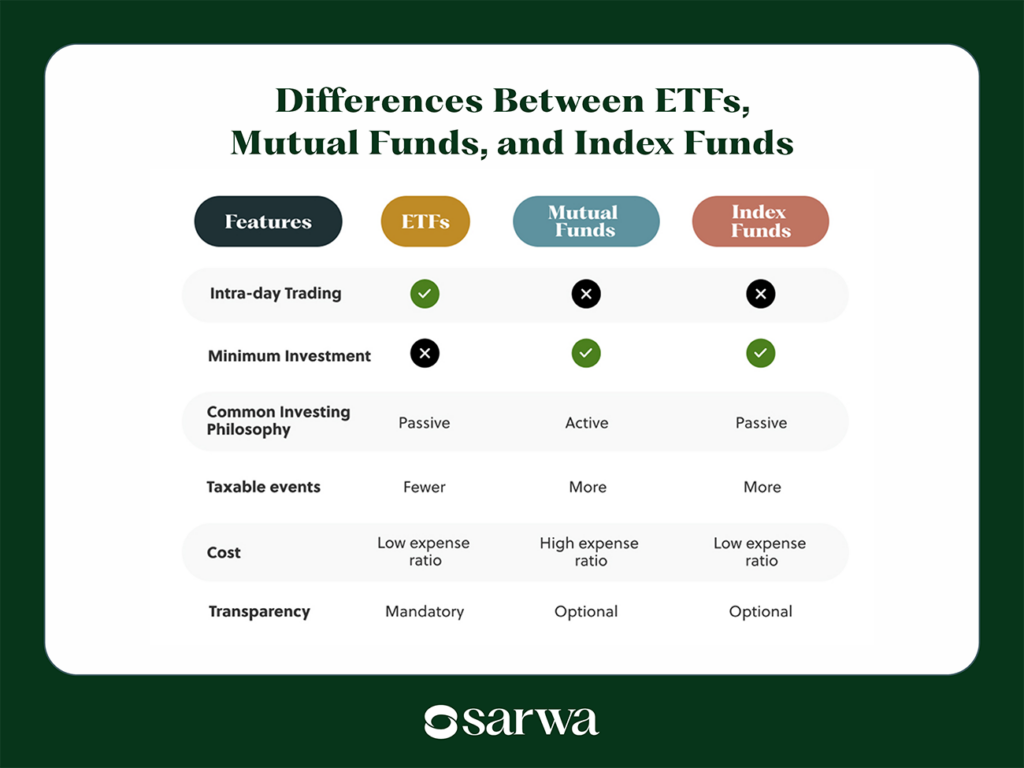
Before clicking the “buy” button, it is essential to understand what you are actually purchasing. An ETF is a type of investment fund that is traded on stock exchanges, much like individual stocks. An S&P 500 ETF specifically aims to track the performance of the Standard & Poor’s 500 Index.
Why the S&P 500 is the Gold Standard
The index is market-capitalization weighted, meaning companies with higher valuations have a larger impact on the index’s performance. When you invest in an S&P 500 ETF, you are betting on the collective ingenuity and profitability of the American corporate landscape. Historically, the index has provided an average annual return of approximately 10% over long periods before inflation. While past performance does not guarantee future results, the index’s resilience through recessions, wars, and technological shifts makes it a cornerstone of modern portfolio theory.
The Advantage of Low-Cost Indexing
The primary appeal of the S&P 500 ETF is its low “expense ratio.” Because the fund simply replicates an existing index rather than paying a team of active managers to pick stocks, the overhead is minimal. Active funds often charge 1% or more in annual fees, which can erode hundreds of thousands of dollars from a retirement nest egg over thirty years. In contrast, many S&P 500 ETFs charge as little as 0.03%, meaning you keep nearly all of your gains.
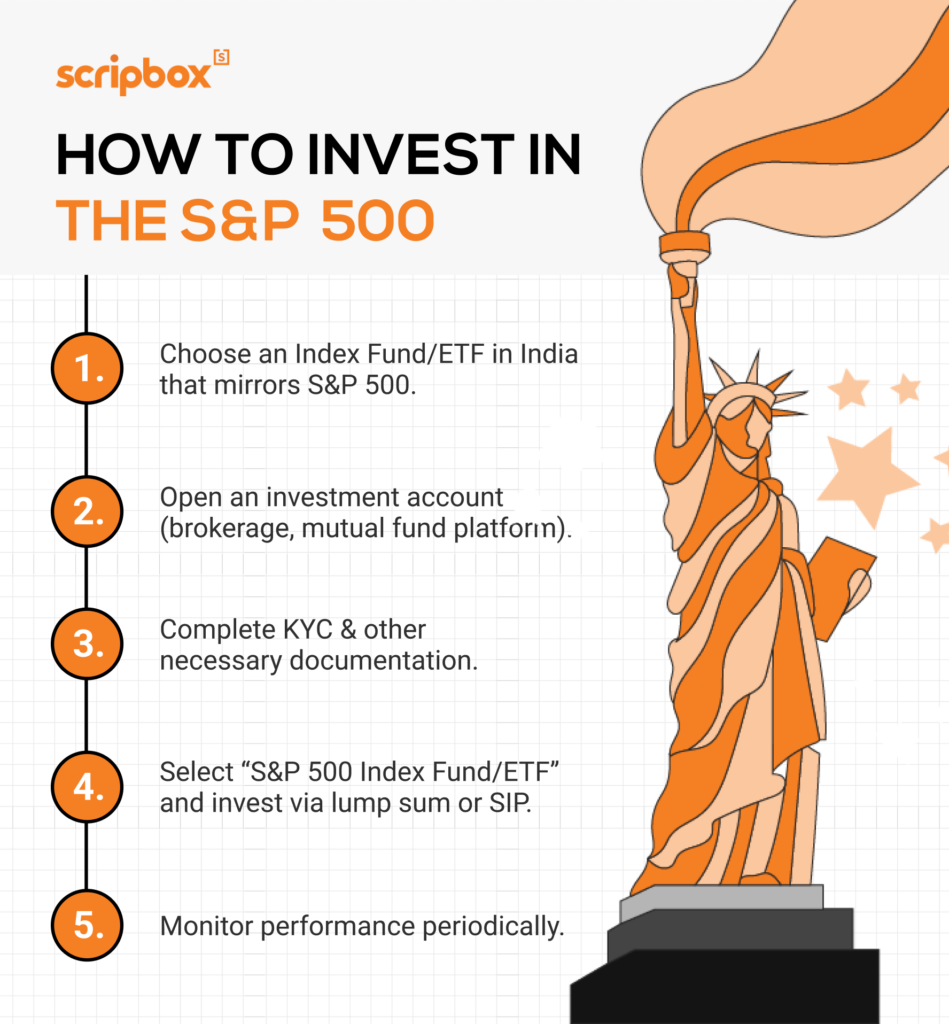
Step 1: Selecting and Opening a Brokerage Account
To buy an ETF, you need a gateway to the financial markets: a brokerage account. In the modern era, this process has been streamlined, with most major platforms offering $0 commissions on ETF trades.
Choosing a Platform
When selecting a broker, consider the user interface, educational resources, and customer service. Major reputable firms include:
-
Vanguard: Known for its investor-owned structure and pioneering index funds.
-
Fidelity: Offers a robust platform with excellent research tools and zero-expense-ratio funds.
-
Charles Schwab: Highly regarded for its customer service and easy-to-use mobile app.
-
Robinhood or Webull: Popular among younger investors for their sleek, mobile-first interfaces, though they may lack some of the deep research tools of legacy firms.
Determining the Account Type
How you buy your ETF depends on your financial goals.
-
Individual Brokerage Account: This is a standard taxable account. You can withdraw your money at any time, but you will owe capital gains taxes on your profits.
-
Roth IRA: A retirement account where you contribute post-tax dollars. The massive benefit here is that your investments grow tax-free, and withdrawals after age 59½ are also tax-free.
-
Traditional IRA: You may get a tax deduction now on your contributions, but you will pay income tax when you withdraw the money in retirement.
Step 2: Evaluating the Best S&P 500 Ticker Symbols
Not all S&P 500 ETFs are created equal. While they all track the same 500 companies, they are managed by different financial institutions and have slight variations in cost and liquidity.
The “Big Three” S&P 500 ETFs
There are three primary ETFs that dominate the market. Any of these is a valid choice for a long-term investor:
-
VOO (Vanguard S&P 500 ETF): This is widely considered the gold standard for long-term buy-and-hold investors. It has an incredibly low expense ratio of 0.03% and is managed by Vanguard, a leader in low-cost indexing.
-
IVV (iShares Core S&P 500 ETF): Managed by BlackRock, this fund also boasts a 0.03% expense ratio. It is highly liquid and perfectly tracks the index, making it an excellent alternative to VOO.
-
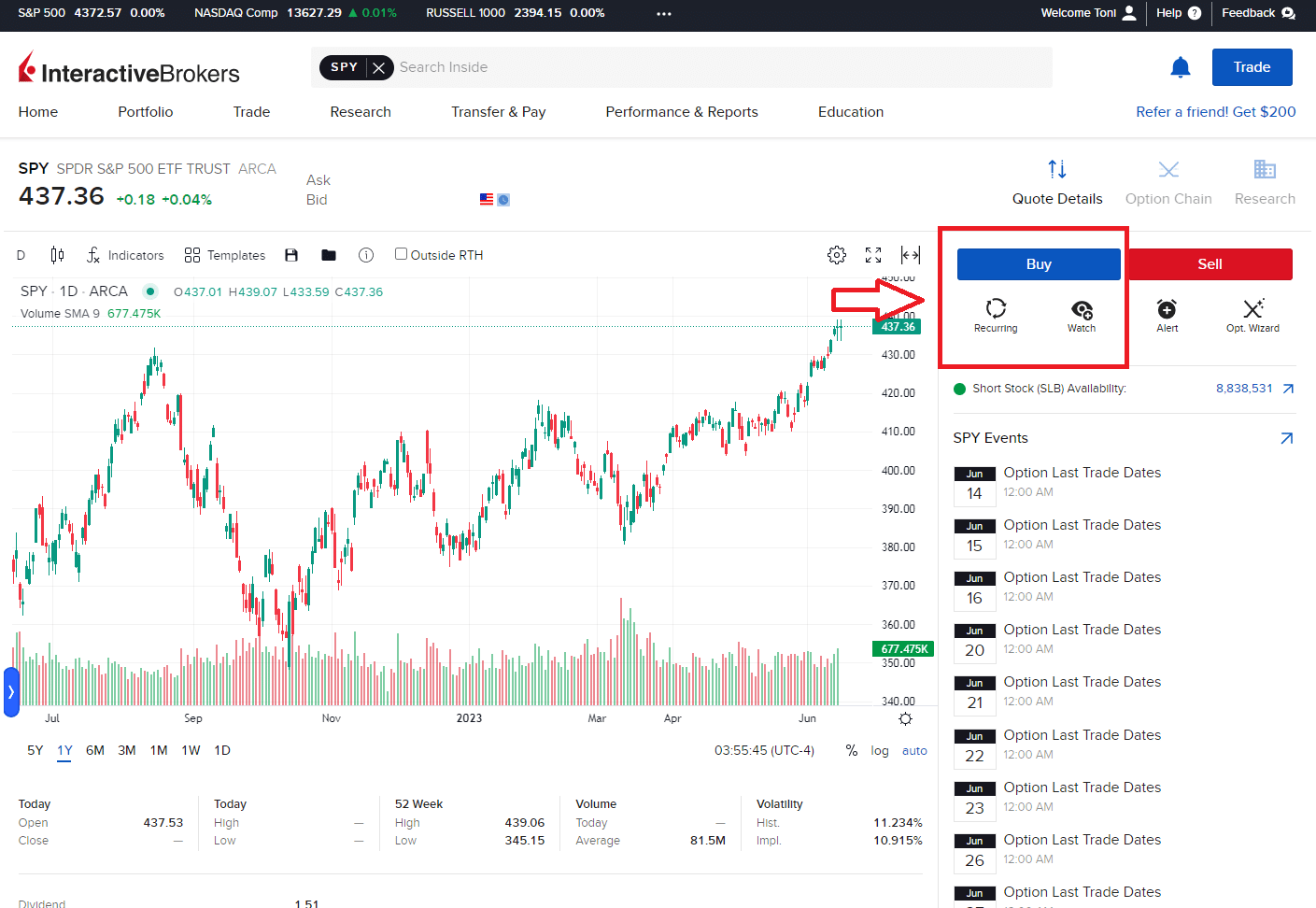
SPY (SPDR S&P 500 ETF Trust): This was the first ETF ever created. While it is the most liquid (meaning it has the highest trading volume), it has a slightly higher expense ratio of 0.09%. While 0.09% is still very low, long-term investors usually prefer VOO or IVV to save that extra 0.06% annually.
Key Metrics: Expense Ratio and Tracking Error
When comparing other niche S&P 500 funds, always look at the expense ratio. Even a small difference of 0.10% can lead to significant divergence in your portfolio’s value over decades. Additionally, check the “tracking error,” which measures how closely the ETF’s returns match the actual index. The major funds mentioned above have near-perfect tracking.
Step 3: Executing the Trade
Once your account is funded (usually via an ACH transfer from your bank), you are ready to place your order. The process is similar to buying a shirt online, but with a few specific financial parameters.
Market Orders vs. Limit Orders
When you go to the “Trade” screen and enter a ticker like VOO, you will be asked what type of order you want to place.
-
Market Order: This executes your trade immediately at the current market price. This is the simplest method and is perfectly fine for long-term investors buying highly liquid ETFs.
-
Limit Order: This allows you to set a maximum price you are willing to pay. For example, if VOO is trading at $450.50, you might set a limit order for $450.00. The trade will only execute if the price drops to that level. This offers more control but risks the trade not being filled if the price moves up.
Fractional Shares
Many modern brokers now allow you to buy “fractional shares.” If an S&P 500 ETF is trading at $500 per share but you only have $100 to invest this month, fractional shares allow you to buy 0.2 shares. This ensures that every dollar of your capital is working for you immediately, rather than sitting as idle cash.
Step 4: Strategic Management and Long-Term Growth
Buying your first share is only the beginning. The real wealth is built through consistency and the power of compounding.
The Power of Dollar-Cost Averaging (DCA)
The stock market is volatile; prices will go up and down daily. Instead of trying to “time the market” (waiting for a crash to buy), successful investors use Dollar-Cost Averaging. This involves investing a fixed amount of money at regular intervals (e.g., $500 every payday), regardless of the price. When prices are high, your $500 buys fewer shares; when prices are low, your $500 buys more. Over time, this lowers your average cost per share and removes the emotional stress of market fluctuations.
Dividend Reinvestment Plans (DRIP)
Most companies in the S&P 500 pay dividends—a portion of their profits distributed to shareholders. When you own an S&P 500 ETF, you will receive these dividends quarterly. To maximize growth, you should enable a “Dividend Reinvestment Plan” (DRIP) through your broker. This automatically uses your dividend payments to buy more shares of the ETF, creating a compounding effect where your shares produce dividends that buy more shares, which in turn produce even more dividends.
Managing Risks and Expectations
While the S&P 500 is one of the safest equity investments over the long term, it is not without risk. Understanding these risks is crucial to maintaining the discipline required for wealth accumulation.
Market Volatility and the 10-Year Horizon
The S&P 500 can experience significant “drawdowns.” It is not uncommon for the index to drop 10%, 20%, or even 50% (as seen in 2008) in a single year. Investing in an S&P 500 ETF should generally be viewed as a 10-year commitment at minimum. If you need the money for a house down payment in two years, the stock market is likely too volatile for those specific funds. However, for retirement or long-term wealth building, the temporary dips are merely “sales” where your DCA strategy allows you to accumulate shares at a discount.
The Role of Diversification
Although the S&P 500 contains 500 companies, it is strictly comprised of large-cap U.S. companies. To have a truly robust financial plan, many investors eventually complement their S&P 500 holdings with exposure to international markets (via an ETF like VXUS) or small-cap stocks. However, for a beginner or a streamlined portfolio, a single S&P 500 ETF often provides enough diversification to outperform the vast majority of professional money managers over time.
By choosing a low-cost fund, automating your contributions, and reinvesting your dividends, you are utilizing the same tools used by the world’s wealthiest investors. The path to financial independence is rarely about finding the next “hot stock”; it is about owning the entire market and letting the collective growth of the world’s most powerful companies work for you.
aViewFromTheCave is a participant in the Amazon Services LLC Associates Program, an affiliate advertising program designed to provide a means for sites to earn advertising fees by advertising and linking to Amazon.com. Amazon, the Amazon logo, AmazonSupply, and the AmazonSupply logo are trademarks of Amazon.com, Inc. or its affiliates. As an Amazon Associate we earn affiliate commissions from qualifying purchases.