
The S&P 500 is arguably the most famous stock market index in the world. Often cited in nightly news reports and used by financial advisors as the primary barometer for the health of the U.S. economy, the Standard & Poor’s 500 represents the 500 leading publicly traded companies in the United States. For the individual investor, understanding what these companies are, how they are selected, and why they dominate the financial landscape is crucial for building a resilient wealth-management strategy.
To the uninitiated, the S&P 500 might seem like a simple list of big brands. In reality, it is a meticulously curated index that captures approximately 80% of the total market capitalization of the U.S. equity market. These companies are the titans of industry—the innovators, the manufacturers, and the service providers that drive global commerce.
The Anatomy of the S&P 500 Index
The S&P 500 is managed by S&P Dow Jones Indices, a joint venture that oversees some of the most influential financial benchmarks in existence. Unlike the Dow Jones Industrial Average (DJIA), which only tracks 30 companies and weights them by share price, the S&P 500 uses a market-capitalization-weighted methodology.
What Defines an S&P 500 Company?
An S&P 500 company is a large-cap U.S. corporation that meets specific eligibility criteria. While the name suggests exactly 500 companies, the index often contains 503 or 505 stocks because some constituent companies issue multiple classes of shares (for example, Alphabet Inc. has both Class A and Class C shares).
These companies are not just “large”; they are the vanguard of their respective sectors. To be included, a company must be headquartered in the U.S., have a highly liquid stock, and maintain a market capitalization that meets the index’s current minimum threshold—which is adjusted periodically to reflect market conditions.
Market Capitalization Weighting Explained
The “Money” aspect of the S&P 500 is fundamentally tied to its weighting system. Because it is market-cap weighted, larger companies have a more significant impact on the index’s performance. If a company like Apple or Microsoft sees a 2% fluctuation in its stock price, it moves the entire index much more than a 2% move from a smaller constituent like a regional utility company.
This structure means that the S&P 500 is “float-adjusted,” meaning it only counts the shares available to the public, excluding those held by insiders or government agencies. This ensures the index reflects the actual tradable value of the American corporate landscape.
The Rigorous Selection Process: How Companies Earn Their Spot
Becoming an S&P 500 company is a mark of prestige and financial maturity. It is not an automatic process based solely on size; a committee at S&P Dow Jones Indices evaluates candidates based on a variety of quantitative and qualitative factors. This “gatekeeping” ensures that the index remains a high-quality representation of the market.
Financial Viability and Earnings Requirements
One of the most important rules for entry is the profitability requirement. A company must report positive as-reported earnings over the most recent quarter, as well as the sum of the most recent four consecutive quarters. This rule helps filter out speculative companies that might have high market valuations but lack a sustainable business model. It is a major reason why many high-growth tech startups wait years before being added to the index, even after their market caps have soared.
Liquidity and Public Float Standards
The index is designed for institutional investors and massive exchange-traded funds (ETFs). Therefore, the companies must be highly liquid. The committee looks for a high “public float,” which is the portion of shares held by public investors. If a company is mostly owned by a single founder or a parent corporation, it may be excluded because there aren’t enough shares for the public to trade efficiently. This ensures that when an index fund needs to buy millions of shares of an S&P 500 constituent, it can do so without causing massive, artificial price swings.
The Role of the Index Committee
Unlike some indices that are purely algorithmic, the S&P 500 is maintained by a committee. This group meets regularly to review the index’s composition. They handle “rebalancing”—the process of adding new companies that have grown to meet the criteria and removing those that have shrunk, been acquired, or fallen into financial distress. This active oversight is intended to keep the index “representative” of the U.S. economy, ensuring that emerging industries are given their due weight while fading industries are phased out.
Sector Representation: The Diverse Engine of the Economy
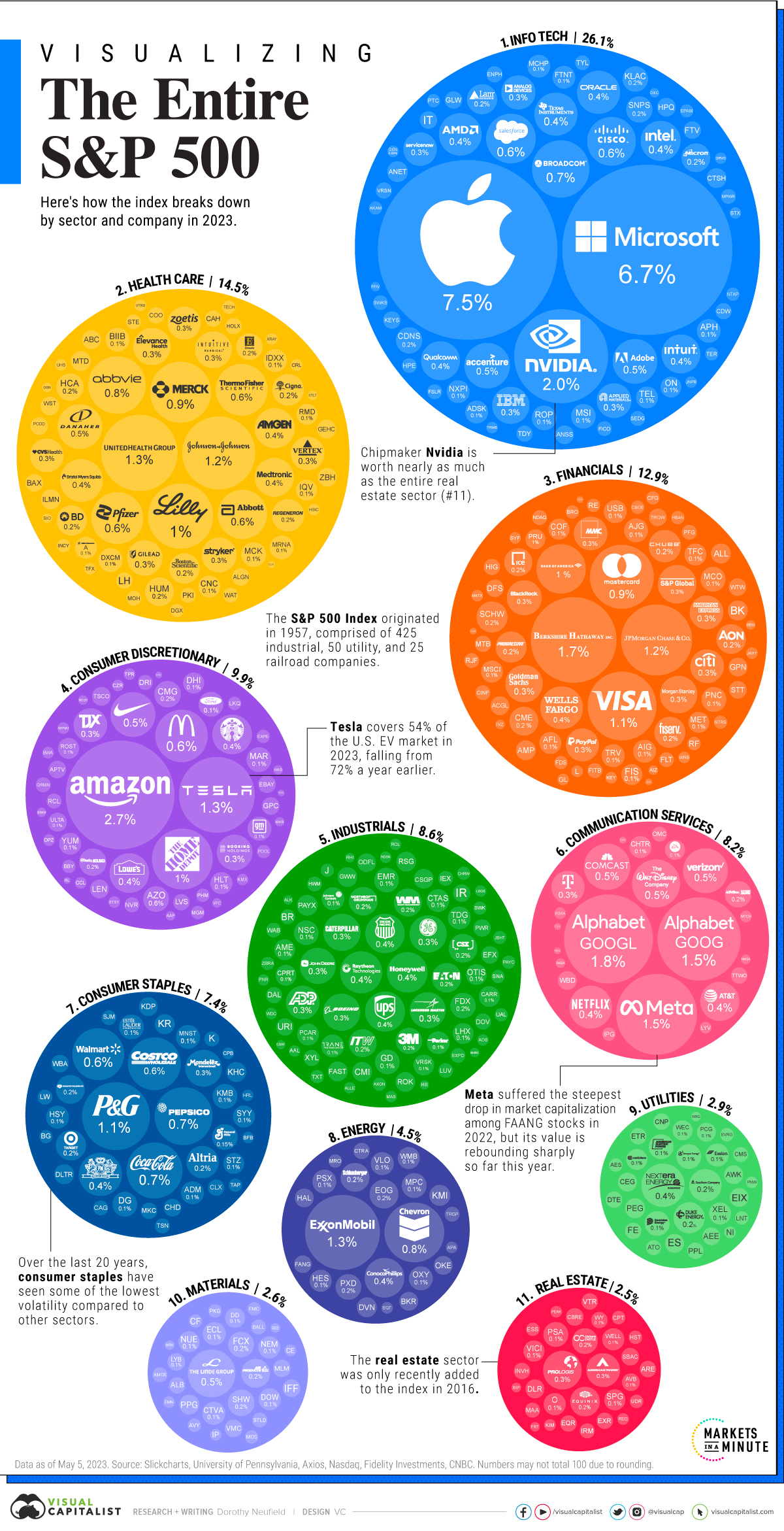
To understand what the S&P 500 companies are, one must look at the sectors they represent. The index is divided into 11 Global Industry Classification Standard (GICS) sectors. This diversity is what makes the index a preferred tool for diversification.
Information Technology and the Growth Engine
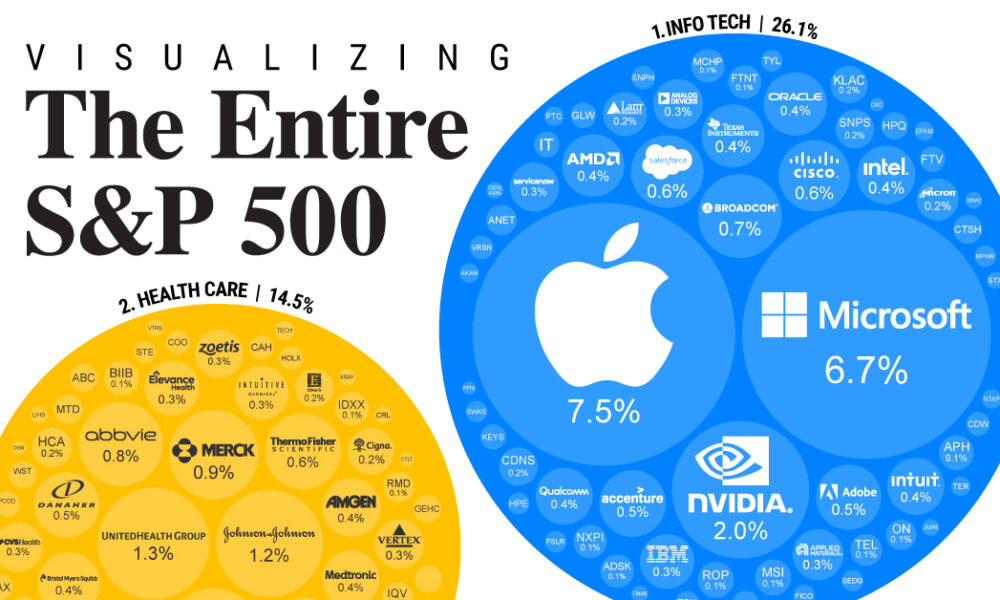
In the modern era, the Information Technology sector is the heaviest weight in the S&P 500. This includes software giants, hardware manufacturers, and semiconductor companies. Names like NVIDIA and Microsoft dominate this space. Because these companies often have high profit margins and global reach, their performance heavily dictates the direction of the broader index. For investors, this sector represents the “growth” component of the S&P 500, fueled by innovations in Artificial Intelligence, cloud computing, and digital transformation.
Healthcare, Financials, and Consumer Staples
While Tech gets the headlines, the backbone of the index consists of defensive and value-oriented sectors. Healthcare includes pharmaceutical giants and insurance providers, offering stability because people need medical care regardless of economic conditions. The Financials sector includes the “too big to fail” banks and asset managers that facilitate global capital flow.
Consumer Staples—companies that produce food, beverages, and household goods—provide a cushion during recessions. When the economy slows down, people may stop buying new iPhones (Consumer Discretionary), but they continue to buy toothpaste and groceries (Consumer Staples). This mix of sectors is why the S&P 500 is often considered a “all-weather” investment for the long term.
The Evolution of Sector Dominance
The composition of S&P 500 companies changes over decades, reflecting shifts in human behavior and technology. In the mid-20th century, the index was dominated by industrial and energy companies—steel manufacturers and oil explorers. Today, those sectors represent a much smaller percentage of the total. This evolution is a natural feature of the index; it automatically harvests the winners of the new economy while pruning the laggards of the old.
The Power of Indexing: Investing in the 500
For most people, “the S&P 500 companies” are not stocks they buy individually, but rather a package deal they access through index funds. This approach, pioneered by John Bogle of Vanguard, revolutionized personal finance by offering a low-cost way to capture the returns of the entire market.
Why the S&P 500 is the Gold Standard for Passive Investing
The S&P 500 has a historical track record of returning approximately 10% annually over long periods (before inflation). By investing in an S&P 500 fund, an individual is essentially betting on the continued growth and ingenuity of the American corporate sector. It eliminates “single-stock risk”—the danger that one company’s failure will ruin your portfolio—because the failure of one company among 500 has a negligible impact on the whole.
Understanding the Risks of Concentration
While the index is diversified across 500 names, the market-cap weighting creates a “top-heavy” effect. Currently, the top ten companies in the S&P 500 account for a significantly high percentage of the index’s total value. This “concentration risk” means that if the largest tech companies suffer a downturn, the entire index can fall even if the other 490 companies are doing well. This is a crucial concept for business finance and personal investing: the S&P 500 is a broad measure, but its heartbeat is driven by its largest members.
Dividends and Total Return
Many S&P 500 companies are “Dividend Aristocrats”—companies that have not only paid but increased their dividends for 25 consecutive years or more. These companies provide a steady stream of income to investors. When you look at the S&P 500’s performance, it is important to distinguish between price return and “total return.” Total return includes the reinvestment of these dividends, which historically accounts for a massive portion of the wealth generated by the index over time.
Implementing an S&P 500 Strategy in Your Personal Portfolio
If you are looking to build wealth, understanding the S&P 500 is the first step toward practical execution. You do not need to be a Wall Street analyst to benefit from these 500 companies.
Choosing Between ETFs and Mutual Funds
Investors can access the S&P 500 through Exchange-Traded Funds (ETFs) or index mutual funds. ETFs, like the SPDR S&P 500 ETF Trust (SPY) or the Vanguard S&P 500 ETF (VOO), trade like stocks throughout the day. Mutual funds are typically bought once a day after the market closes. Both offer extremely low “expense ratios”—the fees charged by the fund manager—often less than 0.05%. This cost-efficiency is one of the primary reasons the S&P 500 is the cornerstone of modern retirement accounts like 401(k)s and IRAs.

The Long-Term Wealth Building Perspective
The S&P 500 is not a “get rich quick” scheme. It is a “get rich surely” mechanism for those with patience. While the index can be volatile in the short term, experiencing drops of 10%, 20%, or even 30% during bear markets, it has historically recovered and reached new highs every single time.
By owning the S&P 500, you are owning the highest-quality earnings engines in the world. You are a partial owner of the companies that provide your software, your medicine, your morning coffee, and your banking services. As these companies find new ways to increase efficiency and reach new markets, your share of their collective value grows. Understanding “what are the S&P 500 companies” is ultimately about understanding the primary vehicle for wealth creation in the modern world: the diversified ownership of the most successful enterprises in history.
aViewFromTheCave is a participant in the Amazon Services LLC Associates Program, an affiliate advertising program designed to provide a means for sites to earn advertising fees by advertising and linking to Amazon.com. Amazon, the Amazon logo, AmazonSupply, and the AmazonSupply logo are trademarks of Amazon.com, Inc. or its affiliates. As an Amazon Associate we earn affiliate commissions from qualifying purchases.