
In the world of finance, few terms are uttered with as much frequency or reverence as “the S&P.” Whether you are watching the evening news, scrolling through a financial app, or discussing retirement plans with a professional, the S&P 500 is the ultimate barometer for the health of the U.S. economy and the success of the global financial markets. But for many individual investors, the index remains a somewhat abstract concept—a moving number on a screen rather than a tangible investment vehicle. Understanding what the S&P is, how it functions, and why it dominates the investment landscape is the first step toward building a sophisticated and resilient personal portfolio.

Defining the S&P 500: The Pulse of American Capitalism
The S&P 500, or the Standard & Poor’s 500 Index, is a stock market index that tracks the performance of 500 of the largest companies listed on stock exchanges in the United States. Created in its modern form in 1957, it has evolved into the primary benchmark for the U.S. equity market. While the Dow Jones Industrial Average (the “Dow”) often receives attention for its historical legacy, the S&P 500 is widely considered a more accurate representation of the market because it includes a broader range of companies across all sectors of the economy.
The Significance of Market Capitalization
Unlike indices that are “price-weighted”—where a company with a higher stock price has a greater influence regardless of its actual size—the S&P 500 is a float-adjusted market-capitalization-weighted index. This means that the impact a company has on the index’s performance is proportional to its total market value (share price multiplied by the number of outstanding shares).
For example, a tech giant with a multi-trillion-dollar valuation will influence the index’s movement significantly more than a regional utility company. This structure ensures that the index reflects the actual economic weight of the companies within it, providing a real-time snapshot of where capital is flowing in the American corporate landscape.
A Diversified Representation of Industry
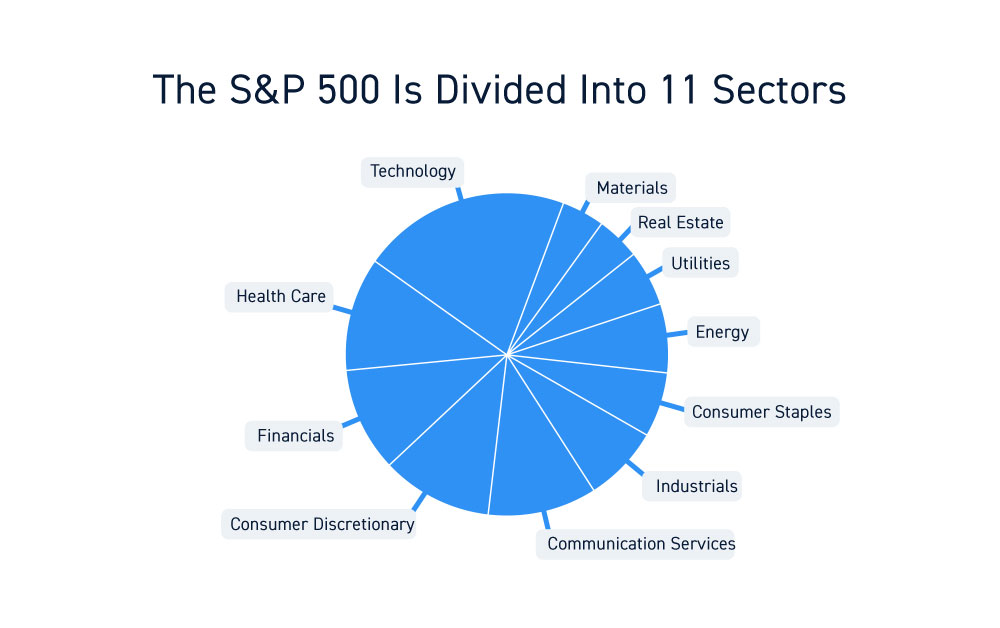
The S&P 500 is not just a list of “the 500 biggest companies.” It is a curated selection designed to reflect the sector balance of the U.S. economy. The index is divided into 11 Global Industry Classification Standard (GICS) sectors, including Information Technology, Health Care, Financials, Consumer Discretionary, and Energy, among others. By maintaining this balance, the index provides investors with a diversified exposure that mitigates the risk of a single industry’s downturn dragging down the entire market.
How the Index is Constructed: The Science Behind the Selection
One of the most common misconceptions is that the S&P 500 is an automated list of the 500 largest U.S. companies. In reality, the index is maintained by the S&P Dow Jones Indices’ Index Committee, which follows a strict set of eligibility criteria to ensure that the index remains liquid, representative, and high-quality.
The Inclusion Criteria
To be considered for the S&P 500, a company must meet several stringent requirements. First, it must be a U.S. company with a market capitalization that exceeds a specific threshold (which is adjusted periodically but generally sits in the billions). Second, the company must be highly liquid, meaning its shares are easily traded in high volumes. Third, and perhaps most importantly, the company must demonstrate financial viability. Specifically, the sum of its most recent four consecutive quarters of earnings must be positive, as must the most recent quarter.
This profitability requirement is a key differentiator. It prevents highly valued but “pre-revenue” or chronically unprofitable companies from entering the index until they have proven their business model. This creates a natural “quality filter” that protects the index from speculative bubbles to some degree.
The Role of the Index Committee
The Index Committee meets regularly to review the composition of the S&P 500. They handle “rebalancing,” which typically occurs quarterly. During these meetings, companies that no longer meet the criteria may be removed, and rising stars that have met the requirements are added. This process of “creative destruction” ensures that the S&P 500 is always evolving. As old industries (like traditional manufacturing or print media) decline, they are replaced by the engines of the future (like cloud computing, biotechnology, and renewable energy).
Performance and the Power of Passive Investing
For the individual investor, the S&P 500 is more than just a data point; it is a powerful tool for wealth creation. Historically, the S&P 500 has delivered an average annual return of approximately 10% (before inflation) over long periods. While the market experiences volatility and periodic “bear markets,” the long-term trajectory of the S&P 500 has been consistently upward, reflecting the growth of corporate earnings and technological innovation.
The Rise of the Index Fund
In the 1970s, John Bogle, the founder of Vanguard, introduced the first index fund for individual investors, based on the S&P 500. His philosophy was simple: if you can’t beat the market, be the market. This birthed the era of passive investing. Instead of paying high fees to a fund manager to pick individual stocks—most of whom fail to outperform the S&P 500 over the long term—investors could simply buy a fund that mirrors the index.
Today, passive investing via S&P 500 ETFs (Exchange-Traded Funds) and mutual funds is a cornerstone of personal finance. These vehicles offer low expense ratios, tax efficiency, and instant diversification. For many, the S&P 500 is the “set it and forget it” solution to retirement planning.
Compounding and the Rule of 72
The true power of the S&P 500 lies in compounding. An investment that returns 10% annually will double approximately every 7.2 years (the Rule of 72). Because the S&P 500 automatically replaces underperforming companies with growing ones, the investor benefits from a self-cleansing mechanism that captures the upside of the winners while limiting exposure to the losers over decades. This makes it an ideal core holding for any long-term financial strategy.
Navigating the Risks: Concentration and Market Volatility
While the S&P 500 is an exceptional tool, it is not without risk. Professional investors monitor several key factors that can impact the index’s performance and, by extension, the portfolios of millions of people.
The Challenge of Concentration Risk
Because the S&P 500 is market-cap weighted, the largest companies have an outsized impact. In recent years, the “top heavy” nature of the index has become a point of discussion. A small group of massive technology companies, often referred to as the “Magnificent Seven,” now accounts for a significant percentage of the index’s total value.
If these few companies experience a downturn, the entire S&P 500 can drop, even if the other 490 companies are performing well. This “concentration risk” means that an S&P 500 investor is heavily exposed to the tech sector. While this has been a boon during the digital revolution, it creates a vulnerability if that specific sector faces regulatory hurdles or cyclical declines.
Volatility and the “Fear Gauge”
The S&P 500 is also the basis for the VIX, or the CBOE Volatility Index. Often called the “Fear Gauge,” the VIX measures the market’s expectation of 30-day volatility based on S&P 500 index options. Investors must understand that the 10% average annual return is not a smooth ride. The index can drop 20% or 30% in a single year due to recessions, geopolitical tensions, or pandemics. Successful S&P 500 investing requires the psychological fortitude to stay invested during these downturns to capture the eventual recovery.
The Practical Path: How to Add the S&P 500 to Your Portfolio
For those looking to move from understanding to action, incorporating the S&P 500 into a financial plan is remarkably straightforward. Modern financial tools have made it accessible to anyone with an internet connection and a few dollars to spare.
Choosing the Right Vehicle: ETFs vs. Mutual Funds
Most investors choose between two primary vehicles:
-
ETFs (Exchange-Traded Funds): Examples include the SPDR S&P 500 ETF Trust (SPY), the iShares Core S&P 500 ETF (IVV), and the Vanguard S&P 500 ETF (VOO). These trade like stocks throughout the day and are often favored for their liquidity and very low fees.
-
Mutual Funds: These are often used in 401(k) plans and are bought and sold at the end of the trading day. They are excellent for automated, recurring investments where an investor wants to contribute a set dollar amount every month.

Dollar-Cost Averaging
The most effective way to invest in the S&P 500 is through dollar-cost averaging. This involves investing a fixed amount of money at regular intervals, regardless of whether the market is up or down. By doing this, you naturally buy more shares when prices are low and fewer shares when prices are high. This strategy removes the emotional burden of trying to “time the market” and leverages the long-term growth of the index.
Ultimately, the S&P 500 is more than just a list of stocks; it is a testament to the resilience and innovation of the corporate world. For the individual investor, it represents a bridge between daily labor and future financial freedom. By understanding its mechanics, respecting its risks, and harnessing its historical growth, anyone can participate in the wealth-generating engine of the modern economy.
aViewFromTheCave is a participant in the Amazon Services LLC Associates Program, an affiliate advertising program designed to provide a means for sites to earn advertising fees by advertising and linking to Amazon.com. Amazon, the Amazon logo, AmazonSupply, and the AmazonSupply logo are trademarks of Amazon.com, Inc. or its affiliates. As an Amazon Associate we earn affiliate commissions from qualifying purchases.