
The ACT, a standardized test widely used for college admissions in the United States, offers a comprehensive assessment of a student’s readiness for higher education. While many are familiar with its English, Math, Reading, and Science sections, a crucial component that often sparks questions is the ACT Writing test. This section is designed to evaluate a student’s ability to construct a well-reasoned argumentative essay. However, a common point of confusion for students and parents alike is understanding what the ACT Writing score is out of, how it’s calculated, and what constitutes a strong performance.
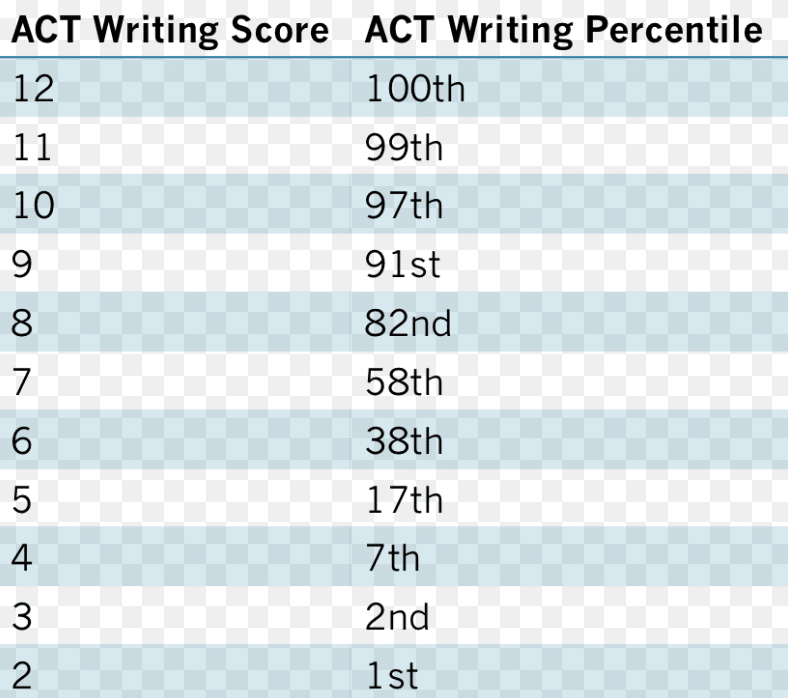
This article aims to demystify the ACT Writing score, providing clarity on its scoring scale, the factors that influence it, and how it fits into the broader context of college admissions, drawing upon insights from the technological, branding, and financial spheres that shape our modern world.
Understanding the ACT Writing Scoring Scale
The ACT Writing test is scored on a scale of 2 to 12. This score is not a raw number of correct answers but rather a holistic evaluation of your essay’s quality based on specific criteria. It’s important to note that this 2-12 scale is separate from the composite ACT score (which ranges from 1 to 36) and the English, Math, Reading, and Science subscores.
How the Essay is Scored
Two highly trained readers score each essay using a rubric. They independently assign a score from 1 to 6. These two scores are then averaged. For instance, if one reader gives a 4 and another gives a 5, the average is 4.5. This average is then converted to the final 2-12 Writing score using a concordance table provided by the ACT.
- Two Readers, One Composite Score: The dual-reader system is in place to ensure fairness and objectivity. If the scores given by the two readers differ by more than one point (e.g., a 3 and a 5), a third, more experienced reader will score the essay to resolve the discrepancy.
- Holistic Scoring: It’s crucial to understand that the 2-12 scale reflects a holistic judgment of the essay’s overall quality. This means that while specific grammar errors or stylistic choices matter, they are considered within the broader context of the essay’s effectiveness in fulfilling the prompt’s requirements.
The ACT Writing Score vs. the Composite Score
This distinction is paramount. The ACT Writing score is an add-on score, separate from the main 1-36 ACT composite. While some universities may consider the Writing score as part of their admissions decision, many do not require it. Colleges that do consider the Writing score will look at it as an indicator of your argumentative and compositional skills, complementing your other ACT scores.
Think of it this way: your composite ACT score is the engine of your college application, while the Writing score is a sophisticated diagnostic tool that can highlight your ability to articulate complex ideas under pressure. In an increasingly competitive academic landscape, where admissions officers are looking for well-rounded individuals, a strong Writing score can be a differentiator.
Key Criteria for a High ACT Writing Score
The ACT Writing prompt asks you to analyze and take a position on a complex issue. You are presented with a situation and three different perspectives. Your task is to choose one of the perspectives or formulate your own, and then argue for your position, considering the nuances and complexities involved. The scoring rubric focuses on four key domains:
1. Ideas and Analysis
This domain assesses the depth and originality of your thinking. A strong essay will:
-
Develop a clear and compelling thesis: Your main argument should be evident and consistently supported throughout the essay.
-
Engage thoughtfully with the prompt: You need to demonstrate a deep understanding of the issue and the different perspectives presented.
-
Present well-reasoned arguments: Your claims should be logical, supported by relevant evidence, and effectively analyzed.
-
Consider multiple perspectives: A high-scoring essay acknowledges counterarguments or alternative viewpoints and explains why your position is stronger. This demonstrates critical thinking and a nuanced understanding of the issue.
-
Tech Analogy: In the tech world, this is akin to a product’s core functionality and innovation. Does the app solve a real problem effectively? Does it offer a unique or superior approach to existing solutions? A shallow or unoriginal idea won’t capture user attention or market share. Similarly, a superficial analysis won’t impress college admissions.
2. Development and Support
This criterion focuses on how effectively you flesh out your ideas and provide evidence to back them up. A well-developed essay will:
-
Use specific and relevant examples: Whether hypothetical or drawn from general knowledge, your examples should clearly illustrate your points.
-
Provide logical reasoning: Explain how your evidence supports your claims. Don’t just present facts; analyze their significance.
-
Elaborate on your points: Avoid making assertions without sufficient explanation or exploration. Each idea should be explored in depth.
-
Maintain focus: All supporting details should directly relate to your thesis and argument.
-
Brand Analogy: This relates to a brand’s narrative and its ability to connect with its audience. A strong brand doesn’t just offer a product; it tells a story. The supporting details are the testimonials, the case studies, the product features explained in relatable terms. How well does the brand’s messaging support its core promise? Similarly, your essay’s support needs to be robust and convincing.
3. Organization
This domain evaluates the structure and flow of your essay. A well-organized essay is easy to follow and persuasive. Key elements include:
-
A clear introduction: Grabs the reader’s attention, introduces the topic, and presents your thesis.
-
Logical paragraphing: Each paragraph should focus on a single idea that supports your thesis, with clear topic sentences.
-
Smooth transitions: Words and phrases that connect ideas between sentences and paragraphs, guiding the reader through your argument.
-
A strong conclusion: Summarizes your main points and offers a final thought or implication without introducing new information.
-
Tech Analogy: Think of user interface (UI) and user experience (UX). A well-designed app has a logical flow, intuitive navigation, and clear pathways for the user. If the interface is chaotic or confusing, the user will struggle to accomplish their goals. Your essay’s organization is its UI/UX; it must guide the reader smoothly through your thoughts.
4. Language and Conventions

This final domain assesses your command of grammar, punctuation, spelling, sentence structure, and vocabulary. While a few minor errors are understandable under timed conditions, a high-scoring essay demonstrates:
-
Clear and precise language: Using words effectively to convey your meaning without ambiguity.
-
Varied sentence structure: Employing a mix of simple, compound, and complex sentences to add rhythm and emphasis.
-
Correct grammar and punctuation: Minimizing errors that could distract or confuse the reader.
-
Appropriate vocabulary: Using words that fit the tone and complexity of the essay.
-
Tech Analogy: This is akin to code quality and software stability. Clean, efficient code leads to a robust and reliable application. Typos in code can lead to major bugs. Similarly, consistent errors in language can undermine the credibility and clarity of your writing.
Strategies for Maximizing Your ACT Writing Score
Understanding the scoring criteria is the first step. The next is to actively prepare and practice. Here are some strategies informed by principles of effective planning, execution, and continuous improvement:
1. Deconstruct the Prompt and Brainstorm Effectively
-
Read the prompt carefully: Understand the core issue and the three provided perspectives. Don’t rush this.
-
Identify the nuances: What are the subtle differences between the perspectives? What are the underlying assumptions?
-
Brainstorm broadly: Jot down ideas, examples, and potential arguments for all perspectives, even if you don’t plan to use them directly. This helps you understand the landscape of the issue.
-
Formulate your thesis early: Based on your brainstorming, decide on your position. It should be clear, arguable, and specific.
-
Financial Analogy: This is like thorough market research before launching a new venture. You need to understand the competitive landscape, customer needs, and potential risks and rewards before committing to a strategy. A well-researched foundation leads to a more robust and profitable outcome.
2. Outline for Clarity and Cohesion
-
Structure your argument: Before you start writing, create a brief outline. This acts as your roadmap.
-
Allocate space for each section: Plan your introduction, body paragraphs (each with a clear point and supporting evidence), and conclusion.
-
Ensure logical flow: Think about the order in which you’ll present your arguments to build a compelling case.
-
Tech Analogy: An outline is like a wireframe for a website or app. It lays out the structure and flow of information, ensuring that users can easily navigate and find what they need. A well-structured outline prevents your essay from becoming a jumbled mess of ideas.
3. Practice Timed Writing Sessions
-
Simulate test conditions: Set a timer for the ACT Writing section (40 minutes) and write full essays based on sample prompts.
-
Focus on all four criteria: During practice, consciously try to strengthen your ideas, development, organization, and language.
-
Review and revise: After each practice essay, take time to review it. What could you have done better? What errors did you consistently make?
-
Personal Branding Analogy: Consistent practice is akin to refining your personal brand. Every interaction, every piece of content you put out, shapes how people perceive you. By practicing, you’re honing your ability to communicate your message effectively and consistently, building a strong reputation for your skills.
4. Develop a Strong Vocabulary and Sentence Variety
-
Read widely: Expose yourself to sophisticated language through books, articles, and essays.
-
Learn new words in context: Don’t just memorize definitions; understand how words are used.
-
Experiment with sentence structures: Practice combining short sentences into longer, more complex ones, and vice versa, to create a dynamic prose style.
-
Digital Security Analogy: This is like building robust security protocols for your digital life. Strong, varied sentence structures and precise vocabulary are like strong encryption – they protect your message from being misinterpreted and enhance its impact and professionalism.
The ACT Writing Score in the Context of College Admissions
While not all colleges require the ACT Writing score, those that do use it to gain a more complete picture of an applicant’s academic capabilities. It can be particularly important for programs that emphasize strong communication skills, such as humanities, law, and journalism.
When is the ACT Writing Score Most Important?
- Colleges that explicitly state it’s considered: Always check the admissions requirements of the universities you’re interested in. Some may have specific score ranges they look for.
- Programs requiring strong writing skills: As mentioned, fields that heavily rely on written communication will likely value this score.
- As a tie-breaker or differentiator: In a pool of highly qualified applicants with similar composite ACT scores, a strong Writing score can help you stand out.
How ACT Writing Scores are Used
- Admissions decisions: It can be a factor in the overall evaluation.
- Course placement: Some institutions may use the Writing score for placement into introductory English or composition courses.
- Scholarship considerations: Certain scholarships might have writing proficiency as a criterion.

Conclusion: Mastering the ACT Writing Score for Your Future
Understanding what the ACT Writing score is out of is the first step towards mastering this important component of the test. The 2-12 scale reflects a holistic assessment of your essay’s ideas, development, organization, and language. By understanding the scoring criteria, practicing diligently, and employing effective writing strategies, you can significantly improve your performance.
In a world increasingly shaped by technological innovation, strong brand narratives, and sound financial acumen, the ability to communicate complex ideas clearly and persuasively remains a cornerstone of success. The ACT Writing test, therefore, is not just an academic hurdle but an opportunity to showcase a skill set that is invaluable for your academic journey and beyond. By investing time and effort into preparing for the ACT Writing section, you are investing in your ability to articulate your thoughts, influence others, and ultimately, achieve your educational and career aspirations.
aViewFromTheCave is a participant in the Amazon Services LLC Associates Program, an affiliate advertising program designed to provide a means for sites to earn advertising fees by advertising and linking to Amazon.com. Amazon, the Amazon logo, AmazonSupply, and the AmazonSupply logo are trademarks of Amazon.com, Inc. or its affiliates. As an Amazon Associate we earn affiliate commissions from qualifying purchases.