
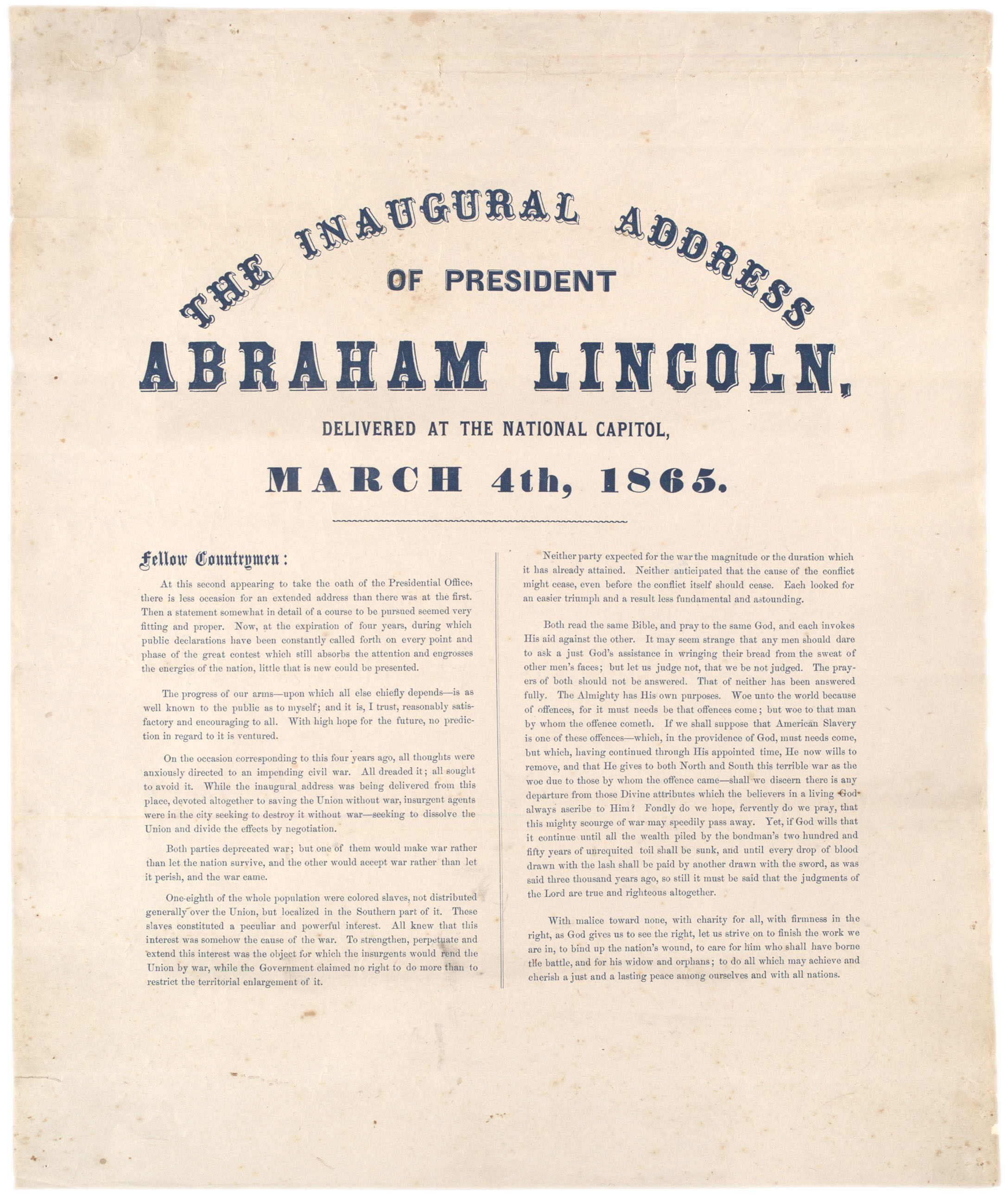
Abraham Lincoln’s Second Inaugural Address, delivered on March 4, 1865, stands as a towering testament to the power of rhetoric, leadership, and strategic thinking. While the immediate context of the Civil War dominated its creation, its enduring relevance can be explored through the prisms of modern concepts like brand narrative, strategic communication, and even the underlying principles of financial reconciliation – themes that resonate deeply within the technological, brand, and financial landscapes of today. This address wasn’t merely a speech; it was a carefully crafted piece of strategic communication, designed to shape public opinion, guide a nation through immense turmoil, and lay the groundwork for a profoundly altered future.

The Strategic Imperative: Uniting a Divided Nation
Lincoln’s primary objective in his second inaugural was undeniably to address the raging Civil War and, crucially, to prepare the nation for its aftermath. The conflict had deeply divided the United States, both ideologically and physically. Families were torn apart, economies were devastated, and the very fabric of the nation was threatened. Lincoln understood that simply winning the war was insufficient; true victory lay in achieving a lasting peace and a reunified populace.
This is where we can draw parallels to modern Brand Strategy. A strong brand isn’t just about a product or service; it’s about a narrative, a set of values, and a vision for the future that resonates with its audience. Lincoln, in essence, was the ultimate brand manager for the Union. His address was designed to solidify the Union’s brand – one of enduring liberty, justice, and eventual reconciliation. He needed to convince both the victorious North and the defeated South that their shared future, despite the immense suffering, held more promise than continued animosity.
Crafting the Narrative: From Blame to Shared Responsibility
One of the most striking aspects of Lincoln’s address is its refusal to dwell on retribution or assign singular blame. While the war had inflicted unimaginable pain, Lincoln steered clear of triumphant pronouncements or vindictive language. Instead, he framed the war as a divine judgment, a consequence of the sin of slavery that had permeated the nation for generations.
This nuanced approach to narrative is a masterclass in Reputation Management and Corporate Identity. Instead of alienating the defeated, Lincoln sought to foster a sense of shared responsibility, albeit through a higher moral framework. He stated, “Fondly do we hope, fervently do we pray, that this mighty scourge of war may speedily pass away. Yet, if God wills that it continue until all the wealth piled by the bondsman’s two hundred and fifty years of unrequited toil shall be sunk, and until every drop of blood drawn with the lash shall be paid by another drawn with the sword, as was said three thousand years ago, so still it must be said ‘the judgments of the Lord are true and righteous altogether.'”
By attributing the war’s devastation to a collective historical failing, Lincoln subtly shifted the focus from individual culpability to a shared burden of atonement. This approach was far more conducive to eventual healing than a purely accusatory stance. It was a strategic decision to manage the nation’s reputation not just in the eyes of its citizens, but in the eyes of history and, as he believed, in the eyes of a higher power. This echoes the modern branding principle of acknowledging past mistakes, demonstrating learning, and articulating a path forward that is inclusive and forward-looking.
The Digital Age Echo: Technology, Communication, and Lincoln’s Message
While Lincoln operated in a pre-digital era, the core principles of his communication strategy have remarkable parallels to how we approach Technology Trends, AI Tools, and Digital Security today. His address was a powerful piece of Content Marketing before the term even existed. He used language as his primary tool to disseminate his message, persuade his audience, and build consensus.
The Power of a Clear Message: Analogues to AI-Driven Content
Consider the clarity and conciseness of Lincoln’s language. He avoids jargon and complex theological arguments, opting for powerful, evocative imagery and accessible prose. This is akin to the modern need for clear, concise communication in the digital sphere. In an age of information overload, where AI Tools can generate vast amounts of content, the ability to craft a message that is both impactful and easily understood is paramount. Lincoln’s address, read aloud and disseminated through newspapers, served as a crucial piece of Digital Security for the nation’s morale – a stable, unifying message amidst chaos.
His ability to distill complex issues into resonant phrases (“malice toward none, with charity for all”) is a testament to his understanding of effective communication. This resonates with the current drive in Productivity and Apps to simplify user experiences and deliver information efficiently. Lincoln’s message was, in essence, an early form of viral content, designed to spread and take root in the hearts and minds of the people. He understood that for his vision of reconciliation to take hold, it needed to be easily digestible and emotionally compelling.
Building Trust Through Transparency: A Precursor to Brand Transparency
Lincoln’s address was also marked by a degree of transparency and intellectual honesty. He acknowledged the profound difficulties ahead and did not shy away from the immense task of rebuilding the nation. This echoes the modern emphasis on Brand Transparency. Consumers and citizens alike increasingly demand honesty and authenticity from their leaders and brands. By openly discussing the challenges, Lincoln built a foundation of trust that would be essential for any future endeavors.
He didn’t offer easy answers or guarantee immediate prosperity. Instead, he offered a vision and a commitment to a difficult but necessary path. This is a crucial lesson for any business or individual looking to build a strong Personal Branding or Corporate Identity. True strength lies not in pretending problems don’t exist, but in confronting them with honesty and a clear plan for resolution.
The Financial Underside: Reconstruction and Economic Reconciliation
While the primary focus of the address is clearly political and moral, the underlying economic implications of Reconstruction are undeniable. The war had decimated the Southern economy, and the process of rebuilding and reintegrating the former Confederate states would require significant economic considerations. Lincoln’s call for “charity for all” and “binding up the nation’s wounds” implicitly included the economic healing of the South.
The Economic Cost of Conflict: A Parallel to Financial Literacy
The immense financial cost of the Civil War – both in terms of human capital and material destruction – serves as a stark reminder of the economic consequences of conflict. Lincoln’s address, by advocating for peace and reconciliation, was indirectly advocating for the economic recovery of the entire nation. This is a crucial parallel to the principles of Personal Finance and Business Finance today. Understanding the true cost of decisions, whether personal or corporate, is essential for sound financial planning and sustainable growth.
The address can be seen as an early articulation of the need for financial prudence and strategic investment in the future. The “wealth piled by the bondsman’s two hundred and fifty years of unrequited toil” represented a fundamental economic injustice. Lincoln’s words, by acknowledging this, laid the groundwork for a future where economic opportunities might be more equitably distributed, even if the path was fraught with challenges.
The Seeds of Economic Strategy: Investing in a United Future
The idea of “binding up the nation’s wounds” can be interpreted as a form of national investment. Rebuilding infrastructure, fostering trade, and reintegrating economies would require capital and strategic planning. This resonates with the principles of Investing and Side Hustles in that it speaks to allocating resources for future returns. Lincoln, in his visionary way, was outlining the need for a collective investment in a unified and prosperous America.
While the specific economic policies of Reconstruction were complex and often flawed, Lincoln’s address laid the philosophical groundwork for a unified economic future. It recognized that a fractured nation could not achieve its full economic potential. This is a vital lesson for entrepreneurs and businesses today who seek to leverage Online Income and build sustainable Business Finance models. True economic prosperity often stems from collaboration and the creation of shared value, rather than zero-sum competition.

Conclusion: A Timeless Blueprint for Leadership and Strategy
Abraham Lincoln’s Second Inaugural Address is far more than a historical artifact; it’s a masterclass in strategic leadership, communication, and the long-term vision required to navigate profound societal shifts. Through the lens of modern business and technological concepts, we can appreciate its enduring power. His meticulous crafting of a unifying narrative, his emphasis on clear and impactful communication, and his implicit understanding of the economic foundations of peace offer timeless lessons.
In an era dominated by rapid technological advancement, evolving brand landscapes, and complex financial considerations, Lincoln’s words serve as a potent reminder that true progress is built on empathy, a clear strategic vision, and the unwavering commitment to a shared and better future. His address continues to be a beacon for leaders, marketers, and strategists alike, demonstrating that even in the face of unimaginable adversity, the power of thoughtful communication and a principled vision can indeed bind up the nation’s wounds and forge a path toward enduring unity.
aViewFromTheCave is a participant in the Amazon Services LLC Associates Program, an affiliate advertising program designed to provide a means for sites to earn advertising fees by advertising and linking to Amazon.com. Amazon, the Amazon logo, AmazonSupply, and the AmazonSupply logo are trademarks of Amazon.com, Inc. or its affiliates. As an Amazon Associate we earn affiliate commissions from qualifying purchases.