
Navigating the landscape of personal finance often requires a meticulous evaluation of recurring expenses, and for the average household, car insurance represents a significant annual outflow. The quest for the “cheapest” car insurance is not a pursuit of a single, universal figure, but rather an exercise in risk assessment, demographic profiling, and strategic shopping. Because insurance companies utilize proprietary algorithms to determine risk, the provider that offers the lowest rate for a suburban homeowner in their 50s will likely differ significantly from the provider offering the best deal to a college student in a metropolitan center.
To truly understand which company holds the crown for the most affordable rates, one must look at the data through the lens of financial strategy. This involves analyzing the major national players, regional powerhouses, and the emerging influence of technology-driven insurers.
The Financial Mechanics of Insurance Pricing
Before identifying specific companies, it is vital to understand the variables that dictate the premium. From a personal finance perspective, your insurance rate is a reflection of your perceived “loss ratio” to the company. Insurers are essentially managing a massive pool of capital, and their goal is to price your policy just high enough to cover potential claims while remaining competitive enough to retain your business.
Core Determinants of Your Premium
The most influential factor in your premium is your driving history. A single at-fault accident or a series of moving violations can increase rates by 30% to 100%, depending on the carrier. However, beyond the driver’s seat, financial health plays a surprising role. In most states, insurers use a credit-based insurance score. Statistically, individuals with higher credit scores are less likely to file claims, leading to lower premiums. Therefore, improving your credit score is often one of the most effective ways to lower your insurance costs over time.
The Role of Geography and Risk Pools
Where you park your car matters as much as how you drive it. Insurance is priced based on local risk pools, which include factors like litigation rates, the frequency of uninsured motorists, and the prevalence of vehicle theft or extreme weather events. A company might offer the cheapest rates in Ohio but be among the most expensive in Florida or Louisiana. This regional variance is why national averages can be misleading; a personal finance strategy must prioritize local market research.
The Top Contenders for National Affordability
When looking at national averages, a few names consistently rise to the top of the list for affordability. These companies leverage massive scales of economy to keep overhead low and offer competitive pricing to a broad spectrum of drivers.
GEICO: The Efficiency Leader
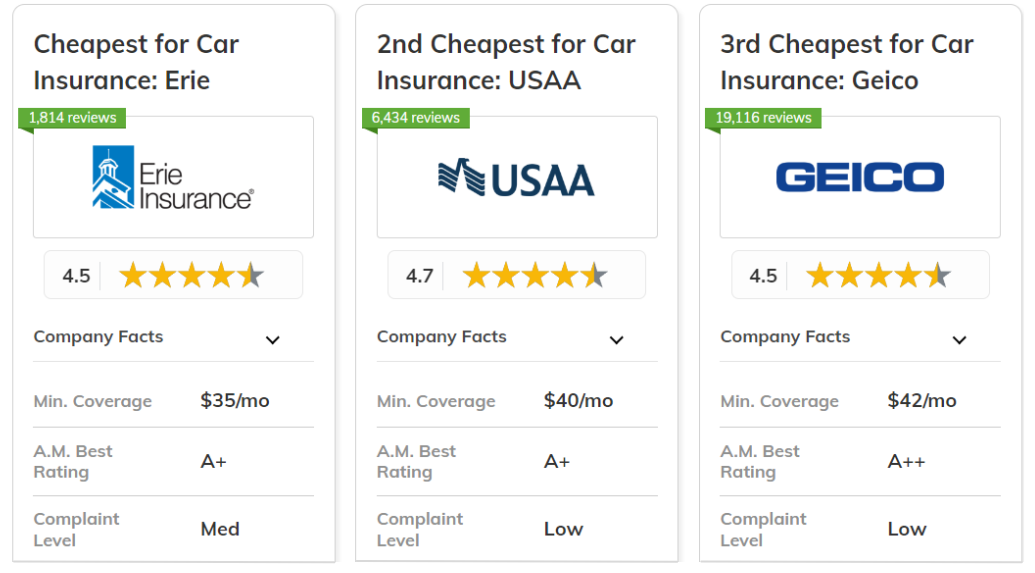
For decades, GEICO has positioned itself as the go-to provider for cost-conscious drivers. By pioneering the direct-to-consumer model—avoiding the high commissions associated with independent agents—GEICO maintains a lean operational structure. Financially, they excel at providing low rates for drivers with clean records and those who prefer a digital-first experience. Their “15 minutes could save you 15%” slogan is rooted in their ability to quickly underwrite standard risks at a lower cost than many legacy competitors.
State Farm: Value Through Scale
As the largest auto insurer in the United States, State Farm utilizes its massive market share to offer competitive pricing, particularly for families and multi-car households. While GEICO often wins on the raw “sticker price” for individual policies, State Farm frequently becomes the cheapest option when bundling home and auto insurance. From a personal finance standpoint, the “multi-line discount” provided by State Farm can often outweigh the lower base premium of a standalone auto policy from a competitor.
Progressive: The Data-Driven Alternative
Progressive is often the most affordable option for drivers who do not fit the “perfect” profile. They have historically been more willing to insure drivers with prior accidents or lapses in coverage at rates that are more competitive than other major carriers. Furthermore, Progressive was an early adopter of telematics via their Snapshot program. For low-mileage drivers or those with exceptionally safe habits, Progressive’s usage-based insurance can drop premiums significantly, making them the cheapest option for a specific subset of the population.
USAA: The Gold Standard for Military Families
While not available to the general public, any discussion of cheap car insurance must include USAA. Consistently ranked as the most affordable provider in nearly every state, USAA is restricted to active-duty military, veterans, and their immediate families. Because their member base is statistically lower-risk and more loyal, USAA can maintain lower premiums while providing industry-leading customer service. If you are eligible for USAA, it is statistically likely to be your cheapest and best option.
Regional and Niche Providers: The Hidden Gems
For many savvy financial planners, the cheapest insurance isn’t found in a national Super Bowl commercial, but rather in the local or regional market. Regional carriers often have a deeper understanding of specific state laws and lower marketing budgets, which translates to savings for the policyholder.
Erie Insurance and Auto-Owners
Erie Insurance, operating primarily in the Midwest and Mid-Atlantic, frequently undercuts the national giants. They are known for a unique “Rate Lock” feature, which prevents your premium from increasing even after a claim, provided you don’t change your drivers or vehicles. Similarly, Auto-Owners Insurance, which sells exclusively through independent agents, often wins on price for high-net-worth individuals or those with complex insurance needs who require a more tailored approach than a digital app can provide.
The Rise of Insurtech: Root and Metromile
The digital revolution has introduced “Insurtech” companies that aim to disrupt the traditional pricing model. Companies like Root Insurance base the majority of their premium on a “test drive” monitored via a smartphone app. If you are an objectively safe driver, Root can often offer rates that are 40% lower than traditional carriers who rely more heavily on demographic data. For city dwellers who rarely use their cars, Metromile offers pay-per-mile insurance, which can be the most financially prudent choice for those driving fewer than 5,000 miles per year.
Strategic Financial Moves to Lower Your Premium
Identifying the cheapest company is only half the battle. To optimize your personal finances, you must also employ strategies that force the insurance market to work in your favor.
Optimizing Deductibles and Coverage Limits
A common mistake in personal finance is over-insuring an asset. If you drive an older vehicle with a low market value, carrying a low deductible (such as $250) may not be mathematically sound. Increasing your deductible to $1,000 can reduce your comprehensive and collision premiums by as much as 15% to 30%. However, this move should only be made if you have an emergency fund capable of covering that $1,000 out-of-pocket expense.
The Power of Annual Auditing
Insurance loyalty rarely pays. In the industry, “price optimization” is a controversial practice where companies gradually raise rates on long-term customers, betting that they won’t take the time to shop around. To ensure you are always paying the lowest rate, it is a best practice to solicit new quotes every 12 to 24 months. Even if you stay with your current provider, mentioning a lower quote from a competitor can sometimes trigger hidden discounts or a re-rating of your policy.
Leveraging Discounts and Telematics
Every major insurer offers a suite of discounts that are often underutilized. From “Good Student” discounts for teenagers to “Defensive Driver” course completions for seniors, these small percentages add up. Furthermore, agreeing to participate in a telematics program—where the company tracks your braking, speed, and time of day—can lead to permanent discounts of up to 30%. For a driver focused on cash flow, the privacy trade-off of telematics is often worth the substantial financial gain.
Evaluating Value vs. Price
While the goal is to find the cheapest insurance, one must distinguish between “cheap” and “low-value.” In the world of finance, an insurance policy is a contract for future service. If a company is the cheapest because they have a reputation for denying legitimate claims or providing poor legal defense, they may end up being the most expensive choice in the long run.
Claims Satisfaction and Financial Stability
Before committing to the lowest quote, consult the J.D. Power Claims Satisfaction ratings and the A.M. Best financial strength ratings. A company with an “A” rating or higher from A.M. Best has the capital reserves to pay out claims even during catastrophic events. From a risk management perspective, saving $100 a year is not worth the stress of a provider that becomes unresponsive when you are involved in a major accident.

Total Cost of Ownership
Ultimately, car insurance is a component of the total cost of vehicle ownership. By selecting a company that offers a balance of competitive rates, reliable service, and stable financial backing, you protect your broader investment portfolio. The cheapest car insurance company is the one that provides the specific coverage you need at a price that allows you to allocate more capital toward your long-term wealth-building goals. Through disciplined shopping and a clear understanding of the factors that drive premiums, you can minimize this necessary expense and maximize your financial flexibility.
aViewFromTheCave is a participant in the Amazon Services LLC Associates Program, an affiliate advertising program designed to provide a means for sites to earn advertising fees by advertising and linking to Amazon.com. Amazon, the Amazon logo, AmazonSupply, and the AmazonSupply logo are trademarks of Amazon.com, Inc. or its affiliates. As an Amazon Associate we earn affiliate commissions from qualifying purchases.