
The trajectory of Tesla, Inc. has transformed from a speculative startup into a dominant force in the global automotive and energy sectors. For investors, financial analysts, and business strategists, the core metric of success has long been one specific number: annual vehicle deliveries. Understanding how many Teslas are sold each year is not merely a tracking of units; it is a fundamental assessment of the company’s ability to scale, its operational efficiency, and its long-term viability in an increasingly competitive landscape. As Tesla moves beyond its early-adopter phase and into the mass-market territory, the financial implications of its delivery cycles have become a primary driver of market sentiment and stock valuation.
The Historical Trajectory: From Niche Player to Mass Market Leader
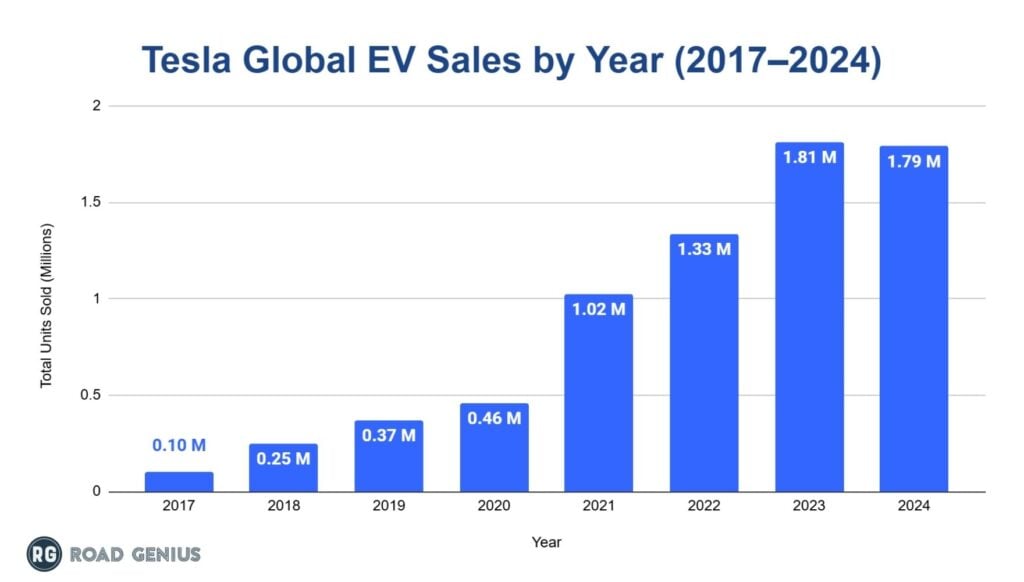
To understand Tesla’s current sales volume, one must look at the exponential growth curve the company has maintained over the last decade. In 2012, the year the Model S was launched, Tesla delivered approximately 2,650 vehicles. At that time, many financial skeptics questioned whether a pure-play electric vehicle (EV) company could ever achieve the scale necessary to be profitable. However, the introduction of the Model X and, more crucially, the Model 3, fundamentally shifted the company’s financial DNA.
By 2017, annual sales had climbed to approximately 103,000 units. The real explosion, however, occurred between 2018 and 2023. With the ramp-up of the Model 3 and the subsequent release of the Model Y, Tesla’s volume crossed the 500,000-unit threshold in 2020. Despite global supply chain disruptions and the economic uncertainty of the early 2020s, Tesla managed to nearly double that figure in 2021, reaching over 936,000 deliveries.
In 2023, Tesla reached a milestone that was once considered impossible by industry incumbents: delivering over 1.8 million vehicles globally. This represented a 38% year-over-year increase, cementing the Model Y as one of the best-selling vehicles—not just EVs, but vehicles of any powertrain—on the planet. For investors, this growth trajectory serves as the primary justification for Tesla’s premium valuation compared to traditional automakers like Ford, GM, or Toyota, who produce millions more vehicles but lack the same margin-improving growth rate.
Scaling Through Gigafactories
The ability to sell millions of cars annually is tied directly to the company’s capital expenditure (CapEx) and the construction of “Gigafactories.” From a business finance perspective, the decentralized manufacturing approach—placing factories in Fremont, Shanghai, Berlin, and Texas—has been essential for reducing logistics costs and insulating the company from regional economic shocks. Each new factory represents a massive investment in corporate identity and operational capacity, allowing Tesla to tap into local labor markets and minimize the impact of import tariffs.
The Model 3 and Model Y Dominance
While the Model S and Model X established Tesla as a premium brand, the Model 3 and Model Y are the financial engines of the company. These two models account for approximately 95% of Tesla’s annual sales volume. This consolidation of the product lineup allows for significant manufacturing efficiencies. By focusing on a high volume of a few models rather than a wide variety of low-volume models, Tesla achieves economies of scale that traditional manufacturers struggle to match, particularly in the EV segment where battery costs are a significant barrier to entry.
Why Sales Volume Matters for Investors
In the world of finance, Tesla’s delivery numbers are a “high-velocity” indicator. Every quarter, the release of delivery data precedes the actual earnings report, providing a preview of the company’s revenue health. For those focused on personal finance and high-growth investing, these numbers are critical for several reasons.
Operating Leverage and Profit Margins
Tesla’s financial model relies heavily on operating leverage. This refers to the company’s ability to increase operating income by growing revenue while keeping costs relatively stable. As Tesla sells more cars each year, the fixed costs of its factories and research and development (R&D) are spread across a larger number of units. This reduces the cost of goods sold (COGS) per vehicle.
In recent years, Tesla has utilized this leverage to engage in aggressive price wars. By cutting prices, Tesla can maintain high sales volumes even in high-interest-rate environments. While this temporarily compresses gross margins, the long-term strategy is to capture market share and build an installed base of users who will eventually subscribe to high-margin software services, such as Full Self-Driving (FSD).
Cash Flow and Reinvestment
The revenue generated from selling nearly 2 million cars annually provides Tesla with a massive cash cushion. Unlike many of its “EV startup” competitors, Tesla is self-funding its growth. This means it can reinvest its profits into new battery technology, the Cybertruck production line, and the development of its next-generation low-cost platform without having to rely on dilutive equity raises or high-interest debt. For the business-minded observer, this transition from a cash-burning startup to a cash-generating machine is the most significant financial milestone in the company’s history.
Global Market Dynamics and Competitive Pressures
The question of how many Teslas are sold each year is increasingly influenced by regional dynamics, particularly in China and Europe. No longer a domestic US story, Tesla is a global enterprise that must navigate complex geopolitical and economic landscapes.
The China Growth Story
China is the world’s largest EV market and a critical pillar of Tesla’s annual sales. Giga Shanghai is the company’s most productive factory, serving both the local Chinese market and acting as an export hub for Europe and other regions. However, China is also home to fierce competition from domestic players like BYD, Li Auto, and Xiaomi.
The financial battle in China is defined by price sensitivity and technological features. To keep sales numbers high, Tesla has had to iterate its marketing strategy rapidly, offering localized incentives and insurance subsidies. Investors closely monitor the “China insurance registration” data released weekly, as it serves as a leading indicator of Tesla’s quarterly performance in its most important growth market.
Navigating Europe and North America
In Europe, Tesla has faced a different set of challenges, including stricter labor laws and a more cautious consumer base. The ramp-up of Giga Berlin has been essential for gaining market share in a region where local champions like Volkswagen and BMW are aggressively pivoting to electric models.
In North America, sales are heavily influenced by federal and state tax credits. The Inflation Reduction Act (IRA) in the United States has played a significant role in making Teslas more affordable for the average consumer, effectively subsidizing the purchase price for eligible buyers. Understanding the tax landscape is a key component of analyzing Tesla’s sales volume, as changes in government policy can lead to massive fluctuations in demand.
Future Projections: Maintaining the Growth Engine
As Tesla reaches the 2-million-unit annual milestone, the market is looking toward the next phase of growth. The company’s stated long-term goal is to reach 20 million vehicles per year by 2030. While this is an incredibly ambitious target—roughly double the current output of Toyota—it outlines the scale at which Tesla intends to operate.
The Next-Generation Platform
To move from 2 million units to 5 million and beyond, Tesla requires a more affordable vehicle. Most analysts believe that the current price points for the Model 3 and Model Y have reached a level of market saturation in developed economies. The development of a “next-generation” platform, often referred to by the media as the “Model 2,” is the key to unlocking mass-market sales in regions like India, Southeast Asia, and Latin America. From an investment perspective, the launch of this platform will be the most significant revenue catalyst of the decade.

The Impact of Autonomy on Valuation
While the sheer number of cars sold is important, the financial community is increasingly focused on the “software-as-a-service” (SaaS) potential of those cars. If Tesla can successfully transition from a hardware manufacturer to a provider of autonomous transport, the number of vehicles sold becomes the “installed base” for a recurring revenue model.
Every Tesla sold today is equipped with the hardware necessary for autonomy. If even a fraction of Tesla’s millions of owners subscribe to FSD or participate in a future “Tesla Network” of robotaxis, the profit-per-vehicle increases exponentially. This is why many institutional investors view the annual delivery numbers not just as car sales, but as the expansion of a proprietary digital ecosystem.
In conclusion, tracking how many Teslas are sold each year provides a window into the company’s financial health, its competitive standing, and its future as a tech-driven industrial titan. For those focused on the intersection of money and business strategy, these figures represent the tangible results of a massive bet on the electrification of transport and the automation of the world’s fleet. As the numbers continue to climb, the focus remains on whether Tesla can maintain its margins while pursuing unprecedented scale.
aViewFromTheCave is a participant in the Amazon Services LLC Associates Program, an affiliate advertising program designed to provide a means for sites to earn advertising fees by advertising and linking to Amazon.com. Amazon, the Amazon logo, AmazonSupply, and the AmazonSupply logo are trademarks of Amazon.com, Inc. or its affiliates. As an Amazon Associate we earn affiliate commissions from qualifying purchases.