
In the modern financial landscape, few metrics are as scrutinized, debated, and volatile as the market capitalization of Tesla, Inc. As a lightning rod for both retail enthusiasm and institutional skepticism, Tesla represents more than just a manufacturer of electric vehicles; it serves as a barometer for the future of transportation, energy storage, and artificial intelligence. Understanding what Tesla’s market cap is, how it is calculated, and why it frequently eclipses the combined value of its century-old competitors requires a deep dive into the mechanics of equity valuation and the unique narrative surrounding the company.

Market capitalization, or “market cap,” is the total dollar market value of a company’s outstanding shares of stock. It is calculated by multiplying the current stock price by the total number of outstanding shares. For Tesla, this number is not a static figure but a fluctuating reflection of global economic sentiment, interest rates, and the perceived success of CEO Elon Musk’s ambitious roadmap. To grasp the significance of Tesla’s market cap, one must look beyond the raw numbers and examine the financial architecture that supports such a massive valuation.
The Mechanics of Market Capitalization and Tesla’s Growth Trajectory
At its core, market capitalization is the most common way to determine the size of a company. It allows investors to categorize Tesla within the “mega-cap” tier, placing it alongside tech giants like Apple, Microsoft, and Alphabet. Unlike traditional automotive companies, Tesla’s market cap has historically behaved more like a high-growth software stock than a capital-intensive manufacturing firm.
The journey of Tesla’s market cap is a study in exponential growth. At its initial public offering (IPO) in 2010, the company was valued at roughly $2 billion. For nearly a decade, it struggled with “production hell” and liquidity concerns, maintaining a valuation that fluctuated but rarely suggested it would one day dominate the global markets. However, the period between 2019 and 2021 saw a meteoric rise. Tesla’s market cap surged from under $100 billion to over $1 trillion in late 2021, a milestone that only a handful of companies in history have ever achieved.
This growth was fueled by several financial factors. First was the achievement of consistent profitability, which paved the way for Tesla’s inclusion in the S&P 500 index in December 2020. This inclusion forced institutional funds and index-tracking ETFs to purchase billions of dollars worth of Tesla stock, creating a massive upward pressure on the market cap. Second was the series of stock splits—a five-for-one split in 2020 and a three-for-one split in 2022. While stock splits do not fundamentally change a company’s market cap, they lower the price per share, making the stock more accessible to retail investors and often increasing liquidity and short-term demand.
Understanding Shares Outstanding and Dilution
To accurately track Tesla’s market cap, investors must monitor the “shares outstanding” count. Unlike many mature companies that engage in aggressive share buybacks to reduce supply and boost share price, Tesla has historically used secondary stock offerings to raise capital for the construction of new Gigafactories in Shanghai, Berlin, and Texas. While issuing new shares can lead to “dilution”—where each existing share represents a smaller percentage of the company—Tesla has managed to grow its valuation so rapidly that the dilutive effects were largely overshadowed by the expansion of the business.
The Role of Market Sentiment and Volatility
Tesla’s market cap is famously volatile. Because a large portion of its value is “priced in” based on future expectations rather than current earnings, any shift in the macroeconomic environment—such as a rise in interest rates by the Federal Reserve—can cause the market cap to swing by tens of billions of dollars in a single trading session. Higher interest rates typically discount the value of future cash flows, hitting growth stocks like Tesla harder than stable, dividend-paying value stocks.
The Pillars Sustaining Tesla’s Premium Valuation
Why is Tesla’s market cap so much higher than other automakers that produce more vehicles? The answer lies in the “Tesla Premium.” Investors are not just buying a car company; they are investing in a vertically integrated technology ecosystem. The market cap reflects several distinct business units that investors believe will generate massive high-margin revenue in the future.
Electric Vehicle Dominance and Manufacturing Efficiency
The primary driver of Tesla’s market cap remains its lead in the electric vehicle (EV) sector. Tesla’s ability to maintain high gross margins—often exceeding 20% during peak periods—set it apart from legacy automakers who struggled with the transition from internal combustion engines. By pioneering “Giga Press” casting and vertical integration of the supply chain, Tesla reduced the cost of goods sold, allowing the market to justify a higher valuation multiple. The Model Y, in particular, became a global bestseller, proving that Tesla could achieve the scale necessary to support a mega-cap valuation.
Full Self-Driving (FSD) and Software-as-a-Service
A significant portion of Tesla’s market cap is attributed to its software potential. Tesla’s Full Self-Driving (FSD) suite is sold as a high-margin subscription or a one-time add-on. Analysts who support a high valuation often model Tesla as a software company. If Tesla successfully achieves Level 4 or Level 5 autonomy, the potential for a “Robotaxi” fleet could transform the company’s business model from selling hardware to collecting recurring service fees. This transition to Software-as-a-Service (SaaS) margins is a key reason why the market grants Tesla a much higher Price-to-Earnings (P/E) ratio than Ford or General Motors.
Energy Storage and the Solar Ecosystem
Tesla Energy, though a smaller contributor to total revenue than the automotive side, is a critical pillar of the long-term market cap narrative. The Megapack (utility-scale storage) and Powerwall (residential storage) products address the global transition to renewable energy. As grids worldwide require stabilization to handle intermittent wind and solar power, Tesla’s energy storage business is viewed as a multi-billion dollar opportunity that is often overlooked by those focusing solely on vehicle delivery numbers.

Tesla vs. The Traditional Automotive Industry: A Valuation Disconnect?
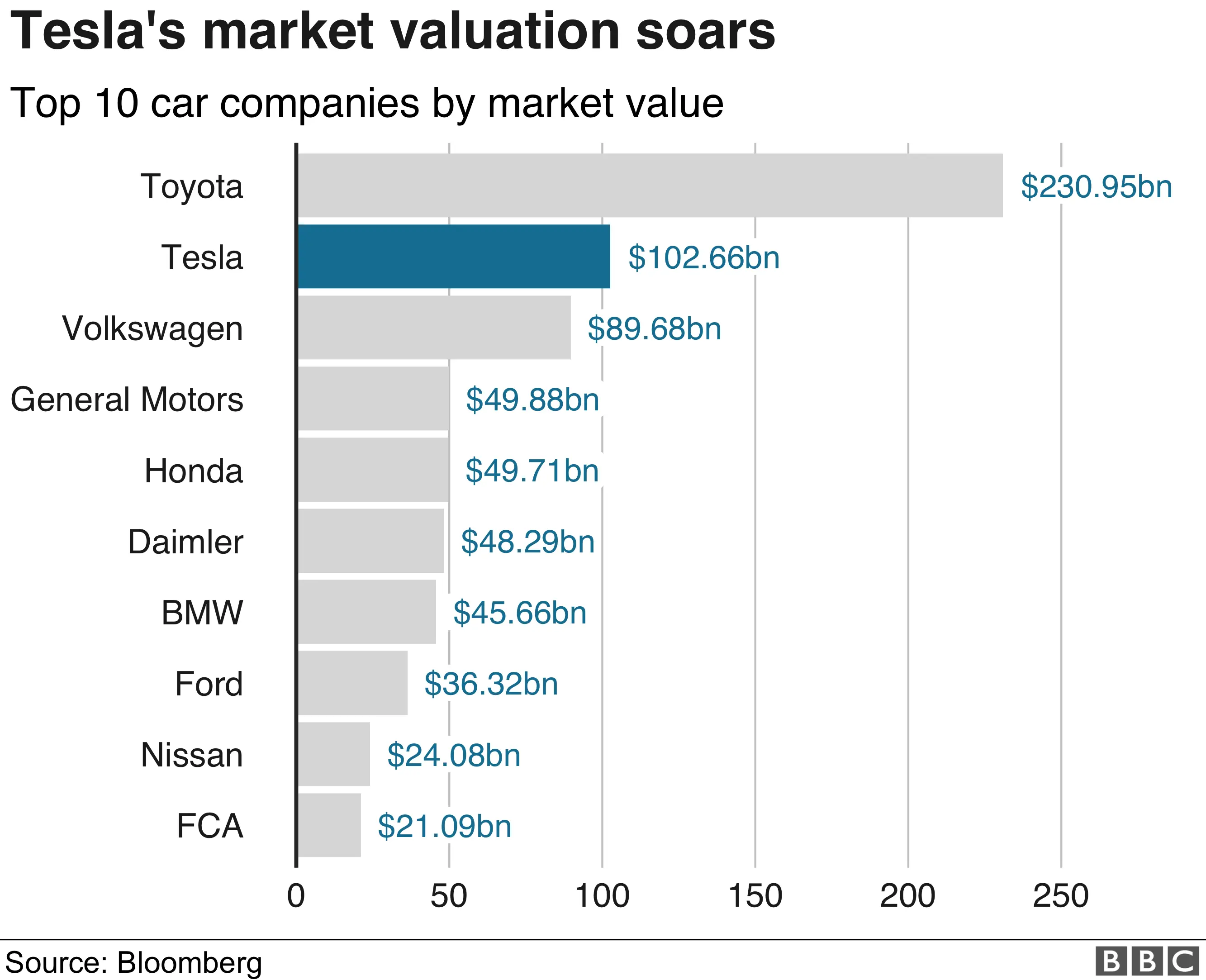
One of the most frequent points of contention in the financial world is the comparison between Tesla’s market cap and the market caps of the rest of the automotive industry. At various points, Tesla’s valuation has exceeded the combined market caps of Toyota, Volkswagen, Mercedes-Benz, BMW, GM, and Ford.
To traditional value investors, this seems like a bubble. They point to the “Price-to-Sales” and “Price-to-Earnings” ratios, noting that Toyota produces millions more cars per year than Tesla while trading at a fraction of the valuation. However, growth investors argue that this is a “false equivalence.” They contend that legacy automakers are burdened by massive debt, pension obligations, and “stranded assets”—factories and technology designed for gasoline engines that will eventually become obsolete.
Tesla, by contrast, has a fortress balance sheet with minimal debt and a significant cash reserve. This financial health allows it to weather economic downturns more effectively than competitors who are simultaneously trying to fund an expensive transition to EVs while servicing old debts. Therefore, Tesla’s market cap represents not just the value of its current production, but the “optionality” of its future dominance in a world where internal combustion is phased out.
The Impact of AI and Robotics on Future Market Cap
In recent years, the narrative surrounding Tesla’s market cap has shifted toward Artificial Intelligence (AI) and robotics. Elon Musk has stated that the long-term value of the company may eventually reside more in the “Optimus” humanoid robot project and the “Dojo” supercomputer than in cars.
If Tesla can leverage its real-world AI data—collected from millions of vehicles on the road—to create a general-purpose humanoid robot, the addressable market would be virtually limitless. Financial analysts are currently divided on how to value this. “Bull” cases include a multi-trillion dollar valuation based on the successful deployment of Optimus in manufacturing and domestic labor. “Bear” cases argue that these projects are speculative and should not be factored into the current market cap.
Regardless of which side one takes, the inclusion of AI and robotics in the Tesla story has helped the company maintain a premium valuation even during periods when EV sales growth slowed. It keeps the “growth narrative” alive, attracting a different class of investors who are interested in the frontier of the Fourth Industrial Revolution.
Risk Factors and the Future of Tesla’s Market Valuation
While Tesla’s market cap has reached historic highs, it is not immune to downward pressure. Several risks could lead to a significant contraction in its valuation.
First is “Key Man Risk.” Much of the market’s confidence in Tesla is tied to Elon Musk’s vision and leadership. Any perceived distraction—such as his involvement in other ventures like X (formerly Twitter) or SpaceX—can lead to a “risk-off” sentiment among Tesla shareholders.
Second is the increasing competition in the EV space. As Chinese manufacturers like BYD scale globally and legacy European brands launch their own electric fleets, Tesla’s market share is under pressure. If Tesla is forced to continue cutting prices to maintain volume, its industry-leading margins could erode, leading to a “multiple compression” where the market is no longer willing to pay a premium P/E ratio for the stock.
Finally, macroeconomic factors such as global lithium prices, supply chain disruptions, and geopolitical tensions (particularly regarding Tesla’s operations in China) remain constant threats. A market cap is a reflection of risk-adjusted future returns; if the risks rise faster than the opportunities, the valuation will inevitably reflect that reality.
In conclusion, the market cap of Tesla is more than just a financial figure; it is a complex intersection of manufacturing prowess, software innovation, and speculative optimism. Whether it sits at $500 billion or $1.5 trillion, it remains one of the most important metrics in the global financial markets, representing the ongoing battle between traditional industrial metrics and the valuation models of the high-tech future. For the investor, monitoring Tesla’s market cap is a lesson in how the market values disruption, scale, and the relentless pursuit of a post-fossil fuel economy.
aViewFromTheCave is a participant in the Amazon Services LLC Associates Program, an affiliate advertising program designed to provide a means for sites to earn advertising fees by advertising and linking to Amazon.com. Amazon, the Amazon logo, AmazonSupply, and the AmazonSupply logo are trademarks of Amazon.com, Inc. or its affiliates. As an Amazon Associate we earn affiliate commissions from qualifying purchases.