
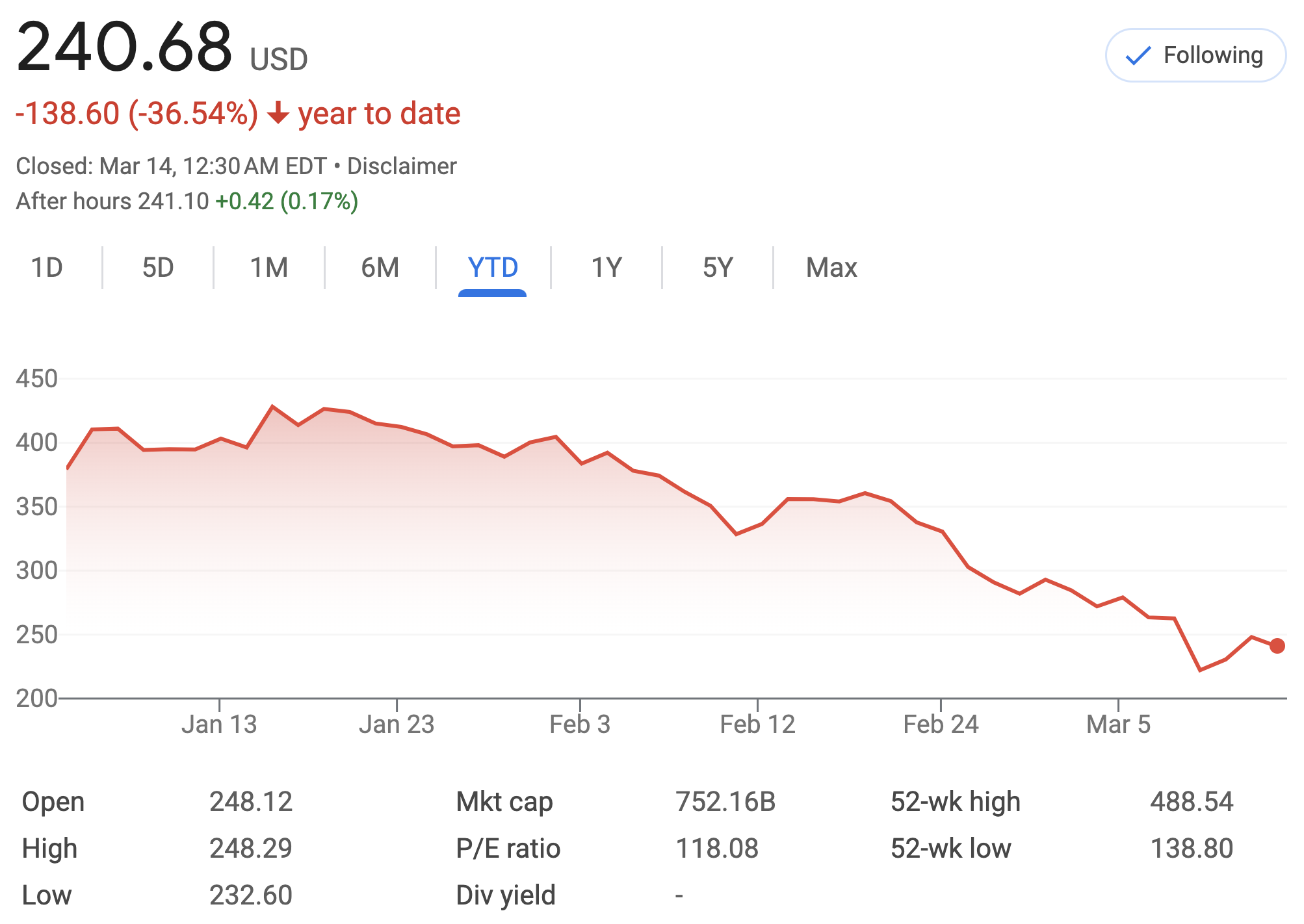
When investors ask, “how much are Tesla shares,” they are rarely looking for a simple numerical value found on a ticker tape. In the modern financial landscape, the price of Tesla (TSLA) represents more than just the cost of equity in an automotive company; it is a barometer for the future of renewable energy, artificial intelligence, and autonomous transport. Understanding the valuation of Tesla requires a deep dive into market mechanics, fundamental financial health, and the speculative fervor that often surrounds one of the world’s most watched stocks.
The Dynamics of Tesla’s Stock Valuation
The price of a single Tesla share is a reflection of the market’s collective expectation for the company’s future cash flows, discounted back to the present day. Unlike traditional legacy automakers such as Ford or General Motors, Tesla has historically commanded a “growth premium.” This means that for every dollar of profit Tesla earns, investors are often willing to pay significantly more than they would for its competitors.
Market Capitalization vs. Share Price
While the share price tells you the cost of one unit of ownership, the market capitalization—calculated by multiplying the share price by the total number of outstanding shares—tells the story of Tesla’s dominance. Tesla frequently maintains a market cap higher than the next several largest automakers combined. This discrepancy is a primary point of contention between “bulls,” who see Tesla as a software and energy giant, and “bears,” who see it as an overvalued car company.
The Role of Stock Splits
In recent years, Tesla has utilized stock splits to manage the accessibility of its shares. When a stock price climbs into the high hundreds or thousands of dollars, it can become prohibitive for retail investors. By executing 3-for-1 or 5-for-1 splits, Tesla increases the number of shares while lowering the price per share proportionally. While this does not change the company’s intrinsic value, it often increases liquidity and retail interest, which can provide a short-term catalyst for price movement.
Key Drivers of the TSLA Share Price
To understand why Tesla shares trade at their current levels, one must look at the diversified revenue streams and technological milestones that the company pursues. Tesla is not a monolithic entity; its valuation is built on several pillars that interact in complex ways.
Vehicle Deliveries and Manufacturing Margins
The most immediate driver of the share price is the quarterly delivery report. Wall Street analysts set specific targets for how many Model 3, Model Y, Model S, and Model X vehicles Tesla should deliver. Beating these expectations typically sends the stock higher, while missing them can lead to sharp sell-offs. Furthermore, investors look closely at the “cost of goods sold.” Tesla’s ability to maintain high margins through manufacturing innovations—like the “Giga Press” and vertical integration of battery supply chains—is a key reason why its shares command a premium.
Full Self-Driving (FSD) and the AI Play
A significant portion of Tesla’s current share price is “priced in” based on the potential of its autonomous driving software. Tesla is increasingly viewed by institutional investors as an Artificial Intelligence company. The promise of a high-margin, recurring revenue stream from software subscriptions (FSD) and a potential future “Robotaxi” fleet represents a massive upside. If the market believes Tesla is closer to achieving Level 5 autonomy, the share price tends to decouple from the realities of car manufacturing and behave more like a high-growth tech stock.
Energy Generation and Storage
The “Tesla Energy” division, which includes Powerwalls for homes and Megapacks for utility-scale storage, is a rapidly growing segment of the business. As the global transition to renewable energy accelerates, the demand for battery storage solutions has skyrocketed. Investors track the deployment of megawatt-hours (MWh) as a leading indicator of future profitability outside of the automotive sector.
Fundamental Analysis: Evaluating the Financials
For the serious investor, the question of “how much are Tesla shares” must be answered through the lens of fundamental analysis. This involves looking beyond the hype and examining the company’s balance sheet and income statement.
Price-to-Earnings (P/E) Ratio
Tesla’s P/E ratio is often the subject of intense debate. It frequently trades at a P/E that is multiples higher than the S&P 500 average. A high P/E ratio suggests that investors expect high growth rates in the future. To justify its share price, Tesla must consistently grow its earnings at a pace that justifies this forward-looking valuation. When earnings growth slows, the stock price often undergoes a “multiple compression,” where the price drops even if the company remains profitable.

Cash Flow and Debt Management
One of Tesla’s greatest strengths in recent years has been its transition from a cash-burning startup to a cash-generating powerhouse. With billions of dollars in free cash flow and a relatively clean balance sheet with low debt, Tesla has the “dry powder” necessary to weather economic downturns and invest in new Gigafactories. A strong cash position reduces the risk for shareholders and provides a floor for the stock price during market volatility.
Impact of Interest Rates
As a growth stock, Tesla is particularly sensitive to interest rate changes by the Federal Reserve. High interest rates make future earnings less valuable in today’s dollars and increase the cost of financing for consumers looking to buy cars. When interest rates rise, Tesla shares often face downward pressure as investors rotate into safer, yield-bearing assets or more stable “value” stocks.
Risks and Market Volatility
Investing in Tesla is not for the faint of heart. The stock is known for its high “beta,” meaning it moves more significantly than the broader market. Several risks can impact the share price at any given moment.
Competitive Pressure
The “EV landscape” is no longer a one-horse race. In China, companies like BYD are producing high-quality electric vehicles at lower price points, challenging Tesla’s market share in one of its most important regions. In Europe and North America, legacy giants like Volkswagen and Hyundai are ramping up their electric offerings. Any sign that Tesla is losing its competitive edge or being forced into “price wars” to maintain volume can negatively impact the share price.
Key Man Risk and Public Sentiment
Tesla is inextricably linked to its CEO, Elon Musk. His public persona, involvement in other ventures (such as X, SpaceX, and xAI), and outspoken nature can create volatility. Professional investors often worry about “distraction risk.” Furthermore, legal challenges regarding executive compensation or regulatory investigations into Autopilot safety can create “headline risk” that causes sudden, sharp drops in the share price.
Geopolitical and Supply Chain Factors
Tesla’s reliance on its Shanghai factory makes it sensitive to US-China relations. Furthermore, the cost of raw materials for batteries—lithium, nickel, and cobalt—can fluctuate wildly based on global supply chains. Since battery costs are the single largest component of an EV’s price, any spike in commodity prices can squeeze Tesla’s margins and hurt its valuation.
Strategic Outlook: Is Tesla a Buy at Current Prices?
Deciding whether Tesla shares are “worth it” at their current price depends largely on an investor’s time horizon and risk tolerance.
Short-Term vs. Long-Term Perspectives
For the day trader, Tesla is a vehicle for volatility, offering opportunities to profit from rapid price swings driven by news cycles and technical indicators. However, for the long-term investor, the share price should be viewed through the lens of a decade-long transformation of the global economy. If one believes that Tesla will successfully transition from a car manufacturer to a global AI and energy infrastructure provider, the current share price might appear undervalued despite its high multiples.
Portfolio Allocation
Most financial advisors suggest that a high-volatility stock like Tesla should be part of a diversified portfolio. Because it sits at the intersection of consumer discretionary (cars) and technology (AI/Software), it offers unique exposure. However, because of its potential for 20-30% swings in a single month, it requires a disciplined approach, such as dollar-cost averaging, to mitigate the risk of buying at a local peak.

Final Considerations for Investors
The question of “how much are Tesla shares” is a moving target. The price is a living entity, reacting in real-time to satellite images of parking lots, software beta testers’ videos, and high-level macroeconomic shifts. To invest successfully in Tesla, one must look past the daily fluctuations and understand the core thesis: Is Tesla a car company, or is it the foundational platform for the next industrial revolution?
By monitoring delivery numbers, staying informed on AI advancements, and keeping a close eye on profit margins, investors can move beyond the “sticker price” of a share and make informed decisions about the true value of a position in TSLA. Whether the shares are currently at a discount or a premium is a matter of intense market debate, but one thing is certain: Tesla remains the most influential stock in the green energy transition, and its price will continue to be a focal point of the global financial conversation.
aViewFromTheCave is a participant in the Amazon Services LLC Associates Program, an affiliate advertising program designed to provide a means for sites to earn advertising fees by advertising and linking to Amazon.com. Amazon, the Amazon logo, AmazonSupply, and the AmazonSupply logo are trademarks of Amazon.com, Inc. or its affiliates. As an Amazon Associate we earn affiliate commissions from qualifying purchases.