
The United States tax system operates on a “pay-as-you-go” basis. While W-2 employees have their taxes automatically withheld from every paycheck, entrepreneurs, freelancers, and investors are responsible for making their own contributions throughout the year. These are known as quarterly estimated tax payments. Failing to navigate this system correctly can lead to significant underpayment penalties and a stressful tax season in April. Understanding exactly where and how to send these payments is a foundational skill for anyone managing their own business finance or diverse investment portfolios.

Navigating the IRS Ecosystem: Choosing the Right Digital Payment Method
In the modern financial landscape, the Internal Revenue Service (IRS) has significantly expanded its digital infrastructure. For most taxpayers, electronic payments are the preferred method because they provide immediate confirmation, reduce the risk of mail loss, and offer a clear digital paper trail for bookkeeping purposes.
IRS Direct Pay
For individuals, sole proprietors, and independent contractors, IRS Direct Pay is often the most efficient tool. This service allows you to pay your estimated taxes directly from your checking or savings account without any additional fees.
To use Direct Pay, you do not need to create an account or register in advance. You simply verify your identity using information from a previous year’s tax return. When selecting the “Reason for Payment,” you must choose “Estimated Tax” and select the current tax year. The system provides a confirmation number at the end of the transaction, which should be saved immediately for your financial records.
The Electronic Federal Tax Payment System (EFTPS)
While Direct Pay is excellent for individuals, the Electronic Federal Tax Payment System (EFTPS) is the gold standard for business entities and high-net-worth individuals who require more robust tracking. EFTPS is a free service provided by the U.S. Department of the Treasury.
Unlike Direct Pay, EFTPS requires a formal enrollment process. Once you sign up, the IRS will mail a Personal Identification Number (PIN) to your registered address, a process that can take five to seven business days. Because of this delay, it is crucial not to wait until the day a payment is due to set up an EFTPS account. The advantage of EFTPS is its scheduling capability; you can schedule all four of your quarterly payments at the beginning of the year, ensuring you never miss a deadline.
Debit, Credit, and Digital Wallets
If you prefer to pay via credit card to earn rewards or manage cash flow, the IRS utilizes third-party payment processors such as PayUSAtax, Pay1040, or ACI Payments, Inc. While the IRS does not charge a fee for these services, the processors do. These convenience fees typically range from 1.85% to 2% of the total payment amount. For large tax bills, these fees can be substantial, so it is important to weigh the cost against any potential credit card points or cash-back benefits.
Conventional Methods: Sending Payments via Mail and Mobile
While digital options are the fastest, some taxpayers prefer traditional methods or may find themselves in a situation where they need to utilize mobile technology while on the go.
The IRS2Go Mobile App
For those who manage their business finance primarily through a smartphone, the IRS2Go app provides a mobile-friendly gateway to the payment systems mentioned above. Available on both iOS and Android, the app allows users to make payments via Direct Pay or credit card. It serves as a streamlined interface that simplifies the process of entering routing and account numbers, making it a convenient option for busy professionals who need to handle their obligations during travel or between meetings.
The Paper Trail: Mailing Form 1040-ES
If you prefer the traditional route of mailing a physical check or money order, you must use Form 1040-ES, “Estimated Tax for Individuals.” This form includes four payment vouchers, one for each quarterly period.
When mailing a payment, your check or money order should be made out to the “United States Treasury.” It is essential to include your Social Security Number (SSN) or Individual Taxpayer Identification Number (ITIN) on the memo line, along with the notation “2024 Form 1040-ES” (or the applicable year).
The mailing address for these vouchers depends on the state in which you reside. The IRS maintains different processing centers for different regions. For instance, taxpayers in Florida or Louisiana send their payments to a different Internal Revenue Service center than those in California or Washington. Always consult the instructions on the most recent version of Form 1040-ES to verify the correct mailing address for your specific location, as these addresses can change periodically.
Understanding the Deadlines: The Quarterly Payment Schedule
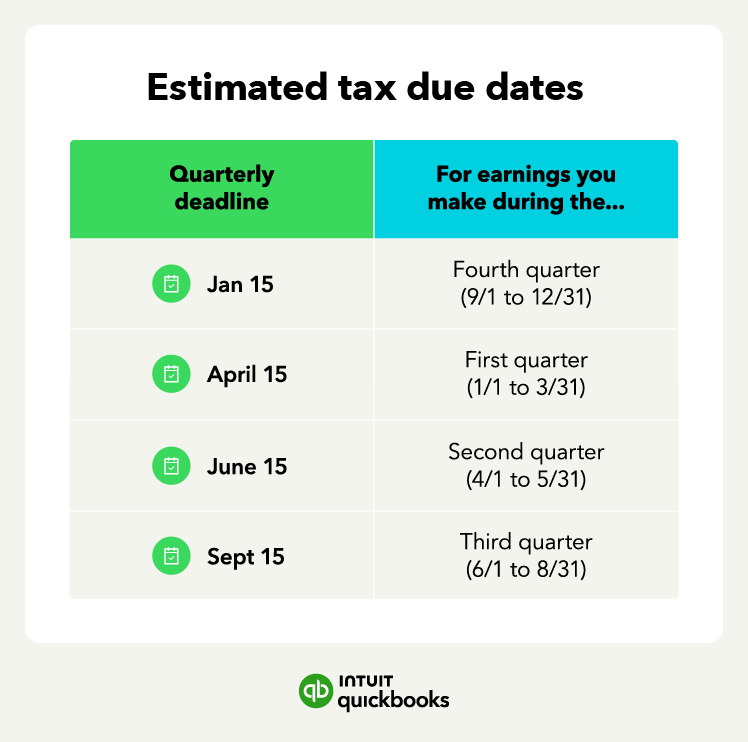
Knowing where to send the money is only half the battle; knowing when to send it is equally critical. The IRS divides the year into four payment periods, and the deadlines do not always align with a standard calendar quarter.
Key Dates to Remember
For a standard calendar year, the deadlines are as follows:
-
April 15: Covers income earned from January 1 through March 31.
-
June 15: Covers income earned from April 1 through May 31.
-
September 15: Covers income earned from June 1 through August 31.
-
January 15 (of the following year): Covers income earned from September 1 through December 31.
It is a common misconception that you only need to pay once a year. If you wait until the January deadline to pay for the entire year, the IRS will likely assess an underpayment penalty for the three previous periods, even if you pay the full balance by the final deadline.
What Happens if a Deadline Falls on a Holiday?
If a payment deadline falls on a Saturday, Sunday, or a legal holiday, the payment is considered timely if it is made on the next business day. For those mailing their payments, the IRS uses the postmark date to determine timeliness. However, to avoid any potential disputes or delays, it is best practice to submit digital payments at least 24 hours before the deadline.
Beyond Federal: Managing State-Level Quarterly Obligations
While federal payments are centralized through the IRS, most states also require estimated tax payments if they collect state income tax. This adds a layer of complexity to your financial management, as state systems rarely talk to federal systems.
State Revenue Departments
Each state has its own Department of Revenue (or equivalent body, such as the Franchise Tax Board in California) with its own set of rules and payment portals. Most states have mirrored the federal government by creating online portals that allow for direct bank transfers.
When determining where to send state payments, you must visit the specific website for your state’s taxing authority. Just like the federal system, states often provide vouchers for those who prefer to mail checks. It is important to note that state deadlines usually—but not always—align with federal deadlines. Some states may have different thresholds for who is required to make estimated payments.
Common Variances in State Payment Systems
Some states require electronic payments once a taxpayer reaches a certain liability threshold. For example, if your state tax liability exceeds $20,000, the state may mandate that all future payments be made electronically. Failure to comply with these state-specific mandates can result in administrative penalties, even if the tax itself is paid on time.
Strategic Financial Management: Calculating and Tracking Your Payments
Successful quarterly tax management is less about the act of sending the money and more about the preparation that happens beforehand. Accuracy is paramount to ensure you aren’t overpaying (and losing liquidity) or underpaying (and incurring penalties).
The Safe Harbor Rule
To avoid underpayment penalties, the IRS provides “Safe Harbor” guidelines. Generally, you will not face a penalty if you pay at least 90% of the tax shown on your current year’s return or 100% of the tax shown on your return from the previous year—whichever is smaller. For high-income earners (those with an Adjusted Gross Income over $150,000), the prior-year safe harbor requirement increases to 110%. Using the safe harbor rule is a highly effective strategy for those with fluctuating incomes, as it provides a predictable target based on known historical data.
Tools for Organization
Managing these payments requires diligent record-keeping. Using dedicated business finance software can automate the tracking of income and expenses, providing a real-time estimate of what is owed each quarter. Additionally, maintaining a separate high-yield savings account—often referred to as a “Tax Sinking Fund”—can ensure that the money is available when the deadline arrives. By transferring a percentage of every check received (typically 25-30%) into this account, you ensure that the quarterly tax obligation is a simple transfer rather than a financial crisis.
In conclusion, knowing where to send quarterly tax payments is a vital component of a healthy financial strategy. Whether you choose the digital convenience of IRS Direct Pay, the structured environment of EFTPS, or the traditional method of mailing vouchers, the key is consistency and timeliness. By mastering these payment channels and adhering to the quarterly schedule, you protect your business and your personal wealth from unnecessary penalties and interest.
aViewFromTheCave is a participant in the Amazon Services LLC Associates Program, an affiliate advertising program designed to provide a means for sites to earn advertising fees by advertising and linking to Amazon.com. Amazon, the Amazon logo, AmazonSupply, and the AmazonSupply logo are trademarks of Amazon.com, Inc. or its affiliates. As an Amazon Associate we earn affiliate commissions from qualifying purchases.