
In an increasingly interconnected world, the movement of money across international borders is a daily necessity for individuals, businesses, and financial institutions alike. Whether you’re an expatriate sending funds home, a multinational corporation paying suppliers abroad, or an online entrepreneur receiving payments from international clients, you’ve likely encountered, or at least benefited from, a system known as SWIFT. Often referred to, somewhat inaccurately, as a “SWIFT account,” the reality is far more intricate and foundational to the global financial system.
This article delves into the true nature of SWIFT, demystifying its purpose, mechanics, and critical role in facilitating secure and reliable international financial transactions. We’ll explore why understanding SWIFT is essential for anyone engaged in global commerce and how this seemingly complex system underpins the seamless flow of capital worldwide.
Understanding the SWIFT Network: The Backbone of Global Finance
At its core, SWIFT is not an “account” in the traditional sense, nor is it a payment system that holds or transfers money itself. Instead, SWIFT stands for the Society for Worldwide Interbank Financial Telecommunication. It is a cooperative society and the world’s leading provider of secure financial messaging services. Established in 1973 by 239 banks in 15 countries, SWIFT’s primary goal was to replace the slow, error-prone, and insecure telex system used for international bank communication.
Today, SWIFT connects over 11,000 financial institutions in more than 200 countries and territories, acting as the nervous system of the global financial world. Its mission is to enable financial institutions to exchange standardized financial messages securely and reliably, facilitating a vast range of financial operations, predominantly international wire transfers.
What SWIFT Does (and Doesn’t Do)
To clarify, SWIFT’s role is akin to a postal service for financial messages. When you send money internationally through your bank, your bank uses the SWIFT network to send a detailed message to the recipient’s bank, containing all the necessary instructions and information for the transaction. This message confirms the amount, currencies, sender, recipient, and the specific accounts involved.
SWIFT Does:
- Provide a highly secure and standardized messaging platform for financial institutions.
- Enable banks to communicate instructions for international money transfers, securities transactions, treasury operations, and trade finance.
- Ensure interoperability among diverse financial systems globally.
- Offer services for compliance, business intelligence, and financial crime prevention.
SWIFT Doesn’t:
- Hold any funds or manage any accounts directly.
- Transfer money itself. The actual transfer of funds happens through correspondent banking relationships between the financial institutions involved.
- Operate as a payment processor like Visa or Mastercard for consumer transactions.
This distinction is crucial. When you initiate an international transfer, your bank debits your account, sends a SWIFT message to the recipient’s bank, and the recipient’s bank then credits their account based on that message. The actual movement of money between banks typically occurs through their pre-established bilateral accounts (nostro/vostro accounts) or via central bank settlement systems.
The Indispensable SWIFT Code (BIC): Your Financial Address
Central to the operation of the SWIFT network is the SWIFT Code, also widely known as a BIC (Bank Identifier Code). If SWIFT is the global financial postal service, then the BIC is the precise address for a bank or specific branch within that system. Without a correct BIC, an international transfer cannot be accurately routed to its destination.
Structure and Significance of a SWIFT/BIC Code
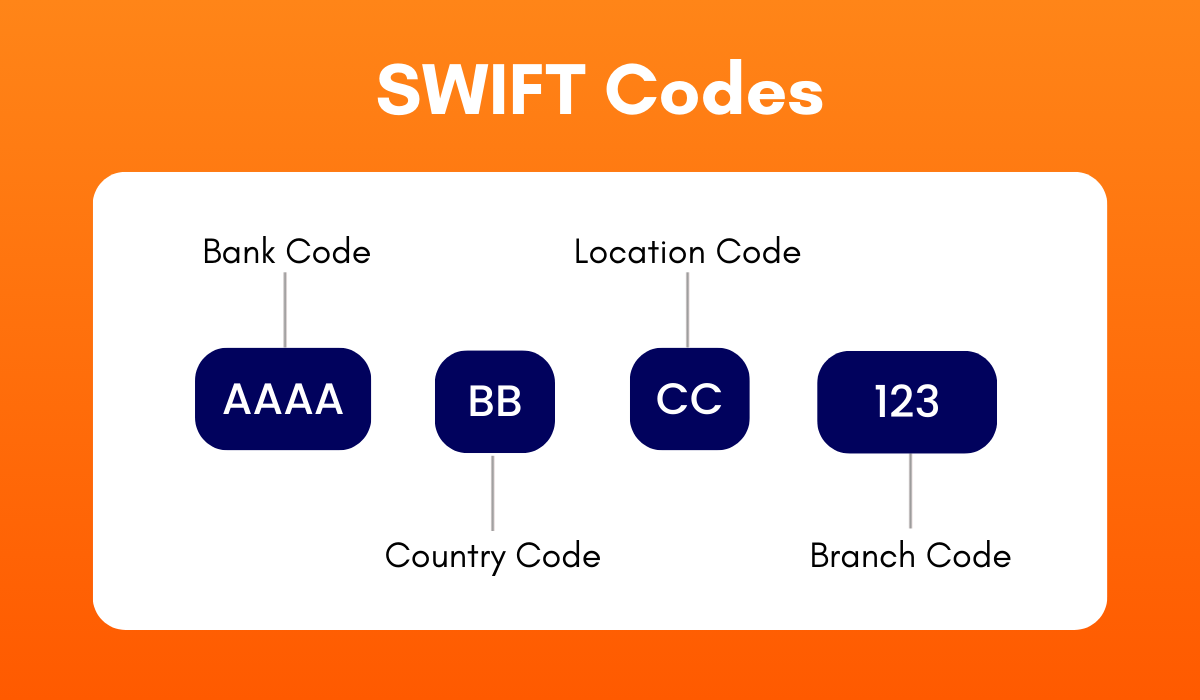
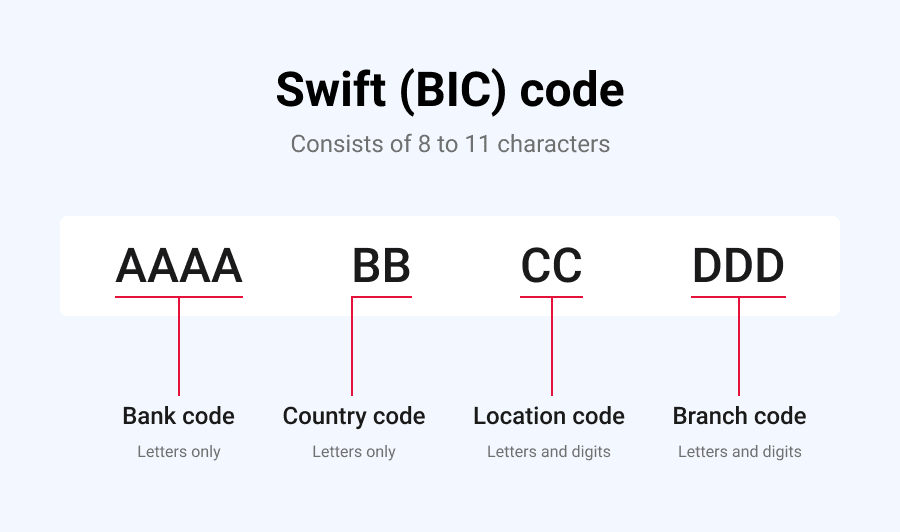
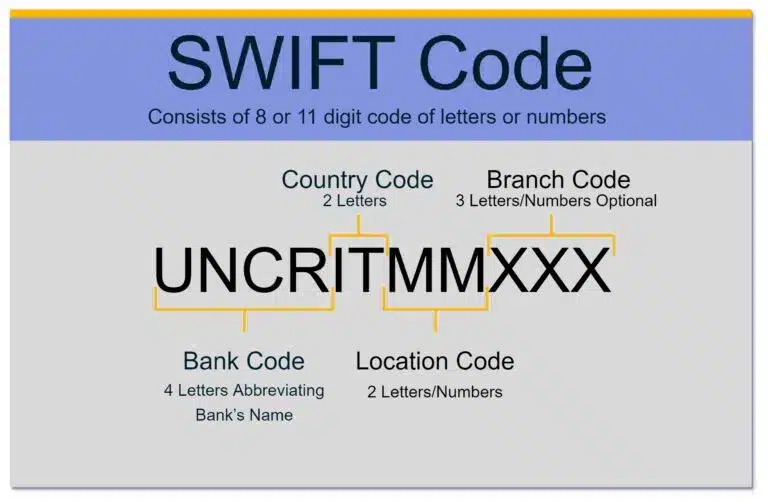
A SWIFT/BIC code is typically 8 or 11 characters long, comprising both letters and numbers, and follows a standardized format:
- Bank Code (4 letters): Represents the financial institution itself. For example, “HSBC” for HSBC Bank or “DEUT” for Deutsche Bank.
- Country Code (2 letters): Indicates the country where the bank is located, following the ISO 3166-1 alpha-2 standard. For instance, “US” for United States, “GB” for Great Britain, “DE” for Germany.
- Location Code (2 letters or numbers): Specifies the city or location of the bank’s headquarters or a particular branch. This helps differentiate banks within the same country.
- Branch Code (3 letters or numbers, optional): Identifies a specific branch of the bank. If omitted, the code usually refers to the bank’s head office. An 8-character code implies the head office.
Example: “DEUTDEFFXXX”
- DEUT: Bank Code (Deutsche Bank)
- DE: Country Code (Germany)
- FF: Location Code (Frankfurt)
- XXX: Branch Code (Head Office)
Why BICs are essential:
- Accurate Routing: They ensure that the SWIFT message, and consequently the funds, are directed to the correct bank and branch, preventing delays or misdirection.
- Standardization: The consistent format makes it universally recognizable and interpretable by all participating financial institutions.
- Security: By uniquely identifying institutions, BICs contribute to the overall security and integrity of international financial transactions.
When you’re preparing to receive or send an international payment, providing or requesting the correct SWIFT/BIC code along with the recipient’s full name, address, and account number (IBAN for European transfers) is paramount. A single incorrect digit or letter can lead to significant delays, fees for returned payments, or even lost funds.
The Mechanics of an International SWIFT Transfer
Understanding the steps involved in a SWIFT transfer provides insight into its robustness and, sometimes, its perceived slowness. Unlike instant digital payments within a single country, international transfers via SWIFT often involve multiple financial institutions.
Step-by-Step: From Sender to Recipient
- Initiation: The sender instructs their bank to make an international transfer, providing the recipient’s details (name, address, account number/IBAN, and the recipient bank’s SWIFT/BIC code).
- Sender’s Bank Action: The sender’s bank debits the sender’s account and generates a SWIFT message containing all transaction details.
- SWIFT Message Transmission: The sender’s bank sends this SWIFT message over the secure SWIFT network.
- Intermediary Banks (Correspondent Banks): If the sender’s bank and the recipient’s bank do not have a direct correspondent banking relationship (i.e., they don’t hold accounts with each other), the message and the funds may pass through one or more intermediary banks. Each intermediary bank deducts a fee for its service. This is a primary reason for varying fees and transfer times.
- Recipient Bank Action: The recipient’s bank receives the SWIFT message, verifies the details, and credits the recipient’s account.
- Notification: The recipient is notified that funds have arrived.
The entire process can take anywhere from 1 to 5 business days, depending on the number of intermediary banks, currency conversions, time zones, and the internal processing speeds of the banks involved.
Advantages and Disadvantages of SWIFT
Advantages:
- Global Reach: SWIFT offers unparalleled reach, connecting virtually every major financial institution worldwide.
- Security: The network is highly secure, employing robust encryption and security protocols to protect financial messages.
- Reliability: It’s a proven and highly reliable system, having operated successfully for decades as the standard for international banking communication.
- Standardization: The use of standardized message formats reduces errors and facilitates efficient processing.
Disadvantages:
- Speed: Compared to modern digital payment solutions, SWIFT transfers can be slow due to the multi-bank routing and manual processing involved.
- Cost: Fees can accumulate, especially with intermediary banks involved. Both the sending and receiving banks, plus any intermediaries, may charge a fee, reducing the final amount received.
- Transparency: Tracking the exact status of a SWIFT transfer in real-time can be challenging, as the network primarily sends messages rather than offering an end-to-end tracking service to customers.
- Complexity: The underlying correspondent banking system can be complex, leading to higher operational costs for banks, which are often passed on to consumers.
SWIFT’s Enduring Role in a Changing Financial Landscape
Despite the emergence of newer, often faster, and cheaper digital payment solutions, SWIFT continues to be an indispensable pillar of the global financial system. Its vast network, established trust, and robust security make it the go-to for high-value corporate transactions and interbank settlements.
SWIFT vs. Modern Alternatives
The financial technology (FinTech) revolution has introduced various alternatives for international money transfers, each with its own niche:
- Online Money Transfer Services (e.g., Wise, Remitly, Revolut): These services often bypass the traditional correspondent banking network by operating local bank accounts in various countries. They aggregate transfers and execute them locally, offering faster speeds and lower fees for retail consumers, often with more transparent exchange rates.
- Cryptocurrency and Blockchain: Technologies like Bitcoin or Ripple offer decentralized, peer-to-peer transaction capabilities that aim for near-instant settlement and significantly lower costs by removing intermediaries. However, volatility, regulatory uncertainty, and scalability remain challenges for widespread adoption in mainstream finance.
- Regional Payment Systems: Many regions have developed their own instant payment systems (e.g., SEPA Instant Credit Transfer in Europe) for domestic and regional transfers, offering real-time settlement within those specific geographies.
While these alternatives excel in certain areas, particularly for smaller, consumer-to-consumer or small business transfers, none yet possess the universal reach, regulatory acceptance, and institutional trust that SWIFT commands for the entire spectrum of global financial communications.
The Future of SWIFT
SWIFT itself is not stagnant. It is continually evolving to address market demands and competitive pressures. Initiatives like SWIFT gpi (global payments innovation) aim to improve the speed, transparency, and traceability of cross-border payments. SWIFT gpi provides end-to-end payment tracking, faster settlement times, and greater transparency on fees, bringing the traditional SWIFT network closer to the performance of modern FinTech solutions.
Furthermore, SWIFT is exploring the potential of new technologies, including distributed ledger technology (DLT), to further enhance its services while maintaining its core principles of security and reliability. Its resilience and adaptability demonstrate its commitment to remaining a central force in the future of global finance.
Conclusion
The notion of a “SWIFT account” is a common misconception that belies the true nature of SWIFT as a secure, standardized messaging network that underpins virtually all international banking communication. While you don’t open a “SWIFT account,” your traditional bank account becomes “SWIFT-enabled” when your bank joins the network and you use its services for international transactions.
Understanding SWIFT, its critical role in facilitating global financial flows, and the indispensable function of the SWIFT/BIC code is essential for anyone navigating the complexities of international finance. Despite the emergence of innovative alternatives, SWIFT’s extensive reach, unwavering security, and continuous evolution ensure its enduring position as the foundational standard for cross-border financial communication, connecting the world’s economy one secure message at a time.
aViewFromTheCave is a participant in the Amazon Services LLC Associates Program, an affiliate advertising program designed to provide a means for sites to earn advertising fees by advertising and linking to Amazon.com. Amazon, the Amazon logo, AmazonSupply, and the AmazonSupply logo are trademarks of Amazon.com, Inc. or its affiliates. As an Amazon Associate we earn affiliate commissions from qualifying purchases.