
Discovering that you owe the Internal Revenue Service (IRS) money can be a significant source of financial stress. Whether it stems from an underpayment of estimated taxes, a side hustle that generated more income than expected, or an error on a previous return, the prospect of a large tax bill is daunting. However, the IRS provides several structured mechanisms to help taxpayers fulfill their obligations without facing immediate financial ruin. Understanding how to set up IRS payments is a critical skill in personal and business finance management, ensuring you remain in good standing with the government while maintaining your liquid cash flow.

Navigating the IRS payment ecosystem requires a blend of administrative diligence and strategic financial planning. By choosing the right payment plan and method, you can minimize interest accrual, avoid aggressive collection actions like liens or levies, and potentially reduce the administrative fees associated with your debt.
Exploring the Different Types of IRS Payment Plans
Before you initiate a payment, you must determine which plan aligns best with your current cash flow and long-term financial health. The IRS offers several “installment agreements” tailored to different debt levels and repayment timelines.
Short-Term Payment Plans (180 Days)
For taxpayers who can pay their debt in full within a few months, the short-term payment plan—often referred to as a 180-day extension—is frequently the most cost-effective option. This plan is available to individuals who owe less than $100,000 in combined tax, penalties, and interest.
The primary advantage of this plan is the lack of a setup fee. While interest and late-payment penalties continue to accrue until the balance is zero, you avoid the administrative costs associated with longer agreements. This is an ideal solution for those expecting a year-end bonus, a significant commission, or the sale of an asset that will provide the necessary liquidity within a six-month window.
Long-Term Installment Agreements (Monthly Payments)
If your tax liability is too high to clear in six months, a long-term installment agreement (also known as a Standard Installment Agreement) allows you to pay monthly for up to 72 months. To qualify for an online application, individuals must owe $50,000 or less in combined tax, penalties, and interest. For businesses, this threshold is generally $25,000 or less for taxes currently in the collection process.
Under this plan, you commit to a specific monthly payment amount. The IRS offers two primary ways to facilitate these payments: Direct Debit and non-Direct Debit (such as check, money order, or credit card). Opting for Direct Debit is highly recommended by financial advisors because it carries a significantly lower setup fee and reduces the risk of missing a payment, which could default the agreement.
Offer in Compromise (OIC)
The Offer in Compromise is a more complex financial tool reserved for taxpayers who truly cannot pay their full tax liability or if doing so would create an unfair economic hardship. In an OIC, the IRS allows you to settle your tax debt for less than the full amount you owe.
This is not a “quick fix” and involves a rigorous evaluation of your income, expenses, asset equity, and future earning potential. The application process requires a non-refundable application fee and an initial payment, though these can be waived for low-income taxpayers. Because the IRS rejects a high percentage of OIC applications, this route should only be pursued with a thorough understanding of the “Reasonable Collection Potential” (RCP) formula used by the agency.
Navigating the Online Payment Agreement (OPA) Application
The most efficient way to set up IRS payments is through the Online Payment Agreement (OPA) system. Moving away from paper-based forms (like Form 9465) saves time and provides immediate confirmation of your agreement status.
Eligibility and Identity Verification
To use the OPA tool, you must first verify your identity. The IRS currently uses ID.me, a third-party credential service provider, to ensure the security of taxpayer data. You will need a government-issued photo ID (like a driver’s license or passport) and a smartphone to take a “selfie” for biometric verification.
Once your identity is verified, the system will display your current balance. It is important to note that you must have filed all required tax returns to be eligible for a payment plan. The IRS will not enter into an agreement with a taxpayer who is not current on their filings, as this is viewed as a sign of ongoing non-compliance.
The Application Process
The application itself is intuitive but requires precision. You will be asked to choose between a short-term or long-term plan. If choosing a long-term plan, you will select your monthly payment amount and the date each month the payment will be due.
When determining your monthly payment, it is tempting to choose the lowest possible amount to preserve cash flow. However, because the IRS charges a failure-to-pay penalty (0.5% per month, capped at 25%) and market-based interest rates (adjusted quarterly), a lower payment results in more interest paid over the life of the loan. It is often wiser to pay as much as your budget comfortably allows to minimize the total cost of the debt.

Fee Structures and Cost Mitigation
The cost of setting up a payment plan varies based on how you apply and how you pay. As of current standards, setting up a Direct Debit Installment Agreement (DDIA) online is the most affordable route, typically costing around $31. If you apply online but choose to pay via a non-automated method, the fee increases significantly (often over $100). If you apply via phone, mail, or in-person, the fees are even higher.
Low-income taxpayers may have these fees waived or reimbursed. Furthermore, if you establish a DDIA, you may be eligible for a reduced failure-to-pay penalty rate (0.25% instead of 0.5%) while the agreement is in effect.
Digital Payment Methods and Transaction Platforms
Once the agreement is in place, you need to execute the payments. The IRS offers several digital platforms, each with distinct advantages depending on whether you are managing personal or business finances.
Direct Pay
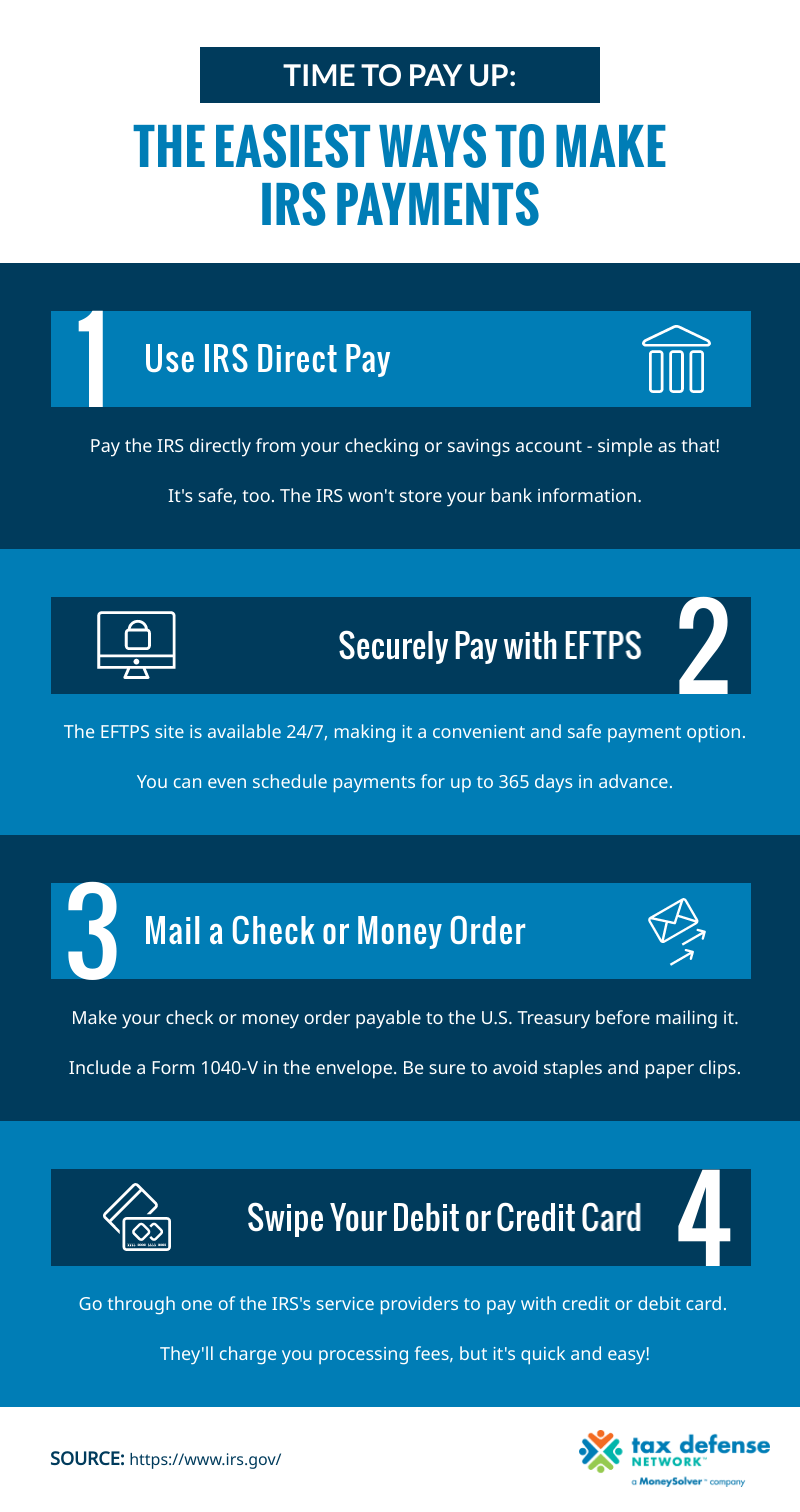
IRS Direct Pay is the gold standard for individual taxpayers making one-time payments or paying toward a short-term plan. It allows you to pay directly from your checking or savings account without any processing fees. The system provides instant confirmation, and you can schedule payments up to 365 days in advance. It is specifically designed for 1040-series tax returns, estimated taxes, and installment agreement payments.
EFTPS: The Electronic Federal Tax Payment System
For business owners or individuals who prefer a more robust tracking system, the Electronic Federal Tax Payment System (EFTPS) is the preferred choice. Unlike Direct Pay, EFTPS requires an enrollment process where a PIN is mailed to your registered address.
EFTPS is highly secure and is the primary tool for federal tax deposits, including payroll taxes and corporate income taxes. It maintains a 16-month history of your payment records, which is invaluable for business accounting and audit defense.
Credit and Debit Card Payments
While the IRS does not directly process credit card payments, they authorize several third-party processors to handle these transactions. Paying by card can be beneficial if you are trying to earn travel rewards or if you need to bridge a very short liquidity gap.
However, from a financial standpoint, this is usually the most expensive option. The processors charge a convenience fee (typically between 1.82% and 1.98% for credit cards). When you combine this fee with the interest rate charged by your credit card issuer, the total cost of debt can skyrocket. This method should only be used if the value of the rewards or the necessity of the “float” outweighs the processing costs.
Best Practices for Long-Term Tax Health
Setting up a payment plan is a reactive measure. To achieve true financial stability, you must transition to a proactive strategy that prevents future tax debt from accumulating.
Adjusting Withholding and Estimated Payments
The most common reason for an IRS balance is inadequate withholding throughout the year. If you are an employee, use the IRS Tax Withholding Estimator to determine if you need to submit a new Form W-4 to your employer. If you are self-employed or have significant investment income, you must stay disciplined with quarterly estimated tax payments (Form 1040-ES).
A good rule of thumb for the self-employed is to set aside 25-30% of all gross income into a dedicated high-yield savings account labeled “Taxes.” This ensures that when the tax deadline arrives, the funds are already liquid and earning interest for you, rather than accruing interest for the IRS.
Monitoring Your IRS Account
Modern financial management involves regular check-ins with your digital footprints. By logging into your IRS Online Account periodically, you can view your payout history, track the progress of your installment agreement, and see any digital copies of notices sent to you. This transparency allows you to catch errors early—such as a payment being applied to the wrong tax year—before they result in penalties or a defaulted agreement.
The Role of Professional Guidance
While the IRS has made the payment setup process more accessible, complex cases involving large sums, business complications, or back-taxes from multiple years may require a Certified Public Accountant (CPA) or an Enrolled Agent (EA). These professionals can represent you before the IRS (Power of Attorney), negotiate more favorable terms, and ensure that you are taking advantage of all available deductions and credits to lower the principal balance.
Managing IRS payments is ultimately about control. By understanding the available plans, utilizing digital tools for efficiency, and maintaining a forward-looking tax strategy, you can transform a potential financial crisis into a manageable, structured process. Prompt action is the most effective way to protect your credit, your assets, and your peace of mind.
aViewFromTheCave is a participant in the Amazon Services LLC Associates Program, an affiliate advertising program designed to provide a means for sites to earn advertising fees by advertising and linking to Amazon.com. Amazon, the Amazon logo, AmazonSupply, and the AmazonSupply logo are trademarks of Amazon.com, Inc. or its affiliates. As an Amazon Associate we earn affiliate commissions from qualifying purchases.