
For many professionals, the shift from a traditional W-2 employment structure to self-employment, freelance work, or small business ownership is a significant milestone in career autonomy. However, this transition brings with it a complex shift in financial responsibility. Under a standard employment contract, your employer handles the heavy lifting of tax compliance by withholding a portion of every paycheck for federal and state authorities. When you become your own employer, that “pay-as-you-go” responsibility falls squarely on your shoulders.
Quarterly estimated tax payments are the mechanism the IRS uses to ensure that taxpayers with income not subject to withholding—such as 1099 income, dividends, or rental income—contribute to the system throughout the year. Mastering this process is not merely a matter of legal compliance; it is a fundamental pillar of sophisticated personal finance and business cash flow management.

The Fundamentals of the Pay-As-You-Go Tax System
The United States tax system operates on a “pay-as-you-go” basis. This means the government expects to receive tax revenue as you earn or receive income during the year, rather than in one lump sum on April 15th. For the self-employed, independent contractors, and investors, this necessitates making quarterly estimated tax payments.
Who is Required to Pay Quarterly?
Generally, you are required to make estimated tax payments if you expect to owe at least $1,000 in federal tax for the current year after subtracting your federal income tax withholding and credits. This applies to individuals, sole proprietors, partners, and S corporation shareholders. If you still have a W-2 job while running a side hustle, you may be able to avoid quarterly payments by increasing the withholding on your W-2 wages. However, if your side income is substantial, the quarterly system becomes unavoidable.
The Safe Harbor Rule and Avoiding Penalties
The IRS imposes underpayment penalties if you do not pay enough tax throughout the year. To avoid these penalties, you must meet the “Safe Harbor” requirements. Generally, you will not face a penalty if you pay at least 90% of the tax shown on your return for the current year or 100% of the tax shown on your return for the prior year, whichever is smaller. For high-income earners (those with an adjusted gross income over $150,000), the prior-year safe harbor requirement increases to 110%. Understanding these benchmarks is critical for financial planning, as they provide a clear target to aim for, regardless of how much your income fluctuates.
Precision Planning: How to Calculate Your Estimated Payments
The most daunting aspect of quarterly taxes is determining exactly how much to send to the IRS. Unlike a fixed salary, entrepreneurial and investment income can be volatile, making it difficult to predict your total annual liability.
Utilizing the IRS Form 1040-ES
To calculate your estimated tax, you should use Form 1040-ES, “Estimated Tax for Individuals.” This form includes a worksheet that guides you through estimating your expected adjusted gross income, taxable income, taxes, deductions, and credits for the year. It is often helpful to use your prior year’s tax return as a baseline, adjusting for any anticipated changes in your business expenses or income streams.
Accounting for Self-Employment Tax
One of the most common oversights for new entrepreneurs is failing to account for self-employment tax. When you are an employee, you pay 7.65% of your income toward Social Security and Medicare, and your employer matches that amount. When you are self-employed, you are both the employer and the employee, meaning you are responsible for the full 15.3%. While you can deduct the employer-equivalent portion of your self-employment tax when calculating your adjusted gross income, you must factor the total amount into your quarterly payments to avoid a massive shortfall at year-end.
Adjusting for Variable Income
If your income is seasonal or highly unpredictable, you may use the “annualized income installment method.” This allows you to pay an amount based on what you actually earned during each specific quarter, rather than paying four equal installments. While this requires more complex record-keeping and the filing of Form 2210 with your annual return, it can significantly improve your cash flow during slower months by preventing overpayment early in the year.
Navigating the Payment Infrastructure
Once you have calculated your liability, the next step is the actual transfer of funds. The IRS has modernized its payment systems, offering several digital pathways that are far more efficient than traditional paper checks.
IRS Direct Pay and the EFTPS System
For individual taxpayers, IRS Direct Pay is the most streamlined option. It allows you to transfer funds directly from your checking or savings account without any prior registration or fees. You simply select “Estimated Tax” as the reason for payment and “1040-ES” as the form.
For business owners or those who prefer more robust tracking, the Electronic Federal Tax Payment System (EFTPS) is a free service provided by the Department of the Treasury. While it requires an initial enrollment process—which involves receiving a PIN via physical mail—it allows you to schedule payments up to 365 days in advance and maintains a detailed history of your transactions. This is particularly useful for ensuring you never miss a deadline.
Mobile and Digital Wallet Options
In recent years, the IRS has expanded its digital reach. You can now pay your estimated taxes through the IRS2Go app or via third-party processors that accept credit cards, debit cards, and digital wallets like PayPal or Click to Pay. While convenient, it is important to note that third-party processors charge a convenience fee (usually a percentage of the total payment), which can be significant depending on the size of your tax bill.
Traditional Mail-In Vouchers
If you prefer a paper trail, you can mail a check or money order along with the payment vouchers found in Form 1040-ES. If you choose this route, it is highly recommended to use certified mail with a return receipt. This provides legal proof that your payment was postmarked by the deadline, protecting you from late-payment penalties resulting from postal delays.
Cash Flow Optimization and Tax Mitigation Strategies
Paying taxes quarterly requires a shift in how you view your “take-home” pay. Treating your gross income as your personal money is a recipe for financial distress. Professional financial management involves building a system that treats taxes as a non-negotiable business expense.
The Dedicated Tax Sinking Fund
A “sinking fund” is a strategic way to set aside money for a specific future expense. For quarterly taxes, you should open a separate, high-yield savings account dedicated solely to tax obligations. A best practice is to move a fixed percentage of every incoming payment—typically between 25% and 35%, depending on your tax bracket and state—into this account immediately upon receipt. By doing this, the money is “out of sight, out of mind,” and you ensure that the funds are available when the quarterly deadline arrives.
Real-Time Expense Tracking
Your quarterly payment is based on your net profit, not your gross revenue. Therefore, the more diligent you are about tracking your deductible business expenses in real-time, the more accurate (and often lower) your quarterly payments will be. Utilizing accounting software that syncs with your bank accounts allows you to see your true taxable income at any given moment. This prevents you from overpaying the IRS and tied up capital that could otherwise be used to grow your business or invest.
Leveraging Tax-Advantaged Retirement Accounts
Contributions to a SEP IRA, Solo 401(k), or SIMPLE IRA can significantly reduce your taxable income. When calculating your quarterly installments, factor in these contributions. By proactively funding your retirement throughout the year rather than waiting until the last minute, you lower your quarterly liability and put your capital to work in the market earlier, benefiting from the power of compounding.
Compliance and Deadlines: Staying Ahead of the IRS
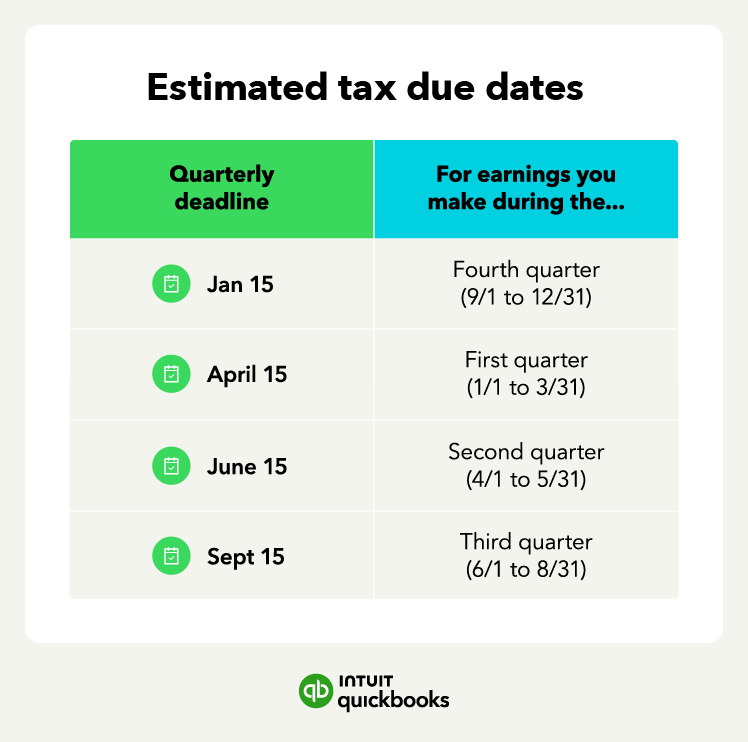
The IRS divides the year into four distinct payment periods. Failing to meet these specific deadlines can result in interest charges, even if you eventually pay the full amount by April.
The Standard Quarterly Schedule
The deadlines for quarterly estimated payments generally follow this pattern:
-
1st Period (Jan 1 – March 31): Payment due April 15.
-
2nd Period (April 1 – May 31): Payment due June 15.
-
3rd Period (June 1 – Aug 31): Payment due September 15.
-
4th Period (Sept 1 – Dec 31): Payment due January 15 of the following year.
If these dates fall on a weekend or a legal holiday, the deadline is pushed to the next business day. It is vital to note that the periods are not of equal length, which is a common point of confusion for new taxpayers. The second “quarter” is only two months long, while the fourth “quarter” is four months long.
Maintaining an Audit-Trail Documentation
The final component of a successful quarterly tax strategy is meticulous record-keeping. For every payment made, save a digital copy of the confirmation number or a scan of the canceled check. Maintain a spreadsheet that tracks the date of payment, the amount paid, and the specific tax year/period it applies to. When you sit down with your CPA or tax software in April, having this “Estimated Tax Ledger” ready will transform a chaotic tax season into a simple reconciliation process.
By viewing quarterly taxes not as a burden, but as a structured component of your financial ecosystem, you gain greater control over your business’s liquidity and ensure long-term fiscal stability. High-level financial success is rarely about how much you earn; it is about how effectively you manage what you keep.
aViewFromTheCave is a participant in the Amazon Services LLC Associates Program, an affiliate advertising program designed to provide a means for sites to earn advertising fees by advertising and linking to Amazon.com. Amazon, the Amazon logo, AmazonSupply, and the AmazonSupply logo are trademarks of Amazon.com, Inc. or its affiliates. As an Amazon Associate we earn affiliate commissions from qualifying purchases.