
In the contemporary financial landscape, few events trigger as much anticipation, volatility, and speculative fervor as the quarterly earnings release from NVIDIA Corporation. Once a niche player known primarily by PC gaming enthusiasts, NVIDIA has evolved into the gravitational center of the global equity market. For the modern investor, knowing exactly when the report drops is only the first step; understanding the financial machinery behind the numbers is what separates a reactive trader from a strategic investor.
Typically, NVIDIA releases its quarterly financial results shortly after the closing bell of the Nasdaq Stock Market, which occurs at 4:00 PM Eastern Time (ET). Most historical releases have been issued between 4:20 PM and 4:25 PM ET. This is immediately followed by a conference call, usually scheduled for 5:00 PM ET, where executive leadership provides context, updates on forward-looking guidance, and answers questions from top-tier institutional analysts.
The Significance of NVIDIA Earnings for the Modern Portfolio
NVIDIA has become more than just a semiconductor company; it is a macro-economic indicator. Because its chips power the vast majority of generative artificial intelligence (AI) applications, its earnings reports serve as a litmus test for the health of the entire tech sector and the broader “AI trade.” When NVIDIA reports, the entire S&P 500 and Nasdaq-100 often move in tandem with its results.
The Barometer for Capital Expenditure
Institutional investors look at NVIDIA’s revenue not just to see how much the company earned, but to gauge how much the “hyperscalers”—companies like Microsoft, Alphabet, Amazon, and Meta—are spending on infrastructure. If NVIDIA’s Data Center revenue exceeds expectations, it signals that the world’s largest corporations are still aggressively investing in future-proofing their businesses. Conversely, a miss or a cautious guide can trigger a cascade of selling across the technology sector, as investors fear a “cooling off” period in capital expenditure.
Market Capitalization and Index Weighting
As NVIDIA’s market capitalization has surged into the trillions, its weight within major indexes has reached a point where it can single-handedly dictate the direction of the market. For those holding passive index funds or ETFs, NVIDIA’s earnings are just as important as they are for individual stock pickers. The “NVIDIA effect” means that a 5% swing in its share price can move billions of dollars in market value across the globe in a matter of seconds during the after-hours trading session.
Key Financial Metrics Every Investor Should Scrutinize
While the headline “beat or miss” on earnings per share (EPS) and revenue often drives the initial price action, seasoned investors dive deeper into the specific line items of the balance sheet and income statement to determine the long-term health of the investment.
Data Center Revenue: The Growth Engine
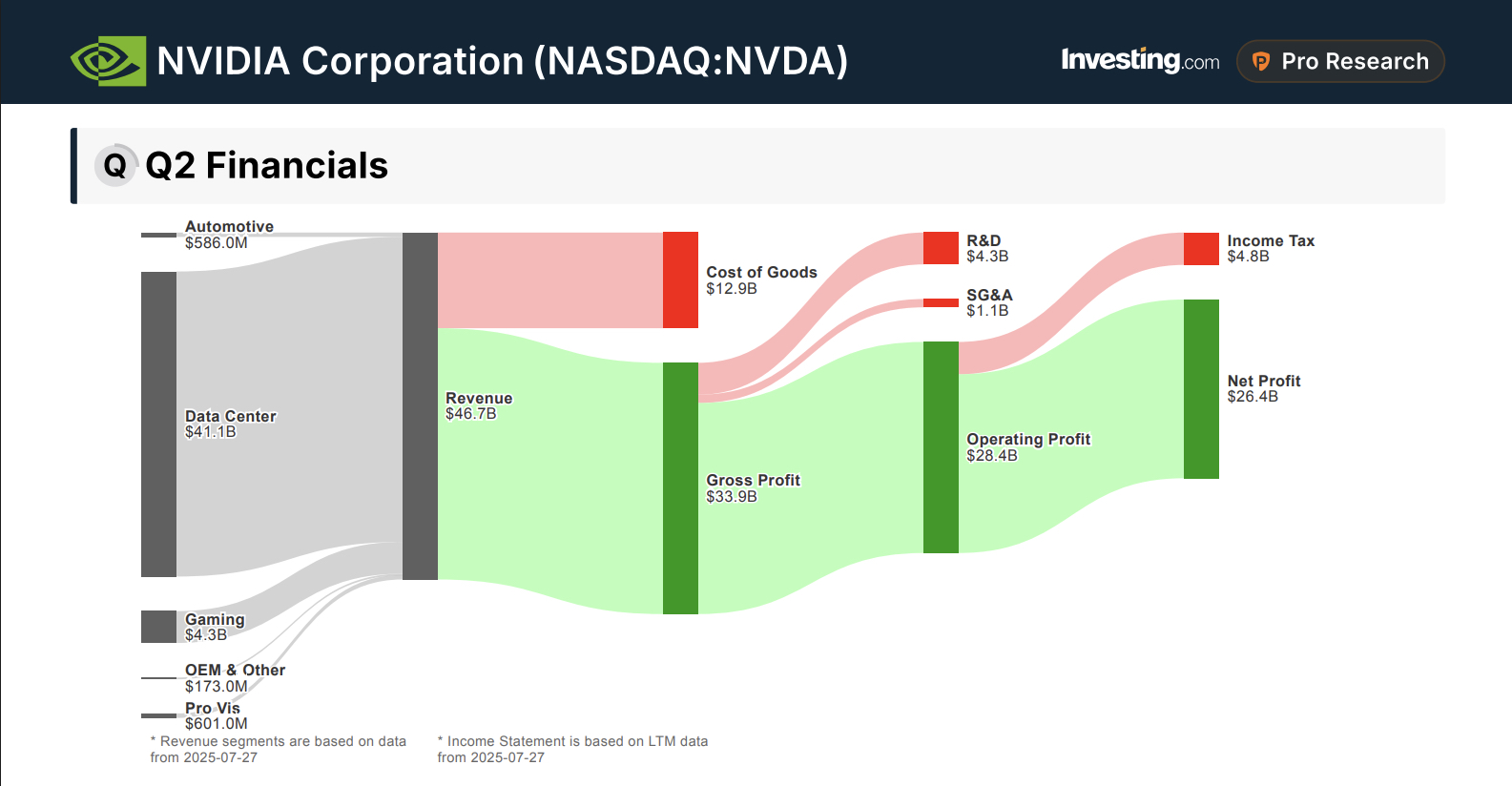
In the current era, the Data Center segment is the crown jewel of NVIDIA’s business model. This segment includes sales of the H100, H200, and the newer Blackwell architecture chips. Investors should look for the year-over-year growth rate in this category. A slowdown here, even if the numbers are objectively high, can lead to a “priced for perfection” sell-off. The sustainability of this growth is the primary driver of the company’s high price-to-earnings (P/E) multiple.
Gross Margins and Pricing Power
NVIDIA has historically commanded impressive gross margins, often exceeding 70%. In the world of finance, high gross margins are a sign of a “moat”—a competitive advantage that allows a company to maintain high prices despite competition. If margins begin to compress, it may suggest that competitors like AMD or bespoke in-house chips from cloud providers are beginning to eat into NVIDIA’s dominance. Monitoring the “Non-GAAP Gross Margin” provides a clear view of how efficiently the company is producing its hardware relative to its sales price.
Forward Guidance: The “Whisper Number”
Wall Street is a forward-looking mechanism. Often, a company can report record-breaking profits for the previous quarter but see its stock price tumble because the “guidance”—the company’s forecast for the next quarter—is lower than analysts’ expectations. The “whisper number” is the unofficial expectation held by traders that often sits higher than the official analyst consensus. To see a positive post-market reaction, NVIDIA generally needs to not only beat the consensus but also raise its full-year outlook.

Navigating Volatility and Strategy Around Earnings Day
Earnings season is notoriously volatile, and NVIDIA is often the poster child for significant price swings. For the retail investor, this volatility presents both a risk and an opportunity, requiring a disciplined approach to risk management.
The Role of Implied Volatility
In the options market, “implied volatility” (IV) typically spikes leading up to the earnings report. This represents the market’s expectation of how much the stock will move. High IV makes options expensive to buy. Many retail investors fall into the trap of “IV crush,” where they buy a call option, the stock goes up slightly, but the value of the option actually decreases because the uncertainty (and thus the volatility premium) vanished the moment the news was released. Understanding this financial mechanic is crucial for anyone using derivatives to hedge or speculate on the report.
Dollar-Cost Averaging vs. Lump Sum
For long-term investors, the exact time of the earnings report is less important than the company’s multi-year trajectory. Rather than trying to “time” a purchase minutes before the 4:00 PM ET bell, many successful investors utilize dollar-cost averaging (DCA). By spreading purchases out over several weeks or months, an investor can mitigate the risk of buying a massive position right before a potential “sell-on-the-news” event.
Reading the Conference Call Transcript
The numbers tell you what happened, but the conference call tells you why. When the call begins at 5:00 PM ET, investors should listen for comments regarding supply chain constraints. In recent quarters, NVIDIA’s growth hasn’t been limited by demand, but by how fast they can manufacture chips. Any mention of improved supply-chain fluidity is generally viewed as a bullish signal for future revenue capacity.
The Broader Economic Ripple Effects
NVIDIA does not exist in a vacuum. Its earnings report has a profound impact on several related financial instruments and sectors, making it a “must-watch” event even for those who do not own the stock directly.
Impact on Semiconductor ETFs
Exchange-Traded Funds such as the VanEck Semiconductor ETF (SMH) or the iShares Semiconductor ETF (SOXX) hold NVIDIA as a top position. Because these ETFs are benchmarks for the industry, NVIDIA’s performance often dictates the flow of institutional capital into the entire semiconductor sector. A strong report can lift the “tide” for all boats, including equipment manufacturers like ASML and foundries like TSMC.
The Correlation with Big Tech
As mentioned previously, the “Magnificent Seven” stocks are highly correlated. If NVIDIA reports a slowdown in AI infrastructure demand, it creates a narrative shift for companies like Microsoft and Amazon. Investors begin to question when the massive investments these companies are making into AI will start to show a Return on Investment (ROI). Therefore, the NVIDIA report often serves as the final confirmation of the strength of the “Big Tech” earnings cycle.
Global Market Sentiment
Because NVIDIA is a global company with a complex international supply chain, its report is also scrutinized for clues regarding global trade relations, particularly between the U.S. and China. Export controls and regulatory hurdles are frequent topics during the Q&A session. Financial analysts use these insights to adjust their risk models for international trade and geopolitical stability.

Conclusion: Preparing for the Release
To properly prepare for NVIDIA’s earnings, an investor should have a checklist ready before the 4:00 PM ET bell. This includes knowing their personal “exit price” or “buy-more price,” understanding the consensus estimates for revenue and EPS, and having a clear view of their portfolio’s total exposure to the semiconductor industry.
The earnings report is a high-stakes moment of transparency in the financial world. While the “what time” is a simple matter of checking the clock, the “what it means” is a complex calculation of growth, valuation, and market psychology. By focusing on the underlying financial metrics—Data Center growth, gross margins, and forward guidance—investors can look past the immediate after-hours noise and make informed decisions that align with their long-term financial goals. Whether the stock moves up, down, or sideways, the data provided in those few minutes after the market closes will dictate the narrative of the financial markets for the months to come.
aViewFromTheCave is a participant in the Amazon Services LLC Associates Program, an affiliate advertising program designed to provide a means for sites to earn advertising fees by advertising and linking to Amazon.com. Amazon, the Amazon logo, AmazonSupply, and the AmazonSupply logo are trademarks of Amazon.com, Inc. or its affiliates. As an Amazon Associate we earn affiliate commissions from qualifying purchases.