
In the world of high-stakes investing, few names command as much attention as NVIDIA Corporation. As the undisputed leader of the artificial intelligence revolution, NVIDIA’s stock price has become a barometer for the broader tech sector and the global economy’s appetite for computational power. For many retail investors, the sheer velocity of the stock’s ascent raises a recurring question: When will NVIDIA stock split again? To answer this, one must look beyond simple price targets and delve into the strategic financial engineering, market psychology, and corporate governance that dictate such decisions.
The Mechanics and Motivation of the Stock Split
A stock split is often misunderstood as a value-creating event. In reality, it is a neutral accounting action. When a company like NVIDIA decides to split its shares—whether it be a 2-for-1, 4-for-1, or the massive 10-for-1 split witnessed in mid-2024—the fundamental value of the company does not change. If you have one pie cut into four pieces, and you then cut those four pieces into eight, you still have the same amount of pie.
However, in the “Money” niche of finance and personal investing, the psychological and structural impacts are profound. The primary motivation for a split is accessibility. When a stock price climbs into the high hundreds or surpasses the thousand-dollar mark, it creates a barrier to entry for the average retail investor. While fractional shares have become more common through modern fintech apps, many traditional brokerage platforms and international investors still prefer or require the purchase of whole shares. By lowering the price per share, a company broadens its potential investor base, democratizing ownership.
Furthermore, stock splits enhance liquidity. By increasing the number of shares outstanding, the bid-ask spread—the difference between what a buyer is willing to pay and what a seller is willing to accept—often narrows. This increased volume makes it easier for large institutional players and small-scale traders alike to enter and exit positions without causing massive price swings. For NVIDIA, a company that thrives on being a household name in both the gaming and enterprise AI sectors, maintaining a “reachable” stock price is a key component of its corporate branding and investor relations strategy.
The Signal of Confidence
Beyond the math, a stock split serves as a potent signal to the market. Historically, management teams only authorize a split when they are confident that the stock price will continue to rise or, at the very least, remain stable at the new, lower level. A split is essentially a “vote of confidence” from the board of directors, suggesting that the current high valuation isn’t a temporary bubble but a new baseline. Investors often react bullishly to split announcements because they interpret them as a sign that the company’s growth trajectory remains steep.
NVIDIA’s Historical Context: A Legacy of Strategic Re-adjustments
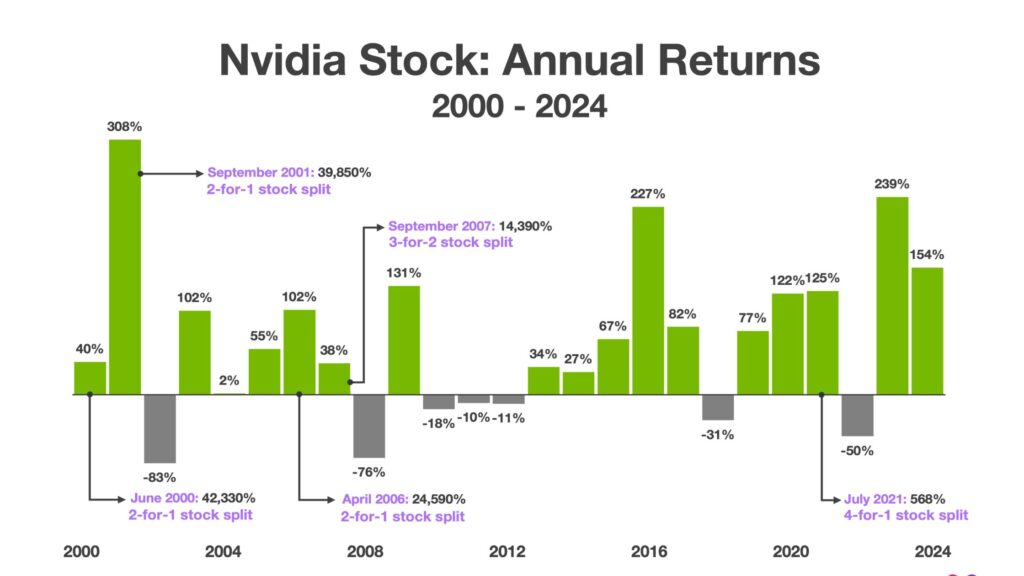
To predict when the next split might occur, we must look at NVIDIA’s history. NVIDIA has a long track record of using splits to manage its share price. Before the explosive growth of the AI era, the company utilized splits to keep pace with its dominance in the Graphics Processing Unit (GPU) market.
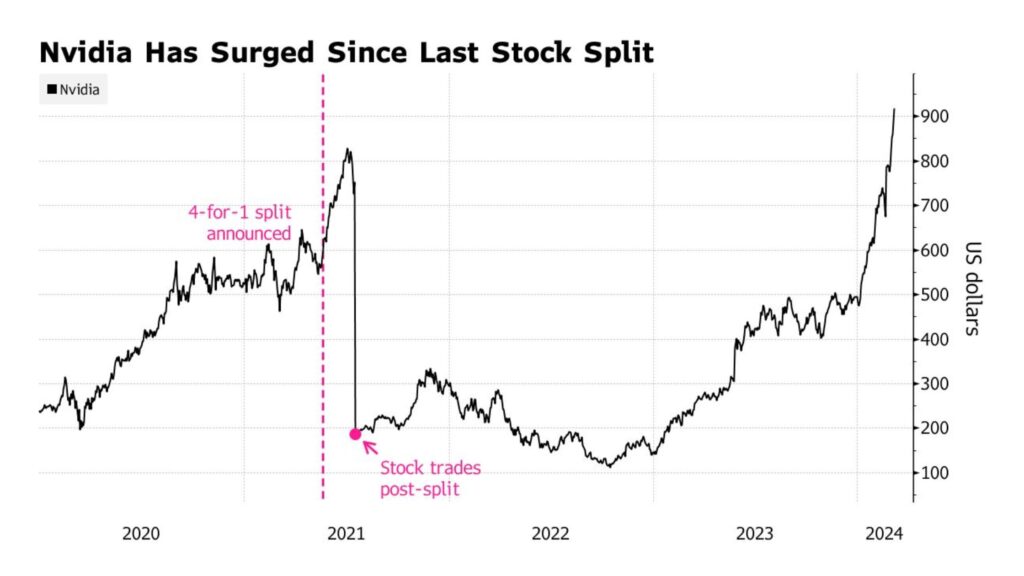
The most recent and significant event was the 10-for-1 stock split that took effect in June 2024. At the time, NVIDIA’s shares were trading north of $1,000. This move was not just about making shares cheaper; it was a strategic alignment with the company’s massive revenue growth. Between 2023 and 2024, NVIDIA’s data center revenue surged by triple digits, driven by the insatiable demand for H100 and Blackwell chips.
Lessons from the 10-for-1 Split
The June 2024 split provides a blueprint for what to expect in the future. NVIDIA’s management waited until the stock had reached a price point where a single share represented a significant hurdle for retail participation. By choosing a 10-for-1 ratio, they aggressively reset the price to approximately $100–$120 per share. This “reset” gave the stock plenty of “runway” to grow again before hitting the psychological $500 or $1,000 barriers.
Historically, NVIDIA does not split shares every year. They tend to wait for a sustained period of outperformance where the price doubles or triples the median share price of the S&P 500. This suggests that while a split isn’t likely in the immediate months following a major adjustment, the window of possibility reopens once the stock begins to flirt with the $500 mark again.
Predicting the Next Move: Key Indicators for Future Splits
Predicting the exact date of a future NVIDIA stock split requires monitoring three critical financial pillars: the “Dow Theory” of inclusion, the options market dynamics, and the AI hardware replacement cycle.
The Dow Jones Industrial Average Ambition
One of the most compelling reasons for NVIDIA to keep its stock price relatively low (via splits) is its potential or ongoing inclusion in price-weighted indices like the Dow Jones Industrial Average (DJIA). Unlike the S&P 500, which is market-cap weighted, the Dow is weighted by the price of the individual shares. A stock trading at $1,000 would disproportionately dominate the Dow, making it impossible for the index to include it without distorting the entire average. By maintaining a share price in the $100 to $200 range, NVIDIA makes itself a viable candidate for the Dow, which brings increased institutional buying from funds that track that specific index.
The Options Market and Volatility
For sophisticated investors, stock splits are vital because of their impact on the options market. Standardized options contracts represent 100 shares of the underlying stock. When NVIDIA trades at $1,200, a single call option contract controls $120,000 worth of stock, making the premium (the cost of the option) prohibitively expensive for most individual traders. When the stock splits, the options also adjust, making the premiums more affordable. This increases the “gamma” and overall trading activity around the stock, which NVIDIA’s board views as a positive for market health and price discovery.
Revenue Growth and the “Blackwell” Factor
The fundamental driver of the next split will be the success of NVIDIA’s next-generation architectures. If the Blackwell chips and subsequent “Rubin” platforms continue to drive record-breaking quarterly earnings, the share price will naturally climb. Most analysts suggest that NVIDIA monitors a “split zone”—a price range typically between $150 and $250. If the stock sustains a price above this range for several quarters, the conversation in the boardroom inevitably shifts toward another split.
Strategic Implications for the Retail Portfolio
For the individual investor, the question of “when” a split happens should be secondary to the question of “how” to position a portfolio in anticipation of one. While the split itself doesn’t change the value of your holdings, the market volatility surrounding the announcement often creates opportunities.
Buying Before or After the Split?
There is a common debate in personal finance: Should you buy before or after a split? Historically, stocks tend to run up in price between the announcement of a split and the actual execution date, as excitement builds. After the split, there is sometimes a short-term cooling-off period as “buy the rumor, sell the news” traders exit their positions. However, for a long-term investor, these micro-movements are less important than the underlying company fundamentals. If NVIDIA continues to dominate the AI chip market with 80% to 90% market share, the “split” is merely a cosmetic change to a high-performing engine.
The Power of Fractional Shares and DCA
In the modern era, you do not have to wait for a split to invest in NVIDIA. Dollar-cost averaging (DCA) allows investors to put a fixed amount of money—say $100 a month—into the stock regardless of its share price. This strategy mitigates the risk of “timing the market” and ensures that you are accumulating shares when they are both “expensive” and “cheap.” If a split occurs, your fractional shares simply multiply in quantity, maintaining your percentage ownership of the company.

Macro-Economic Factors Influencing NVIDIA’s Capital Structure
Finally, we must consider the broader economic environment. Stock splits do not happen in a vacuum. Interest rates, global semiconductor supply chains, and geopolitical tensions regarding Taiwan (where NVIDIA’s chips are manufactured by TSMC) all play a role in the company’s valuation.
If the Federal Reserve enters a cycle of rate cuts, growth stocks like NVIDIA typically benefit from lower discount rates, pushing the share price higher and accelerating the timeline for a split. Conversely, if the AI “hype” cycles into a “trough of disillusionment,” where companies pull back on capital expenditure for data centers, NVIDIA’s stock may consolidate or pull back, delaying the need for any share count adjustment.
NVIDIA’s management, led by Jensen Huang, has shown a preference for long-term strategic planning over short-term market manipulation. They view the stock price as a reflection of the value they provide to the ecosystem. Therefore, the next split will likely occur when the current price begins to hinder the fluidity of the global trading community.
In conclusion, while we cannot pinpoint a calendar date without a formal SEC filing, the indicators are clear. As long as NVIDIA remains the “arms dealer” of the AI gold rush, its share price will continue to face upward pressure. Based on historical patterns and the need for index inclusion and options liquidity, investors should look for the “split conversation” to return whenever the stock price consistently exceeds its peers in the “Magnificent Seven” or nears the quadruple-digit mark once again. For the savvy investor, the split is not the goal—it is a milestone on the journey of a company that has redefined the boundaries of modern computing and wealth creation.
aViewFromTheCave is a participant in the Amazon Services LLC Associates Program, an affiliate advertising program designed to provide a means for sites to earn advertising fees by advertising and linking to Amazon.com. Amazon, the Amazon logo, AmazonSupply, and the AmazonSupply logo are trademarks of Amazon.com, Inc. or its affiliates. As an Amazon Associate we earn affiliate commissions from qualifying purchases.