
In the current financial landscape, few tickers command as much attention, gravity, and speculative fervor as NVDA. NVIDIA has transitioned from a niche hardware provider for gaming enthusiasts into the undisputed backbone of the global artificial intelligence revolution. As investors watch the stock navigate unprecedented highs and periods of sharp volatility, understanding the fundamental drivers, valuation metrics, and macroeconomic pressures is essential for anyone looking to navigate the modern equity market.
To understand what is happening with NVIDIA stocks today, one must look beyond the daily price fluctuations and examine the structural shift in global computing. We are witnessing a transition from general-purpose computing to accelerated computing, and NVIDIA sits at the epicenter of this trillion-dollar migration.
The Engines of Growth: Data Centers and the Blackwell Cycle
The primary catalyst behind NVIDIA’s astronomical stock performance is its Data Center division. In recent fiscal quarters, this segment has accounted for the vast majority of the company’s revenue, often posting year-over-year growth rates exceeding 400%. This is not merely a cyclical uptick; it represents a fundamental rebuilding of the world’s digital infrastructure.
The Dominance of Hopper and the Transition to Blackwell
For the past two years, the H100 “Hopper” GPU has been the gold standard for training large language models (LLMs). Tech giants like Microsoft, Meta, Alphabet, and Amazon have engaged in an “arms race,” purchasing these chips by the tens of thousands to secure their positions in the AI economy. However, the market is currently transitioning to the next generation: the Blackwell architecture.
The Blackwell B200 and GB200 systems represent a massive leap in performance and energy efficiency. From an investment perspective, this transition is critical because it addresses the “air pocket” theory—the fear that demand might dip as customers wait for new hardware. Instead, demand for Blackwell has outstripped supply, with lead times extending well into the next fiscal year. This supply-constrained environment creates a revenue floor, providing investors with a degree of predictability that is rare in the semiconductor industry.
Sovereign AI: A New Frontier for Revenue
Beyond the “hyperscalers” (the large cloud providers), NVIDIA is tapping into a new market known as “Sovereign AI.” Nations across the globe, from Saudi Arabia to Japan and various European states, are investing in their own domestic AI infrastructure to ensure data security and cultural alignment. This diversification of the customer base reduces NVIDIA’s reliance on a handful of Silicon Valley giants, creating a more resilient revenue stream that protects the stock from localized sector downturns.
Valuation Analysis: Is the Stock Overextended?
When a stock grows by triple digits in a single year, the immediate concern for any disciplined investor is valuation. Critics often point to the high price-to-earnings (P/E) ratio as evidence of a bubble reminiscent of the dot-com era. However, a deeper dive into the “Money” aspect of NVIDIA reveals a more nuanced picture.
The PEG Ratio and Earnings Power
While NVIDIA’s nominal share price is high, its forward P/E ratio has, at various points, actually decreased even as the stock price rose. This paradox occurs because the company’s earnings growth has outpaced its share price appreciation. Financial analysts frequently look at the Price/Earnings-to-Growth (PEG) ratio to determine if a growth stock is reasonably priced. For much of its recent run, NVIDIA’s PEG ratio has remained competitive compared to other high-growth software and hardware companies, suggesting that the stock is not as “expensive” as it appears on the surface.
Margins and Free Cash Flow
One of the most compelling aspects of NVIDIA’s balance sheet is its gross margins, which have hovered around 70-75%. In the world of hardware, these are unheard-of numbers, more typical of a high-margin software-as-a-service (SaaS) business. The company’s ability to maintain these margins while scaling production indicates immense pricing power. Furthermore, NVIDIA’s free cash flow generation allows it to fund aggressive R&D, engage in strategic acquisitions, and return value to shareholders through buybacks and dividends, further bolstering the stock’s institutional appeal.
Market Dynamics and Volatility Catalysts
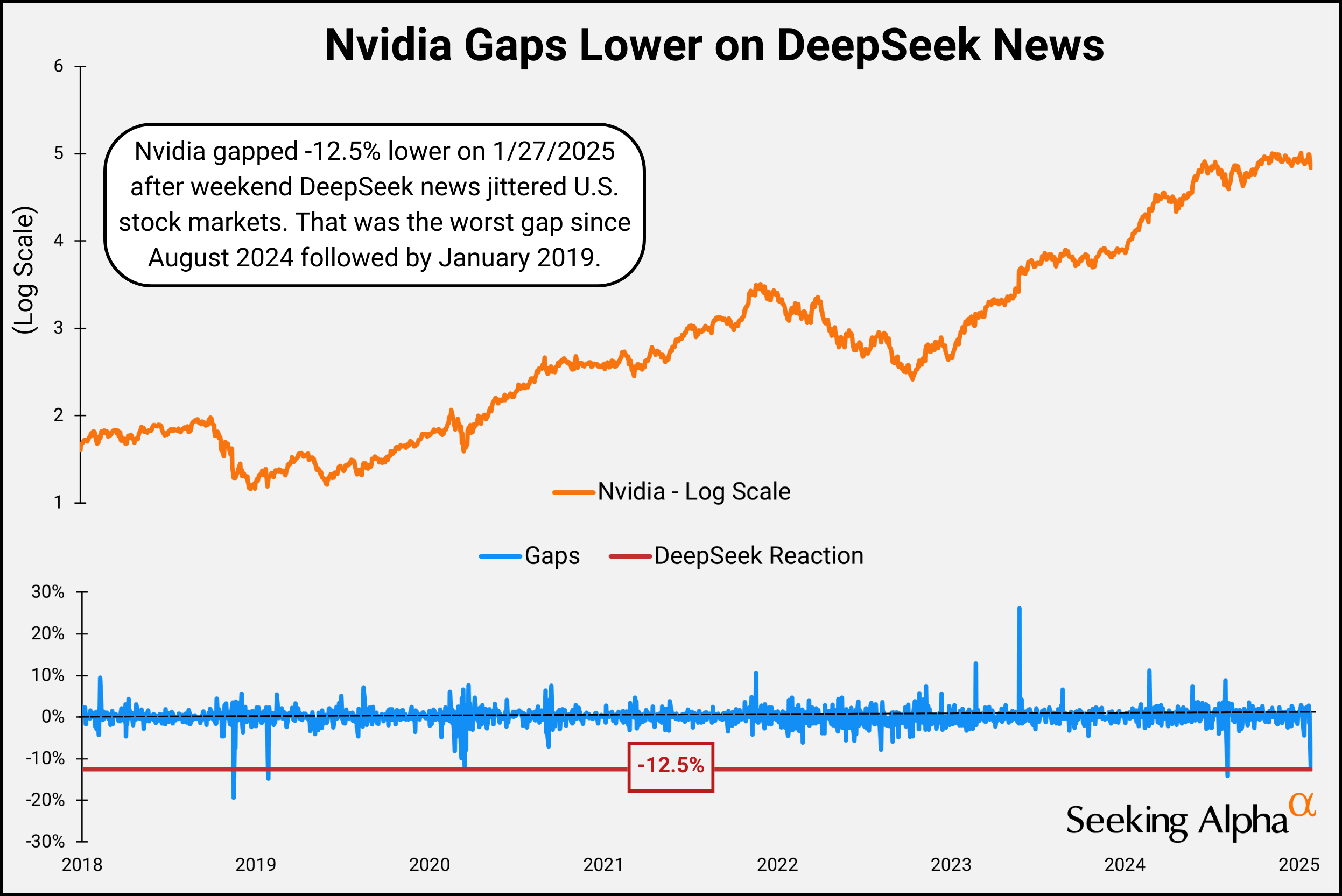
Despite the strong fundamentals, NVIDIA remains one of the most volatile large-cap stocks in the S&P 500. This volatility is driven by several technical and psychological factors that investors must monitor.

The Impact of the 10-for-1 Stock Split
The recent 10-for-1 stock split was a significant psychological milestone. While a split does not change the intrinsic value of the company, it increases liquidity and makes the stock more accessible to retail investors. It also paved the way for NVIDIA’s inclusion in major price-weighted indices. The increased retail participation often leads to higher daily trading volumes, which can exacerbate price swings during earnings reports or macro shifts.
Options Market Influence
NVIDIA has become a favorite for options traders. The sheer volume of call and put options being traded can lead to “gamma squeezes” and other technical phenomena where market makers must buy or sell the underlying stock to hedge their positions. This often results in the stock moving in “stairs up, elevator down” patterns, where steady gains are occasionally punctuated by sharp, high-volume sell-offs. For the long-term investor, these dips are often viewed as entry points rather than structural red flags.
Risks and Competitive Headwinds
No investment is without risk, and for NVIDIA, the challenges are as significant as the opportunities. To understand what is happening with the stock, one must account for the factors that could derail its momentum.
The Threat of Internal Silicon
Companies like Amazon (Trainium/Inferentia), Google (TPU), and Microsoft (Maia) are developing their own custom AI chips. While these internal projects currently lack the broad ecosystem of NVIDIA’s CUDA software, they represent a long-term threat to NVIDIA’s market share among its largest customers. If the hyperscalers can move even 20% of their workloads to internal silicon, it could impact NVIDIA’s top-line growth.
Geopolitical Tensions and Export Controls
NVIDIA is heavily reliant on TSMC (Taiwan Semiconductor Manufacturing Company) for its fabrication. Any geopolitical instability in the Taiwan Strait would have an immediate and catastrophic impact on NVIDIA’s ability to deliver products. Additionally, the U.S. Department of Commerce has placed strict export controls on high-end AI chips to China. China has historically represented a significant portion of NVIDIA’s revenue, and while the company has attempted to create “lite” versions of its chips to comply with regulations, the shrinking of this market remains a headwind for the stock.
The “AI Payback” Debate
A growing narrative among skeptical economists is the “AI ROI” question. Investors are starting to ask when the billions of dollars spent on GPUs will translate into tangible corporate profits for the end-users. If companies like Microsoft or Meta do not see a significant return on their AI investments within the next 12 to 18 months, they may scale back their capital expenditures, leading to a “demand cliff” for NVIDIA’s hardware.
The Long-Term Investment Thesis: Beyond the GPU
What many investors overlook when analyzing NVIDIA stocks is that the company is no longer just a chipmaker; it is a full-stack computing platform. This transition is the key to its long-term valuation.
The CUDA Moat
NVIDIA’s greatest asset is not its hardware, but its software: CUDA (Compute Unified Device Architecture). Millions of developers have spent over a decade building AI applications on the CUDA platform. This creates a massive “moat,” as switching to a competitor’s hardware would require a complete and costly rewrite of the software stack. This lock-in effect ensures that NVIDIA remains the default choice for the foreseeable future.
Software and Services Revenue
NVIDIA is aggressively expanding into software services, including its “AI Enterprise” software suite and its Omniverse platform for industrial digitalization. These segments offer recurring, high-margin revenue that could eventually decouple the stock from the cyclical nature of hardware sales. As the world moves from training AI models to “inference” (running the models in real-world applications), NVIDIA’s software ecosystem will play an even more vital role.
Conclusion: The New Market Anchor
What is happening with NVIDIA stocks is a reflection of the broader shift in the global economy. The stock has become a proxy for the future of productivity and technological advancement. While the path forward will undoubtedly be marked by periods of volatility, regulatory scrutiny, and intensifying competition, NVIDIA’s current position is fortified by a unique combination of cutting-edge hardware, an entrenched software ecosystem, and a management team that has consistently stayed ahead of the curve.
For the investor, NVIDIA represents both a high-octane growth engine and a complex risk management exercise. Its performance dictates the direction of the tech sector and, increasingly, the broader indices. Whether it is viewed as a generational opportunity or a sign of market excess, NVIDIA remains the most consequential story in the world of finance today, demanding constant vigilance and a deep understanding of the intersection between silicon and capital.
aViewFromTheCave is a participant in the Amazon Services LLC Associates Program, an affiliate advertising program designed to provide a means for sites to earn advertising fees by advertising and linking to Amazon.com. Amazon, the Amazon logo, AmazonSupply, and the AmazonSupply logo are trademarks of Amazon.com, Inc. or its affiliates. As an Amazon Associate we earn affiliate commissions from qualifying purchases.