
When investors discuss “the market,” they are typically referring to one of three major indices: the Dow Jones Industrial Average, the S&P 500, or the Nasdaq. Among these, the Nasdaq holds a unique position as the home of innovation, high-growth technology, and the digital economy. However, the question of what stocks actually make up the Nasdaq is more complex than it first appears. To understand the composition of this powerhouse, one must distinguish between the Nasdaq Stock Market (the exchange) and the specific indices that track its performance.
The Nasdaq is fundamentally an electronic marketplace where more than 3,000 companies are listed. While it is synonymous with “Tech,” its constituent list includes everything from pharmaceutical giants and retail chains to airlines and biotechnology pioneers. Understanding which stocks define the Nasdaq requires a deep dive into its most prominent indices—the Nasdaq Composite and the Nasdaq-100—and the specific sectors that drive their valuation.
Understanding the Nasdaq Ecosystem: The Indices vs. The Exchange
To answer what stocks make up the Nasdaq, we must first clarify the difference between the exchange itself and the indices that investors trade. The Nasdaq Stock Market was the world’s first electronic stock market, established in 1971. Unlike the New York Stock Exchange (NYSE), which historically featured a physical trading floor, the Nasdaq has always operated through a computer-based system. This digital-first nature naturally attracted the technology startups of the 1980s and 1990s, many of which have since grown into the largest corporations on earth.
The Nasdaq Composite Index
The Nasdaq Composite is the broadest measure of the exchange’s health. It includes almost all stocks listed on the Nasdaq Stock Market—over 3,000 of them. Because the index is market-capitalization weighted, the largest companies have a disproportionate impact on its movement. If you are looking at the “whole” Nasdaq, you are looking at everything from trillion-dollar tech titans to small-cap clinical-stage biotech firms.
The Nasdaq-100: The Elite 100
When people talk about “The Nasdaq” in the context of investment performance or ETFs like the QQQ, they are almost always referring to the Nasdaq-100. This is a modified market-cap-weighted index composed of the 100 largest non-financial companies listed on the Nasdaq Stock Market. By excluding financial institutions like banks and investment firms, the Nasdaq-100 maintains a laser focus on growth sectors: technology, healthcare, consumer services, and industrials. This index is the “crème de la crème” of the exchange and serves as the primary benchmark for the global growth trade.
The Dominance of Technology and the “Magnificent Seven”
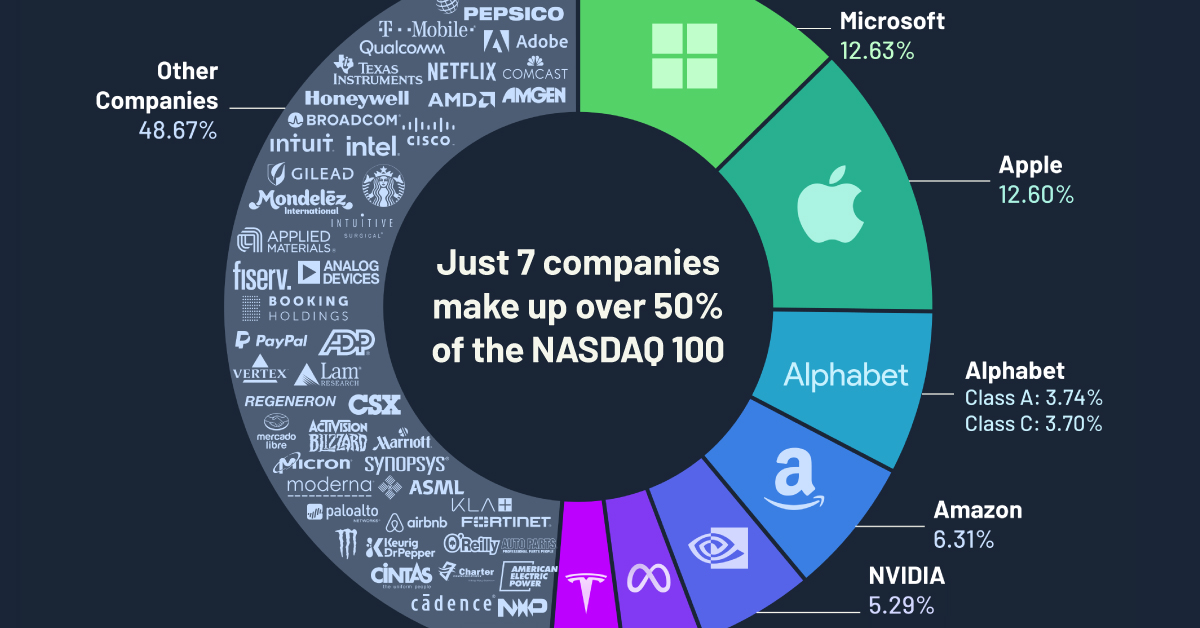
While the Nasdaq contains thousands of companies, its performance is heavily dictated by a handful of massive entities often referred to as the “Magnificent Seven.” These stocks represent the vanguard of the modern economy, and their weight within the Nasdaq-100 is so significant that they can move the entire index regardless of how the other 90+ companies are performing.
The Pillars of Modern Computing
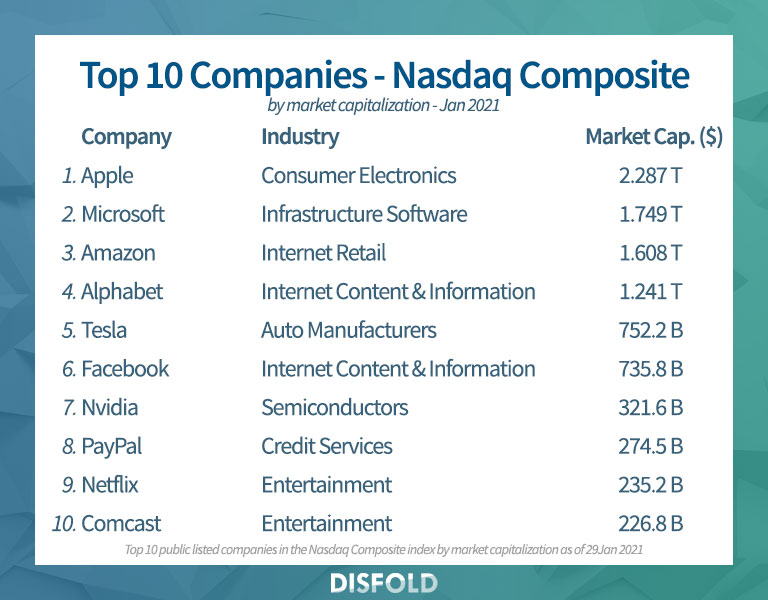
The core of the Nasdaq is built upon Apple (AAPL) and Microsoft (MSFT). For years, these two companies have vied for the title of the most valuable corporation in the world. Microsoft represents the backbone of enterprise software, cloud computing (Azure), and productivity, while Apple dominates the consumer hardware and services space. Following closely is Alphabet (GOOGL/GOOG), the parent company of Google and YouTube, which controls the lion’s share of the global digital advertising market.
The AI and E-commerce Engines
In recent years, the composition of the Nasdaq has shifted toward the infrastructure of artificial intelligence. NVIDIA (NVDA) has skyrocketed in prominence, becoming one of the most influential stocks in the index due to its dominance in the GPU and AI-chip market. Amazon (AMZN) also remains a cornerstone, representing both the shift in consumer retail and the dominance of cloud infrastructure via AWS.
The Disruptors: Meta and Tesla
Rounding out the major tech influence are Meta Platforms (META), which controls the social media landscape, and Tesla (TSLA), which sits at the intersection of automotive manufacturing and software technology. These seven companies collectively make up a massive percentage of the Nasdaq-100’s total market capitalization, making the index a direct bet on the continued dominance of Big Tech.
Beyond Technology: Diversification Within the Nasdaq

A common misconception is that the Nasdaq is exclusively a technology index. While tech accounts for roughly 50% of the Nasdaq-100, the remaining half of the index is composed of vital sectors that offer a level of diversification often overlooked by casual observers.
Healthcare and Biotechnology
The Nasdaq is the primary home for the world’s most innovative healthcare companies. This includes established pharmaceutical giants like Amgen (AMGN) and Gilead Sciences (GILD), as well as Moderna (MRNA), which rose to prominence through its mRNA vaccine technology. The “Nasdaq Biotechnology Index” is a sub-sector that tracks these companies specifically, focusing on the high-risk, high-reward world of drug discovery and genomic sequencing.
Consumer Services and Retail Disruption
Many of the world’s most recognizable consumer brands choose to list on the Nasdaq rather than the NYSE. Costco Wholesale (COST) is a massive constituent, representing the resilience of the brick-and-mortar retail sector when combined with a membership-based business model. PepsiCo (PEP) is another heavy hitter, providing a stable, defensive element to the index with its global snacks and beverages portfolio. Other notable consumer-focused stocks include Starbucks (SBUX), Netflix (NFLX), and Lululemon (LULU).
Industrials and Semiconductors
The “Industrial” classification in the Nasdaq often looks different than it does in the Dow. Instead of heavy machinery and steel, Nasdaq industrials often include logistics powerhouses like CSX Corporation or specialized equipment manufacturers. Furthermore, the semiconductor sector—including Broadcom (AVGO) and ASML—functions as a bridge between industrials and tech, providing the literal hardware that allows the rest of the index’s software to run.
How the Nasdaq is Weighted and Calculated
Understanding what stocks make up the Nasdaq also requires understanding the “Modified Market Capitalization” methodology. In a standard market-cap-weighted index, a company’s weight is determined by its total market value (share price multiplied by outstanding shares). However, because companies like Apple and Microsoft became so large, they threatened to make the Nasdaq-100 an index of just two or three stocks.
The Rebalancing Act
To maintain a level of diversification, the Nasdaq-100 uses a “modified” weighting system. This system puts caps on the influence of the largest components. If the combined weight of the largest five companies exceeds a certain threshold, the Nasdaq performs a “special rebalance” to redistribute the weight among smaller constituents. This happened most recently in 2023 to curb the over-concentration of the Magnificent Seven.
Inclusion Criteria
A company cannot simply “choose” to be in the Nasdaq-100. To be included, a stock must:
-
Be listed exclusively on the Nasdaq Stock Market.
-
Have an average daily trading volume of at least 200,000 shares.
-
Be a non-financial company (no banks or insurance firms).
-
Have been listed for at least two years (with some exceptions for massive IPOs).
This rigorous selection process ensures that the stocks making up the Nasdaq are the most liquid and highly valued companies in the growth sector.
Strategies for Investing in Nasdaq Stocks
For the individual investor, the stocks that make up the Nasdaq offer a primary vehicle for long-term wealth creation, particularly for those with a higher tolerance for volatility. Because the index is skewed toward growth rather than value, it tends to outperform the broader market during periods of economic expansion and low interest rates but can face sharper corrections during downturns.
Index Funds and ETFs
The most common way to gain exposure to the stocks that make up the Nasdaq is through exchange-traded funds (ETFs). The Invesco QQQ Trust (QQQ) is the most famous, tracking the Nasdaq-100. For investors who want exposure to the entire Nasdaq exchange (all 3,000+ stocks), the Fidelity Nasdaq Composite ETF (ONEQ) is the standard choice. These funds allow investors to own a piece of every company in the index without having to buy individual shares of high-priced stocks like Booking Holdings or MercadoLibre.
Assessing Risk in Growth Investing
When investing in the Nasdaq, one must be aware of “valuation risk.” Because the stocks in this index are often priced based on future earnings potential rather than current profits, their Price-to-Earnings (P/E) ratios tend to be higher than those found on the NYSE. This makes the Nasdaq more sensitive to interest rate changes. When rates rise, the “discount rate” applied to future earnings increases, which can lead to a compression of the multiples investors are willing to pay for tech stocks.
The Role of Innovation
Ultimately, the stocks that make up the Nasdaq represent a bet on the future of human ingenuity. From the software that runs our businesses to the biotechnology that treats our diseases, the Nasdaq is the primary venue for the commercialization of new ideas. By understanding the balance between the dominant tech giants and the smaller, disruptive innovators in healthcare and consumer goods, investors can better navigate this essential corner of the financial markets. The Nasdaq is not just a list of stocks; it is a reflection of the evolving global economy, weighted toward the digital and scientific frontiers that will define the next century.
aViewFromTheCave is a participant in the Amazon Services LLC Associates Program, an affiliate advertising program designed to provide a means for sites to earn advertising fees by advertising and linking to Amazon.com. Amazon, the Amazon logo, AmazonSupply, and the AmazonSupply logo are trademarks of Amazon.com, Inc. or its affiliates. As an Amazon Associate we earn affiliate commissions from qualifying purchases.