
For the global investor, the word “NASDAQ” is more than just a name scrolling across a ticker tape at the bottom of a news broadcast. It is a symbol of the shift from the industrial past to a digital-first future. Representing both a high-tech electronic marketplace and a suite of influential stock market indices, NASDAQ has become the definitive barometer for growth-oriented investing. To understand what NASDAQ represents is to understand the mechanics of the modern economy, the evolution of financial technology, and the specific risk-reward profile of the world’s most innovative companies.

The Digital Pioneer: A Revolution in Market Structure
At its core, NASDAQ—originally an acronym for the National Association of Securities Dealers Automated Quotations—represents the democratization of market access through technology. When it launched on February 8, 1971, it was the world’s first electronic stock market. Before its inception, stock trading was a physical, loud, and often inefficient process involving floor brokers shouting orders to one another in crowded pits.
NASDAQ changed the fundamental “representation” of a stock exchange. It proved that a market did not need a physical location to facilitate the exchange of billions of dollars. Instead of a centralized floor, it utilized a decentralized computer system to provide transparent, real-time bid and ask prices. This transition was revolutionary for personal finance and institutional investing alike, as it lowered spreads, increased transparency, and paved the way for the high-frequency trading and retail-app accessibility we see today.
For the modern investor, NASDAQ represents the efficiency of the “over-the-counter” (OTC) model evolved into a premier global exchange. While it eventually moved away from its OTC roots to become a recognized national securities exchange, it maintained its identity as the venue of choice for companies that prioritize technological disruption over traditional industrial brick-and-mortar operations.
The Market Maker Model
Unlike the New York Stock Exchange (NYSE), which historically relied on “Specialists” to manage trades for specific stocks, NASDAQ utilizes a “Market Maker” system. In this environment, multiple firms compete for investor business by posting their own bid and ask prices. This represents a commitment to competition and liquidity. For the business-minded individual, this structure highlights the importance of market depth—the idea that a healthy financial system requires multiple participants willing to buy and sell at any given moment to ensure price stability.
A Barometer for Innovation and the “New Economy”
Perhaps the most significant thing NASDAQ represents today is the “New Economy.” While indices like the Dow Jones Industrial Average (DJIA) were built to track the giants of the industrial age—oil, steel, and manufacturing—NASDAQ was born alongside the semiconductor and the personal computer.
Today, when analysts talk about “the NASDAQ,” they are usually referring to the NASDAQ Composite or the NASDAQ-100. These indices represent the vanguard of the global tech sector. They are the home of the “Magnificent Seven” and the pioneers of artificial intelligence, cloud computing, and biotechnology.
The Tech-Heavy Narrative
It is a common misconception that NASDAQ is exclusively a technology index. While tech companies make up a massive portion of its market capitalization, the exchange also hosts major players in consumer services, healthcare, and retail. However, the representation remains firmly rooted in growth. Companies listed here typically reinvest their earnings into research and development rather than paying out high dividends. Therefore, NASDAQ represents a collective bet on the future. When the NASDAQ rises, it suggests that investors are optimistic about future earnings, technological breakthroughs, and long-term expansion.
Biotechnology and Life Sciences
Beyond software and hardware, NASDAQ is the primary home for the biotechnology sector. This represents the high-stakes, high-reward nature of modern medical innovation. For investors, the presence of these firms means the index is often a leading indicator of risk appetite. Because biotech firms often rely on debt or equity raises to fund years of clinical trials before seeing a profit, their performance within the NASDAQ ecosystem reflects the broader availability of capital and the market’s willingness to fund speculative but potentially world-changing science.
Understanding the Structure: Composite vs. NASDAQ-100
To truly grasp what NASDAQ represents in a financial portfolio, one must distinguish between its two primary indices. Each serves a different purpose for the investor and represents a different slice of the market.
The NASDAQ Composite
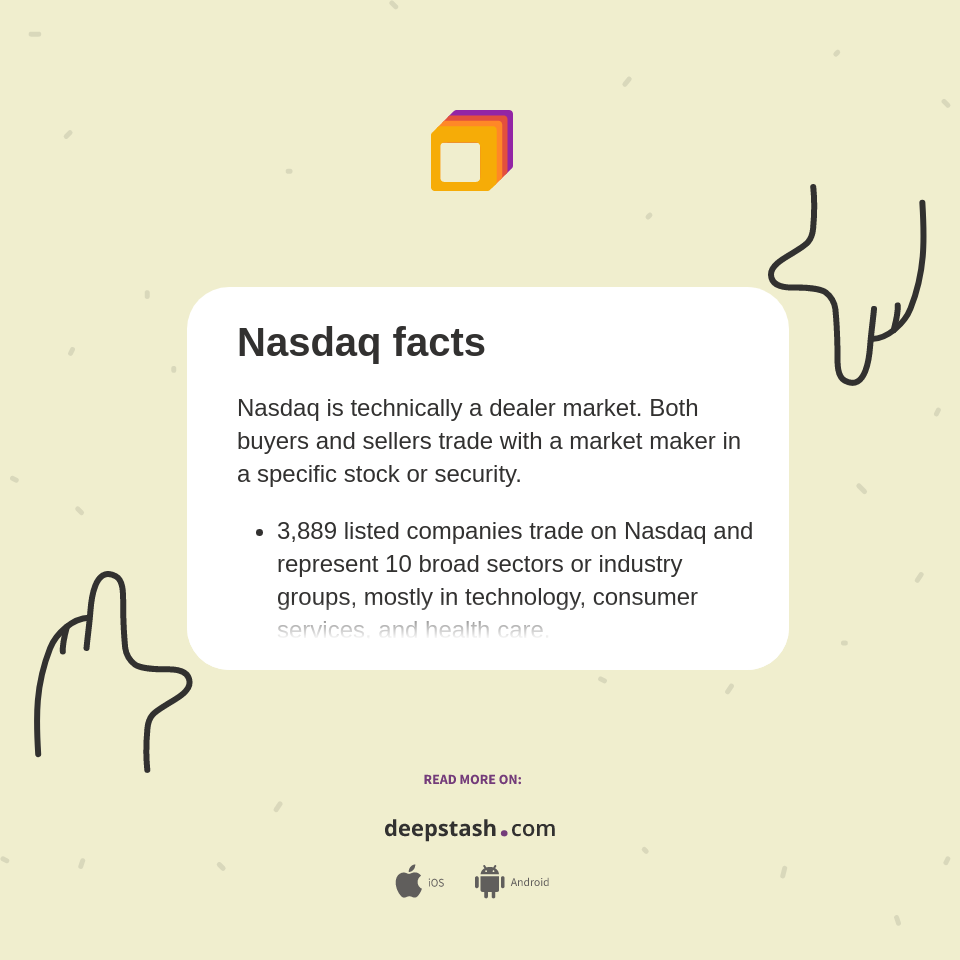
The Composite index includes almost all companies listed on the NASDAQ stock exchange—over 3,000 of them. Because it is so broad, it represents the overall health of the growth-oriented sector of the U.S. economy. It includes small-cap speculative plays alongside trillion-dollar behemoths. When an investor looks at the Composite, they are seeing a wide-angle lens of the innovative spirit of the American and international business landscape.
The NASDAQ-100
The NASDAQ-100 is a more concentrated, “elite” index. It consists of the 100 largest non-financial companies listed on the exchange. This index represents the pinnacle of corporate success in the modern era. By excluding financial firms (like banks and insurance companies), the NASDAQ-100 provides a “pure” look at the industrial, technology, and retail sectors.
What the NASDAQ-100 represents to the modern investor is a growth-focused alternative to the S&P 500. While the S&P 500 is often seen as “the market,” the NASDAQ-100 is “the growth market.” Over the last two decades, the NASDAQ-100 has often outperformed broader benchmarks, though this comes with the trade-off of higher volatility. It represents the concentration of wealth and power in companies that define how we live—how we communicate (Apple/Alphabet), how we shop (Amazon), and how we work (Microsoft).
NASDAQ as a Sentiment Indicator: Growth vs. Value
In the world of business finance, NASDAQ serves as a critical indicator of “Risk-On” or “Risk-Off” sentiment. Because the companies it represents are valued based on their future cash flows, they are highly sensitive to macroeconomic factors, particularly interest rates.
Interest Rate Sensitivity
When the Federal Reserve raises interest rates, the “discount rate” applied to future earnings increases. Since many NASDAQ companies are expected to produce their greatest profits years in the future, their current valuations are hit harder than “Value” stocks that produce steady cash today. Consequently, the NASDAQ represents the market’s reaction to the cost of money. A declining NASDAQ in a rising-rate environment represents a repricing of risk. Conversely, a surging NASDAQ often represents a “goldilocks” economy where inflation is under control and the cost of borrowing is low enough to fuel massive corporate expansion.
Volatility and the Investor Psychology
NASDAQ also represents the emotional heartbeat of the retail investor. Because it contains the brands that consumers interact with daily, it often experiences more dramatic swings than the more staid Dow Jones. For a personal finance strategist, the NASDAQ represents the “engine” of a portfolio—it provides the speed and the gains—but it requires a sturdy chassis (diversification) to handle the bumps. It is the index where “FOMO” (Fear Of Missing Out) and “Panic Selling” are most visible, making it a fascinating study of human psychology in the financial markets.
Strategic Considerations: How to Use NASDAQ Data
For someone focused on online income, side hustles, or serious investing, NASDAQ represents an opportunity set. It is no longer enough to just know what it is; one must know how to utilize what it represents to build wealth.
Accessing the Index through ETFs
The most common way to capitalize on what the NASDAQ represents is through Exchange-Traded Funds (ETFs) like the QQQ, which tracks the NASDAQ-100. For the individual investor, this represents a way to own a piece of the world’s most innovative companies without the risk of picking a single loser. It represents a “buy-and-hold” strategy for the digital age, allowing for participation in the upside of AI and cloud revolutions with institutional-grade liquidity.
A Global Marketplace
Finally, it is important to note that NASDAQ represents the internationalization of capital. While based in the U.S., it hosts many international firms looking to tap into the deep liquidity of the American markets. This represents the interconnectedness of the global economy. When you invest in the NASDAQ, you are not just investing in Silicon Valley; you are investing in a global network of supply chains, consumer bases, and intellectual property.

Conclusion: The Symbol of Perpetual Motion
Ultimately, NASDAQ represents the spirit of “Perpetual Motion” in the financial world. It is an exchange that refuses to stand still, much like the companies that list upon it. From its beginnings as a disruptor of the traditional exchange model to its current status as the home of the world’s largest and most influential companies, it stands as a monument to innovation.
For the investor, NASDAQ is a reminder that the economy is always evolving. It represents the transition of value from physical assets to intellectual property and data. Whether you are a conservative investor looking for a growth tilt or a tech enthusiast tracking the latest AI breakthroughs, NASDAQ is the lens through which the future of business is viewed. It is the intersection of money and imagination, providing a structured, regulated, and highly efficient platform for the capital that builds the future.
aViewFromTheCave is a participant in the Amazon Services LLC Associates Program, an affiliate advertising program designed to provide a means for sites to earn advertising fees by advertising and linking to Amazon.com. Amazon, the Amazon logo, AmazonSupply, and the AmazonSupply logo are trademarks of Amazon.com, Inc. or its affiliates. As an Amazon Associate we earn affiliate commissions from qualifying purchases.