
The Nasdaq Composite Index is one of the most widely followed stock market indices in the world, serving as a vital barometer for the health of the technology sector and the broader growth-oriented economy. Established in 1971, it has evolved from a fledgling electronic quotation system into a powerhouse benchmark that represents thousands of companies. For personal investors and financial professionals alike, understanding the Nasdaq Composite is essential for navigating modern equity markets, particularly when seeking exposure to innovation and high-growth industries.
Unlike the Dow Jones Industrial Average, which consists of only 30 blue-chip companies, or the S&P 500, which tracks 500 large-cap US firms, the Nasdaq Composite is much broader. It includes almost all companies listed on the Nasdaq Stock Market—more than 3,000 securities in total. Because the Nasdaq exchange has historically been the preferred listing venue for younger, innovative firms, the index is often synonymous with the “tech trade,” though its reach extends far beyond software and hardware.
Understanding the Mechanics: How the Index is Calculated
To grasp the movements of the Nasdaq Composite, an investor must first understand its weighting methodology. The index is a market-capitalization-weighted index. This means that the total market value of all outstanding shares of a company determines its influence on the index’s price movement.
Market-Cap Weighting vs. Price Weighting
In a market-cap-weighted system, the larger the company, the more it affects the index. For example, a 1% move in a trillion-dollar company like Apple or Microsoft will have a significantly larger impact on the Nasdaq Composite than a 10% move in a small-cap biotech firm. This stands in stark contrast to the Dow Jones Industrial Average, which is price-weighted, meaning the stock price alone dictates a company’s influence. The market-cap approach of the Nasdaq Composite is generally considered a more accurate reflection of the actual economic impact of the companies within the index.
Eligibility and Composition
The Nasdaq Composite is unique because of its inclusive nature. To be eligible for inclusion, a security must be listed exclusively on the Nasdaq Stock Market. The index includes several types of securities, including:
-
Common stocks
-
American Depositary Receipts (ADRs)
-
Real Estate Investment Trusts (REITs)
-
Tracking stocks
-
Limited Partnerships
It specifically excludes exchange-traded funds (ETFs), preferred stocks, and derivative securities. This broad inclusion ensures that the index captures a wide spectrum of the market, from massive multinational corporations to emerging companies that have just completed their Initial Public Offering (IPO).
Sector Breakdown: More Than Just Technology
While the Nasdaq Composite is frequently referred to as “tech-heavy,” it is a common misconception that it only contains technology stocks. While the Information Technology sector does command the largest portion of the index, the Nasdaq Composite is actually a multi-sector benchmark.
The Dominance of Technology
Technology typically accounts for approximately 50% or more of the index’s weight. This includes giants in software, semiconductors, and cloud computing. Because these companies have seen explosive growth over the last two decades, their market caps have ballooned, further increasing their weight in the index. This concentration makes the Nasdaq Composite highly sensitive to trends in digital transformation, artificial intelligence, and global chip demand.
Consumer Services and Healthcare
The second and third largest sectors are often Consumer Services and Healthcare. The Consumer Services category includes massive internet retailers and media companies that have redefined how the world shops and consumes entertainment. The Healthcare sector is primarily driven by biotechnology firms. The Nasdaq has long been the primary home for biotech, making the index a critical indicator for those tracking medical innovation, drug approvals, and genomic research.
Industrials and Financials
Though they represent a smaller percentage, the index also contains industrial firms and financial institutions. These companies often provide a stabilizing effect during periods when high-growth tech stocks face valuation pressures due to rising interest rates or shifting economic cycles.
The Nasdaq Composite vs. The Nasdaq-100
A frequent point of confusion for new investors is the difference between the Nasdaq Composite and the Nasdaq-100. While they are related, they serve different purposes and offer different risk profiles.
Scope and Diversity
The Nasdaq Composite includes over 3,000 companies. In contrast, the Nasdaq-100 is a “modified” market-cap index consisting of the 100 largest non-financial companies listed on the Nasdaq exchange. By excluding financial companies and focusing only on the “mega-caps,” the Nasdaq-100 is even more concentrated in technology and growth stocks than the Composite.
Performance Divergence
Because the Nasdaq-100 contains the “Magnificent Seven” and other tech titans, it often outperforms the broader Nasdaq Composite during bull markets driven by big tech. However, the Nasdaq Composite offers a layer of diversification that the Nasdaq-100 lacks. By including small and mid-cap companies across all sectors (including financials), the Composite provides a more holistic view of the Nasdaq ecosystem and is less prone to the extreme volatility of a 100-stock concentration.
Why Investors Track the Nasdaq Composite
For the personal finance enthusiast or the professional fund manager, the Nasdaq Composite serves several strategic functions. It is not merely a number on a screen; it is a tool for portfolio benchmarking and sentiment analysis.
A Gauge for Risk Appetite
The Nasdaq Composite is often viewed as a “risk-on” index. Because growth stocks—which prioritize future earnings over current dividends—are sensitive to interest rates and economic outlooks, the index’s performance often signals how much risk investors are willing to take. When the Nasdaq Composite is outperforming the S&P 500, it generally suggests that investors are optimistic about the future and are willing to pay a premium for innovation. Conversely, when the Nasdaq lags, it often indicates a flight to safety toward more defensive sectors like utilities or consumer staples.
Tracking the Innovation Economy
If the S&P 500 represents the “American Economy,” the Nasdaq Composite represents the “Innovation Economy.” It captures the lifecycle of a company from its early days as a public entity through its journey to becoming a global leader. For investors who want to keep their finger on the pulse of disruption—be it in renewable energy, fintech, or cybersecurity—the Nasdaq Composite is the primary source of data.
Volatility and Return Profile
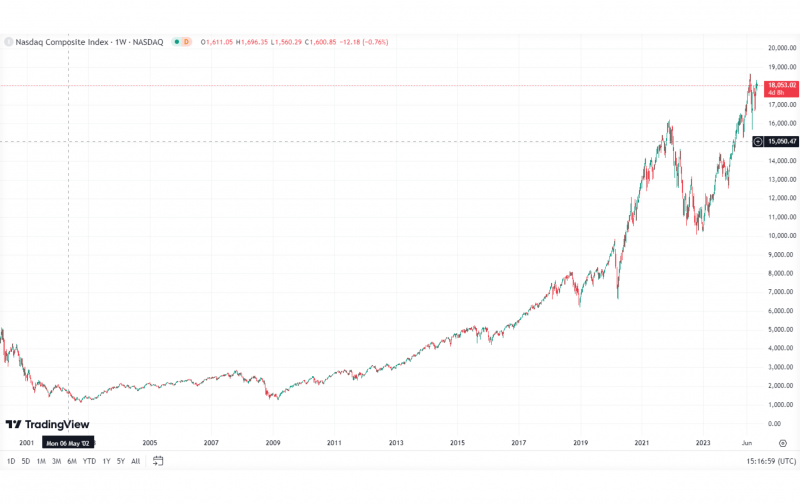
Historically, the Nasdaq Composite has offered higher potential returns than more conservative indices, but these returns come at the cost of higher volatility. During the “Dot-com” bubble of the late 1990s, the index saw meteoric rises followed by a devastating crash. In the decade following the 2008 financial crisis, it significantly outperformed other major benchmarks. Understanding this volatility is crucial for long-term financial planning; investors must ensure their time horizons align with the index’s characteristic price swings.
Practical Ways to Invest in the Nasdaq Composite
Individual investors cannot buy an index directly, as it is a mathematical calculation. However, several financial instruments allow investors to gain exposure to the performance of the Nasdaq Composite.
Index Funds and ETFs
The most common way to invest is through Exchange-Traded Funds (ETFs). For example, the Fidelity Nasdaq Composite Index ETF (ONEQ) is designed to track the performance of the entire Composite. By purchasing shares of such an ETF, an investor gains fractional ownership in all 3,000+ companies within the index. This provides instant diversification and is a cost-effective strategy for those who want broad exposure to the growth sector without the risk of picking individual stocks.
Mutual Funds
Some brokerage firms offer mutual funds that track the Nasdaq Composite. These function similarly to ETFs but are typically traded only once per day at the closing Net Asset Value (NAV). Mutual funds may be preferable for investors who want to set up automatic recurring investments from their bank accounts.
Using the Index as a Benchmark
Even for investors who prefer picking individual stocks or investing in other sectors, the Nasdaq Composite is an essential benchmark. If your personal portfolio is focused on growth, you should compare your annual returns against the Nasdaq Composite. If you are consistently underperforming the index while taking on similar levels of risk, it may be time to reconsider your strategy and opt for a low-cost index fund instead.

Conclusion
The Nasdaq Composite Index remains a cornerstone of the financial world. It reflects the shift from a traditional manufacturing-based economy to one driven by information, services, and technological advancement. By understanding its market-cap weighting, its sector diversity beyond just technology, and its role as a barometer for market sentiment, investors can better position themselves to build wealth in a rapidly changing global marketplace. Whether used as a direct investment vehicle or a high-level economic indicator, the Nasdaq Composite is an indispensable tool in the modern investor’s toolkit.
aViewFromTheCave is a participant in the Amazon Services LLC Associates Program, an affiliate advertising program designed to provide a means for sites to earn advertising fees by advertising and linking to Amazon.com. Amazon, the Amazon logo, AmazonSupply, and the AmazonSupply logo are trademarks of Amazon.com, Inc. or its affiliates. As an Amazon Associate we earn affiliate commissions from qualifying purchases.