
For investors and market watchers, few events generate as much buzz as a potential stock split from Apple Inc. (AAPL). As one of the most valuable companies in the world, Apple’s share price is a bellwether for the tech sector and a cornerstone of millions of retirement portfolios. When the share price climbs toward certain psychological thresholds, the question inevitably arises: when will Apple split its shares again?
While a stock split does not change the fundamental value of a company—it is essentially cutting the same pizza into more slices—it remains a powerful tool for managing market perception, liquidity, and accessibility. To understand when the next split might occur, we must examine Apple’s historical patterns, its current financial health, and the broader economic landscape of the 2020s.
The Mechanics and Motivation Behind a Stock Split
Before projecting the timing of a future split, it is essential to understand why a trillion-dollar company would bother with the administrative complexity of a split. In the modern era of fractional share trading, some argue that the stock split is an archaic relic. However, for a company like Apple, the move remains deeply strategic.
Liquidity and Market Participation
The primary driver for a stock split is often liquidity. By lowering the price per share, a company makes its stock more accessible to a broader range of retail investors. While institutional investors deal in millions of dollars, many individual investors find it psychologically and financially easier to purchase ten shares at $50 than one share at $500. This increased demand from the retail sector can drive higher trading volume, which generally tightens the bid-ask spread and ensures a smoother market for the stock.
Psychological Price Anchoring
There is a powerful psychological component to share pricing. Investors often perceive a stock as “expensive” once it crosses certain round-number thresholds, such as $200, $500, or $1,000. By splitting the stock, Apple resets the clock on this perception. It allows the company to maintain an image of being “attainable” to the average person, aligning the stock price with the mass-market appeal of its consumer products like the iPhone and iPad.
Inclusion in Price-Weighted Indices
One of the most significant reasons for Apple’s massive 7-for-1 split in 2014 was its desire to be included in the Dow Jones Industrial Average (DJIA). Unlike the S&P 500, which is market-cap weighted, the Dow is price-weighted. If Apple’s share price had remained at $700, it would have exerted a disproportionate influence on the index, making its inclusion impossible. By splitting the stock down to the $100 range, Apple became a viable candidate for the Dow, joining the ranks of the most prestigious blue-chip companies in the United States.
Apple’s Historical Precedent: A Timeline of Strategic Splits
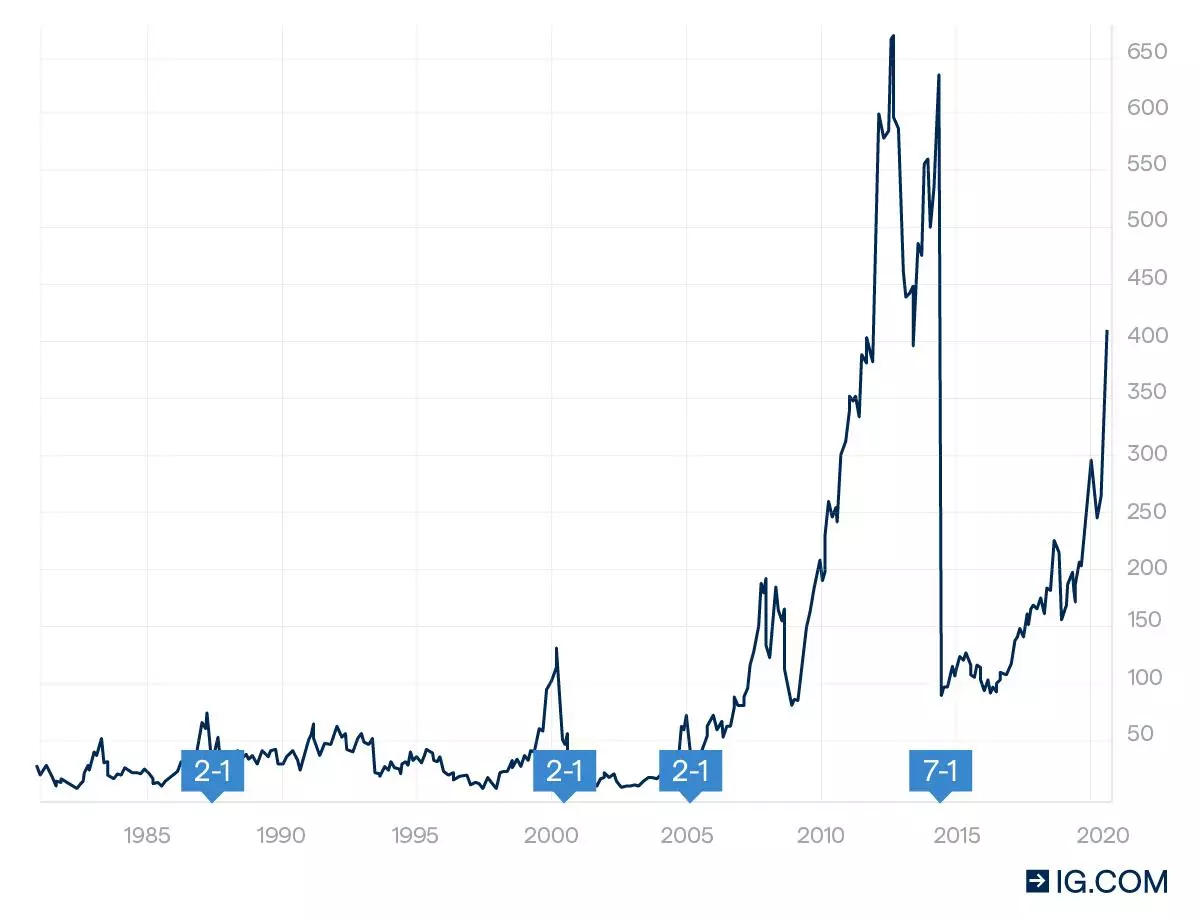
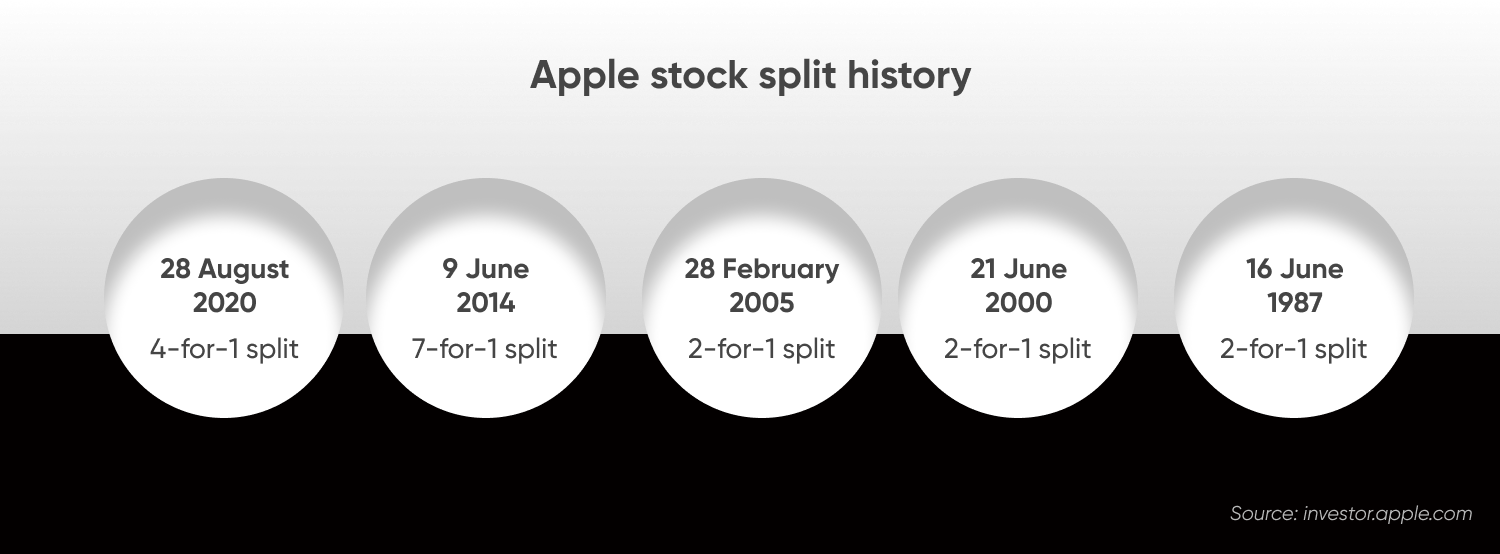
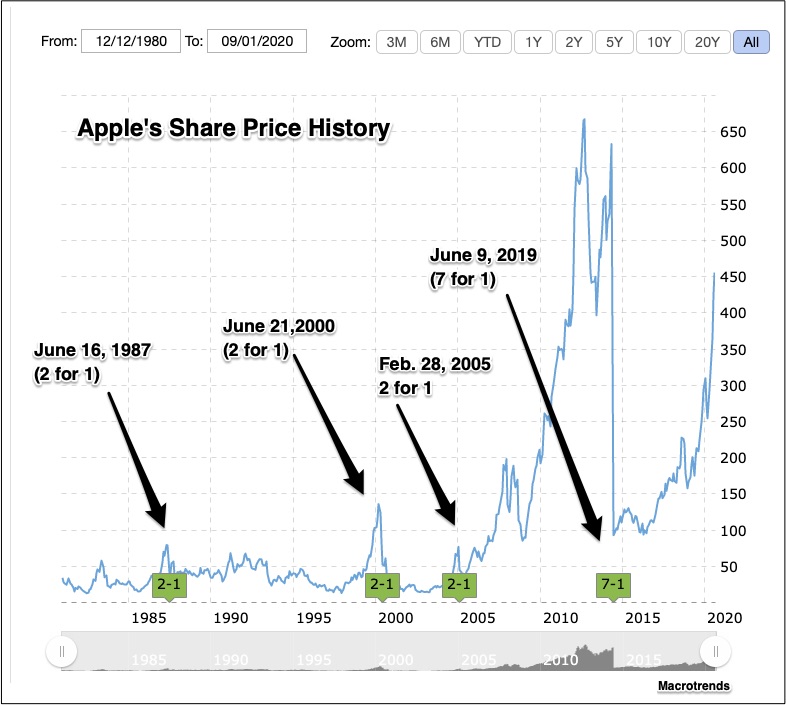
Apple has a long history of utilizing stock splits to manage its share price. By looking at the timing and the price points of previous splits, we can identify a pattern that helps predict future behavior. Apple has split its stock five times since its initial public offering in 1980.
The Early Splits: 1987, 2000, and 2005
In its first few decades, Apple followed a fairly standard 2-for-1 split strategy.
-
June 16, 1987: Apple’s first split occurred when the company was still finding its footing in the personal computer market.
-
June 21, 2000: This split happened at the height of the dot-com era, just as the tech world was experiencing massive volatility.
-
February 28, 2005: Following the success of the iPod, Apple’s growth trajectory accelerated, leading to another 2-for-1 split.
The 2014 “Great Realignment”
The June 9, 2014, split was a departure from tradition. Apple executed a massive 7-for-1 split. At the time, the share price was trading above $645. This move was explicitly aimed at making the stock accessible to a larger investor base and positioning the company for the Dow Jones inclusion. It brought the price down to approximately $92 per share.
The 2020 Pandemic Surge
The most recent split occurred on August 28, 2020. Apple announced a 4-for-1 split when the share price was trading near $500. The move came during a period of unprecedented retail trading activity fueled by pandemic lockdowns and commission-free trading apps. Following the split, the price was reset to roughly $125 per share.
From this timeline, we can observe that Apple tends to act when the share price consistently sustains a level between $400 and $700. The company rarely allows its stock to stay in the high triple digits for long, preferring to keep the entry point within reach of the everyday investor.
Key Indicators for the Next Apple Stock Split
As we look toward the mid-2020s, several financial indicators will signal when the Board of Directors is ready to pull the trigger on another split.
Sustained Price Performance
The most obvious indicator is the share price itself. While Apple has traded in the $150 to $220 range for a significant period, it has not yet reached the “danger zone” of $400 to $500 where past splits occurred. If Apple’s valuation continues to climb—driven by breakthroughs in AI (Apple Intelligence), growth in its Services sector, or the expansion of its wearables category—and the price approaches the $400 mark, the conversation about a split will intensify.
The Role of Share Buybacks
It is important to distinguish stock splits from share buybacks, as Apple is the undisputed king of the latter. Apple has spent hundreds of billions of dollars repurchasing its own shares. While a split increases the number of shares, a buyback reduces them. Apple’s primary method of returning value to shareholders is through buybacks and dividends, which increase Earnings Per Share (EPS). A stock split is a cosmetic change, whereas a buyback is a fundamental financial shift. If Apple decides that its share price is becoming a barrier to retail participation despite its buyback program, a split becomes more likely.
Retail Trading Trends and Fractional Shares
One factor that might delay a future split is the rise of fractional share trading. Platforms like Robinhood, Fidelity, and Charles Schwab now allow investors to buy $5 worth of Apple stock, regardless of whether the share price is $200 or $2,000. This reduces the mechanical necessity of a split. However, corporate tradition and the “Dow effect” still carry weight, and Apple has always been a company that values its brand image among the general public.
The Impact on Investors and the Broader Market
If and when Apple announces another split, the market reaction is often predictable based on historical data.
The “Run-Up” Phenomenon
Historically, companies that announce a stock split see a short-term surge in their share price between the announcement date and the execution date. This is often attributed to the “halo effect” of the news—a split is generally viewed as a sign of corporate confidence. It signals to the market that the Board of Directors expects the share price to continue rising.
Volatility and Post-Split Performance
While the announcement often brings a price bump, the period immediately following a split can be volatile. Once the “new” shares hit the market, there is often a period of price consolidation. Long-term investors, however, generally focus on the underlying fundamentals. For Apple, these fundamentals include its massive cash flow, its ecosystem lock-in, and its high margins on services and hardware.
Diversification for Small Portfolios
For investors with smaller accounts, a split provides the opportunity for better portfolio diversification. If a single share of a company costs $500, an investor with a $1,000 portfolio can only own two shares, making Apple 100% of their holdings. A split that brings the price to $100 allows that same investor to allocate a smaller, more responsible percentage of their capital to Apple while diversifying into other assets.
Expert Projections: When Should We Expect the Announcement?
Given Apple’s current trajectory, when is the most likely window for the next split?
Currently, Apple’s growth is increasingly driven by its Services division (App Store, iCloud, Apple Music) and its pivot into artificial intelligence. These high-margin sectors are fueling a higher valuation multiple than the company historically commanded as a pure hardware play.
Market analysts suggest that if Apple reaches a $4 trillion market capitalization, the share price would likely be well above the $300 range. If the stock hits the $350-$400 threshold, the Board will likely discuss a split to maintain its retail-friendly image. Based on historical intervals—specifically the six-year gap between the 2014 and 2020 splits—a window between 2025 and 2027 seems statistically probable, provided the macroeconomic environment remains conducive to growth.
Investors should monitor Apple’s quarterly earnings calls, specifically the commentary regarding “capital return programs.” While the primary focus is usually on buybacks and dividends, any mention of “shareholder accessibility” is often a coded signal that a stock split is on the horizon.
In conclusion, while there is no immediate pressure for Apple to split its shares at its current trading price, the company’s history suggests it is only a matter of time. As Apple continues to innovate and capture a larger share of the global economy, the share price will inevitably climb. For the patient investor, a stock split is not a creator of value, but rather a celebratory milestone that reflects the enduring growth and market dominance of the world’s most iconic brand. When the price finally knocks on the door of the next major psychological barrier, expect Tim Cook and the Apple Board to slice the pie once again.
aViewFromTheCave is a participant in the Amazon Services LLC Associates Program, an affiliate advertising program designed to provide a means for sites to earn advertising fees by advertising and linking to Amazon.com. Amazon, the Amazon logo, AmazonSupply, and the AmazonSupply logo are trademarks of Amazon.com, Inc. or its affiliates. As an Amazon Associate we earn affiliate commissions from qualifying purchases.