
In the landscape of modern capital markets, few entities command as much influence or possess as complex a corporate structure as Amazon.com, Inc. To the average consumer, Amazon is a digital storefront; to the investor, however, it is a sprawling conglomerate with a portfolio that spans cloud computing, grocery retail, healthcare, entertainment, and advanced robotics. Determining exactly how many companies Amazon owns is a moving target, as the organization frequently acquires, merges, and occasionally divests its holdings. Current estimates suggest that Amazon has acquired over 100 companies since its inception, creating a multifaceted ecosystem that functions as a masterclass in capital allocation and market diversification.

For those analyzing the business finance and investment potential of Amazon, understanding this portfolio is essential. The company’s growth trajectory has transitioned from organic expansion to a sophisticated “buy and build” strategy. By acquiring established players in disparate industries, Amazon secures immediate market share, gains access to proprietary data, and integrates new services into its Prime subscription model, thereby increasing the lifetime value of every customer.
The Architect of Aggregation: Understanding Amazon’s Acquisition Strategy
Amazon’s approach to acquisitions is rarely about mere expansion; it is about the strategic integration of infrastructure and customer touchpoints. Historically, the company’s mergers and acquisitions (M&A) activity can be categorized into three distinct phases: the early e-commerce expansion, the technological infrastructure build-out, and the recent pivot toward high-value services like healthcare and media content.
From Vertical Integration to Market Dominance
In its early years, Amazon focused on acquisitions that strengthened its core retail business. Companies like IMDb (1998) and Zappos (2009) were targeted to bolster data and category dominance. Zappos, in particular, was a $1.2 billion acquisition that taught Amazon the value of specialized customer service and high-touch retail—lessons that were eventually integrated into the broader Amazon platform. This phase of M&A was characterized by vertical integration, where the objective was to eliminate competition and own the entire value chain of online shopping.
The Valuation Impact of a Multi-Industry Portfolio
From an investment perspective, Amazon’s diversified holdings act as a hedge against volatility in any single sector. While the retail arm might face headwinds from fluctuating consumer spending, Amazon Web Services (AWS)—the company’s highly profitable cloud division—continues to provide the cash flow necessary to fund further acquisitions. This “flywheel” effect is powered by the synergy between subsidiaries. For instance, the acquisition of a robotics firm like Kiva Systems in 2012 for $775 million directly improved the margins of the retail business by automating fulfillment centers, demonstrating how a strategic acquisition in one sector can drive financial performance in another.
The Pillars of the Portfolio: Evaluating High-Stakes Acquisitions
While Amazon owns dozens of smaller firms, a few landmark deals define its corporate identity and dictate its financial health. These acquisitions represent billions of dollars in capital expenditure and signal the company’s long-term intentions in the global market.
Whole Foods Market: The Billion-Dollar Grocery Pivot
In 2017, Amazon sent shockwaves through the financial world by acquiring Whole Foods Market for approximately $13.7 billion. At the time, it was the company’s largest acquisition and a clear signal that Amazon intended to dominate the “last mile” of the grocery supply chain. Financially, this move allowed Amazon to bridge the gap between digital and physical retail. By integrating Prime benefits into Whole Foods stores, Amazon converted a traditional brick-and-mortar grocery shopper into a data-rich Prime member, creating a cross-platform revenue stream that continues to yield dividends.
MGM Holdings: The Entertainment and Content Play
The $8.5 billion acquisition of MGM Holdings in 2022 marked Amazon’s aggressive entry into the “streaming wars.” By acquiring a library of over 4,000 films and 17,000 television shows, Amazon provided a massive boost to its Prime Video value proposition. In the world of business finance, content is an asset with a long tail. Owning intellectual property like the James Bond franchise allows Amazon to drive Prime subscriptions, which in turn reduces churn and increases the recurring revenue that investors prize.
One Medical and the Healthcare Frontier
Amazon’s $3.9 billion acquisition of 1Life Healthcare (One Medical) in 2023 highlights its latest strategic pivot: the $4 trillion healthcare industry. This move follows the earlier acquisition of PillPack in 2018. By owning a primary care provider and a digital pharmacy, Amazon is positioning itself as a central player in health insurance and medical services. For investors, this represents a massive growth vertical that leverages Amazon’s existing logistics and data-processing capabilities to disrupt a legacy industry.
Beyond the Household Names: Technical and Logistical Subsidiaries
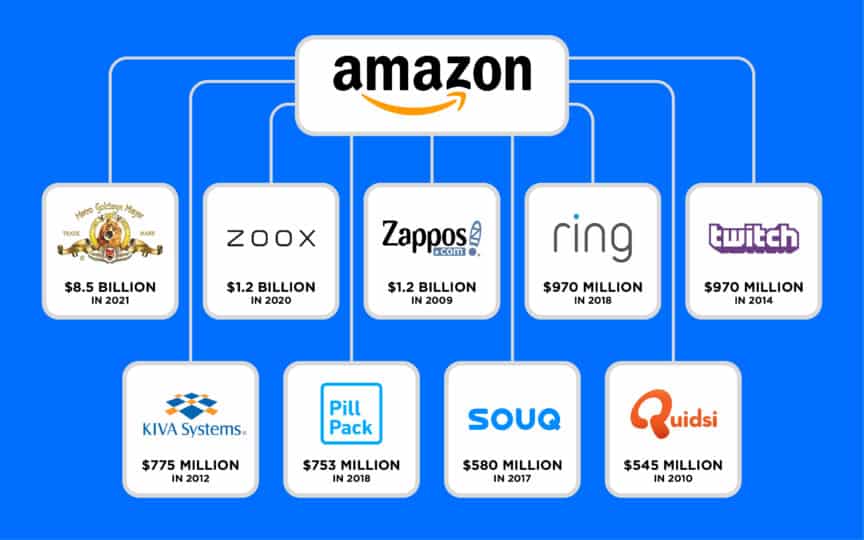
While names like Ring and Twitch are well-known to the public, much of Amazon’s value is locked within technical subsidiaries that operate behind the scenes. These companies provide the “digital plumbing” that allows the conglomerate to operate at an unprecedented scale.
The Invisible Engine: AWS and Technical Acquisitions
Amazon Web Services (AWS) is often viewed as an internal department, but it has grown through numerous strategic acquisitions of software and infrastructure firms. Acquisitions like Annapurna Labs (2015) allowed Amazon to design its own custom chips, significantly reducing the cost of hardware for its data centers. This move toward “silicon independence” is a critical financial strategy, as it lowers operational costs and improves the competitive pricing of AWS’s cloud offerings.
Logistics and Robotics: Driving Fulfillment Margins
Amazon’s dominance in retail is predicated on its ability to deliver products faster and cheaper than anyone else. This is made possible by subsidiaries like Kiva Systems (now Amazon Robotics). By owning the technology that powers its warehouses, Amazon avoids licensing fees and maintains a proprietary advantage in logistics. Furthermore, the 2020 acquisition of Zoox, an autonomous vehicle company, for $1.2 billion, suggests that Amazon’s next major logistical leap will involve self-driving delivery fleets, potentially removing one of the largest costs in the retail business: human labor in transportation.
Expanding the Smart Home Ecosystem
The acquisition of Ring (2018) for $1 billion and Blink (2017) solidified Amazon’s presence in the “smart home” sector. These companies do more than sell hardware; they act as entry points for the Amazon ecosystem. Every Ring doorbell sold is a potential gateway for Alexa integration and Amazon delivery services (such as in-garage delivery). From a business finance standpoint, these subsidiaries create a “sticky” ecosystem where the cost of switching to a competitor becomes prohibitively high for the consumer.
The Financial Rationale: Why Investors Track Amazon’s Subsidiaries
For a sophisticated investor, the number of companies Amazon owns is less important than the synergy between them. The financial rationale behind this massive portfolio is rooted in three key areas: revenue diversification, data acquisition, and cost suppression.
Revenue Synergy and Cross-Platform Monetization
Amazon’s subsidiaries are rarely managed as silos. Instead, they are integrated into the Prime ecosystem. A customer might join Prime for the free shipping (Retail), stay for the streaming content (MGM/Twitch), use the cloud storage for photos (AWS), and get their groceries delivered (Whole Foods/PillPack). This cross-pollination ensures that capital invested in one acquisition benefits the entire portfolio, leading to a higher return on invested capital (ROIC).
Data as a Balance Sheet Asset
In the digital economy, data is often more valuable than physical assets. Every acquisition provides Amazon with a new lens through which to view consumer behavior. Owning One Medical provides insights into healthcare spending; owning Ring provides data on neighborhood safety and home habits; owning Twitch provides a window into the demographic trends of younger generations. This data is leveraged to refine advertising algorithms, which has become one of Amazon’s fastest-growing and highest-margin revenue streams.
The Risks of Regulatory Scrutiny and Antitrust
The sheer scale of Amazon’s portfolio has attracted significant attention from antitrust regulators globally. From an investment risk perspective, the primary threat to Amazon’s conglomerate model is regulatory intervention. The Federal Trade Commission (FTC) and European regulators have frequently questioned whether Amazon’s practice of owning both the platform and the companies that compete on that platform creates a monopoly. Any forced divestiture of major subsidiaries like AWS or Whole Foods would radically alter the company’s valuation and financial structure.

Strategic Outlook: The Future of the Amazon Empire
As Amazon continues to evolve, its acquisition strategy is likely to focus on sectors with high barriers to entry and massive total addressable markets (TAM). Investors should expect continued interest in artificial intelligence (AI), sustainable energy, and fintech.
The recent multi-billion dollar investment in Anthropic, an AI safety and research company, signals that Amazon is prepared to spend heavily to ensure it remains a leader in the generative AI space. While not a full acquisition, this stake reflects Amazon’s preference for owning or controlling the technological building blocks of the future.
In conclusion, Amazon’s identity is no longer tied to a single industry. It is a collection of over 100 specialized firms, each serving as a strategic piece in a larger financial puzzle. For those tracking the company’s “Money” metrics, the focus should remain on how effectively the management team integrates these diverse holdings into a cohesive, cash-generating machine. Whether it is through the groceries we eat, the movies we watch, or the servers that host the internet, Amazon’s portfolio is a testament to the power of strategic diversification and aggressive capital reinvestment. Understanding the breadth of this ownership is not just a matter of counting companies—it is a matter of understanding the architecture of modern global commerce.
aViewFromTheCave is a participant in the Amazon Services LLC Associates Program, an affiliate advertising program designed to provide a means for sites to earn advertising fees by advertising and linking to Amazon.com. Amazon, the Amazon logo, AmazonSupply, and the AmazonSupply logo are trademarks of Amazon.com, Inc. or its affiliates. As an Amazon Associate we earn affiliate commissions from qualifying purchases.