
In the modern landscape of personal finance, loyalty currencies have evolved from simple marketing gimmicks into a sophisticated asset class. Among the most prestigious and versatile of these is the American Express Membership Rewards (MR) program. For the savvy cardholder, these points represent more than just a balance on a screen; they are a flexible financial tool that, when managed correctly, can yield a return on investment far exceeding traditional cash-back programs.
Understanding how to use Amex points requires a shift in perspective. Instead of viewing them as a “bonus,” one must view them as a strategic reserve. Whether you are looking to offset business expenses, fund luxury travel, or optimize your monthly cash flow, the Membership Rewards ecosystem offers a spectrum of redemption paths that vary significantly in their underlying value.
The Financial Architecture of Membership Rewards
To master the use of Amex points, one must first understand the concept of “Value Per Point” (VPP). In the world of financial tools, liquidity and valuation are paramount. American Express provides a baseline value—often cited at 0.6 to 1.0 cents per point—but the ceiling for these points is much higher.
The Power of Transferability
The primary reason Membership Rewards points are highly regarded in the finance community is their status as a “transferable currency.” Unlike “fixed-value” points that are tied to a specific merchant or a set dollar amount, MR points can be moved to a variety of external partners, including international airlines and hotel chains. This flexibility provides a hedge against the devaluation of any single loyalty program. By keeping your points within the Amex ecosystem until the moment of use, you maintain maximum financial optionality.
Assessing Opportunity Cost
Every time you redeem a point, you are making a financial decision regarding opportunity cost. If you use 50,000 points for a $300 statement credit (a valuation of 0.6 cents per point), you are essentially “selling” those points at a discount. Conversely, transferring those same 50,000 points to an airline partner for a flight that would have cost $1,500 represents a valuation of 3.0 cents per point. In the context of personal finance, this is a form of arbitrage—extracting significantly more value from an asset than its nominal cash-equivalent price.
Travel Transfer Partners: The Path to Outsized Value
For those seeking the highest possible return on their points, transferring to travel partners is almost always the most lucrative strategy. American Express maintains partnerships with nearly 20 airlines and three major hotel groups, providing a global reach that covers every major alliance: Star Alliance, SkyTeam, and Oneworld.
Navigating Airline Alliances
The strategic use of Amex points often involves “leveraging the alliance.” For example, you do not need to fly with a specific carrier to use your points for their flights. You can transfer points to British Airways (a Oneworld member) to book flights on American Airlines or Alaska Airlines. Similarly, transferring to Air Canada’s Aeroplan (Star Alliance) can unlock seats on United or Lufthansa.
This “cross-pollination” of points allows cardholders to shop for the best redemption rates across a global network. High-value redemptions are most frequently found in premium cabins—Business and First Class. While a coach ticket might yield 1.2 cents per point, a long-haul international Business Class seat can often yield 4 to 8 cents per point, turning a modest point balance into a five-figure travel experience.
Hotel Transfers and Strategic Stays
While airline transfers generally offer the best “math,” hotel transfers to partners like Marriott Bonvoy, Hilton Honors, or Choice Privileges have their place in a diversified financial strategy. This is particularly true during peak seasons or at high-end properties where the cash price is inflated. However, cardholders should be cautious: the transfer ratios to hotels are not always 1:1, meaning you must perform a careful valuation check before committing your points to ensure you aren’t losing value in the conversion.
Direct Redemptions: Liquidity and Lifestyle Options
While maximizing cents-per-point is the goal for many, there are scenarios where the most “valuable” use of a point is the one that preserves your cash on hand. American Express offers several ways to use points directly within their own platform, providing immediate liquidity.
The Amex Travel Portal
Booking flights, hotels, or car rentals directly through the Amex Travel portal is a straightforward way to use points. For most cardholders, points are worth 1 cent each when used for flights in this manner. However, for those holding the Business Platinum Card®, there is a unique “35% Airline Bonus” (up to a certain limit per year) when using points to book a flight with a selected qualifying airline or any flight in Business or First Class. This effectively boosts the value of the points to approximately 1.54 cents per point, a respectable and guaranteed return that avoids the complexity of transferring to external partners.
Statement Credits and “Pay with Points” at Checkout
The most liquid, yet often least efficient, way to use Amex points is through statement credits or using points at checkout with retailers like Amazon or PayPal. Generally, these redemptions value points at 0.6 cents each. From a wealth management perspective, this is rarely recommended unless the cardholder is in a position where they prioritize cash preservation over the long-term appreciation of point value. It is essentially using a high-value asset to pay for a low-margin expense.
Gift Cards and Retail Partnerships
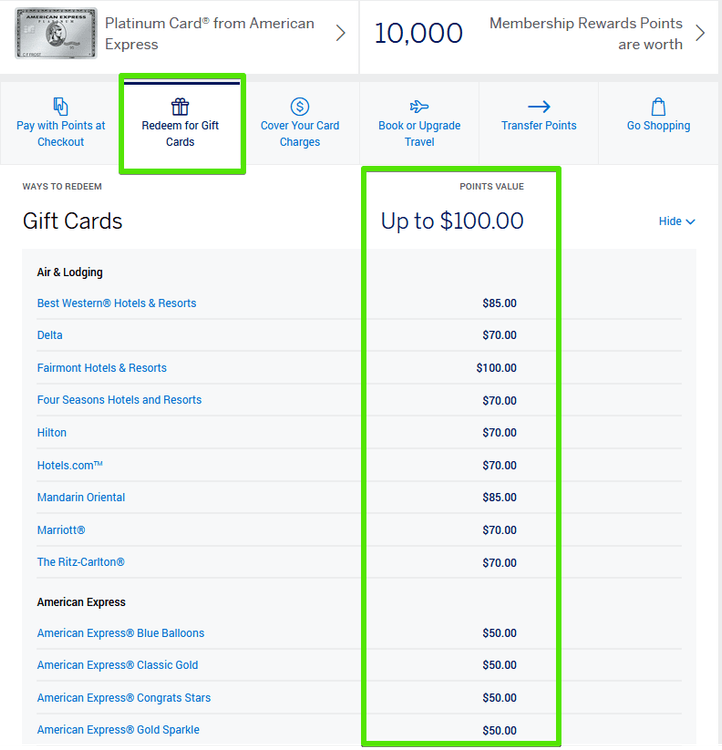
Amex also offers a portal for purchasing gift cards with points. The valuation here is inconsistent; while some brands offer 1 cent per point, others may offer as low as 0.5 cents. If a cardholder can find a 1:1 ratio for a merchant they already frequent—such as a home improvement store or a grocery chain—it can be a viable way to reduce monthly living expenses without navigating the complexities of the travel market.
Advanced Portfolio Management: Timing and Tax Considerations
To treat Amex points as a true financial asset, one must look at the timing of redemptions and the underlying tax implications of earning and spending these rewards.
Capitalizing on Transfer Bonuses
Periodically, American Express offers “Transfer Bonuses” to specific partners. For instance, they might offer a 30% bonus when transferring points to Virgin Atlantic or Hilton. These windows are the most opportune times to move points, as they instantly increase your purchasing power. A savvy financial move is to wait for these bonuses before making large transfers, effectively “buying” your travel at a 30% discount compared to the standard point price.
Business Finance Integration
For business owners, Membership Rewards points can be a powerful tool for managing overhead. Points earned on business expenses can be used to fund employee travel, purchase office equipment, or even be reinvested into the business by using points to pay for shipping or advertising costs through certain Amex partnerships.
Crucially, from a tax perspective in the United States, points earned through credit card spend are generally treated as “rebates” rather than “income” by the IRS. This means they are typically non-taxable assets. Utilizing points to cover business expenses can be a tax-efficient way to reduce your taxable income, as you are essentially substituting a non-taxed asset for a deductible cash expense. (Note: Always consult with a tax professional regarding your specific situation).
Optimizing the Points Lifecycle
The final stage of using Amex points effectively is the management of the points lifecycle—from accumulation to redemption. The goal is to avoid “point inflation.” Just as fiat currency loses value over time due to inflation, loyalty points are subject to “devaluations” by airlines and hotels who may increase the number of points required for a specific reward.
The “Earn and Burn” Philosophy
In the world of financial planning, long-term hoarding of points is often discouraged. Because you have no control over the “inflation rate” of the Membership Rewards ecosystem or its partners, the “Earn and Burn” philosophy is often the most prudent. This strategy suggests that you should have a plan for your points within 12 to 18 months of earning them. This ensures that you realize the value of the points before any potential devaluation occurs.
Strategic Diversification
Just as a healthy investment portfolio is diversified, your “points portfolio” should be as well. While Membership Rewards are a fantastic “core holding” due to their flexibility, they should be used in conjunction with other financial tools. By understanding when to pay cash (to earn more points) and when to use points (to save cash), you create a virtuous cycle of wealth preservation and lifestyle enhancement.
In conclusion, the question of “how to use Amex points” is not merely about finding a way to spend them; it is about determining the most efficient way to deploy them within your broader financial strategy. Whether through the high-ceiling world of international travel transfers or the pragmatic use of the Amex Travel portal, these points represent a versatile and tax-advantaged asset. By applying the principles of valuation, arbitrage, and strategic timing, any cardholder can transform their Membership Rewards balance into a powerful engine for financial and personal growth.
aViewFromTheCave is a participant in the Amazon Services LLC Associates Program, an affiliate advertising program designed to provide a means for sites to earn advertising fees by advertising and linking to Amazon.com. Amazon, the Amazon logo, AmazonSupply, and the AmazonSupply logo are trademarks of Amazon.com, Inc. or its affiliates. As an Amazon Associate we earn affiliate commissions from qualifying purchases.