
In the modern landscape of retail and institutional investing, few names carry as much weight in the semiconductor space as Advanced Micro Devices, Inc. (AMD). For investors asking “how much is one share of AMD,” the answer is a moving target that reflects the complex interplay of global supply chains, artificial intelligence (AI) breakthroughs, and quarterly financial performance. Understanding the price of a single share requires looking beyond the raw number on a ticker tape and delving into the underlying value drivers that make AMD a cornerstone of many growth-oriented portfolios.
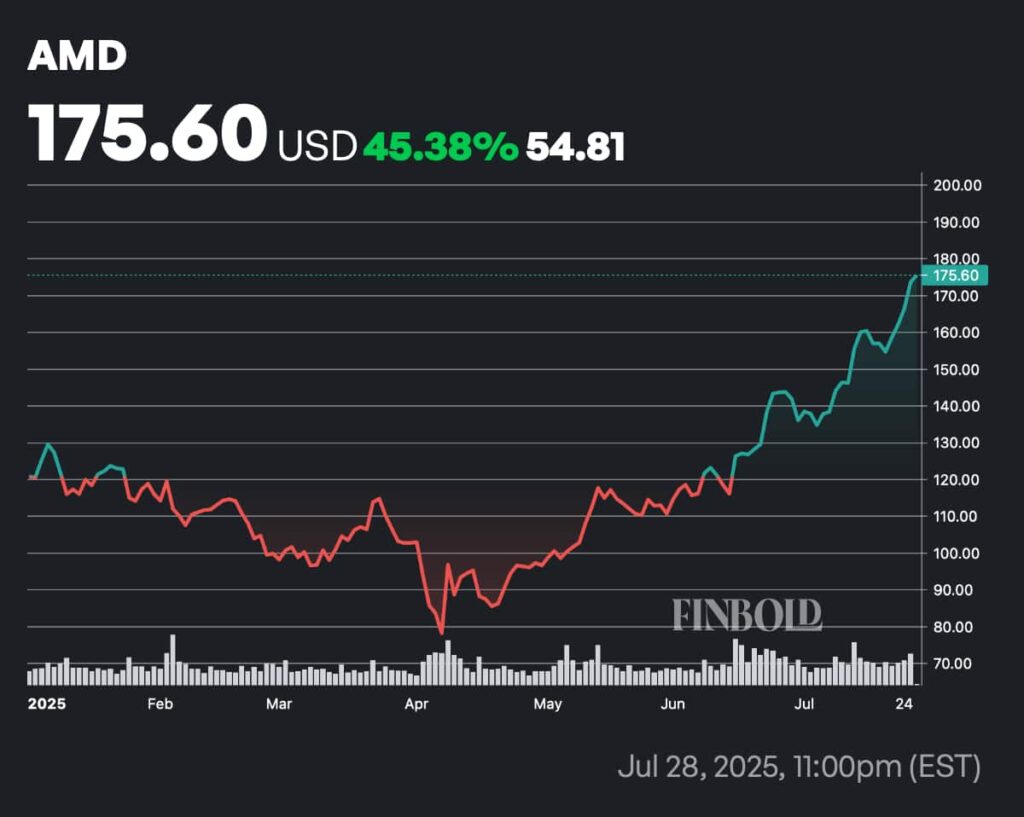
As of the current market cycle, AMD’s share price has seen significant volatility, often fluctuating between the mid-$100s and the low-$200s. However, the true “cost” of a share is best understood through the lens of market capitalization and valuation multiples. With a market cap that frequently exceeds $250 billion, AMD is no longer the scrappy underdog to Intel; it is a blue-chip powerhouse whose stock price is a barometer for the health of the high-performance computing sector.
Deciphering the Price Tag: What Determines the Cost of an AMD Share?
The price of a single AMD share is determined by the collective sentiment of millions of investors, driven by fundamental analysis and macroeconomic trends. When you look at the price on a brokerage app, you are seeing the equilibrium point where buyers and sellers agree on the company’s future earnings potential.
The Role of Quarterly Earnings and Guidance
Every three months, AMD releases its financial results, which serve as the primary catalyst for price movement. Investors focus on two main figures: revenue and earnings per share (EPS). If AMD reports earnings that exceed analyst expectations—a “beat”—the share price typically moves upward. Conversely, the “guidance” provided by CEO Lisa Su regarding future quarters often carries more weight than past performance. If the company forecasts a surge in demand for its AI accelerators or EPYC server processors, the share price will often bake in those future gains immediately.
Market Capitalization and Share Dilution
To understand the price of one share, one must understand how many shares exist. AMD has over 1.6 billion shares outstanding. When a company issues more shares—perhaps to fund an acquisition like the landmark Xilinx deal—the value of each individual share can be diluted if the acquisition doesn’t immediately add proportional value. However, AMD’s strategic acquisitions have generally been viewed as value-accretive, justifying a higher price per share by expanding the company’s total addressable market (TAM).
Supply and Demand in the Semiconductor Cycle
The semiconductor industry is famously cyclical. Prices for AMD shares often rise when there is a shortage of chips and high demand for consumer electronics, data center hardware, and gaming consoles. When the market is oversupplied, prices may stagnate. Currently, the shift toward AI-driven infrastructure has created a “supercycle” that has kept the demand for AMD’s high-end silicon at historic highs, supporting an elevated share price compared to the previous decade.
The AI Revolution: AMD’s Strategic Pivot and Its Impact on Shareholder Value
The primary reason for the premium pricing of AMD shares in the current market is the company’s aggressive entry into the artificial intelligence sector. While Nvidia has long dominated this space, AMD has positioned itself as the primary alternative, which has fundamentally re-rated the stock’s valuation.
The Instinct MI300 Series and Data Center Growth
The launch of the Instinct MI300X accelerator represented a turning point for AMD’s valuation. By offering a high-performance alternative to Nvidia’s H100, AMD tapped into the massive capital expenditure budgets of “hyperscalers” like Microsoft, Google, and Meta. Every time a major tech firm announces an increase in AI spending, AMD’s share price tends to react positively. The data center segment is now the most significant driver of AMD’s top-line growth, often offsetting weakness in the more volatile gaming and PC markets.
The Competition for Dominance
The price of an AMD share is also a reflection of its competitive standing against Intel and Nvidia. For years, AMD gained share in the CPU market at Intel’s expense, leading to a steady climb in stock price. Now, the battle has shifted to the GPU and AI accelerator front. Investors monitor “market share gain” metrics closely. Even if AMD’s revenue grows, the share price might stall if it appears that Nvidia is widening its lead. On the other hand, if AMD captures even 10-15% of the AI chip market, many analysts believe the current share price could be considered a bargain.
The “AI PC” and Client Segment Recovery
Beyond the data center, AMD is integrating AI processing units (NPUs) into its Ryzen processors. As the industry moves toward “AI PCs,” where tasks are handled locally on the device rather than in the cloud, AMD stands to benefit from a refresh cycle in the laptop and desktop markets. This diversification provides a floor for the stock price, ensuring that the company isn’t solely dependent on one niche of the technology world.
Financial Metrics That Matter: Beyond the Ticker Symbol

When an investor asks “how much is one share,” they should also ask “is it expensive?” Price is what you pay; value is what you get. To determine if AMD is priced fairly, professional investors look at several key financial ratios.
Price-to-Earnings (P/E) Ratio
AMD often trades at a high P/E ratio, sometimes exceeding 50x or even 100x on a trailing basis. This indicates that investors are willing to pay a high price today for the profits they expect the company to generate in the future. Comparing AMD’s P/E ratio to the industry average helps determine if the stock is overvalued. A high P/E is common for high-growth tech stocks, but it also makes the share price more sensitive to any missed targets.
Gross Margins and Profitability
A critical metric for chipmakers is the gross margin—the percentage of revenue left after the cost of goods sold. Under Lisa Su’s leadership, AMD has successfully pivoted from low-margin consumer chips to high-margin enterprise and data center products. As gross margins climb toward the 50-60% range, the company becomes more profitable for every dollar of sales, which historically leads to a higher sustained share price.
Free Cash Flow and R&D Investment
AMD reinvests a massive portion of its earnings into Research and Development (R&D). This is necessary to stay competitive with the likes of Nvidia and Intel. Investors look at free cash flow to ensure that the company can fund its innovation without taking on excessive debt. A healthy balance sheet with high cash reserves provides a safety net for the share price during broader market downturns.
Market Risks and Volatility in the Semiconductor Sector
Investing in AMD is not without risk, and the share price can experience dramatic swings in short periods. Understanding these risks is essential for anyone looking to purchase their first share.
Geopolitical Tensions and Supply Chain Fragility
AMD is a “fabless” semiconductor company, meaning it designs its chips but relies on third-party foundries—primarily Taiwan Semiconductor Manufacturing Company (TSMC)—to build them. Any geopolitical instability in the Taiwan Strait or disruptions in the global supply chain can cause AMD’s share price to plummet. Diversification of manufacturing is a long-term goal for the industry, but for now, AMD’s price remains tied to the stability of East Asian logistics.
Regulatory Hurdles and Export Controls
The U.S. government has implemented various export controls on high-end AI chips to countries like China. Since China represents a significant portion of the global semiconductor market, these regulations can directly impact AMD’s revenue. Whenever new trade restrictions are announced, the volatility in AMD’s share price increases as investors scramble to calculate the potential lost earnings.
The Threat of Market Satiation
There is always a risk that the massive build-out of AI infrastructure will slow down. If big tech companies decide they have enough compute power, the demand for AMD’s chips could drop, leading to a correction in the share price. This “boom and bust” cycle is a historical hallmark of the tech sector, and investors must be prepared for the possibility that today’s high prices may face a period of cooling.
Strategic Positioning: How to Approach AMD as an Investor
For those looking to buy AMD shares, the strategy used often matters as much as the entry price. Whether you are buying one share or one thousand, the methodology remains the same.
Dollar-Cost Averaging (DCA)
Given the volatility of the tech sector, many financial advisors recommend dollar-cost averaging. Instead of trying to time the “perfect” price to buy AMD, an investor buys a fixed dollar amount at regular intervals. This results in buying more shares when the price is low and fewer when the price is high, eventually smoothing out the cost basis.
Portfolio Diversification
While AMD is a powerful growth engine, it is often held within a diversified portfolio alongside more stable “value” stocks or index funds like the S&P 500 or the SOX (Philadelphia Semiconductor Index). Holding AMD as part of a broader tech-focused ETF can also mitigate the risk of individual company fluctuations while still providing exposure to AMD’s growth.

The Long-Term Perspective
The most successful AMD investors over the last decade have been those who ignored short-term price fluctuations and focused on the company’s multi-year roadmap. If you believe that the world will require exponentially more computing power five years from now, the current price of one share of AMD may be less relevant than the company’s trajectory toward becoming the backbone of the global digital economy.
In conclusion, “how much is one share of AMD” is a question with a numerical answer that changes by the second, but a value proposition that is built on years of engineering excellence and strategic market positioning. For the modern investor, AMD represents a high-stakes, high-reward play on the future of intelligence itself.
aViewFromTheCave is a participant in the Amazon Services LLC Associates Program, an affiliate advertising program designed to provide a means for sites to earn advertising fees by advertising and linking to Amazon.com. Amazon, the Amazon logo, AmazonSupply, and the AmazonSupply logo are trademarks of Amazon.com, Inc. or its affiliates. As an Amazon Associate we earn affiliate commissions from qualifying purchases.