
Understanding how to calculate monthly payments with interest is one of the most fundamental skills in personal finance. Whether you are looking to purchase a new home, finance a vehicle, or manage credit card balances, the ability to dissect a loan payment allows you to make informed decisions that can save you thousands of dollars over a lifetime. While many people rely solely on online calculators, grasping the underlying mechanics of interest and principal provides a level of financial clarity that a simple automated output cannot offer.
Financial literacy is the foundation of wealth building. When you understand how interest accrues and how your payments are structured, you move from being a passive borrower to an active manager of your capital. This guide explores the mathematical formulas, the various types of interest structures, and the strategic approaches you can take to minimize the cost of borrowing.
Understanding the Fundamentals of Interest and Principal
At its core, every loan payment is composed of two primary elements: the principal and the interest. The principal is the original amount of money borrowed or the remaining balance that must be paid back. Interest, conversely, is the cost of borrowing that money, typically expressed as an annual percentage rate (APR).
Simple vs. Compound Interest
Before diving into complex monthly calculations, it is essential to distinguish between simple and compound interest. Simple interest is calculated only on the principal amount. It is common in short-term personal loans or specific types of consumer financing. The formula is straightforward: Interest = Principal × Rate × Time.
However, most modern financial products—including mortgages, student loans, and credit cards—utilize compound interest or an amortization schedule. Compound interest is “interest on interest.” In the context of a monthly payment, this means that while your interest is calculated based on the remaining balance, the frequency with which that interest is applied can significantly alter the total amount you owe over time.
Fixed vs. Variable Interest Rates
The stability of your monthly payment depends heavily on whether your interest rate is fixed or variable. A fixed-rate loan ensures that the interest rate remains constant throughout the life of the loan. This makes monthly payments predictable and allows for precise long-term budgeting.
Variable or adjustable rates are tied to an index, such as the Prime Rate or the Secured Overnight Financing Rate (SOFR). When the index moves, your interest rate—and consequently your monthly payment—adjusts. Understanding this distinction is vital when “figuring” your payments, as a variable rate requires you to build a buffer into your financial plan to account for potential market volatility.
The Role of the Annual Percentage Rate (APR)
Many borrowers confuse the interest rate with the APR. While the interest rate determines the direct cost of the principal, the APR provides a more holistic view of the loan’s cost by including origination fees, closing costs, and other administrative charges. When calculating your true monthly burden, using the APR as your guide provides a more accurate reflection of your out-of-pocket expenses.
The Mathematics of Monthly Payments
To calculate a fixed monthly payment (such as for a mortgage or auto loan), you must use the standard amortization formula. This formula ensures that by the end of the loan term, the balance reaches zero through a series of equal installments.
The Amortization Formula
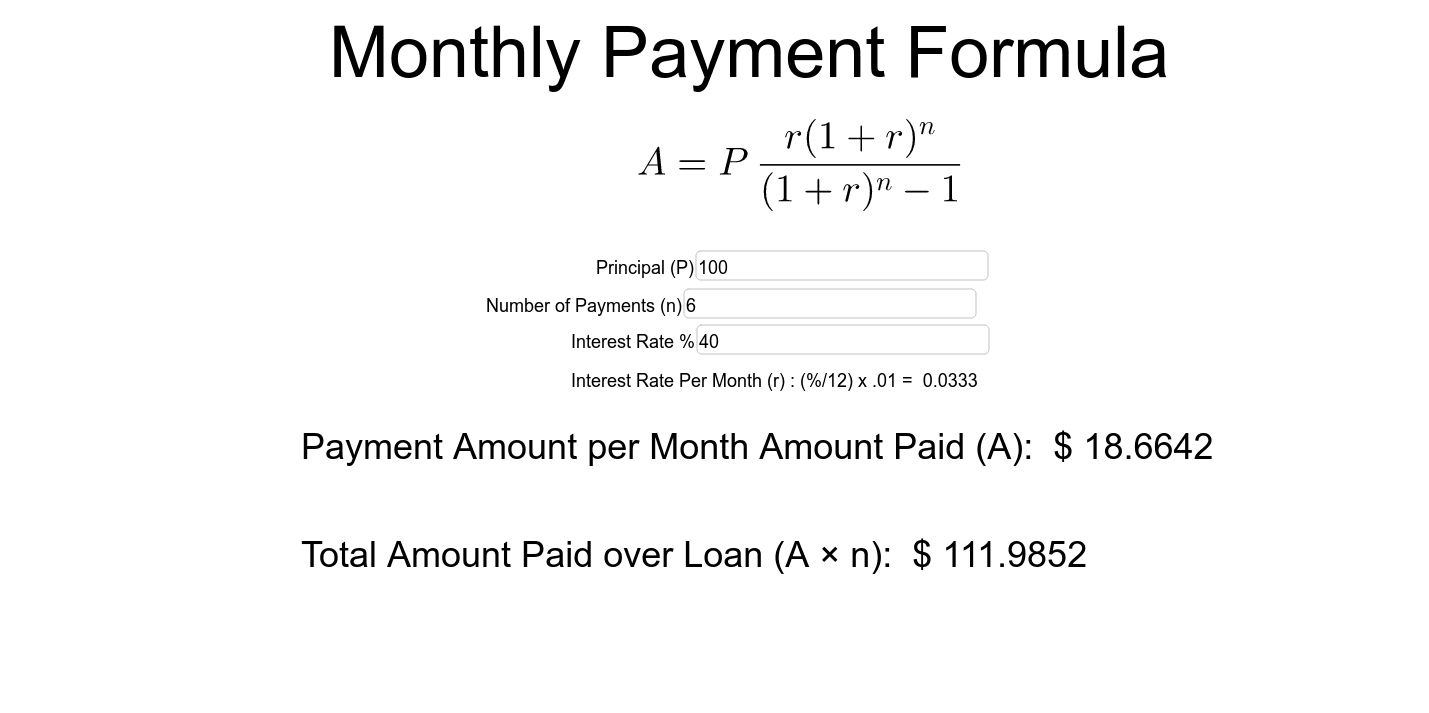
The formula for calculating a monthly payment (M) is:
M = P [ i(1 + i)^n ] / [ (1 + i)^n – 1 ]
In this equation:
-
P represents the principal loan amount.
-
i represents the monthly interest rate. To find this, divide your annual interest rate by 12. (For example, an 0.06 annual rate becomes 0.005 monthly).
-
n represents the total number of months (payments) over the life of the loan. For a 30-year mortgage, n would be 360.
Breaking Down the Calculation Step-by-Step
To see this in action, imagine a $30,000 auto loan with a 5% annual interest rate and a 5-year (60-month) term.
-
Identify the variables: P = 30,000; annual rate = 0.05; monthly rate (i) = 0.004167; n = 60.
-
Calculate the numerator: i(1 + i)^n. This involves raising 1.004167 to the 60th power and multiplying it by the monthly rate.
-
Calculate the denominator: (1 + i)^n – 1.
-
Divide and Multiply: Once you divide the numerator by the denominator and multiply by the principal ($30,000), you arrive at the monthly payment.
In this scenario, the monthly payment would be approximately $566.14. By multiplying this by 60 months, you can see that the total repayment is $33,968.40, meaning the cost of the interest over five years is $3,968.40.
Manual Calculation vs. Financial Tools
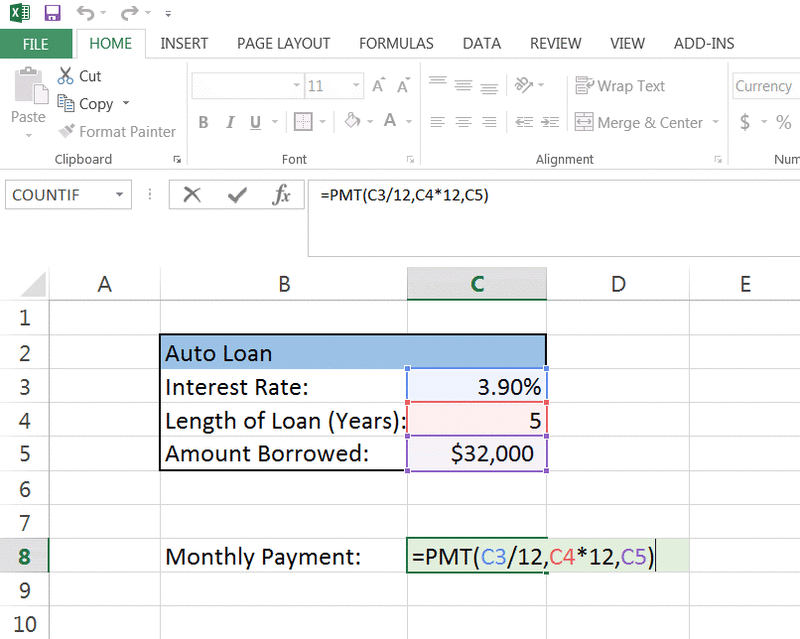
While knowing the formula is empowering, manual calculations are prone to human error. Utilizing spreadsheet software like Microsoft Excel or Google Sheets is a professional standard for managing personal finance. The function =PMT(rate, nper, pv) automates the math described above. By inputting the monthly rate, the number of periods, and the present value (principal), you can instantly toggle different scenarios—such as how a higher down payment or a shorter loan term would affect your monthly cash flow.
Analyzing Different Loan Types and Their Payment Structures
Not all monthly payments are created equal. Depending on the financial product, your payment might cover more than just interest and principal.
Mortgages and the Impact of Escrow
When figuring a mortgage payment, the “P+I” (Principal and Interest) is only part of the story. Most homeowners must also account for property taxes, homeowners insurance, and potentially Private Mortgage Insurance (PMI). These are often bundled into a single monthly payment via an escrow account. When evaluating your monthly budget, it is a common mistake to calculate the loan payment based solely on the amortization formula while forgetting the “T+I” (Taxes and Insurance), which can add hundreds of dollars to your monthly obligation.
Auto Loans and Simple Interest Calculations
Most auto loans use a simple interest amortization schedule. However, because interest is calculated daily based on the remaining balance, the timing of your payment matters. If you pay a few days early each month, less interest accrues, and more of your payment goes toward the principal. Conversely, late payments (even within a grace period) can result in more of your money being swallowed by interest charges.
Credit Cards and the Daily Periodic Rate
Credit cards are unique because they do not have a fixed “term” like a 5-year car loan. Instead, they require a minimum monthly payment, usually calculated as a small percentage of the total balance (e.g., 1% to 3%) plus any interest accrued during the billing cycle.
To figure your credit card interest, you must determine your Daily Periodic Rate (DPR) by dividing your APR by 365. This rate is then multiplied by your average daily balance. Because credit cards compound so frequently, maintaining a balance is one of the most expensive ways to borrow money. Understanding this calculation often serves as the necessary motivation for consumers to prioritize aggressive debt repayment.
Strategies to Reduce Interest and Pay Off Debt Faster
Once you understand how to figure your payments, the next logical step is learning how to manipulate those figures to your advantage. Every dollar you pay above the minimum requirement goes directly toward the principal, which in turn reduces the amount of interest calculated in the following month.
Making Extra Principal Payments
The impact of extra principal payments is most dramatic on long-term loans like mortgages. By adding just one extra monthly payment per year—or by rounding up your monthly payment—you can shave years off your loan term and tens of thousands of dollars off your total interest paid. This is because reducing the principal early in the loan’s life prevents the “interest on interest” from snowballing in the bank’s favor.
The Debt Avalanche vs. Debt Snowball Methods
When managing multiple debts, you must decide where to allocate extra funds.
-
The Debt Avalanche: This method focuses on paying off the debt with the highest interest rate first. Mathematically, this is the most efficient way to reduce the total interest paid over time.
-
The Debt Snowball: This method focuses on paying off the smallest balances first to build psychological momentum. While it may result in paying slightly more interest, the behavioral “win” of closing an account can be powerful for many individuals.
Refinancing and Consolidation
If market interest rates have dropped since you took out a loan, or if your credit score has improved, figuring your new potential payment through refinancing is a vital exercise. Refinancing involves taking out a new loan with better terms to pay off the old one. Similarly, debt consolidation allows you to combine multiple high-interest debts into a single payment with a lower interest rate, simplifying your monthly calculations and reducing your total financial burden.
Using Financial Tools to Track and Optimize Payments
In the digital age, financial management has moved beyond the checkbook ledger. A professional approach to personal finance involves using tools that provide real-time insights into your debt-to-income ratio and payment schedules.
Spreadsheet Modeling for Long-term Planning
For those who want total control, creating a custom amortization table in a spreadsheet is the gold standard. By listing every month of the loan, you can see exactly how much of each payment is going to interest versus principal. This visualization is often eye-opening; in the early years of a 30-year mortgage, for instance, the vast majority of your payment is interest. Seeing this data helps you understand why early principal payments are so effective.
Mobile Apps and Digital Dashboards
Various apps can link directly to your bank accounts to track your debt balances in real-time. These tools often include “what-if” simulators, allowing you to see how a $50 increase in your monthly payment would affect your “debt-free date.” By gamifying the process of debt reduction, these tools make the rigorous math of interest calculations accessible and actionable.

The Importance of Regular Financial Audits
Monthly payments are not “set it and forget it” obligations. A professional strategy involves auditing your debts at least twice a year. Check for changes in variable interest rates, ensure that extra payments are being applied correctly to the principal (and not just “prepaying” the next month’s interest), and scan the market for better rates.
By mastering the art of figuring monthly payments with interest, you gain a significant advantage in the quest for financial independence. You no longer view a loan as a single monthly “bill,” but as a dynamic financial instrument that can be optimized, accelerated, and eventually eliminated. Knowledge of the math behind the money is the first step toward building a secure and prosperous financial future.
aViewFromTheCave is a participant in the Amazon Services LLC Associates Program, an affiliate advertising program designed to provide a means for sites to earn advertising fees by advertising and linking to Amazon.com. Amazon, the Amazon logo, AmazonSupply, and the AmazonSupply logo are trademarks of Amazon.com, Inc. or its affiliates. As an Amazon Associate we earn affiliate commissions from qualifying purchases.