
Understanding how to figure loan payments is a fundamental pillar of personal finance. Whether you are looking to purchase a first home, finance a vehicle, or consolidate high-interest credit card debt, the ability to calculate and dissect your monthly obligations allows you to move from a position of passive borrowing to one of active financial management. When you understand the mechanics of a loan, you gain the power to negotiate better terms, choose the right financial products, and ultimately save thousands of dollars over the life of your debt.

A loan payment is not a static number determined by a lender’s whim; it is a mathematical outcome based on specific variables. By mastering these variables, you can project your future cash flow with precision and avoid the common pitfalls that lead to over-indebtedness.
The Core Components of a Loan Payment
Before diving into the complex formulas, one must identify the four primary levers that dictate the size of a loan payment. Every installment loan, from a small personal loan to a massive commercial mortgage, is built upon these foundational elements.
Principal: The Baseline of Your Debt
The principal is the actual amount of money you borrow. If you take out a $30,000 car loan, your initial principal is $30,000. As you make payments, a portion of that money goes toward reducing this balance. However, the principal is also the base upon which interest is calculated. The larger the principal, the higher the interest charges will be, even if the interest rate remains low.
Interest Rates: The Cost of Borrowing
Interest is the “rent” you pay to the lender for the privilege of using their money. It is typically expressed as an Annual Percentage Rate (APR). In the world of finance, interest is the primary variable that determines the total cost of the loan. It is important to distinguish between the nominal interest rate and the APR, as the latter includes fees and other costs, providing a more accurate picture of what you are truly paying.
Loan Term: Time as a Multiplier
The term is the duration over which you agree to repay the loan. Terms are usually expressed in months (e.g., 60 months for an auto loan) or years (e.g., 30 years for a mortgage). The relationship between the term and the payment is inverse: a longer term results in a lower monthly payment but a significantly higher total interest cost. Conversely, a shorter term requires a higher monthly payment but allows you to build equity faster and pay less to the lender in the long run.
Calculating the Numbers: Formulas and Methods
To figure a loan payment manually, you must utilize the amortization formula. While most consumers rely on digital calculators, understanding the underlying math provides deep insight into how interest consumes your monthly budget.
The Amortization Formula Explained
The standard formula for calculating a fixed-rate monthly payment (M) is:
M = P [ i(1 + i)^n ] / [ (1 + i)^n – 1 ]
In this equation:
-
P is the principal loan amount.
-
i is the monthly interest rate (annual rate divided by 12).
-
n is the total number of months (the number of payments).
For example, if you borrow $10,000 at a 6% annual interest rate for 4 years (48 months), your monthly interest rate is 0.005 (0.06/12). Plugging these numbers into the formula allows you to see exactly how much you must pay each month to bring the balance to zero by the end of the 48th month.
Simple Interest vs. Compound Interest
Most installment loans use simple interest calculated on the remaining balance, but some personal loans or “payday” style products may use different compounding methods. In a simple interest amortization model, interest is calculated based on the principal balance on the day the payment is due. This means that if you pay early, you actually pay less interest for that month because the principal was reduced sooner. Understanding this distinction is vital for anyone looking to accelerate their debt repayment.
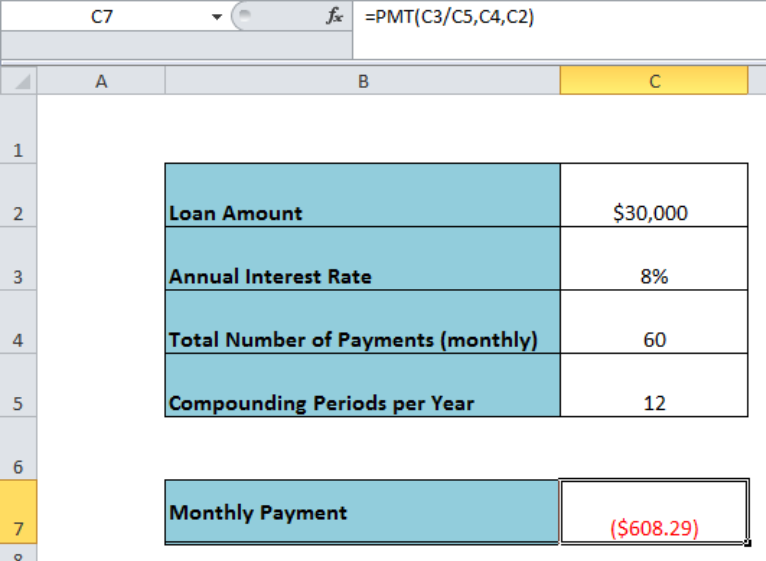
Using Digital Calculators and Spreadsheets
For those who prefer not to do long-form algebra, financial spreadsheets like Excel or Google Sheets offer built-in functions. The =PMT function is the industry standard. By entering =PMT(rate/12, total_months, -principal), the software instantly generates the payment. Mastering these digital tools allows you to run “what-if” scenarios, such as seeing how an extra $50 a month affects a 10-year loan.
Understanding Amortization Schedules
Figuring out the monthly payment is only half the battle. To truly understand your loan, you must look at the amortization schedule—a table that breaks down every single payment over the life of the loan into interest and principal.
How Your Early Payments Work
In the early stages of a long-term loan, such as a 30-year mortgage, a staggering percentage of your monthly payment goes toward interest rather than principal. This is because the interest is calculated based on the high initial balance. For the first several years, you may find that your total debt decreases very slowly. This “front-loading” of interest is a standard feature of amortized loans and highlights why staying in a home or a loan for only a short period can be financially inefficient.
The Shift Toward Principal Over Time
As the principal balance drops, the amount of interest charged each month also drops. Consequently, a larger portion of your fixed monthly payment is applied to the principal. Toward the end of the loan term, the situation reverses: almost the entire payment goes toward principal, and very little goes toward interest. Understanding this curve is essential for timing a refinance or deciding when to sell an asset.
Factors That Influence Your Monthly Total
When you figure your loan payments, the “sticker price” of the loan is rarely the “out-of-pocket” cost. Several external factors can inflate the amount you actually write on your check each month.
Fixed vs. Variable Interest Rates
If you have a fixed-rate loan, your payment remains the same for the duration of the term. This provides stability for long-term budgeting. However, variable-rate loans (or Adjustable-Rate Mortgages) can change based on market indices. When figuring these payments, you must account for “worst-case scenarios” where interest rates rise, potentially increasing your monthly obligation beyond what your income can support.
Escrow, Taxes, and Insurance (The PITI Model)
In mortgage financing, the loan payment is often referred to as PITI: Principal, Interest, Taxes, and Insurance. When you use a standard loan calculator, it usually only gives you the “P” and “I.” To figure your true monthly cost, you must add property taxes and homeowners insurance, which are often held in an escrow account by the lender. Additionally, if your down payment was less than 20%, you may be required to pay Private Mortgage Insurance (PMI), further increasing the monthly total.
Origination Fees and Closing Costs
Many borrowers make the mistake of focusing solely on the interest rate while ignoring the fees. Origination fees, processing fees, and points are often “rolled into” the loan. This increases your principal balance before you’ve even made your first payment. When figuring your loan, always calculate the payment based on the financed amount, not just the purchase price of the asset.
Strategic Approaches to Managing Loan Payments
Once you know how to figure the payments, you can begin to manipulate the variables to your advantage. Strategic debt management is the difference between being “debt-stressed” and “debt-free.”
The Impact of Extra Payments
One of the most effective ways to save money is to pay more than the calculated monthly payment. Because interest is calculated based on the remaining principal, any extra money sent directly to the principal reduces the base for all future interest calculations. For example, making one extra mortgage payment a year can shave years off a 30-year loan and save tens of thousands of dollars in interest. When figuring your payments, always check if your loan has a “prepayment penalty,” though these are becoming increasingly rare in consumer lending.
Refinancing for Lower Payments
If market interest rates drop or your credit score improves significantly, you should re-figure your loan payments based on current refinancing rates. Refinancing allows you to replace a high-interest loan with a lower-interest one, effectively lowering your monthly overhead or allowing you to shorten the term without a massive increase in payment size.

Balancing Debt-to-Income Ratios
Financial health is often measured by the Debt-to-Income (DTI) ratio. Most lenders prefer a DTI where your total monthly debt payments do not exceed 36% to 43% of your gross monthly income. By knowing how to figure your loan payments accurately before you sign a contract, you can ensure that a new debt doesn’t push your DTI into a danger zone that prevents you from qualifying for future credit or, worse, leads to insolvency.
In conclusion, figuring loan payments is an exercise in both mathematics and strategy. By dissecting the components of principal, interest, and term, and by looking closely at amortization schedules, you can gain a clear-eyed view of your financial commitments. This knowledge serves as a safeguard, ensuring that every dollar you borrow is a calculated move toward your broader financial goals. Knowledge of the numbers is the ultimate leverage in the world of personal finance.
aViewFromTheCave is a participant in the Amazon Services LLC Associates Program, an affiliate advertising program designed to provide a means for sites to earn advertising fees by advertising and linking to Amazon.com. Amazon, the Amazon logo, AmazonSupply, and the AmazonSupply logo are trademarks of Amazon.com, Inc. or its affiliates. As an Amazon Associate we earn affiliate commissions from qualifying purchases.