
Determining a “good” monthly car payment is one of the most critical decisions in personal finance, yet it is often approached with more emotion than arithmetic. For many households, a vehicle is the second-largest expense after housing. Because cars are depreciating assets—meaning they lose value over time—committing too much of your monthly cash flow to a car loan can significantly hinder your ability to save for retirement, build an emergency fund, or invest in appreciating assets like real estate or stocks.
A truly good monthly payment is not just a number that fits within your bank balance today; it is a figure that preserves your financial flexibility for the future. To find this number, one must look past the monthly sticker price and evaluate the decision through the lenses of income ratios, total cost of ownership, and long-term financial health.

The Fundamental Framework: The 20/4/10 Rule
Financial experts often point to the “20/4/10 rule” as the gold standard for vehicle affordability. While individual circumstances vary, this framework provides a baseline that prevents the “lifestyle creep” often associated with auto financing.
The Importance of a 20% Down Payment
The first component of a sustainable car payment begins before the monthly installments even start. Putting 20% down serves two primary purposes. First, it immediately reduces the principal balance, which in turn lowers the monthly payment and the total interest paid over the life of the loan. Second, and perhaps more importantly, it protects you from “negative equity,” often referred to as being “underweight” or “underwater” on a loan. Vehicles lose a significant portion of their value the moment they leave the lot. Without a substantial down payment, you may find yourself owing $30,000 on a car that is only worth $25,000, making it impossible to sell or trade in the vehicle without paying out of pocket to clear the title.
Limiting the Loan Term to 48 Months
In recent years, 72-month and even 84-month car loans have become increasingly common. While these long-term loans result in a lower monthly payment, they are generally considered poor financial moves. A long loan term means you will pay significantly more in interest over time. Furthermore, by the time you reach the fifth or sixth year of the loan, the vehicle’s maintenance costs typically rise just as the car’s value plummets. A “good” monthly payment is one that allows you to pay off the vehicle in 48 months (four years). If you cannot afford the payment on a four-year schedule, the car is likely outside your sustainable price range.
Capping Total Costs at 10% of Income
The “10” in the 20/4/10 rule dictates that your total monthly vehicle expenses—including the loan payment, insurance, fuel, and maintenance—should not exceed 10% of your gross monthly income. If you earn $5,000 per month pre-tax, your total “car budget” is $500. It is a common mistake to assume that the $500 applies only to the loan payment. If your loan payment is $450 and your insurance is $150, you are already at $600, which is 12% of your income. This seemingly small 2% difference can result in thousands of dollars of lost investment potential over a decade.
Beyond the Sticker Price: Analyzing Total Cost of Ownership
A monthly payment is only one piece of the financial puzzle. To understand if a payment is truly “good,” you must calculate the Total Cost of Ownership (TCO). A lower monthly payment on an older, less reliable luxury vehicle may actually cost you more per month than a higher payment on a new, fuel-efficient economy car once all variables are considered.
Factoring in Insurance and Registration
Insurance premiums vary wildly based on the vehicle’s age, safety ratings, and replacement cost. Before signing a loan agreement, it is vital to get an insurance quote for that specific VIN. High-performance vehicles or certain imported brands may carry premiums that turn a manageable loan payment into a financial burden. Additionally, many states charge annual registration fees or ad valorem taxes based on the vehicle’s value. On a new $40,000 car, these annual fees can equate to an extra $30 to $50 per month when averaged over the year.
Accounting for Maintenance and Unexpected Repairs
A brand-new vehicle often comes with a bumper-to-bumper warranty and, in some cases, complimentary scheduled maintenance. This provides a level of predictability for your monthly budget. Conversely, a used vehicle out of warranty requires a “maintenance sinking fund.” A good monthly payment for a used car must be low enough to allow you to set aside $100 to $150 per month for tires, brakes, and mechanical failures. If the loan payment itself consumes your entire transportation budget, a single transmission failure could lead to high-interest credit card debt.
The Hidden Reality of Depreciation
While depreciation doesn’t show up as a line item in your monthly bank statement, it is a very real cost. A good monthly payment should be viewed in the context of how much value the car is losing each month. If your payment is $500, but the car is losing $600 in value every month, your net worth is effectively decreasing by $1,100 per month for the privilege of driving that vehicle. Opting for models known for high resale value (such as certain trucks or reliable Japanese sedans) makes the monthly payment “better” from a balance-sheet perspective.
Evaluating Debt-to-Income Ratios and Opportunity Costs
From a personal finance standpoint, a car payment does not exist in a vacuum. It interacts with your credit score, your ability to borrow for a home, and your long-term wealth accumulation.
How Car Debt Impacts Future Borrowing Power
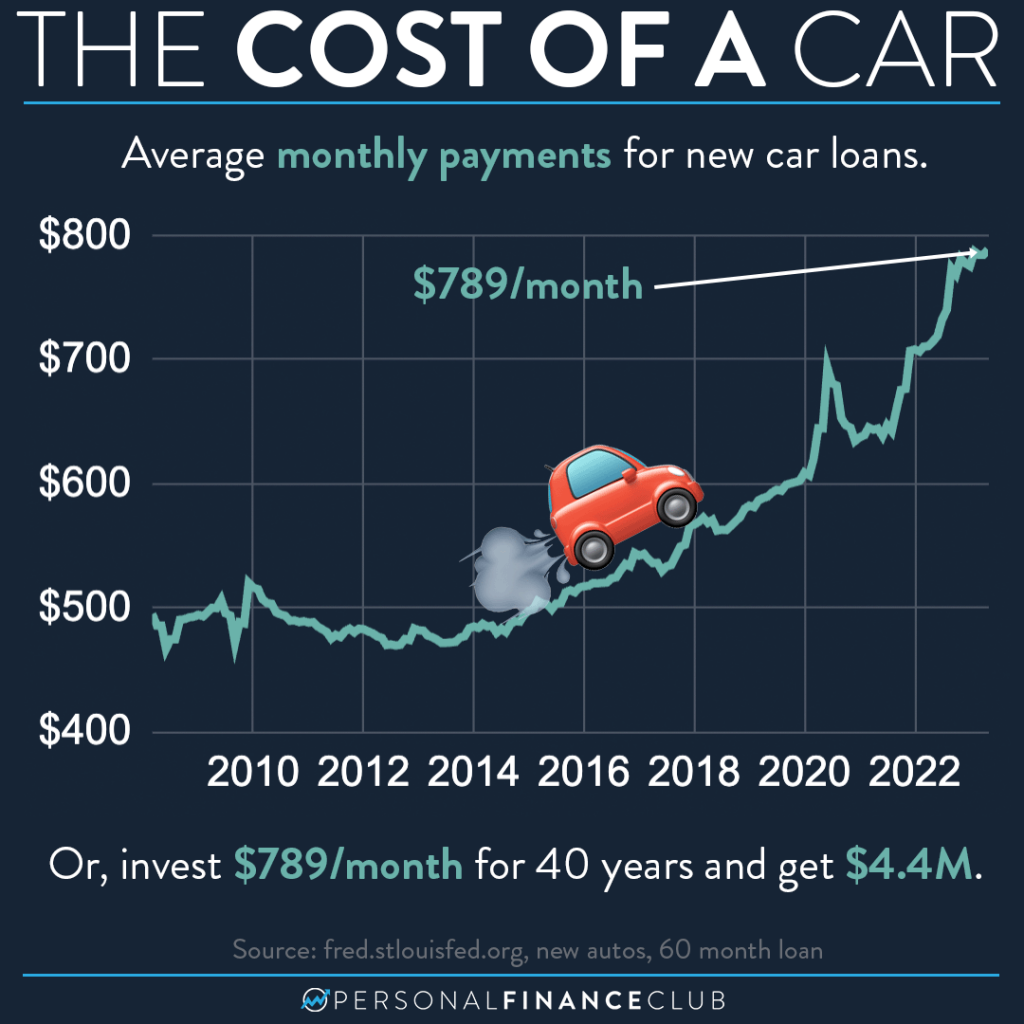
Lenders look at your Debt-to-Income (DTI) ratio when you apply for a mortgage. Most mortgage programs require your total monthly debt payments (including the potential mortgage, car loans, and student loans) to stay below 36% to 43% of your gross income. A “good” car payment is one that leaves enough room in your DTI ratio to qualify for a home or a business loan later. If a $700 car payment prevents you from qualifying for a mortgage on a home that will likely appreciate in value, that car payment is objectively bad for your financial future.
The Opportunity Cost of High Monthly Payments
The most significant danger of a high car payment is opportunity cost. Every dollar sent to a car lender is a dollar that isn’t being invested in the stock market. For example, the difference between a $400 car payment and a $700 car payment is $300 a month. If that $300 were invested in a diversified index fund with an average 7% annual return, it would grow to approximately $52,000 over 10 years. Over 30 years, it could grow to over $350,000. When asking “what is a good monthly payment,” one must ask if the prestige or comfort of a more expensive car is worth hundreds of thousands of dollars in lost retirement savings.
New, Used, or Leased: Which Path Optimizes Your Cash Flow?
The structure of the “payment” depends heavily on whether you are buying new, buying used, or leasing. Each has a different impact on your monthly budget and long-term net worth.
The Financial Case for Pre-Owned Vehicles
Generally, the “best” monthly payment is found in the used car market. A two- to three-year-old vehicle has already taken its steepest depreciation hit (often 30% to 40% of its original value) but likely still has plenty of reliable life left. By purchasing a used vehicle, you can often get a higher-quality car for a lower monthly payment than a base-model new car, while also benefiting from lower insurance rates.
Understanding the True Cost of a Lease
Leasing is often marketed as a way to get a “good” (low) monthly payment on a high-end vehicle. While the monthly cash outlay is lower than a traditional loan, leasing is frequently the most expensive way to operate a vehicle over the long term. At the end of a lease, you have zero equity. You have essentially rented the most expensive years of a car’s life. A $400 lease payment may feel better than a $600 loan payment, but after 36 months, the person with the loan has a car worth $20,000, while the person who leased has nothing.
Actionable Strategies to Secure a Sustainable Payment
If you have determined your target range, the final step is ensuring you actually secure it through smart financial maneuvering.
Leveraging Credit Scores for Lower Interest Rates
The interest rate (APR) is the “tax” you pay for borrowing money. A person with a 750 credit score might secure a 4% interest rate, while someone with a 620 score might be offered 14%. On a $30,000 loan over five years, that difference in interest rates adds roughly $150 to the monthly payment. Improving your credit score before shopping for a car is the single most effective way to lower your monthly payment without changing the car you want.

Timing and Negotiation Techniques
To achieve a good monthly payment, you must negotiate the total purchase price of the vehicle, not the monthly payment itself. Dealerships often use “monthly payment selling” to hide the total cost of the car, extending the loan term to make an expensive car seem affordable. Always negotiate the “out-the-door” price. Additionally, shopping at the end of the month or during year-end clearance events can provide the leverage needed to drive down the principal, which naturally results in a more favorable monthly payment.
In conclusion, a good monthly payment for a car is one that adheres to the 20/4/10 rule, accounts for the total cost of ownership, and does not compromise your ability to invest in your future. It is a figure that provides reliable transportation without creating financial stress, allowing you to move toward your long-term wealth goals with confidence.
aViewFromTheCave is a participant in the Amazon Services LLC Associates Program, an affiliate advertising program designed to provide a means for sites to earn advertising fees by advertising and linking to Amazon.com. Amazon, the Amazon logo, AmazonSupply, and the AmazonSupply logo are trademarks of Amazon.com, Inc. or its affiliates. As an Amazon Associate we earn affiliate commissions from qualifying purchases.