
Purchasing a vehicle is often the second-largest financial commitment a consumer makes, trailing only the purchase of a home. While most buyers focus intently on the “sticker price” or the monthly payment, the most critical factor in the long-term cost of vehicle ownership is the interest. Understanding how interest is calculated on a car loan is not merely an academic exercise; it is a fundamental skill for anyone looking to navigate the complexities of personal finance and preserve their wealth.
Interest is essentially the “rent” you pay to a lender for the privilege of using their capital. However, unlike a flat rental fee, interest on an auto loan is dynamic, moving in tandem with your remaining balance, the passage of time, and the specific terms dictated by your loan agreement.
The Core Mechanics: Simple Interest vs. Precomputed Interest
To understand how your money is being allocated, you must first identify the type of interest structure your loan utilizes. In the modern financial landscape, the vast majority of auto loans are structured as simple interest loans, though some alternative structures still exist in specific lending niches.
The Predominance of Simple Interest
Most reputable banks, credit unions, and captive finance companies (the lending arms of manufacturers like Ford Credit or Toyota Financial Services) use a simple interest formula. In this model, interest is calculated based on the principal balance of the loan on the day the payment is due.
The formula for simple interest is straightforward:
Interest = Principal x Rate x Time
In the context of a daily calculation—which is how most car loans actually function—the lender divides your annual interest rate by 365 (or 360, depending on the contract) to determine a daily interest factor. Every day you carry a balance, that factor is multiplied by your current principal to determine how much interest has accrued since your last payment.
The Trap of Precomputed Interest
While rare today, some “buy-here-pay-here” dealerships or subprime lenders may use precomputed interest. In these contracts, the total interest for the entire life of the loan is calculated upfront and added to the principal.
The danger of precomputed interest is that the borrower does not benefit from paying the loan off early. Because the interest is already “baked into” the total debt, making extra payments doesn’t reduce the interest burden in the same way it does with a simple interest loan. For anyone focused on financial efficiency, avoiding precomputed interest is a mandatory rule of engagement.
The Amortization Process: How Payments are Structured
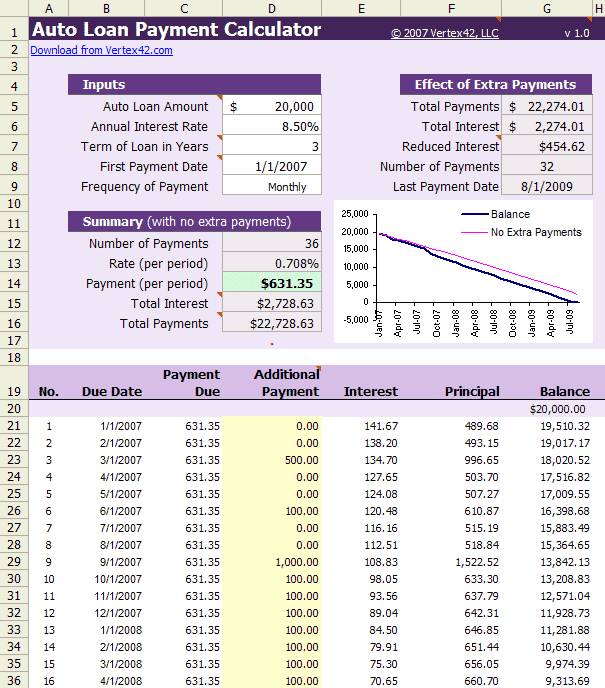
When you make a monthly payment on a car loan, your money is not distributed evenly between the principal and the interest. Instead, it follows an amortization schedule—a mathematical table that dictates how each payment is split over the life of the loan.
The Daily Interest Formula
Most car loans utilize a “daily balance” method for amortization. This means that interest accrues every single day. If you have a $20,000 loan at a 6% annual interest rate, your daily interest rate is approximately 0.0164% (0.06 divided by 365). On day one, you would owe roughly $3.28 in interest.
When your monthly payment arrives, the lender first covers the interest that has accumulated since your last payment. Whatever remains is then applied to the principal balance. This leads to a cascading effect: as the principal drops, the amount of interest that can accrue the following month also drops, allowing a larger portion of your next payment to hit the principal.
The Front-Loading Effect
In the early stages of a 60-month or 72-month loan, a significant portion of your monthly payment goes toward interest. This is known as “front-loading,” though it isn’t a deliberate trick by the bank; it is a mathematical reality of having a high principal balance.
As you progress through the loan term, the ratio shifts. By the final year of the loan, the interest portion of your payment is negligible because the principal balance is so low. Understanding this shift is vital for those considering trading in a vehicle. If you trade in a car only two years into a six-year loan, you have paid a disproportionate amount of interest and very little principal, often leading to a situation known as being “underwater” or having negative equity.
Why Early Payments Save More Money
Because interest is calculated based on the outstanding principal, making a payment even a few days early can technically save you money on a simple interest loan. Furthermore, if you pay more than the minimum amount required, that excess goes directly toward the principal balance. By reducing the principal faster than the amortization schedule requires, you effectively shrink the “base” upon which future interest is calculated, leading to massive savings over the life of the loan.
Variables That Dictate Your Interest Rate
The calculation of your interest isn’t just about the math of the loan itself; it’s about the variables that determine the “Rate” in the $I = P times R times T$ equation. These variables are a reflection of the risk the lender is taking.

The Credit Score Thresholds
Your credit score is the primary lever in interest rate calculation. Lenders categorize borrowers into “tiers” (e.g., Super Prime, Prime, Non-Prime, Subprime). A borrower in the Super Prime category (780+) might be offered a 4% rate, while a Subprime borrower (below 600) might face rates of 15% to 20% or higher.
On a $30,000 car loan over 60 months, the difference between a 4% and a 15% interest rate is staggering. At 4%, you pay roughly $3,150 in total interest. At 15%, you pay over $12,800. In this scenario, the calculation of interest is effectively a tax on your credit history.
Loan Term and Depreciation Risks
The length of the loan also influences the interest rate. Generally, the longer the term (e.g., 72 or 84 months), the higher the interest rate. Lenders charge a premium for longer terms because they are exposed to more risk over time—specifically the risk that the vehicle’s value will depreciate faster than the loan is paid off.
Furthermore, a longer term means that the “Time” variable in the interest equation is larger, ensuring that even with the same interest rate, a 72-month loan will always cost more in total interest than a 48-month loan.
New vs. Used Vehicle Considerations
Interest is often calculated at lower rates for new vehicles compared to used ones. This seems counterintuitive since new cars are more expensive, but from a lender’s perspective, a new car is better collateral. It is easier to value, has a manufacturer warranty (reducing the risk of the borrower abandoning the loan due to mechanical failure), and is easier to resell in the event of repossession. Used car interest rates are typically 1% to 3% higher than new car rates for the same borrower.
Calculating the Monthly Payment: The Mathematical Formula
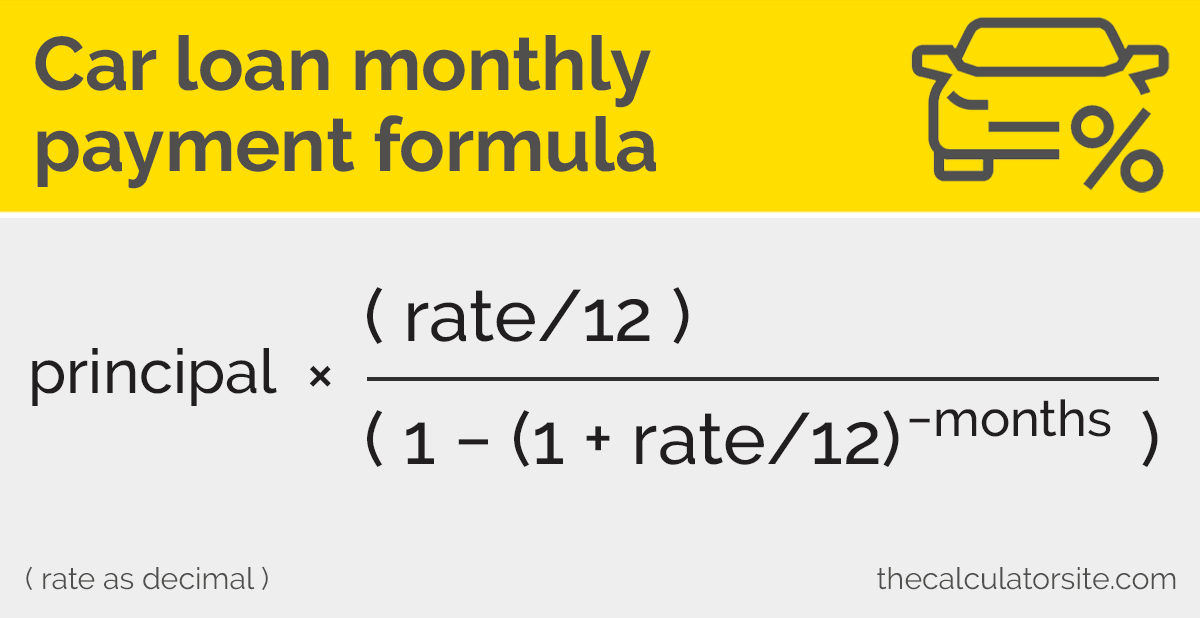
While lenders provide calculators, understanding the underlying formula allows a borrower to audit their loan documents and ensure transparency. The formula for a fixed-rate amortized loan payment is:
M = P [ i(1 + i)^n ] / [ (1 + i)^n – 1 ]
Where:
-
M = Total monthly payment
-
P = Principal loan amount
-
i = Monthly interest rate (annual rate divided by 12)
-
n = Number of months (loan term)
A Realistic Case Study
Imagine you are financing $25,000 for a used SUV at an annual interest rate of 6% for 60 months.
-
Identify variables: P = 25,000; i = 0.005 (0.06 / 12); n = 60.
-
Calculate the numerator: 0.005(1 + 0.005)^60 = 0.006744.
-
Calculate the denominator: (1 + 0.005)^60 – 1 = 0.34885.
-
Divide and multiply: (0.006744 / 0.34885) * 25,000 = $483.32.
By knowing this monthly payment, you can then calculate the total interest paid over the life of the loan: ($483.32 x 60) – $25,000 = $3,999.20. This exercise highlights that even at a relatively modest 6% interest rate, the “cost” of the car is actually $4,000 higher than the negotiated price.
Strategic Ways to Reduce Total Interest Paid
Once you understand the math of interest calculation, you can move from a passive borrower to an active strategist. There are several ways to manipulate the variables of the interest equation to your advantage.
The Power of the Down Payment
The most effective way to reduce interest is to reduce the principal (“P”) from day one. A 20% down payment doesn’t just lower your monthly commitment; it drastically reduces the amount of interest that can accrue during every single day of the loan term. It also protects you from “gap” risk—where you owe more than the car is worth—which can sometimes allow you to qualify for even lower interest rates from lenders who see you as a lower-risk borrower.
Applying Extra Principal Payments
If your loan is a simple interest loan (which most are), you can make extra payments at any time. However, the strategy here is specific: you must ensure the lender applies the extra funds to the principal balance, not just toward the “next month’s payment.”
By lowering the principal balance ahead of schedule, you recalibrate the interest calculation for all subsequent months. Even an extra $50 a month can shave hundreds of dollars off the total interest and shorten the loan term by several months.
Refinancing for a Lower Rate
Interest rates are not static. If you took out a loan during a period of high federal interest rates, or if your credit score has improved significantly since you bought the car, refinancing is a powerful tool. By replacing a 10% loan with a 5% loan, you change the fundamental multiplier of the interest calculation.
When refinancing, the goal is to secure a lower rate while keeping the remaining term the same or shorter. Extending the term during a refinance can sometimes result in paying more in total interest even if the rate is lower, so it is vital to run the numbers through the amortization formula to ensure the move is mathematically sound.
By mastering the mechanics of how interest is calculated on a car loan, you gain control over your financial narrative. You move beyond focusing on what you can “afford” per month and start focusing on the total cost of capital—the true measure of a smart financial decision.
aViewFromTheCave is a participant in the Amazon Services LLC Associates Program, an affiliate advertising program designed to provide a means for sites to earn advertising fees by advertising and linking to Amazon.com. Amazon, the Amazon logo, AmazonSupply, and the AmazonSupply logo are trademarks of Amazon.com, Inc. or its affiliates. As an Amazon Associate we earn affiliate commissions from qualifying purchases.