
The history of the automotive industry is often divided into two distinct eras: the century of internal combustion dominance and the modern age of electrification. At the epicenter of this transition sits a singular machine that challenged every preconceived notion about what a battery-powered vehicle could be. When the Tesla Roadster officially came out in 2008, it did more than just launch a new car company; it served as the technological proof of concept that would eventually disrupt a trillion-dollar global industry.
To understand when the Tesla Roadster came out, one must look beyond the simple delivery dates and examine the timeline of its development, the technological breakthroughs that made it possible, and the subsequent evolution toward the highly anticipated second-generation model.

The Launch and Legacy of the First-Generation Roadster (2008–2012)
While the first production Tesla Roadster was delivered to Elon Musk in February 2008, the journey to that moment began years earlier. The public first caught a glimpse of the vehicle during a star-studded reveal at the Barker Hangar in Santa Monica on July 19, 2006. At the time, the world viewed electric vehicles (EVs) as glorified golf carts—slow, aesthetically unappealing, and limited by lead-acid batteries with negligible range.
The 2006 Prototype Reveal vs. 2008 Production
The 2006 reveal was a watershed moment for Silicon Valley. Tesla showcased a car that was sleek, based on a heavily modified Lotus Elise chassis, and promised performance that could rival a Porsche or a Ferrari. However, the path from prototype to production was fraught with engineering challenges. Tesla spent the intervening two years refining the drivetrain and, most importantly, the battery management system.
Official production began in March 2008. This was the “1.5” version of the car, as Tesla continued to iterate on the hardware even as vehicles began rolling off the assembly line. Between 2008 and 2012, Tesla produced approximately 2,450 units. Each iteration—the 1.5, the 2.0, and the 2.5—introduced technological refinements, improved cabin acoustics, and more efficient power electronics.
Breakthrough Battery Technology: The Lithium-Ion Revolution
The most significant technological contribution of the 2008 Roadster was its use of lithium-ion battery cells. Before Tesla, no automaker had successfully integrated thousands of small, commodity-grade cells into a high-performance automotive battery pack. The Roadster utilized 6,831 individual 18650-form-factor cells, the same type found in laptop computers of that era.
This was a radical departure from the large-format cells being explored by other manufacturers. By using smaller cells, Tesla could implement a sophisticated liquid-cooling system that managed the thermal profile of the pack, ensuring safety and longevity. This architecture became the blueprint for every subsequent Tesla model and eventually the wider EV industry. It allowed the Roadster to achieve an EPA-rated range of 244 miles—a figure that was unheard of in 2008 and remains respectable by modern standards.
Overcoming Early Production Hurdles
The “release” of the Roadster was not a singular event but a rolling evolution. Early models faced significant transmission issues. Originally, Tesla intended to use a two-speed manual transmission to manage the high torque of the electric motor. However, the initial designs could not handle the instantaneous 200+ lb-ft of torque, leading to reliability concerns.
In a move that would define Tesla’s engineering philosophy, they pivoted to a single-speed fixed-gear transmission paired with a more powerful power electronics module (PEM). This shift not only solved the reliability issues but also simplified the drivetrain, proving that electric motors didn’t need complex multi-speed gearboxes to achieve high-end performance.
Redefining Performance: The Tech Behind the Roadster
The Roadster was never intended to be a mass-market vehicle; it was a high-end gadget designed to fund the development of more affordable cars. Its primary mission was to change the “boring” perception of EVs through raw, unfiltered performance.
AC Propulsion Roots and Tesla’s Custom Engineering
The Roadster’s DNA can be traced back to the AC Propulsion tzero, a hand-built electric sports car. Tesla’s founders, Martin Eberhard and Marc Tarpenning, licensed the propulsion technology but quickly realized that a commercial product required a complete ground-up redesign of the electronics.
The Roadster utilized a 3-phase, 4-pole AC induction motor. Unlike the internal combustion engine, which requires a ramp-up in RPM to reach peak torque, the Roadster’s motor provided 100% of its torque at 0 RPM. This resulted in a 0–60 mph time of 3.7 to 3.9 seconds, depending on the trim level. For 2008, these were supercar numbers, and they were achieved without a drop of gasoline.
The Roadster 3.0 Upgrade
Even after the Roadster ceased production in 2012 to make way for the Model S, Tesla did not abandon the platform. In 2014, the company announced the “Roadster 3.0” package. This was a significant technological milestone because it demonstrated the “upgradability” of electric vehicles.

The 3.0 upgrade included a new battery cell that had 31% more energy than the original cell, an aero kit to reduce drag, and new tires with lower rolling resistance. These changes pushed the Roadster’s range to over 340 miles. This served as an early example of how EV hardware could be modular and improved over time, a concept that has since become central to the tech-focused automotive market.
The Second-Generation Roadster: The Next Frontier of EV Tech
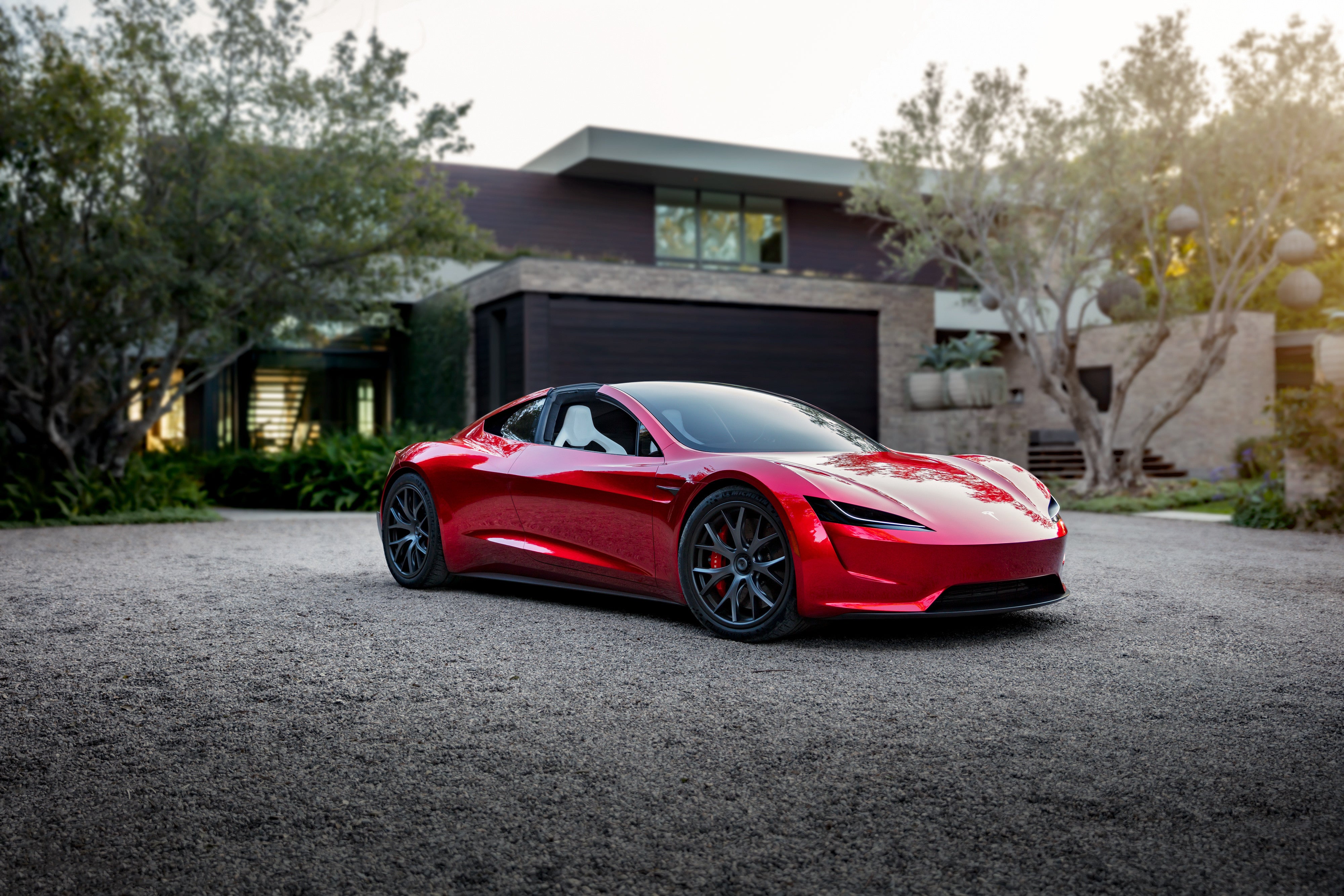
If the first Roadster proved that an EV could be a car, the second-generation Roadster aims to prove that an EV can be the best car in the world, period. Announced in November 2017 during the reveal of the Tesla Semi, the “Roadster 2.0” represents the pinnacle of Tesla’s current technological aspirations.
The 2017 Announcement and the SpaceX Package
When the new Roadster rolled out of the back of a semi-trailer in 2017, the specs seemed like science fiction. Tesla claimed a 0–60 mph time of 1.9 seconds, a top speed exceeding 250 mph, and a range of 620 miles. While the vehicle was originally slated for a 2020 release, its production has been pushed back as Tesla prioritizes mass-market models like the Model Y and the Cybertruck.
Perhaps the most “tech-heavy” aspect of the new Roadster is the proposed “SpaceX Package.” This feature suggests the use of cold gas thrusters—derived from rocket technology—placed around the car to improve cornering, acceleration, and braking. From a physics perspective, this represents a convergence of aerospace and automotive engineering that has never been attempted in a production road car.
Engineering Challenges of the New Roadster
The delay in the second-generation Roadster’s release (currently anticipated for 2025 or later) is largely due to the immense engineering hurdles involved in meeting its promised specs. To achieve a 620-mile range and sub-2-second acceleration, the vehicle requires a 200 kWh battery pack. Packaging that much energy into a small, aerodynamic sports car frame without adding excessive weight is a monumental task.
Tesla is likely waiting for the full maturation of its 4680 cell technology and structural battery pack designs before bringing the Roadster to market. This highlights a key theme in the tech world: the “halo product” often has to wait for the manufacturing infrastructure to catch up to the vision.
Impact on the Global EV Market and Future Expectations
The Tesla Roadster did not just come out in 2008; it erupted into a stagnant market and forced every major OEM (Original Equipment Manufacturer) to rethink their long-term strategy.
From Niche Luxury to Mass Adoption Catalyst
Without the Roadster, there would be no Model S, and without the Model S, the Model 3 would never have become the best-selling electric car in the world. The Roadster followed a classic tech-product rollout strategy:
-
Phase 1: High price, low volume (Roadster).
-
Phase 2: Mid price, mid volume (Model S/X).
-
Phase 3: Low price, high volume (Model 3/Y).
This “Master Plan” established the Roadster as the foundation of the modern EV movement. It proved to investors that there was a market for high-end electric gadgets and proved to consumers that they didn’t have to sacrifice performance for sustainability.
The Roadster in Orbit: A Symbol of Tech Ambition
Perhaps the most famous moment in the Roadster’s history occurred on February 6, 2018. During the maiden flight of the SpaceX Falcon Heavy rocket, Elon Musk’s personal 2008 Roadster was used as a dummy payload. Clad in a spacesuit, a mannequin named “Starman” sat in the driver’s seat as the car was launched into a heliocentric orbit.
This event was a masterstroke of cross-brand marketing, but it also served as a profound technological statement. The Roadster became the first production car to enter deep space, cementing its status as an icon of 21st-century innovation. It represented the ultimate synergy between the tech, automotive, and aerospace sectors.
Conclusion: The Enduring Legacy of the 2008 Debut
When we ask “when did the Tesla Roadster come out,” we are really asking when the transition to sustainable transport truly began. The answer is 2008, but the impact of that release is still being felt today. The Roadster was the first car to prove that the lithium-ion batteries powering our phones and laptops could also power our mobility. It introduced the concept of over-the-air updates, modular battery upgrades, and high-performance electric drivetrains.
As the industry looks toward the release of the second-generation Roadster, the original 2008 model remains a highly sought-after collector’s item and a piece of technological history. It was the spark that ignited the electric revolution, proving that with enough engineering ingenuity, the future of transportation could be both clean and exhilarating. Whether on the streets of Silicon Valley or orbiting the sun, the Tesla Roadster remains the definitive symbol of the tech industry’s power to reshape the physical world.
aViewFromTheCave is a participant in the Amazon Services LLC Associates Program, an affiliate advertising program designed to provide a means for sites to earn advertising fees by advertising and linking to Amazon.com. Amazon, the Amazon logo, AmazonSupply, and the AmazonSupply logo are trademarks of Amazon.com, Inc. or its affiliates. As an Amazon Associate we earn affiliate commissions from qualifying purchases.