
The Dow Jones Industrial Average (DJIA), often referred to simply as “the Dow,” is arguably the most recognized financial benchmark in the world. When news anchors report that “the market is up,” they are frequently referring to the movement of this specific index. Established in 1896 by Charles Dow and Edward Jones, the index was originally designed to track the health of the American industrial sector. At its inception, it contained only 12 companies, primarily in the heavy industry, railroad, and energy sectors.
Today, the Dow has evolved into a sophisticated barometer of the broader U.S. economy. While its name still carries the word “Industrial,” the modern index is a diverse collection of 30 “blue-chip” companies representing nearly every sector of the marketplace, from technology and healthcare to retail and finance. Understanding what makes up the Dow Jones Industrial Average requires looking beyond a simple list of names; it involves understanding the selection process, the unique weighting methodology, and the economic significance of the companies that earn a spot in this exclusive club.
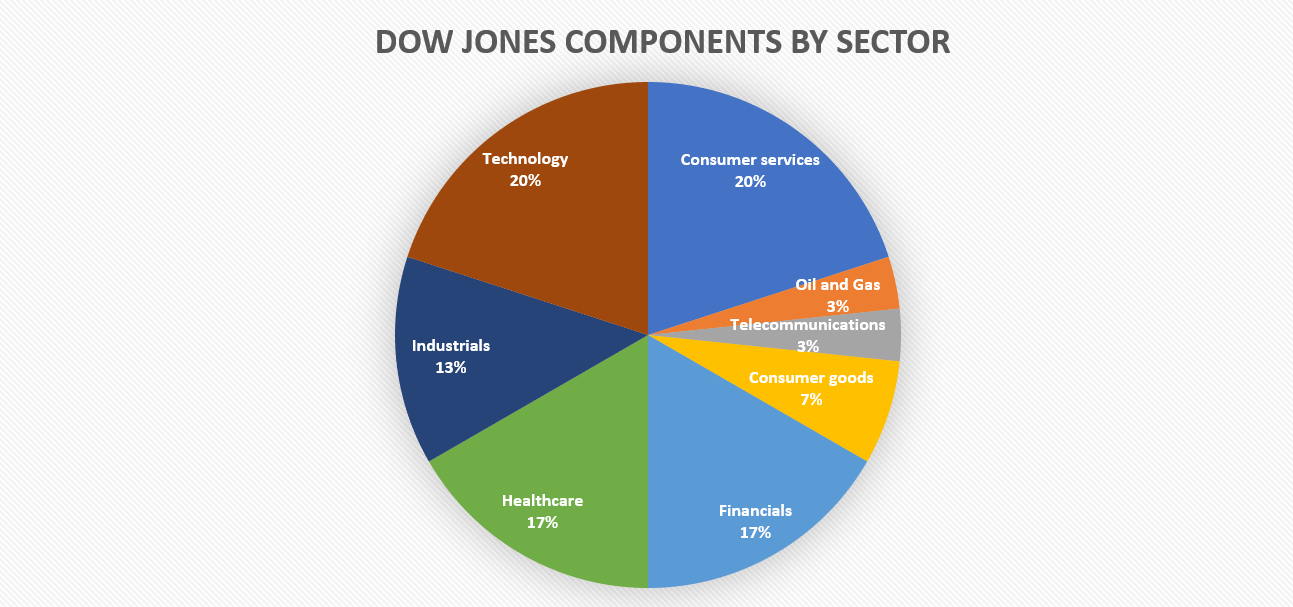
The 30 Blue-Chip Pillars: A Sector Breakdown
The Dow is comprised of 30 large, publicly owned companies based in the United States. These companies are considered leaders in their respective industries and are characterized by their “blue-chip” status—meaning they have a reputation for quality, reliability, and the ability to operate profitably in good times and bad.
Unlike the S&P 500, which includes 500 companies, the Dow’s narrow focus on 30 entities is intended to provide a concentrated look at the titans of American commerce.
Technology and Communication Services
In the late 19th century, “industry” meant steel and coal. In the 21st century, the Dow has shifted significantly toward the digital economy. Giants like Microsoft and Apple are core components of the index, representing the massive influence of software, hardware, and consumer electronics. The inclusion of Salesforce and Cisco Systems further emphasizes the shift toward cloud computing and networking infrastructure. These companies are not just tech firms; they are the fundamental utilities of the modern business world.
Healthcare and Financials
The healthcare sector is a massive component of the U.S. GDP, and the Dow reflects this through the inclusion of companies like UnitedHealth Group, Amgen, and Johnson & Johnson. These firms represent the cutting edge of biotechnology, insurance, and pharmaceutical development.
On the financial front, the Dow includes legendary institutions such as Goldman Sachs, JPMorgan Chase, and American Express. These companies serve as the backbone of the global credit and investment markets. Their performance within the index is often seen as a direct indicator of the health of the consumer and the stability of the banking system.
Consumer Discretionary and Industrials
While the index has modernized, it has not abandoned its roots. Traditional industrial powerhouses like Caterpillar and Boeing remain essential members, representing construction, defense, and aerospace. However, these are balanced by consumer-facing giants like Home Depot, Walmart, McDonald’s, and Coca-Cola. These “consumer staples” and “discretionary” companies provide insight into the spending habits of the American public, which accounts for roughly 70% of the U.S. economy.
How the Dow is Calculated: The Price-Weighting Mechanism
One of the most unique and often criticized aspects of the Dow Jones Industrial Average is how it is calculated. Most major indices, such as the S&P 500 or the Nasdaq Composite, are “market-capitalization weighted.” This means that companies with a larger total market value (share price multiplied by total shares outstanding) have a greater impact on the index’s movement.
The Dow, however, is a “price-weighted” index. In this system, the importance of a company is determined solely by its stock price per share.
The Dow Divisor Explained
If you simply added the stock prices of the 30 companies and divided by 30, the index would be highly susceptible to distortions from stock splits, spin-offs, or changes in the index membership. To solve this, the “Dow Divisor” was created.

The Dow Divisor is a continuously adjusted mathematical constant used to maintain the continuity of the index. When a company in the Dow undergoes a stock split (for example, a 2-for-1 split that cuts the share price in half), the divisor is adjusted so that the total value of the index remains the same before and after the split. Currently, the divisor is a decimal number significantly less than one. This means that a $1 change in the price of any stock in the index results in a multi-point move in the Dow’s total value.
The Impact of High-Priced Stocks
Because the Dow is price-weighted, a company with a high share price has more influence over the index than a company with a lower share price, even if the lower-priced company has a much larger market capitalization.
For instance, if a company trading at $500 per share moves up 1%, it adds $5 to the total price pool. If a company trading at $50 per share moves up 1%, it only adds $0.50. Consequently, the $500 stock has ten times the influence on the Dow’s daily movement. This is why stock splits are such a significant event for Dow components; if a high-priced stock splits, its influence on the index decreases proportionally.
The Selection Process: How Companies Join the Elite 30
There is no rigid, quantitative formula for entering the Dow Jones Industrial Average. Unlike the S&P 500, which has specific market cap and liquidity requirements, the Dow is managed by a selection committee.
The Role of the Averages Committee
The index is maintained by the S&P Dow Jones Indices’ Averages Committee. This committee consists of the Managing Editor of The Wall Street Journal and other professional analysts. Their goal is to ensure the index remains an accurate reflection of the U.S. economy. When the committee decides to remove or add a company, they are looking for “reputation, a history of sustained growth, interest to a large number of investors, and sector representation.”
Criteria for Inclusion
While the process is subjective, several unwritten rules generally apply. To be considered for the Dow, a company must:
-
Be Incorporated and Headquartered in the U.S.: The Dow is strictly a domestic index.
-
Maintain a Sustained Reputation: The committee rarely adds volatile or unproven “meme” stocks. They prefer companies with decades of stability.
-
Represent a Major Segment of the Economy: If a sector (like Renewable Energy or Fintech) becomes large enough, the committee may swap out an older industrial firm for a modern leader in that space.
-
Avoid Excessive Share Prices: Because of the price-weighting system, the committee is hesitant to add companies with extremely high share prices (e.g., $1,000+ per share) because those stocks would dominate the index and make it less representative of the other 29 members.
Why Companies are Removed
Removals usually happen for three reasons: the company is no longer the leader in its field, the company’s industry has shrunk in economic importance, or the company has been acquired. A notable example was the removal of General Electric in 2018. GE was an original member and a symbol of American industrial might, but as its market value plummeted and its business model struggled, it was replaced by Walgreens Boots Alliance to better reflect the growing importance of the healthcare and retail sectors.
The Relevance of the DJIA in Modern Investing
In the world of modern finance, professional portfolio managers often look toward the S&P 500 or the Russell 2000 as more comprehensive benchmarks. However, the Dow Jones Industrial Average remains the most cited index for several critical reasons.
A Signal of Institutional Sentiment
Because the Dow consists of only 30 stocks, it represents the “cream of the crop.” These are the stocks that pension funds, insurance companies, and sovereign wealth funds hold in their core portfolios. When the Dow moves, it signals how the largest institutional investors in the world feel about the stability of the global economy. It is less about “growth at any cost” and more about the fundamental strength of the world’s largest corporate engines.
The Psychological Benchmark
For the average retail investor, the Dow is the primary psychological benchmark. Its century-plus history allows for long-term historical comparisons that few other indices can match. It has survived the Great Depression, two World Wars, the Dot-com bubble, and the Great Recession. This longevity gives the Dow a sense of permanence and authority.
Investing in the Dow
For those who want to invest specifically in the 30 companies that make up the Dow, the most common vehicle is the SPDR Dow Jones Industrial Average ETF Trust (known by its ticker, DIA, or “Diamonds”). This ETF holds all 30 stocks in the same weights as the index, allowing investors to gain exposure to the elite group of blue-chip companies through a single trade.

Conclusion: A Living Map of Capital
The Dow Jones Industrial Average is more than just a list of 30 stocks; it is a living map of American capitalism. While its methodology is unique—and sometimes controversial—its ability to capture the essence of the U.S. economy is undeniable. From its origins in the steam-and-steel era to its current composition of tech titans and healthcare innovators, the Dow continues to reflect the shifting landscape of global finance. By understanding the specific companies involved, the price-weighted math behind the numbers, and the careful selection process, investors can better interpret what is actually happening when they hear that “the Dow is up.” It is the story of the 30 most influential corporate entities on the planet, working in tandem to define the direction of the market.
aViewFromTheCave is a participant in the Amazon Services LLC Associates Program, an affiliate advertising program designed to provide a means for sites to earn advertising fees by advertising and linking to Amazon.com. Amazon, the Amazon logo, AmazonSupply, and the AmazonSupply logo are trademarks of Amazon.com, Inc. or its affiliates. As an Amazon Associate we earn affiliate commissions from qualifying purchases.