
The Dow Jones Industrial Average (DJIA), often referred to simply as “the Dow,” is the most recognized stock market index in the world. When news anchors report that “the market is up,” they are almost always referring to the movement of this specific index. Despite its ubiquity, many investors—both novice and experienced—do not fully understand what actually makes up the Dow. Unlike broader indices like the S&P 500 or the Nasdaq Composite, the Dow is a unique, price-weighted collection of 30 “blue-chip” companies that serve as a barometer for the health of the United States economy.
Understanding the composition of the Dow requires more than just a list of ticker symbols. It involves grasping a century-old methodology, the role of a specialized selection committee, and the mathematical “divisor” that translates stock prices into a point-based index.
The 30 Blue-Chip Giants: The Components of the Dow
At its core, the Dow Jones Industrial Average is composed of 30 large, publicly owned companies based in the United States. These companies are considered “blue-chip,” a term borrowed from poker where the blue chips have the highest value. In financial terms, these are businesses with a reputation for quality, reliability, and the ability to operate profitably in both good and bad economic times.
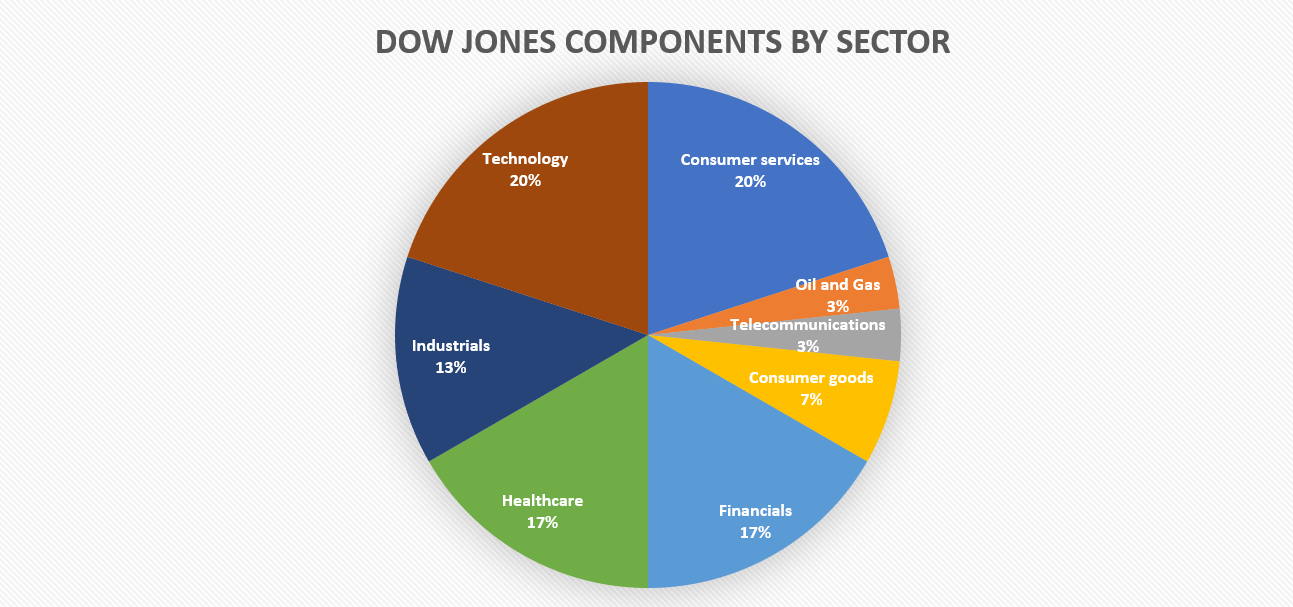
The components of the Dow are not static; they evolve as the American economy evolves. Originally, when Charles Dow first published the index in 1896, it consisted of just 12 companies, most of which were in heavy industry—sugar, tobacco, oil, and rubber. Today, the “Industrial” part of the name is largely historical. The current 30 components span nearly every sector of the modern economy, including technology, healthcare, finance, consumer discretionary, and entertainment.
A key characteristic of a Dow component is its leadership within its respective industry. For a company to be included, it must have an excellent reputation, demonstrate sustained growth, and be of interest to a large number of investors. Notable current members include technology titans like Microsoft and Apple, financial powerhouses like Goldman Sachs and JPMorgan Chase, and consumer staples like Coca-Cola and Walmart. When a company like Amazon was added in early 2024, it signaled the index’s ongoing shift toward the “new economy,” replacing legacy retail names to better reflect how Americans spend their money.
The Exclusion of Utilities and Transportation
It is important to note that the Dow Jones Industrial Average does not include every sector. Specifically, it excludes the transportation and utilities sectors. This is because Charles Dow created separate indices for those industries: the Dow Jones Transportation Average and the Dow Jones Utility Average. To this day, if a company’s primary business is moving goods (like Union Pacific) or providing electricity (like NextEra Energy), it will not find a home in the DJIA, no matter how large it becomes.
The Price-Weighted Methodology and the Dow Divisor
The most significant factor that makes up the Dow—and sets it apart from almost every other major index—is how it is calculated. While the S&P 500 is “market-cap weighted” (meaning larger companies have a bigger impact), the Dow is “price-weighted.”
In a price-weighted index, the component with the highest stock price has the greatest influence on the index’s value, regardless of the company’s actual size or market capitalization. For example, if a stock trading at $500 moves by 1%, it will have a much larger impact on the Dow’s daily point movement than a stock trading at $50 moving by 1%, even if the $50 company has a larger total market value.
Understanding the Dow Divisor
If you were to simply add up the prices of the 30 stocks and divide by 30, the index would fluctuate wildly every time a company performed a stock split or paid a dividend. To prevent these artificial fluctuations, the index uses a mathematical constant known as the “Dow Divisor.”
The Dow Divisor is a figure that is continuously adjusted to account for corporate actions. When a company in the Dow splits its stock—halving its price but doubling the number of shares—the divisor is adjusted downward so that the index value remains the same. As of recent years, the divisor has dropped below 1 (currently hovering around 0.15). This means that a $1 change in the price of any single stock in the index translates to an approximate 6.5-point move in the Dow (1 divided by 0.15).
This methodology has its critics. Skeptics argue that price-weighting is an antiquated system because the absolute price of a stock is somewhat arbitrary. However, proponents argue that the Dow’s price-weighting provides a unique perspective on the “average” performance of high-value shares, and historically, its performance closely tracks that of the market-cap-weighted S&P 500 over long periods.

The Selection Process: Who Decides the Lineup?
Unlike many indices that use a rigid, rules-based formula for inclusion (such as “the 500 largest companies”), the Dow Jones Industrial Average is maintained by a committee. This committee, known as the Averages Committee, consists of representatives from S&P Dow Jones Indices and The Wall Street Journal.
There are no quantitative rules for a company to be added to the Dow. Instead, the selection is qualitative. The committee looks for companies that:
-
Are incorporated and headquartered in the U.S.
-
Generate a plurality of their revenue from U.S. operations.
-
Represent a significant portion of the economic activity within their sector.
-
Maintain a history of consistent growth.
Why the Lineup Changes
The committee does not change the 30 components often. When they do, it is usually because a company has lost its dominance or because the economy has shifted so significantly that the current list no longer represents the American business landscape.
For instance, General Electric was an original member and stayed in the index for over a century. However, as the company struggled with debt and declining industrial relevance, it was eventually removed in 2018 to make room for Walgreens Boots Alliance (which was later replaced by Amazon). These swaps are calculated moves designed to ensure the Dow remains a “living” representation of the economy. When the committee adds a tech stock and removes an oil stock, they are effectively telling the story of the 21st-century economic transition.
Sector Representation: Is the Dow a True Reflection of the Economy?
A common question regarding the makeup of the Dow is whether 30 companies can truly represent an economy as vast and complex as that of the United States. While 30 is a small sample size, the “industrial” makeup of the index has evolved into a diversified portfolio.
Today, the Dow is heavily weighted toward Information Technology, Healthcare, and Financials. These three sectors often account for more than half of the index’s total weight. This reflects the reality of the modern American GDP, which is increasingly driven by software, medical innovation, and capital markets rather than manufacturing and physical goods.
However, because the index is price-weighted, the “sector balance” can be skewed by the share price of a single company. If a healthcare company has a $500 share price and a technology company has a $50 share price, the healthcare sector will have ten times the influence of the technology sector in that specific comparison, regardless of which industry is actually larger in the real world. This is why investors often look at the Dow in conjunction with the S&P 500 to get a fuller picture of market health.

The Dow as a Financial Tool for Investors
For the individual investor, understanding what makes up the Dow is essential for portfolio construction and benchmarking. While you cannot “buy” the Dow Jones Industrial Average directly—as it is just a mathematical index—you can invest in products that track it.
The most famous of these is the SPDR Dow Jones Industrial Average ETF Trust, known by its ticker symbol “DIA” (and often nicknamed “Diamonds”). By holding shares in an ETF like DIA, an investor owns a proportional piece of all 30 companies in the index. Because the index focuses on stable, dividend-paying giants, the Dow is often seen as a “value” or “conservative” play compared to the tech-heavy Nasdaq.
Furthermore, many of the companies that make up the Dow are “Dividend Aristocrats” or “Dividend Kings”—companies that have raised their dividends for decades. This makes the makeup of the Dow particularly attractive to income-focused investors who prioritize steady cash flow over the volatile growth of smaller startups.
In conclusion, the Dow Jones Industrial Average is a carefully curated selection of 30 leaders of American industry. Its makeup is a blend of historical prestige and modern economic relevance, held together by a unique price-weighting system and the ever-changing Dow Divisor. By tracking these 30 giants, the Dow continues to fulfill the mission started by Charles Dow over 125 years ago: providing a clear, concise snapshot of the financial pulse of the nation.
aViewFromTheCave is a participant in the Amazon Services LLC Associates Program, an affiliate advertising program designed to provide a means for sites to earn advertising fees by advertising and linking to Amazon.com. Amazon, the Amazon logo, AmazonSupply, and the AmazonSupply logo are trademarks of Amazon.com, Inc. or its affiliates. As an Amazon Associate we earn affiliate commissions from qualifying purchases.