
Home improvement is one of the most significant expenditures for homeowners, often rivaling the cost of the mortgage itself over the lifespan of the property. For those focused on personal finance and wealth preservation, mastering the art of the “Home Depot discount” is not merely about saving a few dollars at the register; it is a sophisticated exercise in capital management. By understanding the retail giant’s pricing mechanics, loyalty programs, and seasonal cycles, you can significantly reduce the overhead of property maintenance and renovation, thereby increasing your home’s equity without overextending your budget.

Leveraging Seasonal Cycles and Pricing Codes
Financial efficiency in home improvement begins with timing. Retailers like Home Depot operate on a strict inventory lifecycle that creates predictable windows for deep discounts. Understanding these cycles allows you to plan your project expenditures around the lowest possible price points.
The Major Holiday Events and “Spring Black Friday”
While most consumers wait for November, the savvy financial planner looks to the “Spring Black Friday” event, typically occurring in April. This is when Home Depot aggressively discounts outdoor power equipment, mulch, soil, and patio furniture to capture early-season momentum. Additionally, the major “Big Three” holidays—Memorial Day, July 4th, and Labor Day—serve as primary clearing events for appliances and building materials. During these windows, discounts of 30% to 40% on major appliances are common, often bundled with manufacturer rebates that can further lower the net cost.
Deciphering the Pricing Codes
One of the most valuable “insider” secrets in the world of retail finance is the ability to read price tags. At Home Depot, the cents at the end of a price are not random; they indicate the product’s status in the inventory lifecycle:
-
Prices ending in .06: These are clearance items that have been marked down. The price is likely to drop again in six weeks.
-
Prices ending in .03: This is the final markdown. If an item ends in .03, it is at its absolute lowest price and will be removed from the floor or discarded within weeks. If you see a product you need with a .03 price tag, it represents the maximum possible ROI for your purchase.
The Low Price Guarantee
Home Depot maintains a competitive stance through its Price Match Guarantee. If you find a lower price on an identical, in-stock item from a local or online competitor (such as Lowe’s or Amazon), Home Depot will match the price. To execute this correctly, you must present the ad or the website to the associate. From a wealth-management perspective, this eliminates the need to pay for shipping or wait for deliveries, allowing you to keep your capital working for you while securing the lowest market rate.
Maximizing Loyalty and Membership Benefits
For those managing multiple properties or embarking on a large-scale renovation, basic consumer tactics are insufficient. You must transition into the “Pro” mindset, regardless of whether you are a licensed contractor or a dedicated DIYer.
Pro Xtra: Not Just for Contractors
The Pro Xtra loyalty program is free to join and is a cornerstone of professional-grade financial management at Home Depot. The program tracks your spending and offers “Perks” based on your volume. More importantly, it grants access to the “Volume Pricing Program” (VPP). If your order exceeds a certain threshold (usually $1,500), you can submit your list at the Pro Desk for a custom quote. The discounts generated through the VPP often range from 5% to 20%, which, on a major kitchen or basement project, can save thousands of dollars.
The 11% Rebate Match
In specific geographic regions—primarily where Home Depot competes directly with the Menards chain—the company offers an 11% rebate on almost everything in the store. This is not advertised nationally, and it requires a manual online submission through their rebate portal. For homeowners in the Midwest or surrounding areas, tracking these “Rebate Match” weeks is essential. Since the rebate is issued as a Home Depot gift card, it creates a self-sustaining cycle of funding for future projects, effectively lowering your long-term maintenance costs.
Email and Text Incentives
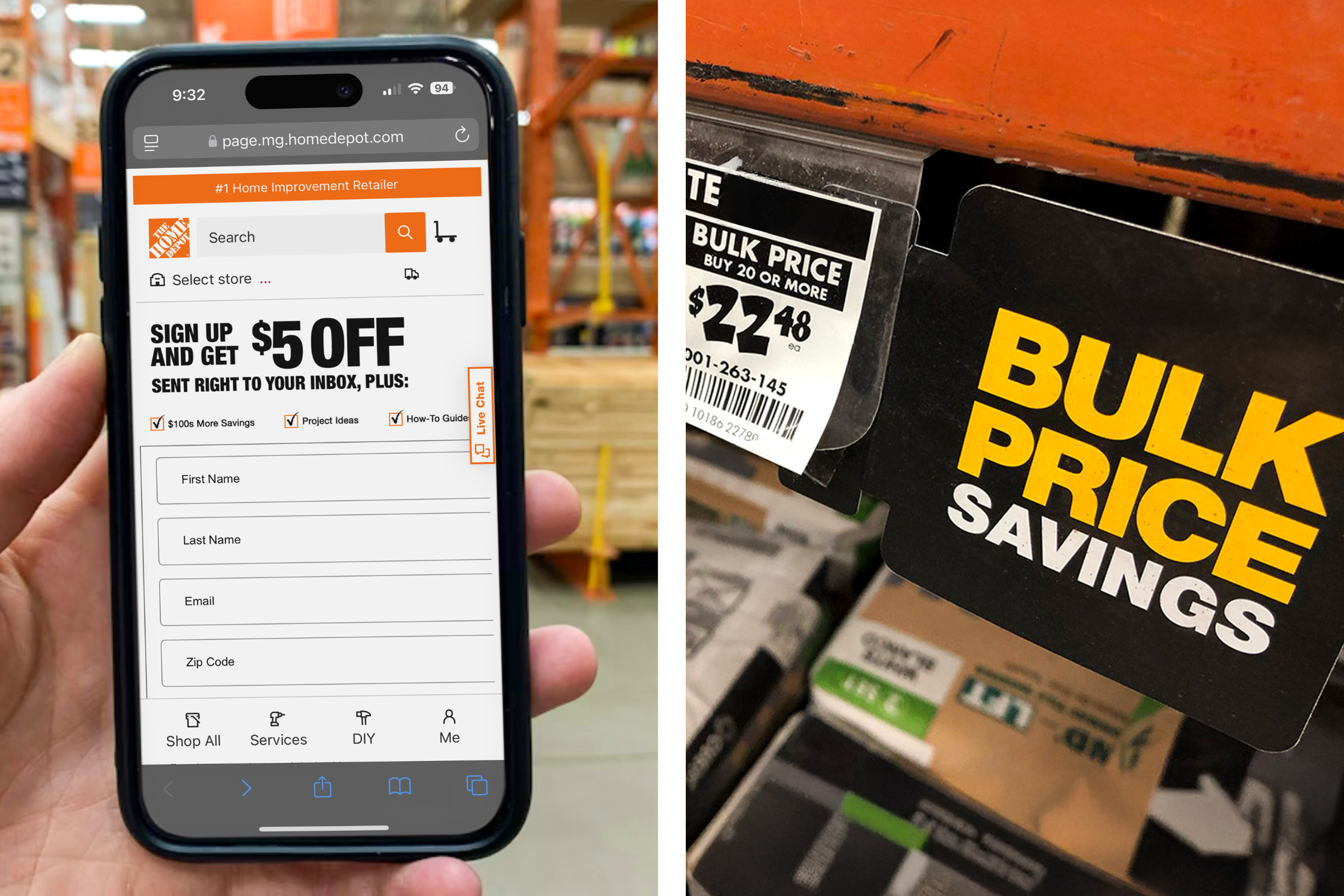
While it may seem like a minor tactic, the initial sign-up for Home Depot’s email and text alerts provides an immediate $5 off a $50 purchase. For the disciplined budgeter, using multiple family member accounts for staggered project phases can result in a consistent stream of $5 and $10 coupons that offset the cost of consumables like fasteners, paint brushes, and cleaning supplies.
Tactical Negotiation and In-Store Savings
The retail environment of a big-box store is more flexible than it appears. Associates and managers have delegated authority to provide discounts to move inventory or satisfy a customer’s specific project needs.
The “Cull” and Damaged Goods Strategy
In the lumber department, look for wood marked with purple spray paint. This is “cull lumber”—pieces that are slightly warped, cracked, or leftovers from custom cuts. These are typically sold at a 70% discount. For projects like garden beds, shed framing, or craft work where perfection isn’t required, cull lumber is an extraordinary way to reduce material costs. Similarly, “open-box” items or products with minor cosmetic damage (dented washing machines or scratched toolboxes) are prime candidates for negotiation. A polite request to a department manager for an additional 10% to 15% off a damaged item is frequently granted.
Bulk Pricing and the “Buy More, Save More” Model
For items like insulation, flooring, and shingles, Home Depot offers tiered pricing. This is a crucial consideration for your project’s cash flow. Often, buying 10% more of a product than you need will trigger a bulk discount that makes the total price cheaper than if you had bought the exact amount. From a financial standpoint, this provides you with “free” overage material to keep for future repairs, or material that can be resold on the secondary market to recoup costs.
Military and Professional Discounts
Home Depot offers a year-round 10% discount to active-duty military, veterans, and their spouses, capped at $400 in savings annually. To access this, you must register through the Home Depot app. For those who qualify, this is an automatic 10% return on investment for every dollar spent, making it one of the most effective personal finance tools available for the military community.
Strategic Financial Planning and Tool Management
Beyond the price tag of the materials themselves, the way you finance and equip your project determines the ultimate impact on your net worth.
The Credit Conundrum: Consumer Cards vs. Project Loans
The Home Depot Consumer Credit Card often offers “six months interest-free” on purchases over $299. If you have the cash on hand and can guarantee repayment within the window, this is a way to use the bank’s money for free while keeping your own capital in high-yield savings or investment accounts. However, for massive renovations, the “Project Loan” offers a fixed monthly payment and a much longer duration. The goal here is to match the financing to the expected ROI of the project. If you are flipping a house, the short-term interest-free window is ideal. If you are building a long-term family home, a project loan may provide the stability needed for a complex budget.
Renting vs. Buying: The Asset Management View
One of the biggest leaks in a home improvement budget is the purchase of specialty tools that are only used once. Home Depot’s Rental Center is a strategic alternative. From a financial perspective, a $600 demolition hammer that you use for one weekend is a depreciating asset with a poor utilization rate. Renting that same tool for $60 preserves $540 of your capital for materials that actually add value to the property. Conversely, for “core” tools like drills or saws, purchasing during “Buy a Battery, Get a Tool Free” promotions ensures you are building a valuable tool library at a fraction of the retail cost.

Using Discounted Gift Cards and Cash-Back Portals
Before walking into the store, check gift card resale platforms. You can often purchase Home Depot gift cards at a 3% to 7% discount from individuals who received them as gifts but prefer cash. Additionally, utilizing cash-back apps or credit card portals (which occasionally offer 5% back on home improvement categories) adds another layer of savings. When you stack a discounted gift card with a sale price and a loyalty perk, you are effectively compounding your discounts, a fundamental principle of wealth accumulation.
By approaching Home Depot not as a casual shopper, but as a strategic manager of household capital, you can drastically alter the financial trajectory of your home ownership. Whether it is through the technical deciphering of price tags, the high-volume benefits of Pro Xtra, or the tactical negotiation of damaged goods, every dollar saved is a dollar of equity earned. Home improvement doesn’t have to be a drain on your finances; with the right strategy, it becomes a controlled investment in your most valuable asset.
aViewFromTheCave is a participant in the Amazon Services LLC Associates Program, an affiliate advertising program designed to provide a means for sites to earn advertising fees by advertising and linking to Amazon.com. Amazon, the Amazon logo, AmazonSupply, and the AmazonSupply logo are trademarks of Amazon.com, Inc. or its affiliates. As an Amazon Associate we earn affiliate commissions from qualifying purchases.