
The American financial landscape is anchored by a select group of massive institutions that manage trillions of dollars in assets, facilitate global trade, and provide the essential infrastructure for domestic commerce. These institutions, often referred to as the “Big Four” and their immediate successors, are more than just places to hold a checking account; they are systemic pillars of the global economy. Understanding who these giants are, how they attained their size, and what their scale means for your personal and business finances is critical for navigating the modern financial world.
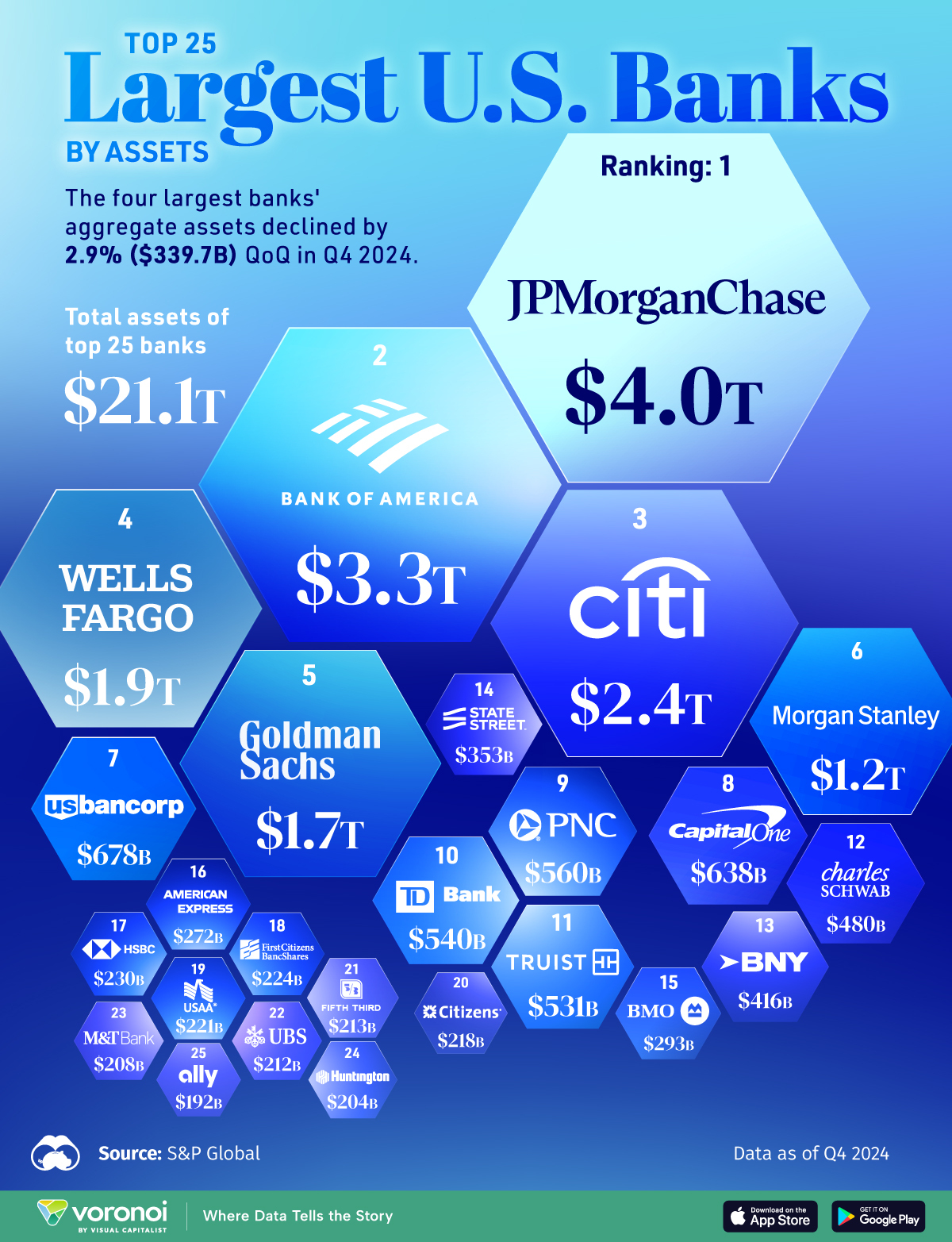
As of the current fiscal landscape, the ranking of the largest banks in the United States is primarily determined by total consolidated assets. These assets include loans, investments, and physical holdings managed by the bank. While the rankings at the very top have remained relatively stable for the last decade, the gap between the largest institutions and the rest of the industry continues to widen, driven by digital transformation and a series of strategic mergers.
The Big Four: The Titans of American Finance
At the pinnacle of the U.S. banking system sit four institutions that are designated as Globally Systemically Important Banks (G-SIBs). These organizations are so large that their stability is considered integral to the stability of the entire international financial system.
JPMorgan Chase & Co.
JPMorgan Chase & Co. consistently holds the title of the largest bank in the United States. With total assets frequently exceeding $3.9 trillion, it is a financial juggernaut with a reach that spans consumer banking, investment banking, commercial lending, and asset management. The bank’s retail arm, Chase, operates thousands of branches and tens of thousands of ATMs, making it a household name for millions of Americans.
The strength of JPMorgan Chase lies in its “fortress balance sheet” philosophy—a commitment to maintaining high levels of liquidity and capital to weather economic storms. For the individual consumer, this scale translates into a massive technological advantage, with the bank investing billions annually into its mobile app and digital security features. For corporations, the bank provides the deep liquidity necessary for massive infrastructure projects and international expansion.
Bank of America Corp.
Bank of America (BofA) follows closely behind, with assets typically hovering around the $3.2 trillion mark. Headquartered in Charlotte, North Carolina, BofA has transformed from a regional player into a global powerhouse, largely through the acquisition of institutions like Merrill Lynch and Countrywide Financial during the 2008 financial crisis.
BofA is a leader in the integration of wealth management and traditional banking. Through Merrill, it offers a seamless transition for clients moving from basic savings to sophisticated investment portfolios. The bank has also been a pioneer in digital banking, with its virtual assistant, Erica, setting a high bar for AI-driven customer service in the financial sector.
Citigroup Inc.
With assets totaling approximately $2.4 trillion, Citigroup is perhaps the most internationally focused of the Big Four. While its physical retail presence in the U.S. is smaller than that of Chase or Bank of America—concentrated heavily in major metropolitan hubs like New York, Chicago, and Los Angeles—its global footprint is unmatched.
Citigroup serves as a vital artery for cross-border transactions and global corporate treasury services. It is a dominant force in the credit card market, partnering with major retailers and brands to issue millions of co-branded cards. For high-net-worth individuals and multinational corporations, Citi provides a level of global connectivity that few other institutions can replicate.
Wells Fargo & Co.
Rounding out the Big Four is Wells Fargo, with assets near $1.9 trillion. Historically known for its “stagecoach” branding and a focus on community-style banking on a national scale, Wells Fargo has a significant presence in the mortgage and small business lending markets.
Despite facing various regulatory hurdles in recent years, Wells Fargo remains a cornerstone of the U.S. economy. It holds more domestic deposits than many of its competitors and remains a primary lender to middle-market companies. Its strategy focuses heavily on the “Main Street” economy, emphasizing traditional banking services like home loans, auto loans, and small business lines of credit.
The Super-Regional and Investment Giants
While the Big Four dominate the headlines, the next tier of banks—often called “super-regionals”—and the major investment-focused banks are equally vital to the flow of capital in the U.S.
Goldman Sachs and Morgan Stanley
While traditionally viewed as investment banks, both Goldman Sachs and Morgan Stanley transitioned to bank holding companies during the 2008 crisis. Goldman Sachs, with assets around $1.6 trillion, has expanded significantly into consumer banking through its Marcus platform, offering high-yield savings and personal loans. Morgan Stanley, following its acquisitions of E*TRADE and Eaton Vance, has become a massive force in retail brokerage and wealth management. These institutions represent the convergence of high-stakes Wall Street finance and everyday personal investing.
U.S. Bancorp and PNC Financial Services
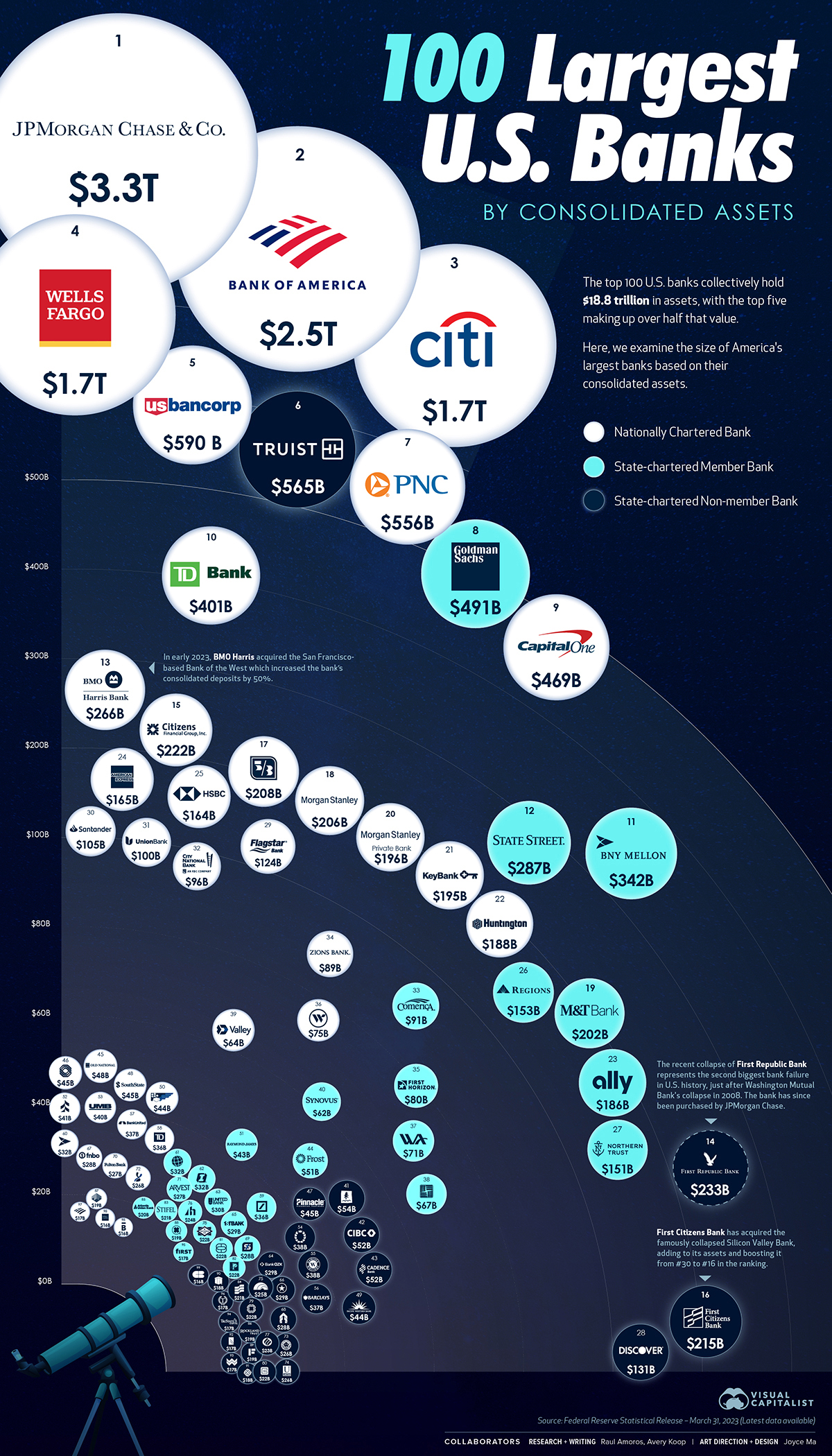
U.S. Bancorp (the parent of U.S. Bank) and PNC Financial Services are the leaders of the regional banking category. U.S. Bank is known for its conservative management and strong presence in the Midwest and West. PNC, based in Pittsburgh, expanded its footprint significantly by acquiring BBVA USA, making it a true national competitor. These banks often offer a middle ground for consumers: the technological capabilities of a national giant with a service model that feels more localized.
Truist Financial Corporation
Truist was formed by the “merger of equals” between BB&T and SunTrust. With assets exceeding $500 billion, Truist is a dominant force in the Southeast and Mid-Atlantic. Its creation was a direct response to the need for scale; by combining resources, these two regional leaders could afford the massive investments in technology required to compete with the likes of JPMorgan and Bank of America.
How Bank Size Impacts Your Financial Strategy
The sheer scale of these institutions is impressive, but for the average consumer or business owner, size translates into specific tangible pros and cons. When choosing where to park your capital or seek a loan, understanding these dynamics is essential.
The Advantages of Scale: Infrastructure and Security
The primary benefit of banking with a top-ten institution is the infrastructure. Large banks possess the capital to build and maintain sophisticated digital ecosystems. This includes robust mobile apps, real-time fraud monitoring, and seamless integration with third-party financial tools.
Furthermore, the largest banks provide unparalleled physical access. If you travel frequently for work or leisure, the ability to find an ATM or a branch in almost any major American city is a convenience that smaller community banks cannot match. From a security perspective, these giants have the budget to employ thousands of cybersecurity experts, providing a level of data protection that is difficult for smaller institutions to replicate.
The Trade-offs: Interest Rates and Personal Touch
The downside to the size of the largest banks is often reflected in their interest rate structures. Because JPMorgan Chase or Bank of America have such a massive, “sticky” deposit base, they often feel less pressure to offer high interest rates on savings accounts or Certificates of Deposit (CDs). They rely on convenience rather than yield to attract customers.
Additionally, large banks are often criticized for their bureaucratic nature. For a small business owner seeking a complex, customized loan, a large bank may rely strictly on automated credit scoring models. In contrast, a smaller regional or community bank might take a more “holistic” view of the business’s local reputation and long-term potential.
The Shifting Landscape: Digital Evolution and Competition
The hierarchy of the largest U.S. banks is not static. While the leaders have held their ground, the way they operate is being fundamentally challenged by the rise of fintech and online-only “neobanks.”
The Rise of Digital-First Competition
Institutions like Ally Bank, SoFi, and Capital One have pioneered a model that eschews the traditional branch network in favor of higher interest rates and lower fees. Capital One, in particular, has grown into a top-ten bank by total assets by blending a massive credit card business with a savvy, tech-forward retail banking experience. The success of these models has forced the traditional “Big Four” to accelerate their own digital transformations to prevent a mass exodus of younger, tech-savvy depositors.
The Impact of Consolidation
The trend of consolidation is likely to continue. As the cost of regulatory compliance and technological development rises, smaller regional banks are finding it increasingly difficult to compete. This leads to mergers like the one that created Truist or the acquisition of First Republic by JPMorgan Chase during the 2023 banking stress period. While this consolidation creates more stable, well-capitalized giants, it also raises questions about competition and the availability of specialized banking services in rural or underserved markets.

Navigating Your Choice of Financial Institution
Selecting a bank is one of the most foundational decisions in a person’s financial life. If you prioritize global access, cutting-edge mobile features, and a “one-stop-shop” for everything from credit cards to mortgages, the largest banks in the U.S. are designed for you. They provide a level of stability and utility that is unmatched.
However, for those who prioritize high-yield savings or personalized commercial lending relationships, it may be beneficial to use a “hub and spoke” model. This involves keeping a primary account at one of the Big Four for daily transactions and convenience, while moving long-term savings or specialized business needs to high-yield online banks or local credit unions.
The largest banks in the U.S. are more than just repositories for cash; they are the engines of the American economy. By understanding the strengths and focuses of JPMorgan Chase, Bank of America, Citigroup, and Wells Fargo, as well as the rising super-regionals, you can better position your personal or business finances to take advantage of the vast resources these institutions offer. In an era where “too big to fail” has become a part of the regulatory lexicon, these giants continue to evolve, ensuring their place at the center of the financial world for decades to come.
aViewFromTheCave is a participant in the Amazon Services LLC Associates Program, an affiliate advertising program designed to provide a means for sites to earn advertising fees by advertising and linking to Amazon.com. Amazon, the Amazon logo, AmazonSupply, and the AmazonSupply logo are trademarks of Amazon.com, Inc. or its affiliates. As an Amazon Associate we earn affiliate commissions from qualifying purchases.