
When discussing the upper echelons of global wealth, the name Jeff Bezos is synonymous with the meteoric rise of Amazon. However, to view Bezos simply as the founder of an e-commerce giant is to overlook one of the most sophisticated and diversified financial portfolios in modern history. Beyond his remaining stake in Amazon, Bezos has meticulously constructed an empire that spans media, aerospace, venture capital, and an unparalleled real estate collection.
Understanding what Jeff Bezos owns provides more than just a glimpse into a billionaire’s shopping list; it offers a masterclass in capital allocation, risk management, and the “Day 1” investment philosophy that prioritizes long-term growth over short-term dividends.
The Core Asset: Amazon and the Power of Equity
The bedrock of Jeff Bezos’s wealth remains Amazon.com, Inc. While he stepped down as CEO in 2021 to become Executive Chairman, his financial identity is inextricably linked to the company’s performance.
The Evolution of the Amazon Stake
At the time of Amazon’s IPO in 1997, Bezos owned a significant portion of the company. Over the decades, he has sold or gifted billions of dollars worth of shares, yet he remains the company’s largest individual shareholder. As of 2024, his ownership hovers around 9% to 10% of the company. In the world of finance, this represents a “concentration of wealth” strategy that most advisors warn against, but for a founder-led tech titan, it has been the primary engine of his multi-billion-dollar net worth.
Dividend vs. Growth Strategy
Unlike many legacy corporations, Amazon famously does not pay a dividend. From a business finance perspective, Bezos has always championed the idea of reinvesting every cent of free cash flow back into the business—expanding logistics, cloud computing (AWS), and Prime Video. This “growth-first” model has allowed his net worth to compound at a rate that far outpaces traditional income-generating portfolios, demonstrating the power of holding high-conviction equity over decades.
Bezos Expeditions: A Case Study in Venture Capital
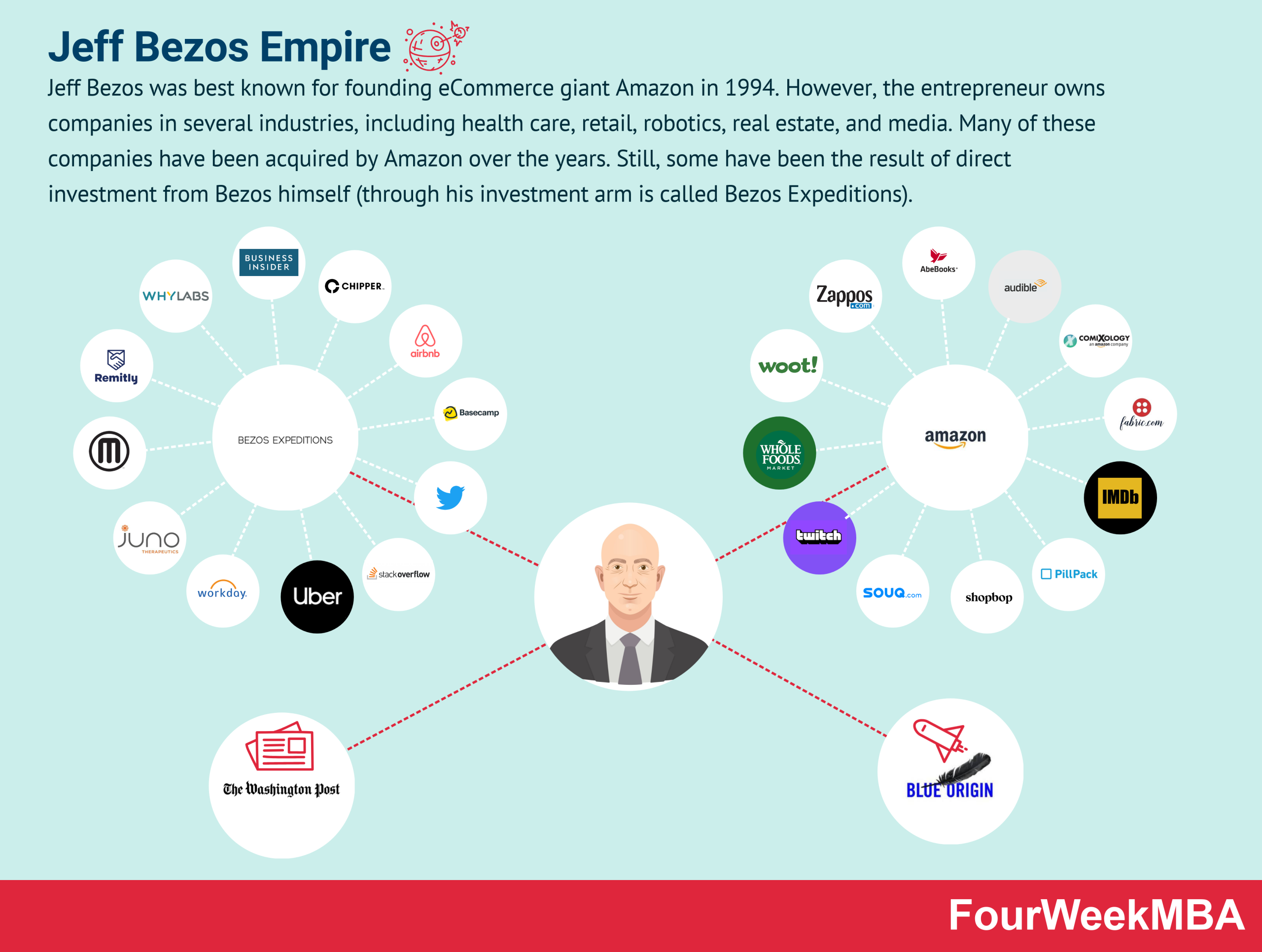
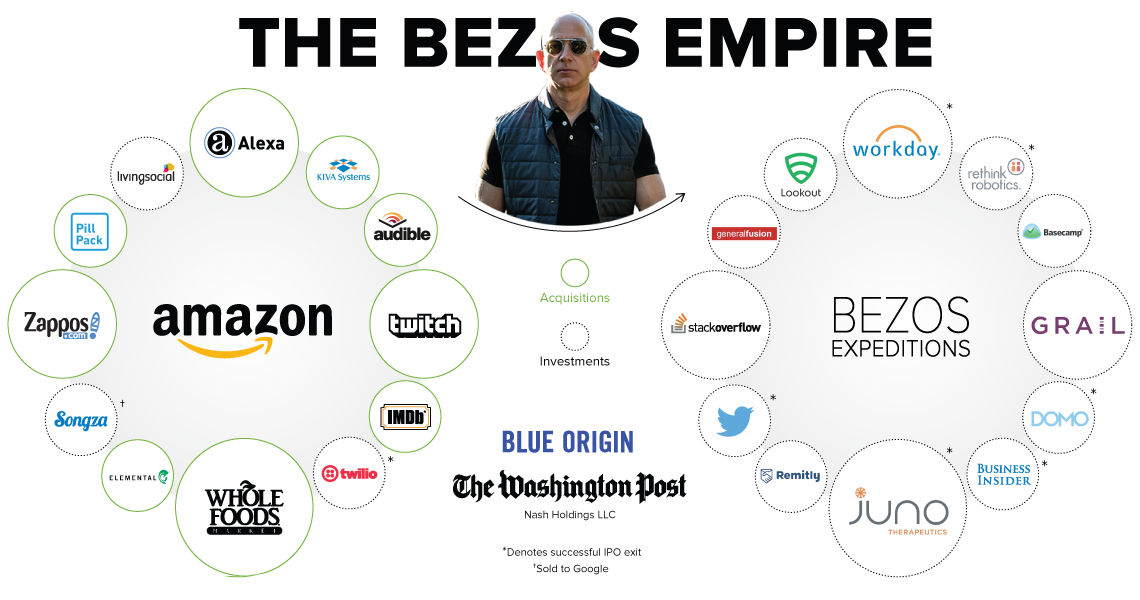
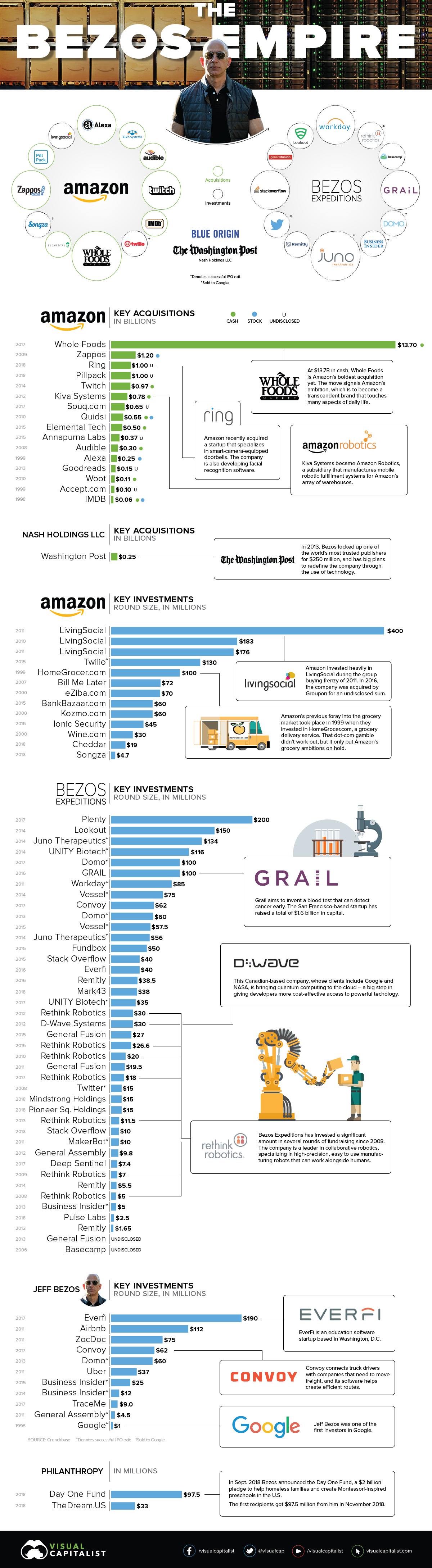
While Amazon is his most visible asset, Bezos Expeditions is the vehicle through which he manages his private venture capital investments. This firm manages his personal wealth and operates separately from Amazon’s corporate venture arm.
Early Bets on Modern Giants
One of the most legendary moves in the history of investing was Bezos’s $250,000 investment in Google in 1998, well before it became the search engine behemoth we know today. This single move turned into billions of dollars in value. Through Bezos Expeditions, he has participated in funding rounds for companies that have since become household names, including:
- Airbnb: Disrupting the hospitality industry.
- Uber: Revolutionizing urban transportation.
- Workday: A leader in enterprise cloud applications.
- Nextdoor: The hyper-local social networking platform.
Diversification into Healthcare and Biotechnology
In recent years, Bezos has shifted a significant portion of his “Money” strategy toward the longevity and healthcare sectors. He was a primary investor in Altos Labs, a biotechnology startup focused on cellular rejuvenation programming to reverse disease. He also invested in Juno Therapeutics, which focuses on cancer immunotherapy. These investments indicate a shift from purely digital assets toward “hard science” and the future of human health, which is often cited as the next multi-trillion-dollar market.
Blue Origin and the “Space Economy” Investment
If Amazon represents the past and present of Bezos’s wealth, Blue Origin represents his vision for the financial future. Unlike his other investments, which are often passive or minority stakes, Blue Origin is a wholly-owned private company.
The $1 Billion Annual Liquidation
To fund the astronomical costs of rocket development and space exploration, Bezos has historically sold approximately $1 billion of Amazon stock every year. From a personal finance perspective, this is a unique strategy: converting “paper wealth” from a liquid, public asset (Amazon) into a “capital-heavy” private asset (Blue Origin). It is a testament to his belief that the orbital economy—including satellite internet and space tourism—will eventually eclipse the terrestrial e-commerce market.
Strategic Infrastructure and Long-term Value
Bezos’s ownership of Blue Origin isn’t just a “passion project.” It is a calculated bet on infrastructure. Just as Amazon relied on the existing infrastructure of the U.S. Postal Service and the internet, Blue Origin aims to build the infrastructure (heavy-lift rockets and lunar landers) that will allow future entrepreneurs to build businesses in space. This is a classic “picks and shovels” investment strategy applied to the final frontier.
Media, Real Estate, and Hard Assets
Wealth preservation is just as important as wealth creation. Bezos has diversified his holdings into “hard assets” that traditionally hold value during market volatility and provide social influence.
The Washington Post: A Direct Acquisition
In 2013, Bezos purchased The Washington Post for $250 million. This was not an Amazon acquisition, but a personal one. Under his ownership, the Post transformed its financial model, moving from a struggling print-centric publication to a digital powerhouse with a subscription-based revenue stream. From a business finance standpoint, Bezos applied the “Amazon Playbook”—investing in technology and user experience—to turn a legacy media asset into a profitable digital enterprise.
A Residential Portfolio Beyond Compare
Bezos owns one of the most expensive and geographically diverse real estate portfolios in the world. His holdings include:
- Maui, Hawaii: A massive private estate purchased for an estimated $78 million.
- New York City: Multiple apartments in a single Fifth Avenue building, effectively creating a “vertical mansion” worth over $100 million.
- Washington D.C.: The former Textile Museum, which he converted into the city’s largest private residence.
- Beverly Hills: The Harry Warner estate, purchased for $165 million, setting a California record at the time.
- West Texas: A 300,000-acre ranch that serves as the base for Blue Origin operations.
These properties represent more than luxury; they are a diversification of his net worth into tangible assets that act as a hedge against currency fluctuations and market crashes.
The Financial Philosophy: Lessons from the Bezos Portfolio
What can the average investor learn from what Jeff Bezos owns? His portfolio is a reflection of a specific financial philosophy known as the Regret Minimization Framework.
Long-Termism and Risk Management
Bezos does not “day trade.” Whether it is his 30-year hold on Amazon or his decade-long commitment to Blue Origin, his ownership style is defined by extreme patience. In personal finance, this is known as “time in the market,” which almost always beats “timing the market.” By owning assets that have the potential for 100x returns (like early-stage tech) while anchoring his wealth in blue-chip equity and real estate, he balances high-risk “moonshots” with stable wealth preservation.
Cash Flow vs. Valuation
A key takeaway from the Bezos empire is the distinction between cash flow and valuation. For years, Bezos was one of the richest men in the world while drawing a modest salary (historically around $81,000) and reinvesting all corporate profits. His wealth is “asset-heavy” rather than “cash-heavy.” This is a sophisticated tax and growth strategy; by not taking large dividends or salaries, he avoids immediate income tax hits, allowing his wealth to compound tax-deferred within his corporate and investment structures.
Conclusion
Jeff Bezos owns a microcosm of the global economy. From the digital retail dominance of Amazon to the venture-backed startups of Silicon Valley, and from the storied halls of The Washington Post to the launchpads of West Texas, his portfolio is a testament to the power of diversification.
For those looking to understand business finance, the Bezos model proves that true wealth is built by identifying a core “engine” of growth and then systematically deploying the proceeds from that engine into a variety of uncorrelated assets. Whether it’s the “Space Economy” or “Life Sciences,” Bezos continues to own the future by investing in it today.
aViewFromTheCave is a participant in the Amazon Services LLC Associates Program, an affiliate advertising program designed to provide a means for sites to earn advertising fees by advertising and linking to Amazon.com. Amazon, the Amazon logo, AmazonSupply, and the AmazonSupply logo are trademarks of Amazon.com, Inc. or its affiliates. As an Amazon Associate we earn affiliate commissions from qualifying purchases.