
The history of the calculator is not a single moment of “eureka” by a solitary inventor, but rather a multi-century relay race of technological innovation. From the clinking of brass gears in the 17th century to the lightning-fast processing of silicon chips today, the calculator represents one of humanity’s most persistent quests: the automation of thought. Understanding who invented the calculator requires looking at the progression from mechanical curiosity to the ubiquitous digital tools that power modern engineering, finance, and daily life.

The Dawn of Mechanical Computation: From Pascal to Babbage
The journey of the automated calculator began long before the first battery was ever produced. In the mid-17th century, the world was entering an era of scientific awakening, where trade, astronomy, and taxation demanded more precise mathematics than the human mind could reliably provide.
Blaise Pascal and the Pascaline
In 1642, at the age of 19, French mathematician and physicist Blaise Pascal invented what is widely considered the first functional mechanical calculator, known as the Pascaline. Pascal was motivated by a desire to help his father, a tax collector, with the tedious labor of summing long columns of figures.
The Pascaline was a marvel of mechanical engineering. It utilized a series of linked wheels and gears, where each wheel represented a digit (ones, tens, hundreds). When a wheel completed a full rotation (representing the number nine going to zero), a internal mechanism would “carry” the one to the next wheel. While the Pascaline was primarily an adding and subtracting machine, it laid the foundational logic for all mechanical computation that followed. Despite its brilliance, the Pascaline was expensive and difficult to produce, making it more of a status symbol for the elite than a tool for the masses.
Gottfried Wilhelm Leibniz and the Stepped Reckoner
A few decades later, in 1671, the German polymath Gottfried Wilhelm Leibniz took Pascal’s concept several steps further. Leibniz was a proponent of the binary system and believed that “it is unworthy of excellent men to lose hours like slaves in the labor of calculation.”
Leibniz invented the “Stepped Reckoner,” a machine that could perform all four basic arithmetic functions: addition, subtraction, multiplication, and division. The key innovation was the “Leibniz wheel,” a cylinder with nine teeth of varying lengths. This mechanism allowed the machine to perform repeated additions (multiplication) much more efficiently than previous designs. While Leibniz’s machine suffered from manufacturing limitations of the time—the gears were prone to jamming—his “stepped drum” design remained the standard for mechanical calculators for the next 200 years.
The Industrial Era: The Arithmometer and Mechanical Supremacy
It wasn’t until the 19th century that calculators became commercially viable tools. In 1820, Charles Xavier Thomas de Colmar, a Frenchman, patented the Arithmometer. Based on the Leibniz wheel design, the Arithmometer was the first mechanical calculator strong enough and reliable enough for daily office use.
As the Industrial Revolution surged, the demand for these machines grew. By the late 1800s, inventors like William Seward Burroughs were patenting “adding-listing machines,” which could not only calculate but also print the results on paper tape. This period marked the transition of the calculator from a scientific novelty to an essential pillar of the modern corporate and technological infrastructure.
The Electronic Revolution: The Birth of Digital Logic
The transition from mechanical gears to electronic pulses in the mid-20th century represents the most significant leap in the history of calculation. This era saw the calculator shrink from the size of a suitcase to a device that could sit on a desktop, powered by the same logic that would eventually give birth to the modern computer.
Vacuum Tubes and the First Electronic Calculators
In the late 1940s and 1950s, researchers began experimenting with vacuum tubes—the same technology used in early radios and the ENIAC computer—to perform mathematical operations. Vacuum tubes could switch on and off thousands of times faster than a mechanical gear could turn.
The first all-electronic desktop calculator was the ANITA (A New Inspiration To Arithmetic), released in 1961 by the Bell Punch Co. in the UK. It used vacuum tubes and cold-cathode tubes for its display. While it was silent and incredibly fast compared to its mechanical ancestors, it was still massive, heavy, and generated significant heat. It was clear that for calculators to evolve, they needed a more efficient switch than the vacuum tube.
The Transistor Era and Miniaturization
The invention of the transistor at Bell Labs in 1947 changed everything. Transistors performed the same switching function as vacuum tubes but were smaller, more reliable, and consumed far less power. In the mid-1960s, companies like Sharp, Casio, and Canon began racing to produce the first fully transistorized calculator.
In 1964, Sharp introduced the CS-10A, a desktop calculator that utilized over 500 transistors. Although it weighed nearly 60 pounds and cost as much as a small car, it proved that the future of calculation was solid-state. This period was characterized by a fierce technological competition in Japan and the United States, often referred to as the “Calculator Wars,” which drove the rapid miniaturization of components.
The Integrated Circuit: The Foundation of Modern Gadgets
The true breakthrough for the modern calculator came with the development of the Integrated Circuit (IC). Instead of wiring individual transistors together, engineers could now etch hundreds, then thousands, of transistors onto a single silicon chip.
This innovation led to the “Busicom 141-PF” project in 1969. The Japanese company Busicom approached a young American firm called Intel to design a set of specialized chips for their new calculator. Instead of creating several single-purpose chips, Intel engineer Marcian “Ted” Hoff proposed a revolutionary idea: a single, programmable, general-purpose processor. This resulted in the Intel 4004—the world’s first microprocessor. In a very real sense, the quest to build a better calculator is what gave us the modern CPU.
The Pocket Revolution: How Portability Redefined Tech
By the early 1970s, the goal was no longer just to make calculators electronic, but to make them portable. This era transformed the calculator from a professional instrument into a consumer gadget, setting the stage for the mobile technology revolution.
The Race for the First Handheld Device
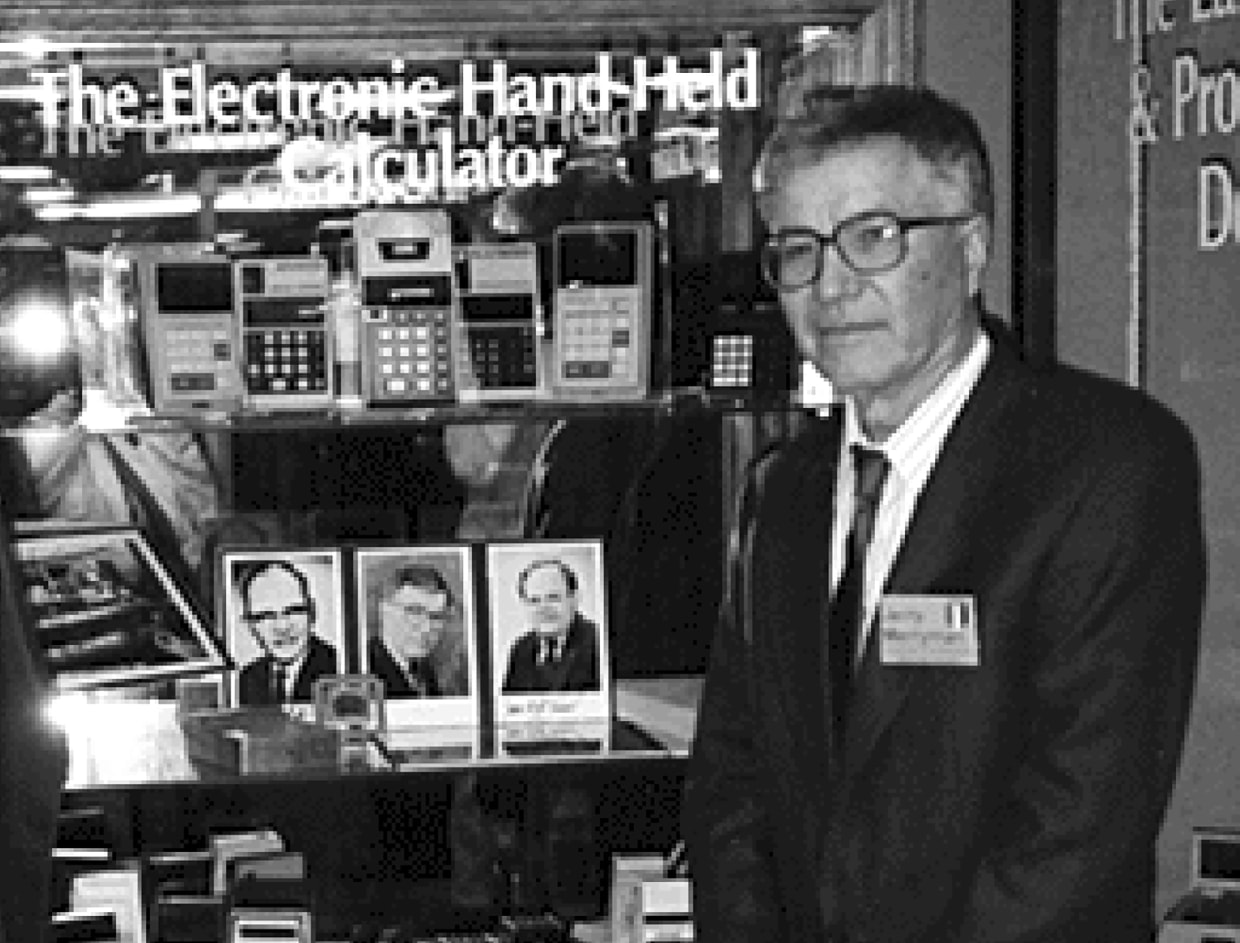
In 1967, Jack Kilby and his team at Texas Instruments (TI) developed the “Cal-Tech,” a prototype for a battery-powered handheld calculator. It was a massive technical achievement, capable of performing basic math and printing the results on a small thermal paper strip.
The first commercially available handheld electronic calculator, the Sanyo ICC-0081, arrived in 1970, followed closely by the Sharp QT-8B. These devices used rechargeable batteries, making them truly portable for the first time. However, it was the 1971 release of the Bowmar Brain that captured the public’s imagination. It was small enough to fit in a pocket, featured a bright red LED (Light Emitting Diode) display, and suddenly made the high-tech power of a computer accessible to the average person.
The Impact of the HP-35 and Scientific Computing
While Bowmar and Sharp focused on basic arithmetic, Hewlett-Packard (HP) aimed for something more ambitious. In 1972, Bill Hewlett challenged his engineers to fit the functionality of a “Difference Engine” into a shirt pocket. The result was the HP-35, the world’s first handheld scientific calculator.
The HP-35 was a technological tour de force. It could perform trigonometric and exponential functions, which previously required the use of slide rules or thick books of logarithmic tables. It used Reverse Polish Notation (RPN), a logic system that allowed for complex strings of calculations without the need for parentheses. The HP-35 was so disruptive that it effectively rendered the slide rule—a tool that had been used by engineers for 300 years—obsolete in a matter of months.
Liquid Crystal Displays and the Standardized Interface
As the 1970s progressed, the red LED displays, which consumed a lot of battery power, were replaced by Liquid Crystal Displays (LCDs). LCDs required significantly less energy, allowing calculators to run for hundreds of hours on tiny button-cell batteries or even solar power.
By the early 1980s, the “standard” calculator interface had been established: the solar strip, the LCD screen, and the iconic grid of rubber keys. Companies like Casio pioneered the “credit card” calculator, while Texas Instruments focused on the educational market with the TI-80 series of graphing calculators. These devices didn’t just solve problems; they visualized them, allowing students to see the relationship between algebraic equations and geometric curves on a digital screen.
The Modern Era: Software, AI, and the Future of Calculation
Today, the standalone calculator has largely been absorbed into our smartphones and computers. However, the technology continues to evolve, moving away from simple arithmetic toward complex symbolic computation and artificial intelligence.
From Hardware to Apps: The Digital Transformation
In the 21st century, the “calculator” is more likely to be an app than a physical object. The Apple iPhone and Android devices come pre-installed with calculators that possess more processing power than the supercomputers used to send men to the moon. Software like “WolframAlpha” has taken the concept even further, acting as a “computational knowledge engine” that can solve calculus problems, perform data analysis, and interpret natural language queries.
Modern calculators are no longer limited by hardware buttons. Graphing apps like Desmos allow for real-time manipulation of variables on high-resolution touchscreens, providing an interactive experience that 17th-century mathematicians like Pascal could never have imagined.
Artificial Intelligence and Symbolic Computation
The current frontier of calculation technology involves Artificial Intelligence (AI). We are seeing the rise of “AI Math Solvers” that use computer vision to scan handwritten equations and provide step-by-step solutions. These tools utilize neural networks to recognize mathematical symbols and logical structures, bridging the gap between human intent and machine execution.
Furthermore, symbolic computation systems (like Mathematica) allow machines to manipulate mathematical expressions in their algebraic form rather than just decimal approximations. This is crucial for advanced physics, cryptography, and aerospace engineering, where precision is paramount.

The Future of Quantum Calculation
Looking ahead, the next “invention” in the world of calculators may involve quantum computing. While current calculators rely on binary bits (0 or 1), quantum calculators will use qubits, allowing them to perform massive calculations in parallel. This technology promises to solve mathematical problems that are currently impossible for even the most powerful silicon-based supercomputers, such as factoring incredibly large prime numbers or simulating complex molecular interactions.
From the first brass gears of the Pascaline to the impending arrival of quantum processors, the history of who invented the calculator is a testament to human ingenuity. It is a story of continuous refinement, where each inventor stood on the shoulders of those before them to create tools that make the world more predictable, more efficient, and more technologically advanced. The calculator was the first true “smart” device, and its evolution continues to define the limits of what we can achieve.
aViewFromTheCave is a participant in the Amazon Services LLC Associates Program, an affiliate advertising program designed to provide a means for sites to earn advertising fees by advertising and linking to Amazon.com. Amazon, the Amazon logo, AmazonSupply, and the AmazonSupply logo are trademarks of Amazon.com, Inc. or its affiliates. As an Amazon Associate we earn affiliate commissions from qualifying purchases.