
At first glance, “what is half of 1/8?” might seem like a trivial arithmetic problem, a relic from elementary school textbooks. However, beneath its simple façade lies a fundamental concept that underpins countless financial scenarios. From calculating investment returns and understanding asset allocation to splitting business profits and deciphering complex interest rates, the ability to grasp and manipulate fractions is an unsung hero in personal finance and business. This article delves into the practical significance of this seemingly basic question, revealing how a solid understanding of fractional math can empower you to make more informed, confident, and ultimately, more prosperous financial decisions.
In a world increasingly dominated by sophisticated financial instruments and digital platforms, it’s easy to overlook the foundational principles. Yet, whether you’re analyzing a stock split, determining your equity stake in a startup, or even just understanding a discount applied as a fraction of an original price, the concept of “half of 1/8” and its ilk are ever-present. This piece will not only provide the straightforward answer but, more importantly, contextualize it within the broader landscape of financial literacy, offering insights into why such basic mathematical fluency is indispensable for navigating the complexities of modern money management.
The Foundation: Understanding Fractions in Finance
Fractions are more than just numbers written with a numerator and a denominator; they are powerful tools for representing parts of a whole, proportions, and relationships. In the realm of finance, where every dollar, every percentage point, and every share represents a part of a larger sum or entity, fractions become an intuitive language for describing these divisions. Without a firm grasp of what fractions signify, one might struggle to truly comprehend the nuances of financial data, leading to misinterpretations and potentially costly errors.
Beyond the Basics: Why Fractions Matter for Your Money
The human mind often struggles with abstract numbers, but fractions provide a tangible way to visualize proportions. For instance, saying you own “1/4 of the company” is far more intuitive than stating you own “0.25 of the company” when discussing equity, even though they represent the same value. This intuitive understanding is critical in financial discussions, negotiations, and strategic planning.
Moreover, many financial concepts are inherently fractional. Interest rates are fractions of a principal over time, dividends are fractions of earnings per share, and stock splits alter the fractional ownership per share. An individual who can fluently convert between fractions, decimals, and percentages possesses a versatile toolkit for financial analysis, allowing them to switch perspectives and gain deeper insights into financial health and opportunities. This foundational understanding builds confidence, enabling individuals to question assumptions, verify calculations, and actively participate in financial planning rather than passively accepting presented figures.
Practical Examples: Where Fractions Appear in Finance
Fractions permeate every layer of the financial world. Consider these common scenarios:
-
Investment Portfolios: When you allocate your assets, you might decide to put 1/2 into stocks, 1/4 into bonds, and 1/8 into real estate, with the remaining 1/8 in cash. Here, fractions directly dictate your risk profile and diversification strategy.
-
Business Ownership: In partnerships or startups, ownership stakes are often expressed as fractions. One partner might own 3/5, another 1/5, and an investor the remaining 1/5. Understanding these fractions is crucial for profit sharing, voting rights, and eventual exit strategies.
-
Real Estate: When dealing with property, especially inherited property or shared investments, fractional ownership (e.g., tenants in common, where each party owns an undivided fractional share) is common. Calculating capital gains, maintenance costs, or rental income often involves these fractions.
-
Discounts and Sales: A sale offering “1/3 off” or a “half-price” deal directly uses fractional concepts. Understanding how these apply to the original price is essential for smart shopping and budgeting.
-
Taxes and Deductions: While often expressed as percentages, these are inherently fractional. A tax bracket of 25% means the government claims 1/4 of your income within that bracket. Understanding the fractional relationship can demystify tax calculations.
These examples underscore that fractions are not merely academic exercises but practical tools for managing and growing wealth.
Deconstructing “Half of 1/8”: A Step-by-Step Financial Application
Now, let’s address the core question and then extend its simple mathematical solution into meaningful financial applications. The calculation itself is straightforward, but its implications can be far-reaching.
The Core Calculation: Mathematics Made Simple
To find “half of 1/8,” we perform a multiplication. “Half of” mathematically translates to multiplying by 1/2.
So, the calculation is:
(1/2) * (1/8)
When multiplying fractions, you multiply the numerators together and the denominators together:
Numerator: 1 * 1 = 1
Denominator: 2 * 8 = 16
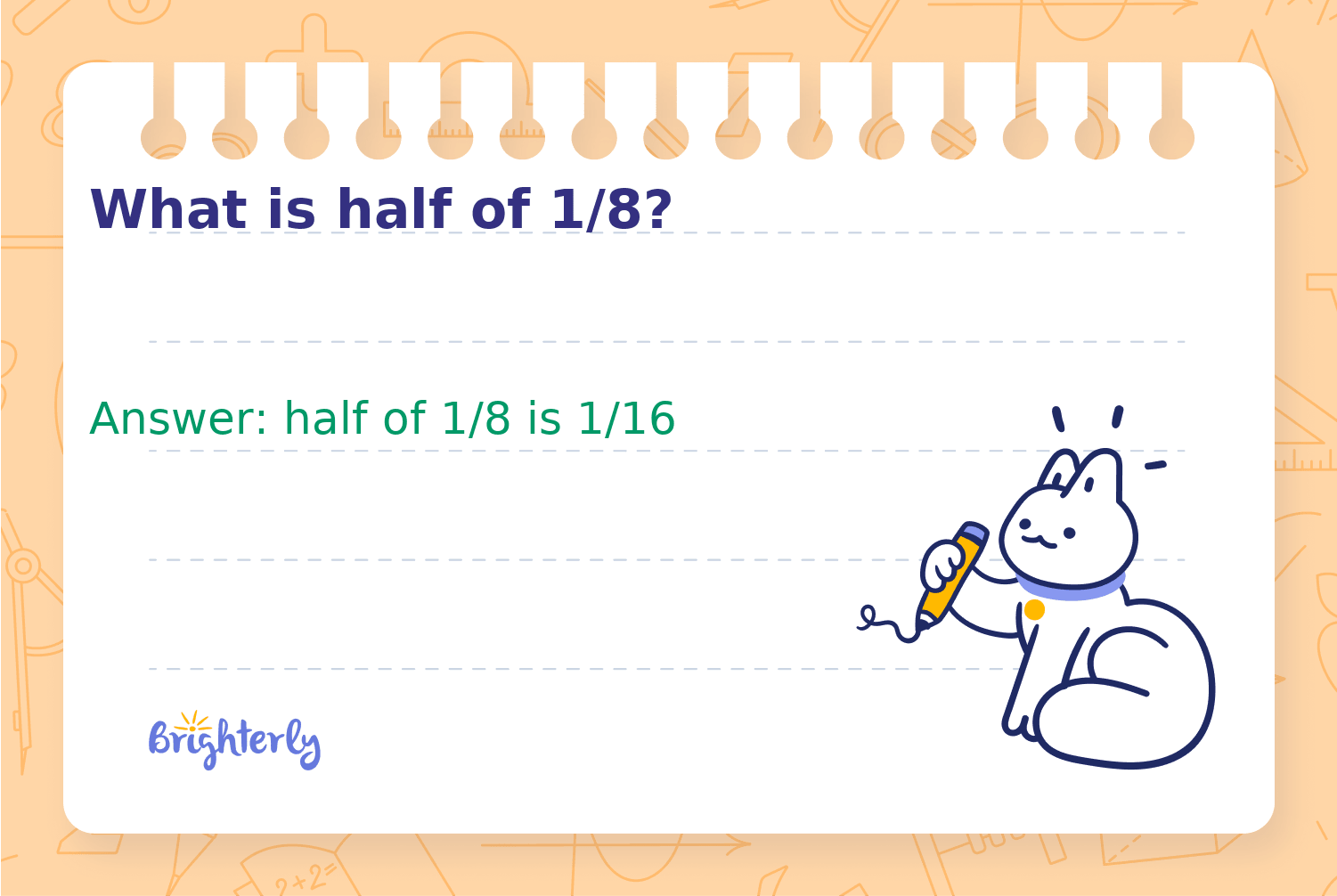
Therefore, half of 1/8 is 1/16.
In decimal form, 1/8 is 0.125. Half of 0.125 is 0.0625.
In percentage form, 1/8 is 12.5%. Half of 12.5% is 6.25%.
The simplicity of this calculation belies its utility. What matters most is not just the answer, but the conceptual understanding of what that answer represents in a financial context.
Applying the Result: Real-World Scenarios
Let’s imagine how this seemingly abstract result, 1/16, might manifest in real financial situations:
-
Stock Splits: Suppose you own shares in a company, and you initially hold 1/8th of a particular asset pool related to that company (perhaps in a special purpose vehicle, SPV). If the company then announces a 1-for-2 reverse stock split for that specific asset, effectively halving the fractional value of each existing share, your 1/8th stake would become 1/16th. Conversely, in a standard 2-for-1 forward split, if you had a conceptual 1/8th ownership represented by your shares, a split would double the number of shares you own, while your total proportional ownership of the company (e.g., 1/8th) would remain the same, but each individual share would represent half its prior fractional value relative to the whole, so if your share value was 1/8, it would become 1/16.
-
Profit Sharing: You are part of a business venture, and your initial agreement grants you 1/8th of the net profits. However, due to a restructuring or new investor coming on board, your original stake is halved to accommodate new terms. Your new share of profits would then be 1/16th. This directly impacts your income and wealth accumulation.
-
Inheritance Division: Imagine an estate where a specific asset, like a valuable piece of art, is divided among heirs. If you are initially slated to receive 1/8th of its value, but a codicil to the will states that your portion is further halved (perhaps due to an unforeseen beneficiary), your final share would be 1/16th of the asset’s total value.
-
Compound Interest (Conceptual): While not a direct “half of 1/8” calculation, understanding how interest rates are broken down over periods is similar. If an annual interest rate is 1/8 (or 12.5%), and it’s compounded semi-annually, then for each half-year period, the effective rate applied would be half of 1/8 (or 1/16). This demonstrates how fractional thinking extends to understanding compounding.
These examples highlight that even basic fractional calculations have tangible monetary consequences and directly affect your financial standing.
From Theory to Practice: Leveraging Fractional Understanding for Better Decisions
Moving beyond specific calculations, a deeper understanding of fractions empowers individuals to analyze, compare, and strategize more effectively across various financial domains. It fosters a proportional mindset essential for long-term financial success.
Investment Portfolios and Asset Allocation
Understanding fractions is paramount for managing an investment portfolio. When diversifying, you might allocate 1/2 to equities, 1/4 to bonds, 1/8 to real estate, and 1/8 to commodities. If market conditions shift, and you decide to halve your exposure to a particular asset class – say, you want to reduce your bond allocation by half – you need to accurately calculate the new fractional portion. If your bond allocation was 1/4, halving it would mean (1/2) * (1/4) = 1/8. Your new allocation to bonds would be 1/8. This precise understanding prevents over- or under-exposure and ensures your portfolio remains aligned with your risk tolerance and financial goals.
Furthermore, when evaluating fund fees, expense ratios, or even understanding how exchange-traded funds (ETFs) track an index through fractional ownership of underlying assets, a solid fractional comprehension provides clarity. It helps demystify the seemingly complex world of investment vehicles and allows investors to make choices based on actual proportional costs and benefits.
Budgeting and Expense Management
Fractions are implicitly used in budgeting, even if one typically thinks in percentages. When you dedicate “half” of your income to fixed expenses or “one-quarter” to savings, you’re employing fractional thinking. If you budget 1/8 of your monthly income for entertainment, and you decide to cut that in half for a savings push, you’re effectively reducing your entertainment budget to 1/16 of your income. This kind of precise adjustment, enabled by fractional understanding, allows for granular control over spending, helping you identify areas for savings and optimize cash flow.
Moreover, understanding how to apply fractions to debt repayment strategies can accelerate your journey to becoming debt-free. For instance, if you decide to allocate an additional 1/10th of your income towards paying down high-interest credit card debt, knowing how to calculate that fraction of your income accurately can make a significant difference in interest saved and repayment time.
Understanding Discounts, Interest, and Returns
Many financial offers, from retail discounts to loan interest rates and investment returns, are framed in fractional or percentage terms. A “1/3 off” sale, a loan with an “8% APR” (which is 8/100 or 2/25), or an investment promising “a 1/5 return” all require fractional thinking. When a discount is layered (e.g., an item is 1/8 off, and then you get an additional half off that discounted price), the ability to calculate “half of 1/8” becomes directly applicable to determining the final price.
Similarly, grasping how interest accrues or how returns are calculated involves understanding proportional growth. If an investment yields 1/8 annually, knowing that this translates to 12.5% helps you compare it effectively with other investments quoted as percentages or decimals. This interconversion between fractions, decimals, and percentages is a powerful skill for evaluating financial products and services.
Overcoming “Math Phobia” in Personal Finance
Many people shy away from financial planning because they perceive it as overly mathematical and complex. However, as demonstrated, much of the essential financial math boils down to basic arithmetic and a clear understanding of fractions. Conquering “math phobia” can be one of the most liberating steps towards achieving financial independence.
Tools and Techniques for Simplifying Financial Math
While mental math is valuable, modern tools can simplify complex calculations:
-
Calculators and Spreadsheets: For more involved scenarios, using a calculator or spreadsheet software (like Excel or Google Sheets) can automate calculations, allowing you to focus on the conceptual application of fractions rather than manual computation.
-
Online Financial Calculators: Websites often provide specialized calculators for mortgages, investments, retirement, and more. These tools are built on foundational mathematical principles, often involving fractions and percentages, and can give you quick answers for complex scenarios.
-
Visual Aids: Sometimes, drawing a pie chart or a bar graph representing fractions can make complex divisions more understandable. Visualizing 1/8 vs. 1/16 of a whole can clarify the difference in scale and proportion.
-
Practice and Repetition: Like any skill, financial math improves with practice. Regularly engaging with your budget, analyzing investment statements, and calculating discounts can build confidence and proficiency.
The Power of Proportional Thinking
Ultimately, the lesson from “what is half of 1/8?” extends beyond mere calculation to the development of proportional thinking. This is the ability to understand how different parts relate to a whole, how changes in one variable affect others proportionally, and how to scale numbers up or down accurately.
In finance, proportional thinking allows you to:
-
Evaluate the true impact of fees and charges on your overall returns.
-
Understand the relative risk and reward of different investment options.
-
Allocate resources efficiently across various financial goals.
-
Negotiate better deals by grasping the underlying value and fractional adjustments.
It transforms financial data from an intimidating collection of numbers into a clear narrative of relationships and opportunities.

Conclusion: The Unseen Value of Simple Math in Complex Financial Worlds
The seemingly innocuous question, “what is half of 1/8?”, serves as a profound reminder of the fundamental importance of basic mathematics in navigating the intricacies of the financial world. Far from being a mere academic exercise, understanding fractions is a cornerstone of financial literacy, enabling individuals to make informed decisions about their money, investments, and business ventures.
From precisely allocating assets in a diversified portfolio to shrewdly managing a budget and accurately interpreting profit shares, the ability to work with fractions empowers you. It builds confidence, demystifies complex financial instruments, and provides a clear lens through which to view opportunities and risks. In an age where financial prosperity often hinges on astute decision-making, mastering these foundational mathematical concepts is not just helpful—it’s essential. Embrace the clarity that fractional math brings, and you’ll find yourself better equipped to build, protect, and grow your wealth, one precisely calculated fraction at a time.
aViewFromTheCave is a participant in the Amazon Services LLC Associates Program, an affiliate advertising program designed to provide a means for sites to earn advertising fees by advertising and linking to Amazon.com. Amazon, the Amazon logo, AmazonSupply, and the AmazonSupply logo are trademarks of Amazon.com, Inc. or its affiliates. As an Amazon Associate we earn affiliate commissions from qualifying purchases.