
At first glance, the question “what is 2/3 in a fraction” seems like a simple query from a primary school mathematics textbook. It’s a fundamental concept, a building block for understanding quantities, proportions, and divisions. However, in our increasingly digitized world, the significance of grasping such basic mathematical principles extends far beyond the classroom. For anyone navigating the complex landscape of technology—from software developers and data scientists to app users and digital security experts—a clear understanding of fractions, exemplified by 2/3, is not merely academic; it is foundational for digital literacy and practical application across numerous tech domains.
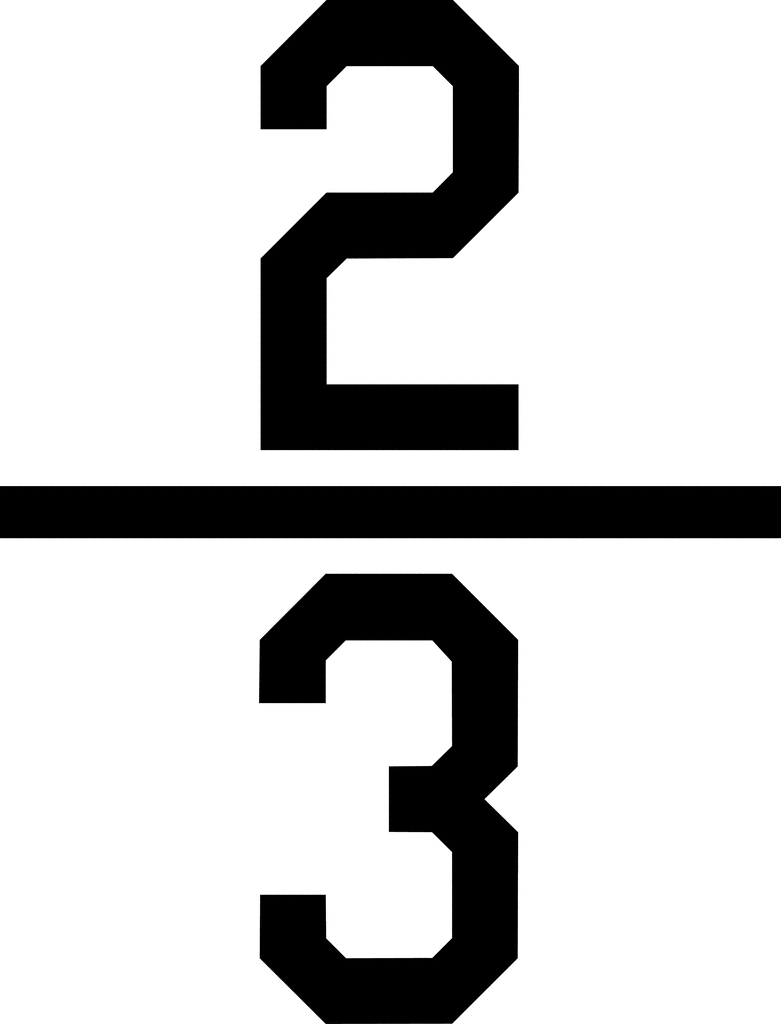
This article delves into the core meaning of 2/3 as a fraction and then explores its profound relevance within the technology sector. We will uncover how this seemingly simple concept underpins everything from data representation in software to the design of user interfaces, the efficiency of algorithms, and even the cutting edge of artificial intelligence. By understanding 2/3 in a digital context, we gain a deeper appreciation for the mathematical underpinnings that power the technological world around us.
The Foundational Concept of Fractions in a Digital World
Before we can appreciate the technological implications, let’s briefly revisit the core definition. A fraction represents a part of a whole. It consists of a numerator (the top number) and a denominator (the bottom number), separated by a vinculum (the line in between). The denominator tells us how many equal parts the whole is divided into, and the numerator tells us how many of those parts we are considering.
Understanding 2/3: A Quick Recap
In the case of “2/3,” the number 3 is the denominator, indicating that a whole has been divided into three equal parts. The number 2 is the numerator, signifying that we are considering two of those three parts. Imagine a pizza cut into three equal slices; 2/3 of the pizza would mean you have two of those three slices. It can also be expressed as a division: 2 divided by 3, which results in an endlessly repeating decimal, 0.666… This distinction between its fractional and decimal forms is particularly crucial in computing.
Why Basic Math Still Matters in Tech
In an era dominated by advanced algorithms and artificial intelligence, one might assume that basic arithmetic skills are becoming obsolete, outsourced to machines. However, this couldn’t be further from the truth. A deep understanding of foundational mathematics, including fractions, is indispensable for several reasons in technology:
-
Logical Reasoning: Math cultivates precise logical thinking, a critical skill for debugging code, designing system architectures, or identifying security vulnerabilities.
-
Problem Solving: Breaking down complex problems into smaller, manageable parts is a core tenet of both mathematics and technological development. Fractions inherently teach proportional thinking and part-to-whole relationships.
-
Data Interpretation: Every aspect of modern technology, from user analytics to scientific simulations, involves data. Understanding fractions and ratios is essential for correctly interpreting data, identifying trends, and making informed decisions.
-
Algorithmic Efficiency: Many algorithms rely on mathematical principles for their design and optimization. Concepts like fractional resource allocation or probabilistic outcomes frequently surface.
Therefore, while a computer can easily calculate 2/3, the human understanding of what that fraction represents is vital for developers, analysts, and even end-users to correctly interpret and leverage digital information.
How Digital Systems Handle Fractions: Beyond the Decimal Point
The way computers represent and manipulate numbers, especially fractions, is a cornerstone of digital technology. Unlike humans who can easily conceptualize “two-thirds” as an exact quantity, computers often approximate these values, leading to potential issues if not properly managed.
Floating-Point Numbers and Their Limitations
Most programming languages and hardware use “floating-point numbers” to represent non-integer values, including those derived from fractions. A common standard is IEEE 754. While floating-point numbers are incredibly versatile and allow computers to handle a vast range of magnitudes, they are inherently an approximation. For instance, the fraction 2/3 (0.666…) cannot be perfectly represented in binary floating-point format; it will always be stored as a very close but not exact approximation.
This approximation can lead to subtle but significant errors in calculations, especially when dealing with financial data, scientific simulations, or any application requiring high precision. For example, 0.1 + 0.2 in many programming languages might not exactly equal 0.3 due to these floating-point inaccuracies. Understanding this limitation is paramount for any developer or data scientist to mitigate potential issues through careful data handling and rounding strategies.
Representing Fractions Accurately in Software
When exact fractional representation is critical, developers employ various strategies:
-
Rational Number Libraries: Many programming languages offer libraries that handle fractions as “rational numbers,” storing them as a pair of integers (numerator and denominator). This ensures perfect precision for fractional arithmetic. For instance, a rational number library would store 2/3 as
(2, 3)and perform calculations precisely, avoiding floating-point approximations. -
Decimal Types: For financial calculations where exact decimal precision is paramount, programming languages often provide specific “decimal” data types (e.g.,
Decimalin Python,BigDecimalin Java). These types represent numbers in base 10, preventing the approximation errors inherent in binary floating-point arithmetic. -
Symbolic Math Systems: In scientific computing and academic software, symbolic math systems can manipulate expressions containing fractions without evaluating them to a numerical value until explicitly requested, preserving mathematical purity.
The Role of Libraries and APIs in Fractional Computations
The complexity of handling fractions accurately often means developers rely on established libraries and Application Programming Interfaces (APIs). These tools abstract away the low-level details of number representation and provide robust functions for fractional arithmetic, conversions, and comparisons. Understanding how to integrate and utilize these resources is a key skill for ensuring the integrity of numerical operations in software, whether calculating probabilities (like 2/3 chance) or precise measurements.
Practical Applications of 2/3 and Other Fractions in Technology
The practical applications of fractional understanding in technology are pervasive, touching upon user experience, data analysis, core algorithmic design, and multimedia processing.
User Interface Design: Proportions and Layouts

When designing user interfaces (UIs) for websites, mobile apps, or desktop software, fractions play a crucial role in ensuring proportional layouts and responsive design. Web designers often use fractional units (e.g., width: 66.66% for 2/3 of a container) to ensure elements scale correctly across different screen sizes. A layout where a main content area takes up 2/3 of the screen width, with a sidebar occupying the remaining 1/3, is a common design pattern. Without a solid grasp of fractions and percentages, achieving aesthetically pleasing and functional responsive designs would be significantly more challenging.
Data Analysis and Visualization: Interpreting Ratios and Percentages
In data science and business intelligence, fractions are fundamental to understanding and communicating data. A fraction like 2/3 might represent:
-
Market Share: “Company A holds 2/3 of the market share for a specific product.”
-
Conversion Rates: “2/3 of users who added an item to their cart completed the purchase.”
-
Survey Results: “2/3 of respondents preferred feature X.”
Data visualizations, such as pie charts, bar graphs, and stacked area charts, are essentially visual representations of fractions and proportions. Accurately interpreting these visualizations—understanding that a segment representing 2/3 of a pie chart is twice as large as a 1/3 segment—is crucial for extracting meaningful insights from data. Statistical models also frequently rely on probabilities expressed as fractions.
Algorithm Design: Efficiency and Resource Allocation
Fractions influence the design and efficiency of algorithms in various ways:
-
Resource Allocation: Operating systems might allocate 2/3 of CPU time to high-priority tasks. Network protocols might reserve a certain fraction of bandwidth for critical data.
-
Load Balancing: Distributing computational tasks across multiple servers might involve assigning a specific fraction of the total load to each server based on its capacity.
-
Probabilistic Algorithms: Many algorithms, especially in AI and machine learning, make decisions based on probabilities, which are inherently fractional values between 0 and 1. A decision might be made with a 2/3 probability, influencing the algorithm’s outcome.
Digital Audio and Video: Sampling Rates and Compression Ratios
In multimedia technology, fractions govern how analog signals are converted to digital and how digital media is stored and transmitted:
-
Sampling Rates: Digital audio often uses sampling rates (e.g., 44.1 kHz), where the “point one” indicates a fractional component necessary for accurate sound reproduction.
-
Compression Ratios: Audio and video compression algorithms reduce file sizes by expressing them as fractions of their original size. For instance, a video might be compressed to 1/10th of its original size, meaning its new size is 1/10th of the original. Understanding these ratios helps in optimizing file quality versus size.
The Future of Fractional Understanding: AI, Machine Learning, and Beyond
As technology advances, the underlying mathematical principles, including fractions, continue to play a pivotal role, often in more sophisticated and abstract ways.
Machine Learning Models and Probabilistic Fractions
Machine learning models, particularly those for classification, often output probabilities. For example, an image recognition model might predict with 0.66 (or approximately 2/3) certainty that an image contains a cat. Understanding these probabilistic fractions is essential for interpreting model predictions, assessing confidence levels, and making deployment decisions. The mathematical foundations of statistics and probability, heavily reliant on fractional concepts, are core to how these intelligent systems operate and learn.
Quantum Computing and Superposition
In the nascent field of quantum computing, the concept of superposition means that a quantum bit (qubit) can exist in a combination of states simultaneously, expressed as a linear combination of basis states. The coefficients in this combination are complex numbers whose squared magnitudes represent probabilities. These probabilities are inherently fractional, determining the likelihood of measuring a qubit in a particular state. While highly abstract, the fundamental idea of parts of a whole, or fractional probabilities, remains central.
Bridging the Gap: Educating for Fractional Fluency in Tech
The enduring relevance of fractions in technology underscores the importance of strong foundational math education. As our digital world becomes more complex, a deeper human understanding of these basic building blocks becomes even more critical.
The Importance of Foundational Math Skills
For aspiring technologists, a solid grounding in mathematics, starting with fractions, is non-negotiable. It builds the analytical skills necessary to comprehend complex algorithms, troubleshoot technical issues, and innovate. Universities and educational institutions are increasingly recognizing the need to integrate practical, application-driven math education into technology curricula, demonstrating how seemingly abstract concepts directly apply to real-world tech challenges.

Tools and Tutorials for Mastering Fractions Digitally
Paradoxically, technology itself offers powerful tools to help individuals master fractions. Interactive educational apps, online calculators that display fractional results, and programming environments that allow for experimentation with rational number libraries can demystify these concepts. Tutorials that bridge the gap between abstract mathematical concepts and their concrete applications in coding, data analysis, or digital design can significantly enhance a learner’s fractional fluency.
In conclusion, while the question “what is 2/3 in a fraction” may seem rudimentary, its implications for the world of technology are vast and multifaceted. From the precise representation of numbers in software to the proportional layouts of user interfaces, the interpretation of data, the efficiency of algorithms, and the cutting edge of AI, fractions are an indispensable part of our digital fabric. A clear understanding of 2/3, and fractions in general, is not just a math lesson; it’s a fundamental aspect of digital literacy, empowering individuals to create, analyze, and navigate the technological landscape with greater insight and precision.
aViewFromTheCave is a participant in the Amazon Services LLC Associates Program, an affiliate advertising program designed to provide a means for sites to earn advertising fees by advertising and linking to Amazon.com. Amazon, the Amazon logo, AmazonSupply, and the AmazonSupply logo are trademarks of Amazon.com, Inc. or its affiliates. As an Amazon Associate we earn affiliate commissions from qualifying purchases.