
For many retirees, Social Security benefits represent a cornerstone of their financial stability, providing a reliable income stream after years of contributing to the system. However, a common misconception is that these benefits are entirely tax-free. In reality, a significant portion of Social Security recipients find that a portion of their benefits is subject to federal income tax, and in some cases, state income tax as well. Navigating these rules can be complex, often leading to confusion and unexpected tax liabilities. Understanding how to accurately figure the tax on your Social Security benefits is not just a matter of compliance; it’s a crucial component of effective retirement financial planning, allowing you to anticipate your tax obligations and make informed decisions about your income sources.
This comprehensive guide will demystify the taxation of Social Security benefits, providing a clear, step-by-step approach to understanding the rules, calculating your taxable amount, and exploring strategies to potentially mitigate your tax burden. By the end, you’ll have a robust framework for integrating Social Security benefits into your overall financial picture with confidence and clarity.
Understanding the Basics of Social Security Taxation
The taxation of Social Security benefits began in 1983 as part of a bipartisan effort to shore up the system’s finances. Since then, the rules have been updated, but the core principle remains: if your total income exceeds certain thresholds, a portion of your Social Security benefits becomes taxable. This taxation applies at the federal level, and some states also impose taxes on these benefits.
Who is Subject to Taxation?
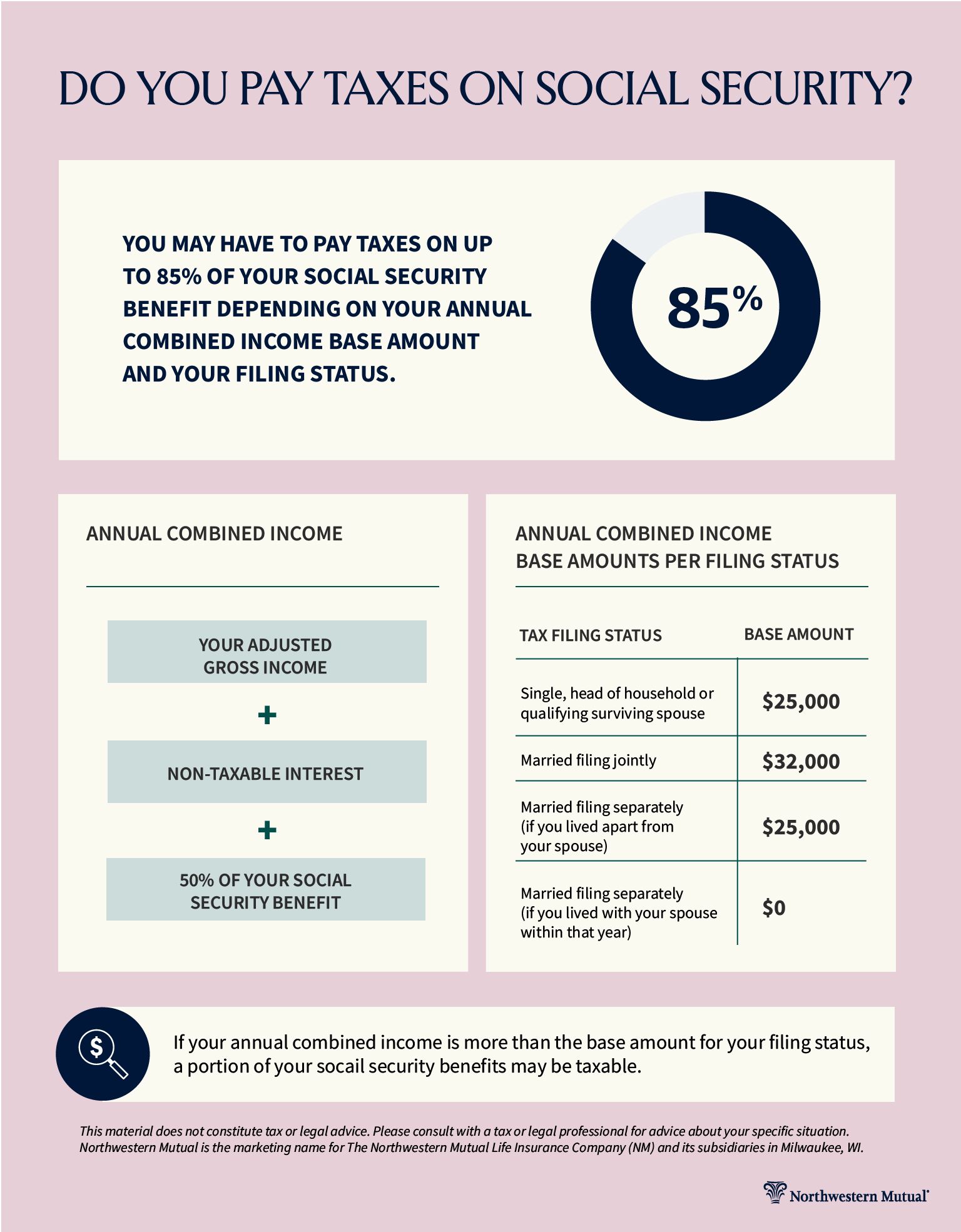
Whether your Social Security benefits are taxable depends primarily on your “combined income,” also known as provisional income. This isn’t just your Social Security income; it’s a calculation that factors in other sources of income you might have. If your combined income falls below specific thresholds, you might not owe any federal tax on your benefits. However, if it exceeds these thresholds, then 50% or even 85% of your benefits could be subject to federal income tax. It’s important to remember that these thresholds are not indexed for inflation, meaning more beneficiaries may become subject to taxation over time as their other income rises.
The Concept of “Combined Income”
Combined income is the linchpin in determining Social Security benefit taxation. It’s not your Adjusted Gross Income (AGI) and it’s not just your total income. It’s a specific calculation defined by the IRS:
Combined Income = Your Adjusted Gross Income (AGI) + Nontaxable Interest + One-Half of Your Social Security Benefits
Let’s break down these components:
-
Adjusted Gross Income (AGI): This includes most taxable income sources like wages, self-employment income, pensions, annuities, taxable interest, ordinary dividends, capital gains, and withdrawals from traditional IRAs and 401(k)s.
-
Nontaxable Interest: This refers to interest from tax-exempt bonds, such as municipal bonds. Even though this income isn’t taxed directly, it’s included in the combined income calculation to determine Social Security taxation.
-
One-Half of Your Social Security Benefits: Only 50% of the total Social Security benefits you received for the year are included in this calculation, not the full amount.
Understanding this specific definition is critical because it dictates whether your income level crosses the thresholds for taxation.
Key Thresholds and Tiers
The IRS sets specific thresholds for combined income that determine how much of your Social Security benefits, if any, will be taxed. These thresholds vary based on your tax filing status:
For Single, Head of Household, or Qualifying Widow(er) filers:
-
Below $25,000: None of your Social Security benefits are taxable.
-
Between $25,000 and $34,000: Up to 50% of your benefits may be taxable.
-
Above $34,000: Up to 85% of your benefits may be taxable.
For Married Filing Jointly filers:
-
Below $32,000: None of your Social Security benefits are taxable.
-
Between $32,000 and $44,000: Up to 50% of your benefits may be taxable.
-
Above $44,000: Up to 85% of your benefits may be taxable.
For Married Filing Separately filers:
-
If you lived with your spouse at any time during the tax year, up to 85% of your benefits are taxable regardless of your combined income. This rule is designed to prevent couples from artificially lowering their combined income by filing separately.
-
If you lived apart from your spouse for the entire tax year, you would use the single taxpayer thresholds.
These thresholds are pivotal. Crossing them doesn’t mean all your benefits are taxed at 50% or 85%; rather, it means up to that percentage of your benefits could be taxable. The exact amount depends on where your combined income falls within these tiers.
Calculating Your Taxable Social Security Benefits
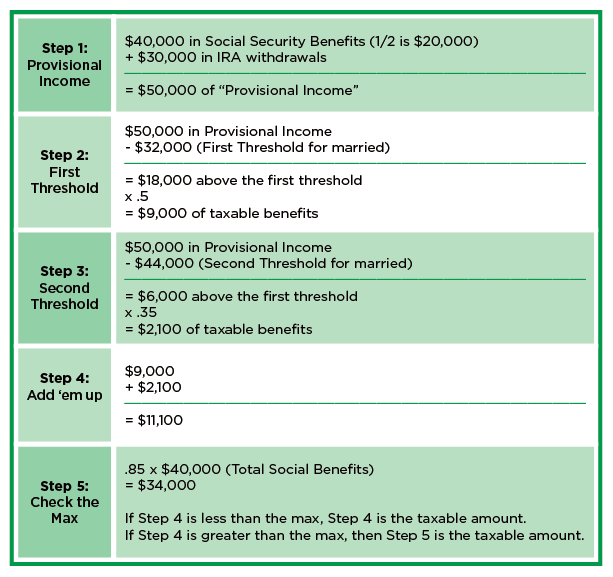
Once you understand the basic components and thresholds, the next step is to perform the actual calculation. This process involves a series of steps to determine your exact taxable benefit amount.
Step-by-Step Combined Income Calculation
Let’s walk through an example to illustrate how to calculate combined income.
Example Scenario:
-
Filing Status: Single
-
Adjusted Gross Income (AGI): $20,000 (from a pension and taxable interest)
-
Nontaxable Interest: $2,000 (from municipal bonds)
-
Total Social Security Benefits Received for the year: $18,000
Calculation:
-
Start with AGI: $20,000
-
Add Nontaxable Interest: $20,000 + $2,000 = $22,000
-
Add One-Half of Social Security Benefits: $22,000 + ($18,000 / 2) = $22,000 + $9,000 = $31,000
Result: The combined income in this example is $31,000.
Applying the Benefit Taxation Tiers (50% and 85% Rules)
Now that we have the combined income, we apply the thresholds for a single filer:
-
Below $25,000: 0% taxable
-
Between $25,000 and $34,000: Up to 50% taxable
-
Above $34,000: Up to 85% taxable
Our combined income of $31,000 falls into the second tier ($25,000 – $34,000), meaning up to 50% of the benefits may be taxable. The calculation for this tier is slightly more involved and typically uses a worksheet from IRS Publication 915, “Social Security and Equivalent Railroad Retirement Benefits.”
The general calculation involves these steps:
-
Amount Subject to 50% Rule:
-
Subtract the first threshold ($25,000 for single) from your combined income ($31,000 – $25,000 = $6,000).
-
Compare this amount ($6,000) with one-half of your Social Security benefits ($9,000) and 50% of the first threshold interval ($4,500, which is 50% of $9,000 difference between $25k and $34k). The smallest of these is $4,500. This is the portion of your benefits that will be taxed at 50%.
-
The taxable amount will be the smaller of:
-
(Combined Income – First Threshold) multiplied by 50%
-
50% of your total Social Security benefits
-
50% of the difference between your combined income and the first threshold ($31,000 – $25,000 = $6,000. 50% of $6,000 = $3,000).
-
In this specific example, the taxable amount would be $3,000.
-
-

-
Amount Subject to 85% Rule (if applicable):
- If your combined income exceeds the second threshold ($34,000 for single), an additional calculation applies. You would calculate the amount above the second threshold and multiply it by 85%. You would also consider 85% of your total benefits received. This is a more complex calculation that can result in up to 85% of your total benefits being taxable.
It’s crucial to understand that the “up to 50%” or “up to 85%” applies to the amount of your benefits that could be taxed, not necessarily the tax rate you pay on them. Your marginal tax rate will then be applied to this taxable portion.
Factors Affecting Social Security Taxation
The interplay of various income sources and filing statuses can significantly impact how much of your Social Security benefits become taxable. Understanding these dynamics is essential for proactive tax planning.
Impact of Other Income Sources (Wages, Pensions, Dividends)
Every dollar of taxable income you receive from sources like wages, pensions, traditional IRA/401(k) distributions, interest, and dividends directly contributes to your AGI, which in turn elevates your combined income. This means that even a modest increase in these income streams can push you over a Social Security taxation threshold. For instance, a part-time job in retirement, a larger-than-expected pension, or strong dividend payouts can unintentionally trigger or increase the taxation of your Social Security benefits. Conversely, strategies to reduce your AGI, such as contributing to a traditional IRA (if eligible), could indirectly reduce your taxable Social Security benefits.
Spousal Considerations and Filing Status
Your filing status plays a paramount role. As outlined earlier, the thresholds for single filers are lower than for married filing jointly. This means that a couple with the same combined income as a single individual might have a lower (or no) taxable Social Security benefit simply due to their higher thresholds. However, the “married filing separately” status often results in up to 85% of benefits being taxable if you lived with your spouse at any time during the year, effectively eliminating any tax advantage for most couples. It’s vital for couples to assess their joint income and filing options carefully to minimize their overall tax burden.
Role of Tax-Exempt Interest (Municipal Bonds)
One of the more surprising elements of the combined income calculation for many retirees is the inclusion of nontaxable interest from municipal bonds. While the interest from these bonds is exempt from federal income tax (and often state and local taxes if issued in your state of residence), the IRS still requires it to be added back into your combined income when determining Social Security benefit taxation. This means that while municipal bonds offer tax advantages for some income streams, they can indirectly increase the taxable portion of your Social Security benefits, a factor that should be weighed when evaluating their overall suitability for your retirement portfolio.
Strategies to Manage Social Security Benefit Taxation
Proactive tax planning can significantly influence how much of your Social Security benefits are subject to taxation. By understanding and implementing various strategies, you can potentially reduce your combined income and, consequently, your tax liability.
Tax Planning Before and During Retirement
Strategic tax planning should begin well before you start collecting Social Security benefits and continue throughout retirement.
-
Pre-Retirement: Consider the tax efficiency of your retirement accounts. A mix of traditional (tax-deferred) and Roth (tax-free withdrawals) accounts provides flexibility. By having tax-free income sources, you can better manage your AGI in retirement.
-
Managing RMDs: Once you reach age 73 (or 75 for some), Required Minimum Distributions (RMDs) from traditional IRAs and 401(k)s become mandatory and are included in your AGI. Strategically delaying or reducing other taxable income sources can offset the impact of RMDs on your combined income.
-
Tax Loss Harvesting: Selling investments at a loss to offset capital gains and a limited amount of ordinary income can reduce your AGI.
-
Delaying Benefits: While not a tax strategy per se, delaying Social Security benefits increases the monthly payout. If you have other income sources in early retirement, delaying benefits might keep your combined income below thresholds during those years, potentially lowering total lifetime taxes.
Roth Conversions and Qualified Charitable Distributions (QCDs)
These two strategies are powerful tools for managing your AGI and, by extension, your combined income.
-
Roth Conversions: Converting a traditional IRA to a Roth IRA involves paying taxes on the converted amount in the year of conversion. While this increases your current year’s taxable income, it reduces the balance in your traditional IRA, leading to smaller future RMDs. More importantly, withdrawals from a Roth IRA in retirement are tax-free and do not count towards your AGI or combined income, offering long-term tax benefits, especially if you anticipate higher tax brackets in the future or wish to keep your Social Security benefits untaxed.
-
Qualified Charitable Distributions (QCDs): If you are age 70½ or older and are charitably inclined, a QCD allows you to donate directly from your traditional IRA to a qualified charity. This distribution counts towards your RMD (if applicable) but is excluded from your AGI. By reducing your AGI without adding other taxable income, QCDs can effectively lower your combined income, potentially reducing the taxable portion of your Social Security benefits.
Understanding Provisional Income and Future Planning
A deep understanding of “provisional income” (combined income) is paramount. By modeling different income scenarios – such as taking a part-time job, selling investments, or drawing from various retirement accounts – you can anticipate how these actions will affect your combined income and, consequently, your Social Security taxation. This foresight allows you to make informed decisions that optimize your retirement income and minimize unnecessary tax liabilities. Regularly reviewing your income projections and tax situation with a financial advisor can help fine-tune these strategies as your financial landscape evolves.
Reporting and Withholding Your Social Security Benefits
Once you’ve navigated the complexities of calculating your taxable Social Security benefits, the next step involves properly reporting this income to the IRS and ensuring appropriate tax payments are made.
Form SSA-1099: Your Annual Statement
Each year, typically by late January, the Social Security Administration (SSA) sends out Form SSA-1099, “Social Security Benefit Statement.” This crucial document details the total amount of Social Security benefits you received during the previous year. It also shows any Medicare premiums deducted from your benefits and any federal income tax you had voluntarily withheld. The information on Form SSA-1099 is what you will use to complete your federal income tax return (Form 1040) and calculate the taxable portion of your benefits using the worksheets provided in IRS Publication 915. Keep this form safe, as it’s essential for accurate tax filing.
Estimated Taxes vs. Voluntary Withholding
Unlike wages from employment, Social Security benefits do not automatically have federal income tax withheld. If your combined income indicates that a portion of your benefits will be taxable, you have two primary methods to pay the estimated tax:
-
Estimated Tax Payments: Many retirees who have taxable Social Security benefits, along with other sources of income (like pensions or IRA distributions), are required to pay estimated taxes throughout the year. These payments are typically made quarterly (April 15, June 15, September 15, and January 15 of the following year) to cover your tax liability for the year. Failing to pay enough estimated tax can result in penalties.
-
Voluntary Withholding: To simplify tax payment, you can elect to have federal income tax withheld directly from your Social Security benefits. You can do this by submitting Form W-4V, “Voluntary Withholding Request,” to the Social Security Administration. You can choose to have 7%, 10%, 12%, or 22% of your monthly benefit withheld. This can be a convenient way to ensure you’re paying your taxes throughout the year and avoid a large tax bill or penalties at tax time. The amount withheld will be reflected on your SSA-1099.
Choosing between estimated taxes and voluntary withholding depends on your individual financial situation and preference for managing your tax obligations.
Seeking Professional Guidance
The rules surrounding Social Security benefit taxation can be intricate, particularly when combined with other income sources, varying deductions, and potential state taxes (which apply in some states). While this guide provides a comprehensive overview, individual circumstances can introduce complexities. For personalized advice, precise calculations, and optimal tax planning strategies, consulting with a qualified tax professional or financial advisor is highly recommended. They can help you navigate the specific nuances of your financial situation, ensure compliance, and maximize your after-tax retirement income, providing invaluable peace of mind.
aViewFromTheCave is a participant in the Amazon Services LLC Associates Program, an affiliate advertising program designed to provide a means for sites to earn advertising fees by advertising and linking to Amazon.com. Amazon, the Amazon logo, AmazonSupply, and the AmazonSupply logo are trademarks of Amazon.com, Inc. or its affiliates. As an Amazon Associate we earn affiliate commissions from qualifying purchases.